Where were you when the middle aged woman in the Suburban cut me off on the freeway, and I beat my fists on the steering wheel in adrenaline-filled rage, bruising my fingers?
Where were you when I ached to go home after a long, late work day and night, and the customers, a mom and her teenagers, came in five minutes before closing and stayed in the store for 20 minutes after the doors were conspicuously locked and the dishes loudly clanged and banged in the sink so the world could hear my irritation and exasperation to no avail?
Where were you when the barista totally screwed up my order and had to re-do it after making me wait for 10 minutes, resulting in my risking my life and others’ on the road as I drove like a mad woman to get to work on time, my head pounding from raised blood pressure when I got there?
Where were you when my adult daughter forgot to pick up the dinner I asked her to bring me three hours prior, even as I was working her shift for her so she could get her homework done, the indignity and betrayal that boiled my blood and caused me to cut her down with cruelty in words and knife of guilt?
And where were you when the clearly guilty ones unabashedly told lies under oath about me, causing me to gasp in horror and dismay and anger and disbelief and dread and angst and wrath and despair…?
Where were you, my good witch, to remind me how much power I give the powerless? Where was your wave of the wand over the glass we peer into, showing me how much I fight the familiar profile of the masochistic female who takes up as little space as possible, accepts suffering inflicted by others with rage then resignation, and doubts her own truths in deference to others’, only to flay those efforts in a flip of the switch–unravel reality–when ceding my grace and acceptance of what is, where I am, who they are, with knowledge of my own powerlessness over others, and the gratitude and equanimity to bear that accession?
I needed you those times to tell me, “You’ve had the power all along, girl. The rubies are the moments of opportunity, of power properly placed. Now take it on home.”
Comet Love

What’s it like to land on a comet with its flaming tail at the speed of night? The fantastical imaginary of the ordinary citizen can only know a breath of it. If only such a landed probe could take pictures of all of the people looking up in awe and wonderment at its passing. That would be the ideal outcome, to capture the best of the human spirit as it is not in the human capacity to reach beyond our galaxy as we sit on the earth now, but it is in our capacity to dream and imagine and reach with our minds.
Perhaps that is what space travel will be eventually, a cosmic astral projection of minds to other minds in distant galaxies and that the stuff of television shows and NASA or other space agency attempts are mere clumsy limitations of the mind. The physical transport is an outdated mis-read of where humans should be directing their efforts–not at transporting the body to other galaxies with improved technology for craft life but transporting the mind through developed improvements in using more of the human brain, much more than the ten percent we do. If scientists can figure out the workings of the brain and how to use more of it, we would go farther in all of our feeble attempts, due to lack of imagination and physical ability, to space travel the verses–uni or multi. That’s my dark matter hope. As grand as our meager steps are in proportion to who we are, I can only speculate that more brain is better for bigger steps toward human survival–if that is even worth it. My limited brain cannot imagine what could be more important.
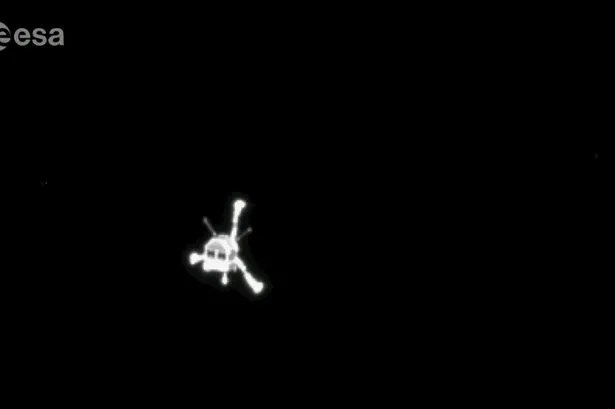
Philae successfully landed on Comet 67P. The scientists in news-flash photos, mostly men, and I seem to be the only ones excited about that. Though the landing did not go entirely to plan, that didn’t dent the jubilation of the paunchy breath-holding middle aged scientists who hopped, jumped and hugged in high-five glee and release at its touchdown. The love and pride for their cyber child was bounded only by the liquid vision of the for-once unshielded tears of these utilitarian fathers of the brave foundling. One of her thrusters did not thrust, but she is safe and is useful nevertheless. If she does what she is programmed to do, take pictures and collect other data, she will bless her human makers with information unknown about the travels of a lone comet that circles the sun of its destruction, succumbing to the irresistible force of suicide, desire and heat.
So long as there is an infinite unknown, I anthropomorphically will it to be so: that she brings back an ancient love story beyond comprehension for its pre-dating and surpassing human imagination. That way we can continue to wonder and strive, which is the best humans have to offer.
She will give us imagery to parse and dream about, analyze the pre-solar system traces so that we may sniff the scent of our own origins–even just a hint. The human mind will take it from there. And if those paunchy old and young science-saddled men and women get nothing more than a glimpse into the relationship of a comet with a blustery sun that blasts and winds like the litany of a curmudgeon whose cranky rant on a rainy arthritic day thunders and grates, then humans will be that much more edified. They only need new clues to edge ever nearer to the ever elusive answers to the age old questions that echo in the ignorant blackness of the deep-of-darkness matter: How did we come to be? Are we alone? Why does that even matter?
Stewing Storm
I stew, seethe and sorrow. I am a woman.
I love.
There is a yearning. It penetrates the wall of silenced fear.
A slow ache, amorphous yet round all at once.
Closed circle.
I am broken. I was never really fixed.
It’s just that I feel the lack of a whole now.
I age.
No longer I bear the one way pouring.
What goes out must have a coming in.
I am sere.
My mind teases out strands of sense.
They float above my pavement feet.
I waver.
It is time to be honest, let it seep in.
Some people must die and go home.
To free me.
Guest Post by MPM
The Child As Mistress
This blog focuses on the mistress (and ‘mister’) we have, we are, or we become, whether the mistress is a person, an activity, a modality of thought, a cultural norm, or any of a million other possibilities. Today’s quote by Dumas and accompanying picture imply the traditional concept of the mistress – that of a woman on the outside of the marriage that the husband is involved with clandestinely. But I am an example of a mistress withIN a marriage. And I am not alone. My brother is as well, as are millions of us without ever imagining ourselves so. In fact we are mistresses that have the full, ahem, ‘blessing’ of no less than the Catholic Church.
Perhaps a little background is in order. My parents were married in the middle of the Baby Boomer decade of the 1950’s. My father was in his mid-30s and had never been married before. From stories my mother told me about him after their divorce 20+ years later he did not have the best reputation around town. He wasn’t a criminal, he was just someone that was difficult to like closer than an arms-length friendship. He was blue collar WW II veteran with a ‘C-‘reputation and the social graces of a venomous desert insect. He was also cheap, opinionated, and a Republican in a sea of Democrats.
My mother was one of five sisters who were all well liked, well mannered, and, ahem, well endowed. She had been married before to ‘the love of her life’, as she would later tell me along with the stories of my father. Tragically, he was a gunner in the last American bomber shot down over Japan before Hiroshima and Nagasaki, killing all aboard. Rather ironically, as this would not be possible here in the US due to the circumstances, there is a memorial in the city where the plane crashed commemorating the event. For the next decade mom was lost in grief, certain she would never ever find a man that matched up to the standards established by Charles. Their togetherness had been established in high school before the war and was intended to continue long after till death did them part. And of course this relationship was going to produce an abundance of children as did all Irish relationships in those days. With the sadly abrupt passing of Charles this plan, this dream, passed with him.
Enter my father some ten years later. He began pursuing mom with all aplomb of a drunken dancer. Mom, mindful of his ‘C-‘reputation, held him somewhat at bay. However his continuous pursuit finally wore her down enough to allow for a benign and tepid relationship. She had no intention of marrying this man. But being in her late 30s, and since it had been a decade since her last enduring relationship, she eventually allowed herself to get close enough to him to enable the relationship to continue its natural upward course. My father was in his mid-30s and determined to take their pairing to the logical conclusion of the day – marriage. Their opposing stances eventually caused a standoff. Mom began to pull further away from him to distance herself from ‘C-‘to seek a ‘C+’ or better partner.
In those days a woman in her late 30s could not conceive of having children. Mom’s dream and desire of lining the nest with rug rats had crashed with Charles’ plane. The medical arts of the time were not prepared for the complications that could arise from a pregnancy so late in a woman’s life. It was accepted by society and culture that mom was ‘too old’ to be a safe and reliable contributor to the boom of babies that generation provided to the nation. And so, seeing mom begin to slip away and certain she was his last chance at the legitimacy and rise in stature a marriage would bestow upon him, dad made a bold and strategic move. With the precision of a championship archer he aimed Cupid’s arrow directly at mom’s heart. He said to her, ‘We can always adopt kids.’ The arrow had found its mark. Mom set aside the reservations she had over dad’s ‘C-‘ character. She immediately raised his grade, albeit on a curve and due to his extra-credit essay on adoption, to the lofty status of ‘C’. They married soon after and began a life together that would provide each with what they wanted. She was going to receive children and he was going to receive marital legitimacy.
Until it didn’t. Soon after the consummation of their alliance, dad, living up to his ‘C-‘reputation, reneged on his promise to adopt. Naturally this caused a breach of contract dispute. Their union began to develop cracks and seemed about to crumble. Somehow they agreed to a mediation. They jointly decided to seek the counsel of the precursor to modern psychiatry, the Catholic Church.
The Father they selected as their confessor and whose penance they agreed to abide by was a kind and genial man each of them respected and admired. They each knew his wise and wonderful wisdom would apply the mortar to repair the cracks that had developed between them. After several sessions of listening and head nodding by the good Father he pronounced himself ready to rule. His decision was simple and direct. He admonished my father for breaking his contractual agreement with my mother and ordered him to fulfill its original terms. They were to adopt a baby. The role of this child would be to repair the damage caused by the breach. My father reluctantly and resentfully accepted his penance and set about the task of choosing a child off the rack that would be able to assume the required role. Indeed, what else could an Irish Catholic do when a pronouncement was delivered by the sagest of the sage, the wisest of the wise, a representative of the respectable and all-knowing (insert booming and echoing voice from above) CATHOLIC CHURCH?
Enter me. They decided to baby shop at the orphanage where I had been on display since I had been born a mere three months prior. This made me the latest and greatest model. I still possessed that new baby smell so desired by adopting couples seeking their first human purchase together. I was featured in my crib in which I had been placed and had not budged from except for the occasional diaper change and attendant hosing down. After a series of paper signing (more contracts) and counseling by the (holy shit!) representative of the Catholic Church present at the orphanage, a stern nun, I was whisked away to begin my new life and new duties as the bastard marriage savior.
For a few years into toddler-hood I fulfilled my role dutifully. My father surprised himself by actually enjoying having a little bastard around. He genuinely took to the situation he had once avoided. But my mother was ecstatic. I was the first born son (ok, first adopted son) she had always wanted. Over time, I later learned, I received all the love and attention she was supposed to divide between me and my father. I had become her little bastard mistress son. I was now the third person in the marriage Dumas spoke of. (Well, he didn’t actually mean a child but work with me here.)
My father soon tired of his relegated role and began to resent the little bastard. This, of course, renewed the cracking and crumbling that the advice of the CATHOLIC CHURCH had repaired a few short years ago. Duty bound by their allegiance to the earthly representative of the guy in the sky they returned to the counsel chambers of the good Father. After a suitably perfunctory and long enough listening period the good Father prescribed the same mood altering substance he had last time: adopt another child. And so another little bastard entered the fray of our ménage a matrimony and began sharing the role I had originally been enlisted to perform as a solo act.
I’ll spare the reader and refrain from detailing the years of acrimony, repression, resentment, frustration, anger, bitterness, abuse, and bad days that ensued. Instead I’ll wind this missive down by stating that the open inclusion of little bastard mistresses into the marriage failed. In my teenage years (and my brother’s) mother and father divorced and he moved out, never to be seen or heard from again. The remaining trio of mom and her two little bastard mistresses were relieved immeasurably. But life from then on was no picnic and the requisite emotional scars and attempted surgical removal of them by an unending stream of psychiatrists, psychologists, drugs (legal and sometimes accessible only via cavity search), alcohol, shamans, and voodoo practitioners some 40+ years later and continuing is testament to that. This example of mistress insertion may not prove Dumas right or wrong. But hopefully it is a cautionary tale that forewarns the reader to choose a mistress wisely and not off the rack.
“Why I Date Married Men”
Heather L. Hughes, a freelance writer, contributes to Salon.com “Why I Date Married Men” and lends light insight into her choice of dating partners, a kind of liberation for a sexual late bloomer (a virgin until 29), when she concludes:
Affairs with married men offer controlled companionship — there’s warmth and there’s space, there’s intimacy and there’s distance. I can’t control growing older. But as the other woman, I’ll always have an element of mystery, an invitation to a different narrative, like that lit-up window in the darkness.
The “lit-up window in the darkness” refers to her ignorance of and outsider status to the married man’s family life, his other life, about which she admits to being curious and even fantasizes.
The “controlled companionship” concept certainly appeals to the more introverted of us. Hughes doesn’t say so, but adding up the facts of her nerdy entertainment choices, her lack of sex and her lauding “controlled companionship” aka I love you now get out and give me my space, she is probably an introvert. Introverts need battery-recharging alone time, something marriage doesn’t always afford.
The best and worst part of any long-term relationship is the daily living together, the friction and resentment that builds up by the large and small stuff, disliking a mother in law or snoring. Space, one’s own space, could help relieve some of that tension. When my husband and I were separated, it was the first time I had ever had my own room. I was delighted, covetous of that space to call my own, clean as I wished, decorated as I wished. That ownership of space alone improved my disposition. That separateness also allowed me to see my then estranged husband when I wanted to and not when I had to, which improved our relationship. In sum, controlled companionship is not only convenient but a high recommendation to the relationship that allows for that. Of course, married couples can and do afford each other space, but unless one of the couple travels a lot, there is not that completely divided space that one owns and occupies like a room of one’s own.
I suppose the element of mystery in being the other woman that Hughes refers to is also tied into that controlled and convenient aspect of the dating a married man relationship–parts of the other are left private and unknown. A couple does not kill the mystery and one another with familiarity. How often have I heard, “I know you only too well”? That is not only a mood killer, an instant irritation, but is an accusation that the accused is a pattern predictable and boring, and can be no other way. Ironically, the accuser both desires and despises that kind of predictability that produces comfort and boredom too.
The most interesting part of Hughes statement, however, is that the other woman is “an invitation to a different narrative.” The assumption is the different refers to different from the man’s wife and family, the life he has set up in the daily display of the house he lives in, perhaps, the wife, kids and job he has, community he is part of and the like. His story. Perhaps it is the story of the suburban upper middle class man with money to buy nice cars, house and toys for himself and his family–the lucky guy who has everything story on the outside from society’s point of view, the very same one who keeps another woman on the side, immoral from society’s point of view. Perhaps that is the draw: look like a good boy while being a bad boy.
However, I take issue slightly with Hughes “invitation.” The assumption, though imperceptible, is that one narrative is more legitimate than the other, i.e., the married narrative is the acceptable one and the one with the other woman is “different”, weakly argued as mysterious to make the invitation more inviting. However, invitation could be bridging the territory of its silent rhymed reminder of temptation, which, of course, suggests the illicit nature of the “affair.” Hughes takes the cautious self-repudiating approach even as she defends–lightly–her choice of lifestyle. It’s weak.
Her mention of narratives reminds me of something unacknowledged. I am reminded of an old studied philosopher from school years back, one who baffled me more than enlightened except in intermittent glimmers. But now as I am older and wider read, I realize he is a writer who has covertly influenced my way of thinking and viewing the world more than any other philosopher or writer. Jean Francois Lyotard, the French philosopher who describes the postmodern condition (post WWII) as one without universals or generalities that work any longer, lured me in with his anti-establishment thought. He exposes the overarching theories and philosophies (meta narratives) that historically govern thought and behavior since the Enlightenment, for example the notion of absolute freedom or justice, as no longer tenable to order an ethical, legal, philosophical or moral structure of societies made of individuals with such an acknowledged immeasurable degree of variety.
Lyotard argues that reality is created by and social structure consists of micro narratives that we all speak and act on, engage in on the local level in discrete situations of daily life, which show how different and diverse we all are in our beliefs, desires, and actions. So even though we may say we subscribe to the belief that all humans are born free and freedom is the ultimate right and happiness, the way we live daily from situation to situation negates that actuality. Each day I work, drive kids around, eat, sleep and speak at the dictates of others. Freedom is negotiated within the pockets of time and allowance of others, not some overarching principle that governs thought and behavior.
Extrapolating from Lyotard, the way we think and act should not be proscribed, encouraged or naturalized by broad moral banners that wave the monogamy narrative or the marriage narrative as THE narrative. It is painfully obvious that we actually operate within the language and rules of private, small group situations, and specifically with respect to Hughes’ dating: man, woman, children, other woman. What is justified behavior is applicable to and determined by each individual, i.e., this man needs newness to keep him alive and happy, while this woman needs the security of a marriage to keep her free to do what she needs to do, etc, in conjunction with another or others. The agreements and socio-ethical rules are local to the participants. And they are agreements. It’s only when we start believing the grand narratives of right or wrong for everyone is where we fall into fantasy land, wanting to believe there is one right for everyone.
Some may say this is merely relativism, which may be regarded as chaotic, unstructured and anarchy (I can hear a friend say, “If you stand for nothing, you’ll fall for anything”). I don’t believe that is true. It is simply an acknowledgment that people actually operate on the level of their one on one or small group interactions relative to their lives, and their behavioral ethics are determined within that local climate.
So, Hughes, relax. This works for you. You’re different from others. Celebrate difference. It’s what we all are anyhow.
The Limerent

Limerent lover, you caught me when I fell from the sky, unable to fly any more, like Marquez’s winged Gabriel landed in the chicken coop, a mute wonder of decrepit miracle and obscene spectacle for sale. My wings had been clipped from the systematic circus of prosecutorial car clowns and elephantine asses braying in the windy tents of their failures. My flight was downed by opinion–a crippling injustice. You, imagining the first man bemoaning the lack of his mate, knew my journey even before I spoke it. I was the sign. You were the signifier.
Pouring into me the hope of a happy ending, the magic of healing and soul-worn revival of the A-1 amphetamine or the super pill of soporific splendor, I was your mother duck after the ardor of digging elongation from the dark enclosure and safety of the shell. You stretched. Your first light was the sun’s reflection in my tear-stained retinal orbs, blinding your peripheral vision forever and altering your perception of the pumping pinions of this bird, discerning a halo through the steaming breath in the cold of that fall night of your birth. I was your real.
Soon the collage I collaborated with in the making was filled with wind-swept plains of dust and despair or poppy plummets into sweet surrender-ful liquid love potion stares of hypnotic release. Wherever love and hate could be found I was there: in the trees that conspired to collapse the condor’s nest and in the giant avian mother’s courage to free her ovate unborn, in the evil of cardboard figures of terror-filled torturing shadow puppet fights and in the savior soldier’s merciful sacrificial sword of righteous right. I was the paste on your brush to sparkle your smile and the crusted crud on the blade of your unclean can opener.
Shooting up my words, your veins thicken even now long after the flash of my tail light has faded from view and the neon sign points to the hotel next door. Plum with the injected placebo of blossoming romance and forever ending rivulets of passion dribbles eked out of a nano-glance, a sliver of a smirk, an eye glimmer from a passing head light, you are confirmed. It means something. You have thought two thousand times in two thousand hours that it is so. In truth, you have obsessively intruded on the tale, remade the story.
You once threatened, the plot must end well or there will be no end to sorrow’s cascading falls into the mountain crevasses that poorly piloted Cessna’s crash into and crack up their cargo–ordinary men and women with a taste for the daring. The height of expectation and card castles is too great, the air too thin and be-speckled with polluting particles for a pure realization. Limerent. Listen. You.love.you.loving.me. That’s all.

Fifty Observations About Married Cheaters
I came across the Dumas quote posted today while perusing yet another pro-con work over of the role of the mistress, this one conceding, as always a wee bit sheepishly for fear of being accused of less than stellar morals or lawfulness, mistresses are not always destructive but can actually spark renewed love and interest in a marriage. That they do have such a productive effect sometimes seems logical to me and has been my own experience.
In researching under the wide umbrella topic of the mistress, I have come across so many articles dissecting the causes for, effects of, and history of cheating spouses or partners. So much of what has been written, regardless of the insertion of a psychologist, sex therapist, counselor, attorney or theologian, are largely opinion pieces based on specific testimonials and experiences. People come to the subject with their own predispositions toward cheating experientially, religiously and intellectually. Generalizations in these writings and the overall attempt to be one size fits all denigrate what morsels of truth and advice there may be in them. The painfully obvious truth is, all situations are unique in so far as they involve individuals, who, though human and so patterned with some universal behaviors, are different from other individuals in their components and combinations, and so add the complexity to a very complex subject.
Reducing cheating to a ten ways, ten reasons or ten anything seems implausible to me. Most of those articles contain mere observations from specific experiences of specific people. I too have observed the behavior and words of cheating spouses–nearly my entire life. I have been cheated on and I have cheated, though not on my husband of 35 years. When he and I separated for six or more years in the late 80s to mid-90s and then again when we agreed to an open marriage in 2010, I engaged in long and short-term affairs/relationships including married partners. I did not seek married people; the relationships arose organically from circumstances I and the other party were in at the time. Like any relationship, they were based on mutual need, admiration, friendship, respect and often, love.
In addition, I was a divorce and bankruptcy attorney for 24 years. I heard so many stories of the whys, wherefores and whereabouts of the innumerable reasons for and circumstances of divorce, including cheating spouses, mid-life crisis dumps, long-term mistresses or misters, open marriages, and just a host of marital and non-marital arrangements.
The following list of 50 items is one I have compiled over the years by merely listening and observing (and yes, at times, judging). It is not a list I prepared with any intent. I am not sure I even prepared it at all. Living my life is all it has taken to come up with this list and remembering what I have done, what has been done to me, what I have thought and what I have heard. With respect to marrieds, I put this list together not to recommend, advise, admonish, judge or astonish. Nothing on the list is revelatory. These items do not purport to be causes, reasons, solutions or symptoms. They are merely observations about being human. I have no other intention but to share my observations, in no particular order, for whatever interest they may lend to the reader.
Married people I have had affairs/relationships with:
1. Are attracted to me because I am not their spouse.
2. Want more or different sex than what they get at home.
3. Want to be listened to and feel they are not.
4. Want to be prioritized over the kids, sacrificed for.
5. Love and are beholden to spouses who sacrifice themselves for the kids.
6. Want to be thought of as sexy, naughty, romantic and/or irresistible.
7. Want to be thought of as creative, intelligent and/or funny.
8. Want passion again or for the first time.
9. Want to live out their fantasies, some, all or any of them.
10. Want to be young again.
11. Want to have control and feel they don’t.
12. Want to be shown love and tenderness more, different or any.
13. Want to be the center of someone’s world, for the first time or again.
14. Want to experience vitality and power again.
15. Want a person with traits lacking in their spouses.
16. Want to conquer or be a savior.
17. Want to possess.
18. Want the excitement of risk.
19. Want their egos flattered.
20. Want to want their spouses.
21. Don’t want their spouses but don’t want to leave them.
22. Are very good at compartmentalizing.
23. Are very good at justification and rationalization–moral equivalencies.
24. Don’t want to disrupt their families: kids, parents, spouses, colleagues, friends.
25. Are afraid of divorce/loss of life they have known.
26. Are trapped in a marriage whether self-induced or otherwise.
27. Are guilty for perceived hurt of their spouse, for their own failures.
28. Are repressed sexually or otherwise.
29. Feel overburdened by the lives they themselves created.
30. Have overactive sex drives.
31. Express love through sex.
32. Escape into sex.
33. Need touch.
34. Are afraid.
35. Are angry.
36. Want to feel something.
37. Want to be understood.
38. Want to be validated.
39. Want to hurt their spouses.
40. Want revenge.
41. Are commitment-phobes.
42. Fear success.
43. Self-sabotage.
44. Have low self-esteem.
45. Are narcissistic.
46. Are sociopathic.
47. Are immoral.
48. Are amoral.
49. Are competitive, wanting to beat the system or someone else.
50. Feel comforted even as they are disconcerted by carrying a secret.
I could write at least 50 more, but they would be as banal as these 50.
Quote of the Day by French Writer Alexandre Dumas

“The chains of marriage are so heavy that it often takes two people to carry them, and sometimes three.”
How-To Guides to Becoming a Mistress or a “Side Chick”

These two articles, “How to be a Mistress, the 1/3 Method” and “How to be a Side Chick: 11 Steps (with Pictures)” from the Wiki How series are hilarious. Who is the audience for these two, people looking to get into the mistress biz? Really? Does someone actually think about being a mistress and research it before doing so? My guess is it is something that just happens, in most cases. Even if there were such an audience of advice seekers, what kind of advice or instruction do these articles give: To be whatever the married guy wants you to be? They assume that there are certain universals regardless of the parties to the relationship of husband, wife and mistress, that individuals cannot act otherwise because it is a mistress-married man relationship. But stereotyping and platitudes about human behavior are dangerous, often make for validating prejudice and de-humanization (think about history of any genocide attempt). The instruction needs to be first, decide on what is acceptable parameters to each of the involved parties, including a wife who knows but chooses not to know. The assumption is that adults cannot communicate about what they are doing and that they all act the same when it comes to sex and marriage.
The illustrations and instructions are amusing, but the generalizations and assumptions that men want what they don’t have and some women out there are “ambitious” enough to consult a Wiki How to make sure they know how to be what any man doesn’t have–someone who doesn’t wear sweats and sneakers in front of her man or ask him questions, of any sort because this is what these simpleton folks–men–want (since they’re cheaters)–are lame. I am hoping these articles are ironic or comical by intent. Otherwise, I smell some moralizing in the manner in which men and women to “this type of behavior” are assumed to be: selfish and low self-esteemed. Each basically intimates that if you’re going in for this type of thing, this is the crap you’ll get–and you deserve it or you just shouldn’t.
“Why It’s Natural to Have Taboo Fantasies”
Though this subject has been parsed on this blog in a number of writings, this article by goodinbed.com is very light fare (thinking of someone else during sex is taboo fantasy?), readable and succinct, even though questionable as to its definition of both taboo and fantasy. There is nothing earth shattering but it is an assuring read for those of us with a host of tools to accomplish our sexual goals. Enjoy.