Helping Men be Men Despite Technology


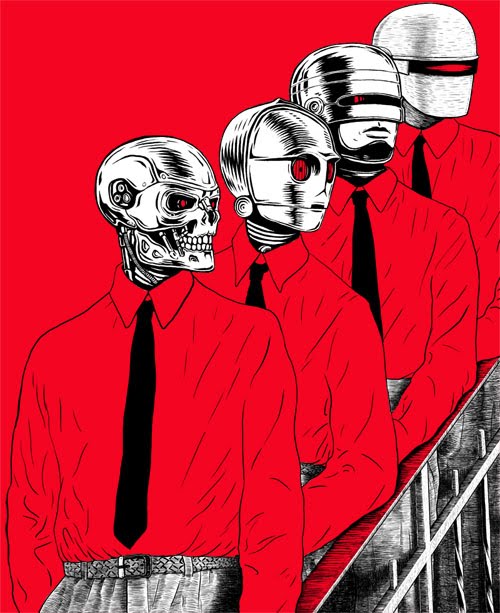
credit: http://www.djfood.org/wp-content/uploads/2012/02/Men-Machines.jpg

…men usually have what they term “single-cue arousability”. Give a man the image of a pair of attractive breasts or a curvy backside and they are half-way to happiness, where women need multiple cues: they are aroused by men who are “attractive and nice to children and self-confident….

I have been wanting to read this text when I first came across the title and recognized the author for his previous studies. However, scanning a few reviews of a new book, Man (Dis)Connected: How Technology Has Sabotaged What it Means to be Male, and What Can be Done, by psychologist, Philip Zimbardo, who “argues that technology, online porn, gaming and sedentary jobs are causing terrible damage to the male psyche,” I cannot help but once again bemoan the insidious perpetuation of stereotypes that net individuals into the indoctrinating tidal wave of culturally predetermined roles.

While I am well aware that psychologists observe human behavior and make prognostications, the collateral effects of Zimbardo’s conclusions in his latest book, although an admirable contribution to the conversation of gender roles amidst social climate change, is to reinforce sedimented stereotypes. 

Zimbardo, known for his famously criticized Stanford Prison Experiments, asserts in his book that men are biologically susceptible to falter in a world that promotes less physical work, more sedentary entertainment and less in-person interaction due to technology. Male reliance on online gaming, dating, and pornography in addition to less physically demanding office work has socially retarded men and made them not only obese but ineffective as social beings. He also blames the shift in roles due to feminism as well as other social “ills” or challenges for men as The Telegraph’s Chris Moss summarizes.

It’s when you combine absent fathers, staying at home into early adulthood, video gaming, overreliance on internet porn, obesity (with its associated decline in testosterone and increase in oestrogen) and lack of physical activity, educational failure, joblessness and lack of opportunities for interaction – plus a women’s movement that continues to empower that gender and thrust positive female role models into economic and political arenas – that you have the makings of a screwed-up masculinity with all the wider social consequences that implies.

While I can appreciate Zimbardo’s work, my sensibilities are a bit ruffled at the suggestion that empowering women disempowers men and thereby ominously causes “social consequences” implied by that disempowerment. But why do the implications necessarily bode ill?  Intelligent, resilient men, of which there are plenty, certainly realize the freedom from sole breadwinner responsibility results not only in less pressure to perform and be their careers, but also more opportunity to develop other neglected skills and traits long scorned by social necessity due to inherited cultural predispositions. 

Just like the current shifted economy squeezes out old patterns of work formulas like the corporate career that ends in a gold watch retirement and forces individual innovation and creativity for survival, so too the breakdown in traditional role models can lead and has led to opportunities for growth emotionally and psychologically through the loss that naturally occurs in evolution. All transitions are an equation of cost and benefits, the pre and aftermath of change.

But the reiteration of steretypical male expectations to be physical and in control, and the remorse suggested in the loss of that attribute and power position, all bundled in a cause and effect legitimacy (we all trust cause and effect, right?), ominously confirms both the stereotypes and the doomsayers who look for feminism to blame for harming men. Pointing the finger at feminism, even as a co-contributor, couched in scientific clout–the psychologist–serves to confirm the current suspicions piled on feminism by some factions as harmful, a disturbance of a centuries old patriarchal order. For some, the byproduct fear and hatred results in injury to women. 

The country does not need any more binaries, dichotomies and polarization. Blaming feminism even under the guise of scientific observation does not help men. Bringing men the positive about change that has inevitably occurred and will continue to occur–technology and empowered women–benefits men. 

I am hopeful that when I read his text, Dr. Zimbardo will conclude his observations with helpful insights on how to help men adjust.

Zoophiliac’s Dream


Credit: http://static.comicvine.com/uploads/scale_small/1/15776/1322468-cat_fem6.jpg

She mewed at him provoking sense and shifted gaze.

The glint in his eye sparked flame among the blue.
Smoke surrounded her, drifting a tail of thin vapor.


His Circe gone, the scent of woman-cum-feline stirred.
The endless voyage in hiatus, his will broke in on itself
feathering out the tics drinking below the surface calm.


Caged ardor pounces a captain’s dreams ad delirium.
The restraints of a space-time compendium of battles
writ to air beats love into holes of clawed subordinates.

Secret’s Out


credit: http://edge.neocha.com/wp-content/uploads/2010/09/huzi@neochaEDGE_01.jpg

I saw her picture first

cut off head, breasts
ample, pink spandex
clad, gathered at the
neck, accentuating
her rack so shapely.
She saw my photos
and thought to meet,
she and I anywhere.
But she turned out to
be a fashion maven
adoring all the latest
and I have no style 
but my own practical
to the bone and spare.
And I told her so, that
we had no center, no
common denominator
as I cared a whit for
what she cared a lot
about and so, what
kind of conversation 
could we dream up, 
impossible to sustain?
She revealed nothing
more than color and
fabric galore, for sure
a goddess of cinched
waist and good sense
of season and tricks
to enhance features.
For me, choosing the
day’s attire wears me
thin and ragged with
choices so few as I
keep a cry-cluttered
chaos of t-shirts and
jeans, no belts of any
kind, scoop necks or
v-necks only, turtle
necks producing a 
sweat and strangle
merely imagining a
collar so high up to
a neck’s constriction.
So with clothes only
we could not share
enough experiences.
I told her so, that she
needed to seek her 
own since I could not
compete, never get
beyond intimidated.
But the truth is, she
revealed her secret,
opened to me and I, 
unable to configure,
to examine fragment
instead of a shortcut,
a whole composite of
what she potentially 
could be, a mind not
reacting rationally or
flexibly without data
computable as usual
designation of man or
woman or somehow
tangibly identifiably a
sexual orientation that
would posit me in a 
known position, how
to act and what to 
ward off, defend or
protect, how to play
games, wait and see
properly, knew not 
what to say, how to
be. What could he
presenting as a she
expect of mere me?
Fear of falling free
of label safety just
dismantled me, a 
gaping loss of words
and thoughts of how 
to be only me with a
human:  he/she/we 
I skulked, hung it up.


Motherhood on Mother’s Day: Let it Be


My Dear Daughters:


   No letter, especially one to daughters, should begin with I’m sorry, but this one does. I’m sorry. Though regrets are a waste of time, I must apologize for your inheritance. No, I don’t mean money. In all likelihood, your fortunes are your own to make. And I know of no genetic medical challenges in store for you in this lifetime. No, this apology comes upon seeing the two of you drive off to lunch together, one tight-lipped and tense, the other tentative and earnest.


You see, dear daughter number two in birth order, you have inherited the portion of your mother’s temperament that ruffles easily when you convince yourself that another has acted poorly or unjustly or incompetently. You do not suffer lightly the effects of others’ actions on your life, irritated at the shortcomings of your fellow beings. You stew. 


To make matters worse, you can’t shake it off. When you decide to change teams and find the coach knows little more than the last one and your teammates are no different, no more skillful or intelligent or cooperative than the last, you simmer, aggravated after a game where the forwards hardly ever anticipate your serves from mid-field and so miss scoring opportunity after scoring opportunity, while the coach fails to instruct and the defense fails to adjust for the deflected offense. 


So you grouch for the rest of the day, angry at your teammates, your coach, but mostly at yourself for having chosen the team, or for even playing soccer in the first place.


And you, daughter number one, I owe you an apology for both your inability to fix your sister and your desire to do so. Like me, you feel discomfort when others display unpleasant emotions, even if  they are mere facial expression. Your sister cannot hide what she feels, though she speaks not a word or a sigh. Her face tells the story–sorry again, second born, for yet another trait passed on. 


And you feel responsible when you are not completely oblivious. Sensitivity is not your strongest attribute. You need to be hit over the head, spoken to directly, told what someone feels, unable to intuit. I gave you that obtuseness. Then when you hear the complaint, the source of woes, compassion turns to anxiety to solve the break, the mood, or problem. 


That anxiety leads to paralysis. Your mind turns foggy with the pressure to create, find an idea. And so you retreat, get disinterested and frustrated. You have no idea what to do to please her, though you try: bribe her with first choice of music in your car or chocolate or a trip to the mall. You try teasing and joking but the list of sorry-I-gave-that-trait-to-you includes stubbornness on her part as it does cluelessness on yours. 


But you know she unwinds in time, flexes her tension and exhales in release when she does, so there’s no rushing through it. The two of you cleave to one another as the best of friends, so you know.


Daughter born first, the days ahead bring many lessons about letting go, acceptance and boundaries, yours in relation to others. Your compassion will hold you in good stead if you never swallow it down in futility rather than acceptance: you can offer but no one has to accept. Perhaps she cannot. That is not your fault. Give, nevertheless, without the expectation of receiving. Help others because others need help, not to get results. You are not here to fix but to try.


Daughter born second, when you too learn to accept yourself, mistakes and all, your moods will calibrate, even out. Your expectations so high for yourself, you project those on to others who cannot meet them. If only you can merely see people, observe them without judging, and accept your strengths and weaknesses realistically without judgment, you may be able to do the same for others. 


The expanding pressure contracts and recedes in the exhaust of toxic release, the poison of fear–of disappointment, not measuring up, and not succeeding–whether aimed at you or others.


You both have a lifetime ahead of procuring patience, and if you get the jump on everyone else, you may discover the secret, the jewel of existence, of slowing down just as time speeds up. If you can, if somehow in cinematic slo-mo you can envision your two hands grab the big hand of the clock, just like when you were little we learned from that interactive picture book with the brightly colored spinning clock hands (blue for the big one and red for the small one) and hold that big boy back with all your might, you better the odds at beating the odds against you–your inheritance. 


Take time, my daughters, to be and let be. She who came after you needs time to work the inarticulable undulations of anger mounted on uncertainty overlaid on the foundation of fear that shift and morph like sea kelp ebbing and flowing with the tide. If you, my first born, breathe slowly, let every drop out before you sip another slow breath in, the extra seconds may allow you the focus, the time it takes for the words to come, the ideas to set you free:  “She is who she is, and I am who I am. Nothing more.”

I am sorry but have no regrets. You two embody the best I have to offer–and more. 

With all my love…
Happy Mother’s Day, Mom. I know you know.
  

Anchor’s a Weight

An anchor rests upon my left foot, 
center of the crown atop metatarsals 
while the shank steels up to my knee 
to measure the length of tibial boxes.


Its weight causes a limp in my walk.


Anchoring my bones,
it weighs against my walking away
and ties me to the hull 
where I see pass by
ocean life abounding 
color and coral free waves 
of undulating weed and water
to please my senses five.
  
Though tethered to a ship,
I am free to enjoy, observe,
swimming gleefully 
in surging seas.
  
credits: 

Mistress Humor

image

Credit: http://www.victorianweb.org

Two Ladies Talking in Heaven

1st woman: Hi! Carol,

2nd woman: Hi! Sylvia. How’d you die?

1st woman: I froze to death.

2nd woman: How horrible!

1st woman: It wasn’t so bad…. After I quit shaking from the cold, I began to get warm & sleepy, and finally died a peaceful death. What about you?

2nd woman: I died of a massive heart attack. I suspected that my husband was cheating, so I came home early to catch him in the act. But instead, I found him all by himself in the den watching TV.

1st woman: So, what happened?

2nd woman: I was so sure there was another woman there somewhere that I started running all over the house looking. I ran up into the attic and searched, and down into the basement. Then I went through every closet and checked under all the beds. I kept this up until I had looked everywhere, and finally I became so exhausted that I just keeled over with a heart attack and died.

1st woman: Too bad you didn’t look in the freezer—we’d both still be alive.

Bauhinia


Bauhinia, 

the delicate pink orchids 

that blossom each spring 

cheer the grog of the morning 

march to distances 

far and few 

from your branches. 

The blistering sun’s alchemy 

or the blustery grey

 of the day–alters. 

Drifting and burgeoning, 

transforming and contrasting 

as my moods, 

sometimes filled, lagrimal

of rusted red seed pod, 

feet and fingers of them 

like stultified streams 

of leaking fear frozen 

brown and red in mid drip. 

It’s then that your leaves wither 

at the edges, 

blackened and burned. 

The weather turned for the worse, 

your leaves round hearts 

of butterfly green, 

full and wide bloom. 

But when the winter wears away, 

your flowering bauhinian 

bells and stamen 

reach for my notice 

as I breeze past 

to travels once again 

drawing me from you.

The Music of Ménage a Trois

In reality, it was an unusual but mutually agreeable menage a trois, whose intimacy is reflected in that extraordinary scene of the three of them, side by side in bed, sheltering from Hitler’s aerial bombardment.
Ursula was, in her own words, “fathoms deep in love”, but Williams told her he would never leave Adeline.

So she could only be the “icing on whatever cake he had, and not a disruptive influence”.

The fascinating story of poet Ursula Wood and British composer Ralph Vaughan Williams was the subject of news in 2007 when she died at age 96, having succeeded her once-lover-then-husband by 50 years. She was 38 years his junior when they met at her prompting. At the time, Vaughan Williams was married to Adeline Fisher, cousin of Virginia Woolf, and Ursula to Michael Wood, an officer in the British army. Ursula Wood’s fascination and passionate love at first sight for the composer not only flattered the composer’s naturally roving eye for pretty women, but fueled his dying spirit as caretaker for his inherently cool natured wife who was eventually rendered immobile by rheumatoid arthritis.

When Wood entered the composer’s life, it was not long before the affair between them started. Her presence at the Vaughan Williams household was first legitimated under the auspices as young assistant and caretaker, but Adeline was shrewd enough to be credited with knowing the score. Thus, the excerpt above, which is detailed in The Daily Mail’s article by John Bridcut, as depicting Wood holding the hands of both the composer and his wife during a raid in 1944 by Hitler’s army.


Indeed, on one occasion, Ralph and his wife and Ursula and her husband all met up at the opera for what must have been a most uncomfortable evening, particularly as the opera (Williams’s own Hugh The Drover) was a romantic story of rivals in love.

After Vaughan Williams’ death, then Ursula Vaughan Williams kept the affair discreetly within her memory until her death in 2007 at which time the details were revealed by her own desire to have the true story told. Wood’s biography of her husband also provided the basis of the documentary by Bridcut, released shortly after her death.

Though it is unknown how Adeline felt about the affair right under her nose, by all appearances, however, she tolerated her husband’s relationship most likely knowing that he was a man of passion that she herself could not reciprocate whether due to her own nature or her illness or both. So, it is not far fetched to assume that rather than lose her husband, she accommodated.

Of all three, the story of patience is the most magnificent human attribute fleshed from their ménage a trois: his for caring for the wife he vowed he would not leave despite his love for Ursula, Ursula’s patient caring for both while she longed to be with him, and Adeline’s patient endurance of the love affair right before her eyes that had to hurt. Of the three, I admire Adeline the most for her practical concession of her exclusive rights to her husband’s monogamy, whether that was calculating to her own advantage or wise and charitable love in consideration of her husband’s needs, or both. 

I have maintained before that the mistress role is not easily doffed off with vilified stereotypes of cheating and deception. Sometimes–oftentimes–it is far more complicated with subtleties that reveal the intricacies of human nature adapting to circumstances, a fascinating anthropological, psychological and sociological study.


Support Others Supporting Others: Infidelity Counseling Network Drive

  
Posted on Infidelity Counseling Network yesterday, Praveen Kumar’s Reasons Why Couple’s Cheat on Each Other in boldsky limitless living cites the statistic that ten percent of marriages are headed for divorce due to infidelity. Though unverified in the article, I don’t doubt that is true. Anecdotal evidence from my former practice conforms to that reality. Kumar goes on to state that most cheat before they separate and then lists the reasons for cheating in relationships: neglect, dissatisfaction and boredom, essentially. 

While these reasons are no revelation, some of the statements the author makes are rather surprising. For one, she distinguishes male from female patterns:

The cheating patterns of men tend to be a bit different than that of women. Some men would perceive cheating as just having fun outside the relationship.

And women don’t? I am curious as to the basis of the author’s conclusions. Which studies differentiate men and women’s cheating patterns on the basis of fun? Seems to me the validity of the article’s conclusions would be more compelling and interesting with some foundational support and less bias. In Kumar’s brief summation, men are presumed to be superficial weasels–of which I am sure there are plenty–and women victims. 

Some of those cheating men don’t even feel guilty unless they are cornered. When it comes to women, most of them resort to cheating when they are emotionally dissatisfied or feeling lonely in their relationships.

However, attributing dishonesty and overall bad behavior to one gender strikes me as a hasty generalization. Shortcutting the work of proof and relying on stereotypes perpetuated by cultural lore or media does no one any good. Moreover, it makes fluff of some serious consideration: the causes of infidelity and its immediate and collateral devastation to spouses and children.

One non-profit organization that focuses on those life-altering effects of infidelity is the aforementioned Infidelity Counseling Network, which is having a fundraising drive today. While I have balked at some of the articles on their website as genderist, favoring women, I have since come to realize that their services would logically benefit those who come forward to seek help from the heartbreak and trauma of cheating and resulting divorce: most prominently women. 

There is currently debate in the field of evolutionary psychology whether an innate, evolved sex difference exists between men and women in response to an act of infidelity; this is often called a “sex difference”. Those that posit a sex difference exists state that men are 60% more likely to be disturbed by an act of sexual infidelity (having one’s partner engage in sexual relations with another), whereas women are 83% more likely to be disturbed by an act of emotional infidelity (having one’s partner fall in love with another) (Buss, et al., 1992). Those against this model argue that there is no difference between men and women in their response to an act of infidelity.

This excerpt from Wikipedia citing The Journal of Personality and Social Psychology suggests there are sound reasons to believe that women are more affected by infidelity than men, and thus, it would seem, along with socially constructed beliefs men hold about confessing emotion and weakness, women are more likely to avail themselves of counseling services for their pain.

And so, I believe there is a necessity to support nonprofits like Infidelity Counseling Network, a group of professionals that inform and support those suffering from the pain borne from betrayal, loss, and rejection, some of the profound suffering resulting from any broken relationship but especially from one irreparably or remediably damaged by cheating. 

An invaluable public service focused on healing and compassion thrives only on the support of the many who believe in spreading the wealth of giving, caring and sharing.

Here is the link for this Cinco de Mayo support drive:  Infidelity Counseling Network May 5th drive.
Peace.

White Horse Bride


A daugher, a horse and her father
danced the lands of long and wide.

Hers were the steps of wan beauty
chaste and coveted centuries deep.

Her suitors at the foot of her father
poured the gifts of grain and steed.

Only one chosen the other pursued
fated to follow a white horse fleeing.

Two promised galloping to the rise
fly mountain top steeple to an altar.

And there the arrows reached true
both slain by jealous pride enduring.

A white horse exchanged for a bride
betrayed their sullen chase in hiding.

So bride-spirit inhabits equine prairie
to roam a world turned rage and fury.