Acrophobia–poem 14


When FDR declared the nation had only fear to fear,

he never had a gun to his head,

Ballistaphobia

never had a cobra hood opened at his bare legs

Ophidiaphobia

or strolled past the body of a jumper from a Manhattan 32 story high rise,

Necrophobia

the thump of the fall nearly lifting my feet off the ground.
 
But it wasn’t then that acrophobia hit.

No, it was the carefree days of carnivals and Ferris wheels,

free from regulations and safety straps, not even for seats

that turned upside down with the slow-turning wheel.

I was five and my car mates were nine and ten, measurably

larger, taller than I so that the metal bar kept them in as

the wheel spun us upside down and then right side up,

me clutching with all my strength to keep myself inside.
 
Thanatophobia. I had never heard the word in my five years,

but I lived my way through it many times since, perched on a ledge
 
peering down thirty floors into a postage stamp courtyard,
 
pondering the weighty sum of a life’s body at its impact against the immovable.

Have a Nice Day: Poem 21

When I came to California, a gruff New Yorker,
 
well nigh 38 years plus change ago,
 
the first time I heard, “Have a nice day!” from
 
a super market clerk after I had purchased
 
a loaf of bread, a jar of peanut butter and milk,
 
I thought to myself, “What the actual fuck?!”
 
I had no idea what she was up to or what she meant.
 
And then I heard it everywhere, “Have a nice day,”
 
said the ice cream store clerk and the sandwich shop
 
cashier and even the gas station attendant.
 
I thought I had landed on some spooky, sticky planet
 
of gooey good cheer, totally fake and reflexive.
 
So now, much more accustomed to the saying,
 
as common as “Where should we go to eat? Or
 
“Did you finish your homework?”, I jokingly reply,
 
“Don’t tell me what to do! I have authority issues,” and
 
I wink, the closest I can come to a smiley faced emoticon.

At the Diner (Hour 23)


At the diner at 4 a.m.,
cheesecake and coffee
the brew so dusty sweet
and the cake real ricotta.
At the diner, we’d talk
after the bars close
and the beer wore off,
and eat French fries
or eggs and put dimes
in the table top juke box,
hear our favorite songs
like Free bird and
Sympathy for the Devil.
And we’d splay our
legs on long, red, vinyl
seats sometimes cracked,
our backs against booth
walls of plastic sheen.
At the diner, we’d hum
the songs we heard at the
bar we just left, our favorite
local bands playing, while
we drank Heineken and
smoked Camel cigarettes,
out back for a J or two.
But under the bright lights
of the diner til quarter to 7 or
later, we’d laugh sometimes
spitting our coffee or Pepsi
at some stupid shit one of us
said, and everything’s funny
when you haven’t slept all night.
At the diner, off the expressway,
the waitresses know us, and
bring us our eggs and toast
the way we like them, sunny
side up and easy tan and grape
jelly in the little plastic peel off
boxes, three or four of them.
And every Friday and Saturday
it was the same for us three,
Deb, Jackie and me, at the diner.

I believe in moons


“Martian moons are Phobos and Deimos,
 
the latter translated as Panic,” I told you then.
 
It was mid-way through our junior year–our glory days.
 
I would leave you that very next week for California.
 
The last time we drove around the lake in your jeep,
 
open air, breeze whipping the hair against our ears, you
 
replied: “I don’t believe in moons, stars or planets.”
 
I still don’t know what you mean.


Food


My childhood household held food that never rests on my pantry shelves. My mother, who cooked or assembled three meals a day for five children and one husband, subscribed to the then food pyramid. Dinner always consisted of a meat, starch and vegetable. Ours was barely a blue collar wage earning home, straddling the middle class line, so my mother bought what was cheap and easy: whole fryer chicken, chuck steak, potatoes, Minute Rice, lamb chops, pork chops, Green Giant canned peas and carrots, corn, beets and green beans. Special meals around the holidays expanded into beef stew, stuffed cabbage and chicken soup. She ground liver, eggs and onions into chopped liver for Passover.

My father liked Devil Dogs, Yankee Doodles and Ring Dings with a tall cup of milk before heading out to work late afternoons, so there were plenty of those box cake snacks in the house, along with my mother’s favorites, Entenmann’s coffee cake or coffee cheese cake. We lived under the fragrant shadows of that cake-snack factory. Entenmann’s filled our stomachs and noses.

After I moved away from home, past the college days of living on graham crackers and cottage cheese or jars of peanut butter, I shied away from those foods. For one, I could not find snack cakes with the same names in California, nor could I afford the price and weight-gain of them. My first job in California landed me in a frozen yogurt shop, where I ate hot fudge yogurt sundaes most every day. I needed to lose a couple dozen pounds after six months there.

But on my own, I chose healthier foods, simpler foods, like veggies and high-fiber carbs. When in my twenties and already married, I started working out at the gym. My intake was largely sugar or fat free, ready-mades and packaged foods until I learned to cook ten years later when my oldest daughter sprouted teeth at 9 months. Then, meals were consciously and conscientiously planned for freshness of ingredients and taste suitable to both the gourmand adults and plebeian small children–not an easy feat.

Before children, my husband and I dined well, sampling Southern California’s finest cuisine and accompanying wine. We were working professionals without children for 16 years, so we honed our pallets here and abroad. We ate plateau de fruits de mer in bistros in Paris; stone-grilled caribou and buffalo in Banff, Canada, apres ski; pabellon criollo in Caracas, Venezuela; and street stand tacos mariscos in San Felipe, Mexico.  We ate haute wherever we went. 

After kids, we had to bring the haute cuisine home, so we hosted dinner parties. I subscribed to Bon Appetit, invested in cooking tools and amassed recipes. I learned to shop for and prepare rib roast and imported French oysters for Christmas dinner and portobello pot roast for Chanukah. I mastered the soufflé and creme brûlée. We served 9 course meals til 2 a.m. to guests lined along stunning tables of Reidel glassware and hand painted China with perfect wine pairings

But then life got busy. The children grew up and into unforgiving, unyielding soccer-school schedules that left us eating on the run, in the car and out the door. My husband and I were back to ready-makes from Trader Joe’s and “healthier” fast foods like chicken rice bowls from Wahoos or Waba Grill. Happily, I still get to cook Thanksgiving dinner every year for the entire 20 to 30 of our clan to keep my cooking skills primed.

And then there was that one year I tried to single-handedly polish off an entire Thanksgiving leftover ten-pound Honey Baked ham, 2006, I believe. So sick, I couldn’t even think about eating meat for weeks. I just never picked up the habit again. I’ve never really missed it, except for the occasional temptation, like the lamb we bought up in Humboldt at the farmer’s market that my niece barbecued or the smell of a burger sizzling in the fry pan.  

Unlike my childhood household, my family never talks about diets or obsesses about food or weight. We did give our daughters choices based on experimentation. Like the times they wanted to eat donuts before playing soccer just like their friends did–instead of the banana or Luna bar I’d give them. I let them. Then, after watching their sluggish performance, I’d ask them how it felt fueling on donuts before a game. That’s all it took.

My mother, who dieted constantly–lurching between binging on a bag of Chips Ahoy chocolate chip cookies and going to Weight Watchers–did not impose restrictions on our eating habits unless it was snacking before dinner, but her constant struggle and obsession with weight was modeled to us. Some of us took to conscious eating as a result.

My young daughters wanted to follow my lead and forego the meat, but I did not allow them to until they understood how to eat meatless. Now, both mostly adults, they each have their own versions of a regime suitable to their lifestyles. The older is learning to be a vegan gourmet, while the younger is enjoying the role of test taster. Me too.

Bar Tending Ambitions: Ten for Today


In my thirties, whenever I’d go to a party or otherwise meet new people, inevitably the subject of what I did for a living came up. So often when I revealed I was a lawyer, I’d end up hearing someone’s legal problems. Of course, I’d make the salutary joke: “Okay, I’ll listen (tapping at my imaginary wrist watch), but I’ll have to charge you.” Ha ha (sigh).
 
The dreaded question, “What do you do for a living?” became a drag, so I started answering, “I’m a bartender.” It came to me on the spot once, and then it stuck. Everyone who asked me what I did, I answered, “bartender.” Then the conversation moved on to something else. Rarely did anyone want to hear more, and I was fine with that.
 
I once had aspirations to be a bartender. I was 19 and working at a Mexican restaurant as a hostess, training to be a waitress. I was promised a shot at bar tending when I became of age and had enough experience waiting. Until I got “laid off.” My manager, a middle aged man (could have been 30 from my young perspective of what middle age was back then), and I butt heads on this one point. He hinted at first, but after I didn’t bite, then insisted that I wear make up; he thought I needed a less hippy, more sexy look as greeter and server, especially when I worked the bar.
 
Ten or more years later, one early morning when I found myself watching the sun rise outside the window of my 12th floor law office after pulling an all-nighter to meet deadline, I closed my gravelly eyes before heading home to change clothes. Heaven forbid I should be seen with the same suit from the day before. In the soothing warmth of closed lids bordering on seconds of sleep, I flashed on a flicker of fantasy: I’m giving up this hellish grind and going to bar tending school.
 
That thought–that I could always be what I pretended to be–gave me solace. Still does. When I grow up, I still want to be a fifty-something year old bartender. Is it too late?

Room Mosaic–Ten for Today

Fan 

A fan blows rhythm into wood;

Across the room stirs fluttered paper;

Vibrations travel far into distant jungles.
 
Poster

Sylvia Plath said it; trapped inside the mind

Nothing you can say or do to get out of that fertile futility forest

Except to lose it.
 
Picasso

The politics of a line fascinates the artist,

Astonishes the viewer with simplicity, 

Of message, method and mood–peace face.
 
Photo

Three folded into one chair–Mamie, flanked by two little granddaughters–summer in France,

My two girls embraced in awkward submission, forced smiles,

Posing for another camera off center.


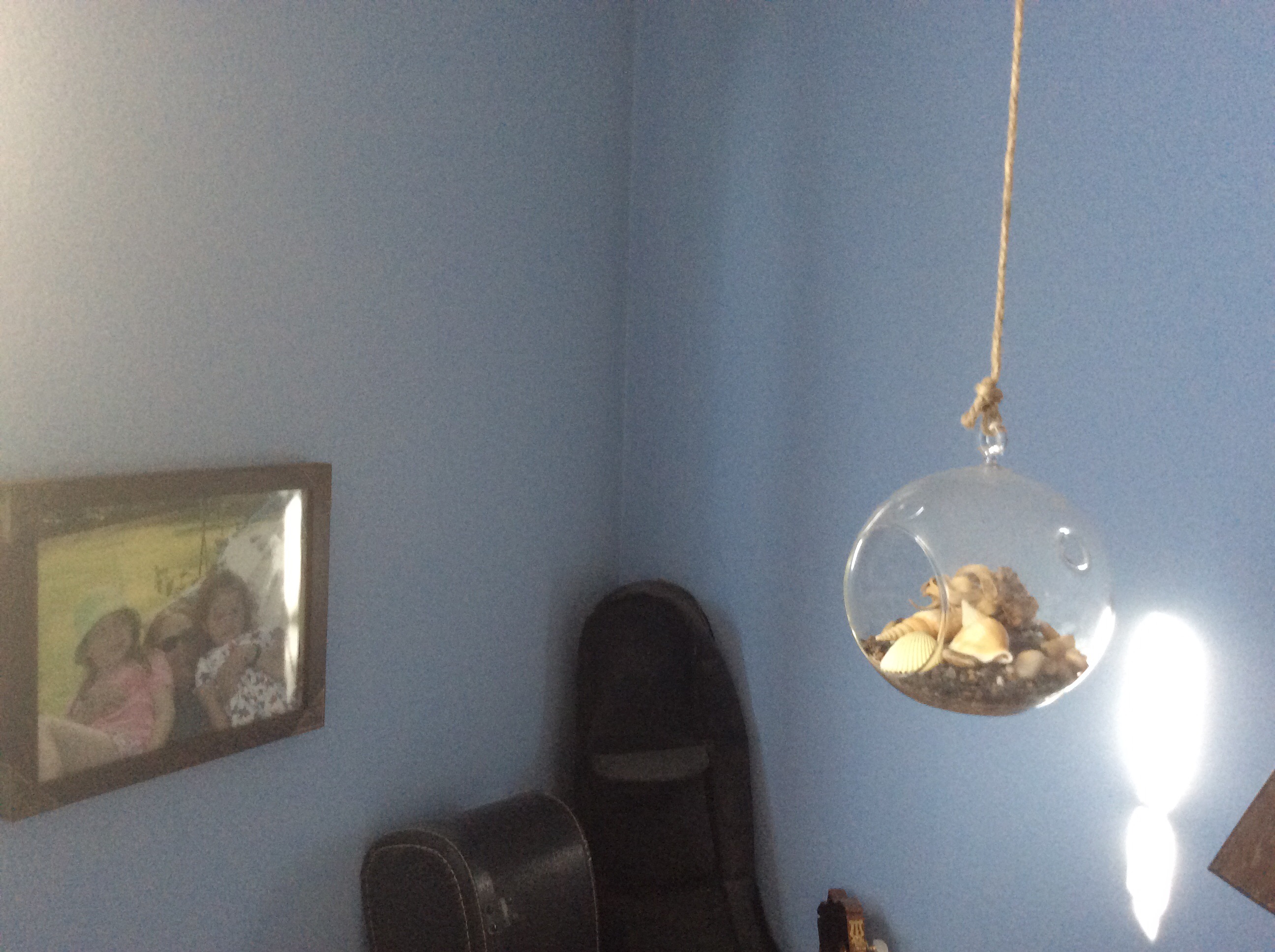
Air Plant

A floating glass bubble filled with silver and brown sand,

Hemp roped from the ceiling,

Inside crowd rocks, pebbles, earth, shells and one dead succulent.
 
Clay Pot

An art fair in Santa Monica, a day before many moons ago,

When time belonged to browse and easy chatter,

Not like now 20 years later when sparse, efficient words work us through the hours. 

A kind of kindness (Ten for Today)


We’re in the car. I muse out loud, “I want to carry into the world the kindness and caring I feel when I do yoga or when I write about the garden I peek at sometimes through the fence separating our yard from the neighbor’s or when I’m baking apricot and garlic spread into baguette then topping it with sun dried tomatoes that have soaked in Greek olive oil a good long while, for our dinner guests.”

The one in the front seat is silent, but the wise ass in the back seat, snarkily asks in disbelief, “You?” Then she shakes her head slowly and says, “Nah.” They both laugh.

I laugh. She’s a quick witted funny kid. But as we drive a way into the silence, a momentary pause in conversation, each with our thoughts, I frown inside. 

I meant it. The kindness does not extend far beyond the mat. I don’t want to manufacture it for myself by motion and feel-good-pat-on-the-back exercises and readings. I want to exercise it, stress test it in the throes of messy, even horrible existence, in the battles on the streets, on the road, in the supermarket, and on social media. 

This election circus distracts me (a Trump funk), foments mental terror and pulsing anger that requires the quelling by kindness, everyone’s. But mine is especially important in my world, to the people I touch. Hiding inside words, playing nice with language won’t do. I won’t be jailed by the surrounding toxic vitriol. I vow to melt it, laser it with the heat of my passionate dispassion. 

Love. Love. Love. Love. Love. Love. Love…

Writing the Divine (Ten for Today)


August 8, 2016
 
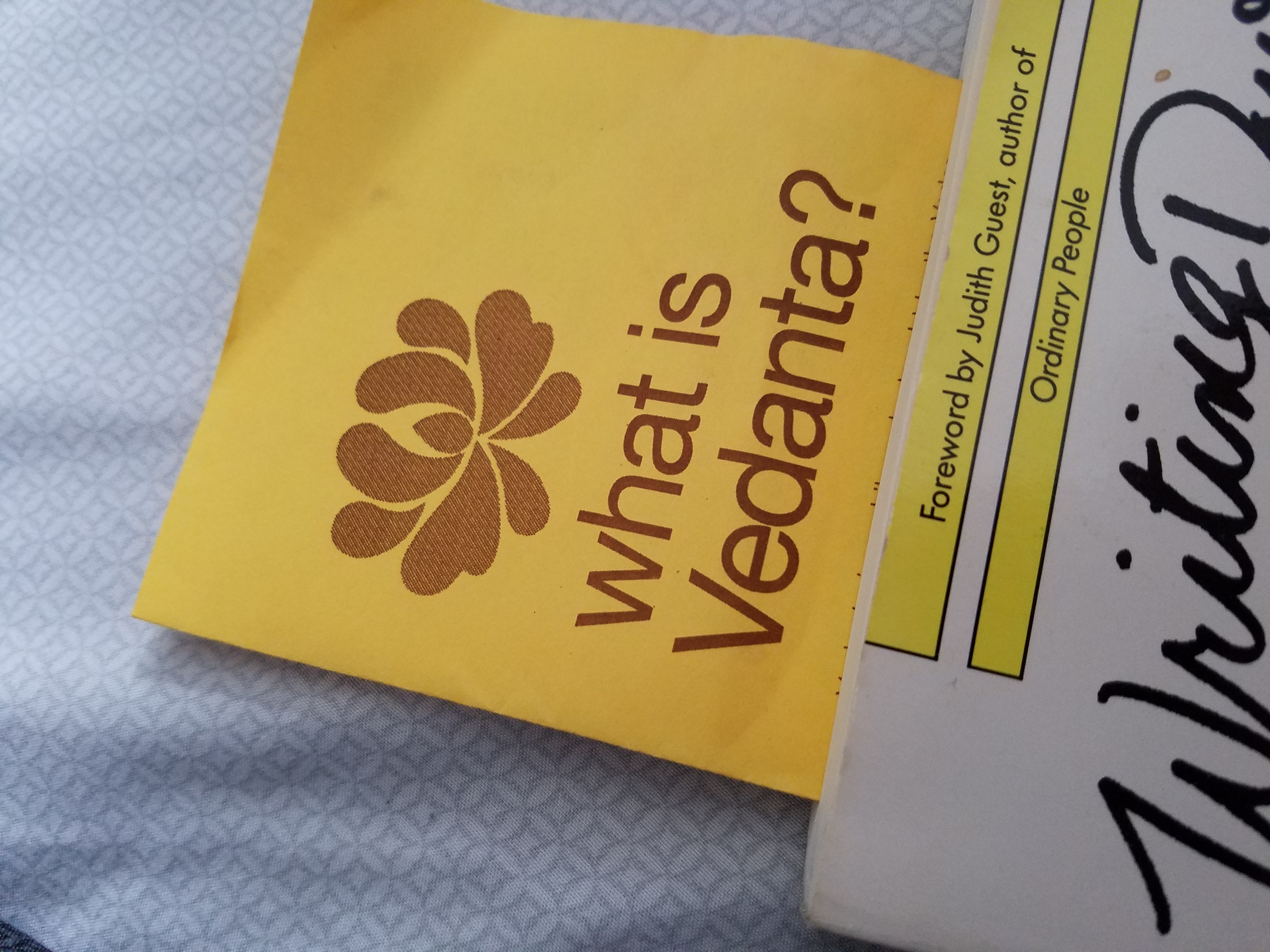
I stuck a three-fold brochure entitled “What is Vedanta?” inside my book on writing. It’s a book mark but also a reminder. The pairing is everything.
 
The Vedanta is a philosophy based on the oldest scriptures of India, the Vedas. The basic premise teaches the divine in all of us, and the pursuit of the divine is all there is. Writing needs no definition. Most everyone writes.
 
But writing for some is more than communication, practical missives that need delivery to complete some operation, some function of human existence. Some of us write because it’s what we do to reach the divine in us. I’m not sure I’m including myself in that “us,” but I’d like to consider that conviction more.
 
More than God and the divine, the Vedanta embraces all other belief systems whose end goal is reaching the divine. In other words, it makes no difference the words or way, it’s making the journey that matters. And that’s sort of my approach to writing. I write. Every day. Some of it’s good, some not. No matter, it’s the doing that counts.
 
Some days writing is therapy. Some days it’s meditation. Others it’s creation, while still others–struggle. Writing is life. It’s all we do. Some of us.
 
The finest and lowest moments connect to writing: that painful process of birthing a poem, a story, an article, a listicle, even, like molding bramble, hay and rocks together to make a statue of the Mona Lisa. And then the miracle of finishing with something approximating Da Vinci’s girl, or even pretty damned close–well, that’s heavenly.
 
The struggle to achieve, find, see and discover the divine of us in, by, through and despite the Vedanta continues moment by moment. It is the ever-present, ever-elusive (seemingly) goal. Writing is the mock up. 

Cut

I cut myself last night, a slice not deep but well-placed

like a knotted finger string, center tip of the left index

or pointer, that guiding gun dog of the hand.

It happened as I chopped and spoke, diced and

listened, as she teasingly warned, “Careful. Don’t cut yourself.”

And then, not five minutes after smug riposte, “I don’t cut myself

any more. I’ve been chopping longer than you’re alive,” the eye first,

followed a hair-pin later by stinging prick alarm, ending with

stifled exhale and reflex footing to clear water.

Quick pouring like a scalp wound, I swiftly improvised a napkin

tourniquet, then resumed my chop in plump, papered digit,

slow labor, but serviceable, hidden, blunted, wrapped

crimson seeping like shame, pride and irreverence tucked

under the skin resting on disbelieving bones.

I slipped so quickly to the sink and back, returning

to my task unfazed and fluid, so they wouldn’t see, she

who pronounced my fate and the other who witnessed.

Brushing off the slight speed bump in the banter, I turned

the absorbing wrap growing redder toward me, out of sight.

And soon they left me for work and parties, wounded, hindered

and aching to know, the pain signal, what attention needed

paying, which moment or opportunity squandered.

Today, I press it, that slit in consciousness, right thumb to

left index, cataloguing input–sensory, intuitive and cognitive–

carefully20160807_202150.jpg caressing the seconds at my fingertips.