Ten Minutes More

2000px-Horloĝo_001.svg

June 28, 2016

I breathed into this one a great deal yesterday: Tomorrow will be a day full of challenges small and large, the largest being the lack of time to think. A day full of so much activity (appointments, work, work and work) without any time to ponder the condition of the day–and me–for a small yet centered bit of time used to be every day. And that was just fine. I rather preferred not thinking and just doing. It warded off the demons I was keeping down inside me, in that deep, deep place no one—not even I—can locate. The busier I was, the less time I had to reflect about how my life was going or not going. It suited me just fine and then, of course, delayed the inevitable revolt of the repressed, those wild demonic fears and dissatisfactions named “where am I going and where have I been?”

But today’s busy-ness did not arrive with relish. In fact, the scheduled activities brought nothing more than the challenges of practicing what I know I must do but find difficult to do: appreciate everything more. Yet there’s no question in my mind (first mistaken location to start the day) that I do not appreciate taking my father to his doctor appointment down south 30 minutes in weekday traffic, abiding his ever stream of mad rant. “Why are we going to more doctors? They don’t know anything and just want to take my money and make me miserable. I’d like to give them some of their own medicine. Why do they allow trucks on the freeway? In New York, they only allow trucks on the expressway so the shmucks don’t slow down traffic. Look at that asshole driving so slow, holding up traffic.” This is the running monologue I expect and too often get before he asks me what we’re going to eat when we get out of the good-for-shit doctor’s office.

Today’s Ten-Minute Write

I don’t know what I think until I write it down—Joan Didion

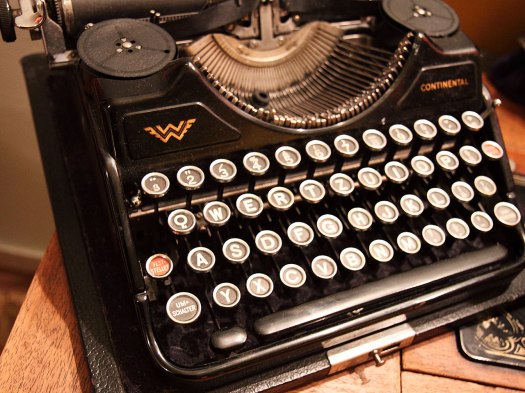
typewriter

In my web journeys today, I discovered a site called Life in 10 Minutes that collects and features ten-minute life writes. Much to my delight, this site celebrates what I do most days anyhow, write for ten minutes to a timer just to get a little heat to my brain and fingers, a warm-up if you will. After the free-write, I am ready to take on larger writing endeavors, like an essay or poem or whatever else that needs writing.

Though I have never thought of publishing these exercises in their entirety, taking only bits and pieces to flesh out into something grander, I might tinker with this idea of setting them out here as-is for a while to see what they bear.

I hope you enjoy today’s ten minutes of life.

June 27, 2016

Today feels like yesterday, except less fatigued and more awakened. My muscles after a half hour of yoga to start the day feel thick and rubbery like those industrial size rubber bands that bind a ream of paper’s worth of words—a manuscript, for example–together with firmness yet flexibility. My strut is glide-easy balanced between the push and pull of gravity.

And though the heat is slightly oppressive and my father is calling me on my cell phone once again from just inside the other side of the house, disrupting my writing—yet again, to ask me one of several questions he asks daily: “Are you hungry? What are we eating? Do you need anything from Sam’s? The answers to which are all 90 % of the time “No, I don’t know and no,” I sit in good-willed contentment and compassion. It is how he communicates, after all, how he crafts the world—plot, character and theme all food.

So today, with soft-hardness under the pads of my feet and surrounding the gooey gray matter inside my hard head, I have promised us both not to take it personally, not to react like night to day, inevitable and expected, even as nothing is ever guaranteed. I let the word “Dad” that flashes on my Samsung phone screen evoke a nanosecond of knee-jerk irritation before I exhale with the word ‘calm’ unformed but sunk-in performed. We will have this day of little perturbation, only small speed bumps that we will drive over slowly, braking down, deliberately pressing the gas pedal with a long whispered inhale and even longer exhale.

Not all children are poets

Not at all children are poets, but some are.

I remember my four-year old saying, with gravelly complaint and

consternation as we rounded the last lap of tract homes from the 

neighborhood park, “It feels like there’s an elephant in my shoe.”

Those days, I was not a poet myself, so I simply took off her shoe

to see what was the matter, what was in there, a rock or a sock?

Neither of those could possibly be the size or weight of an elephant

but I skipped right over the poetry and assumed the play out of it:

She just meant that something was slowing down her gait, some

obstruction that was making her walk like an elephant, and that

full explanation did not even articulate in my mind, just swallowed

up in the patching up holes and problems, as parents are wont to do.


And then those hours of “Mother Goose” nursery rhymes that 

pleased and placated my tiny joy-riding song and wordsters who

pleaded, “Again” after we’d go through the entire night’s rhymes read

before bed time, and all I could think was, “What does this mean, 

‘hickory dickory dock’, mice, clocks and ‘Little Jack Horner’s plum’, 

dishes eloping with spoons and cracked “Humpty” eggs that garnered

so much respect that all the king’s horses and men came to its aid?”

My mind drifted as I sang-sung the words that were impossible to

read plainly, prosaically–meter forced down the reader’s tongue and 

bones–through history, fairy tales and folktales, lore of

cultures and small pockets of rural societies past when these words, 

rules and references made sense, all the while losing the music that 

kept my poetettes lulled to the opiate rhythms of story-song silliness.


Only when I noticed their wobbling knees and fatty little fingers 

opening and closing like metronomes to music I forgot to hear, the

pulse of primal iambs that beat like limbic hearts, laughter-ful, wordless 

sense, even while my lips, breath, voice, tongue and ears decoded and 

reproduced the text just as it was meant to be read–filled with 

drama, pause, whole notes and half notes, lento and allegro, 

ha-ha! loud and sh-sh soft as we three piggies word-danced, they

with their poet souls and me with my mimed mastery of lines.

Searching for the light switch in the dark

SingleLightswitch

“If a man going down into a river, swollen and swiftly flowing, is carried away by the current — how can he help others across?” – The Buddha

I am that man. Some days, at least. Absorbing the toxic words and actions around me in the news, on the roadways and in my own home, I swell with anger or fear so plumped that I could not pull myself out of the fast flowing river of popular roars and rants if there were a thousand outstretched helping hands lined up along the banks for miles.


And yet, I know the flip of the switch we all possess to alleviate the suffering that comes from the world being too much with us. Choosing not to allow the inflow of water or to let it pass through prevents the swollen suffering.

Detachment isn’t a synonym for tuning out, more so tuning in while refusing to participate. The only way to survive this volatile time on the planet and at home is as the scientist examining the world and my responses to it under a bell jar, watching with dispassionate interest the outcome and culmination of all the forces I choose not to be swept up by, like that river that I can fall in and under or navigate with the vessel that allows safe passage–for me and you.

There is a switch we can all turn on that allows us not to react to the chaos and frenzy around us but to observe it without attachment. I keep looking for that light switch in the dark.

Stillness and Presence


“At the still point of the turning world. Neither flesh nor fleshless;

Neither from nor towards; at the still point, there the dance is,

But neither arrest nor movement. And do not call it fixity, 

Where past and future are gathered. Neither movement from nor towards,

Neither ascent nor decline. Except for the point, the still point,

There would be no dance, and there is only the dance.”

T.S. Eliot, “Four Quartets” 

The dance is ongoing. It is presence. It never was nor will be but at the still point of our ever turning, evolving world–that is us. And the dance is lovely and freeing if you stay there.

The Art of Lovers’ Lessons Learned


A lover once taught me shapes of fair, fragile snowflakes,

Their pockets of space designing mass and configuration

As much as frozen rain mists, cloud-fallen and drifting.
**********************************************

Another one telescoped me the distance and size of stars,

Colored me planetary pictures of rings and ovals, spheres

In spotty galaxies smudged by gaseous gems on sky maps.
***********************************************

One modeled his lessons to me in structured time slots,

Configured inside meetings and lunch, clocking out hour

And over-time pay shifts, allowances for home absence.
***********************************************

And yet another, this one, schooled me in the art of love,

A rare calligraphy of swirling letters adorning words in

Poems and stories that beat true passion into thick skin.
***********************************************

All of these and more have lent a lesson to have and hold

By imagery water-colored on silk screen partitions placed

Between my heart and ribs, thighs and brain, sculpting me.

Preview of Upcoming Publication: Yoga and Gravity Unbound


Happy International Yoga Day. In honor, I have written a soon-to-be-published essay about yoga, meditation, gravity, growth, language, presence and play.

“Growing up” is the metaphor, like a slow-rocket burst through the air in defiance of gravity. So many metaphors about that first half of the arc that rainbows our lives bespeak struggle against warring forces like the pitfalls of acquiring experience called trial and error and raging hormonal bodily take-over that is puberty. Not only the breaking through, busting out and bursting metaphors of rising roots characterize maturing, but also minefield metaphors of making mistakes as we learn, falling in missteps (failing a driver’s license test, picking the wrong partner, losing a job) and picking oneself up from such falls. Struggle.

Learning our bodies and minds requires overcoming. Charlotte Joko Beck in Everyday Zen writes about the spiritual growth of achieving zen and states that “the process of becoming fully independent (or of experiencing that we already are that) is to be terror, over and over and over.” Our struggle lies in the fear of breaking free of our own mind chains–of falling.

Dance, Abe.


Hey there, 6 foot 2,

You’re the legend I 

Never really knew,

Just tales and arms

That wrapped me up

In dreams disarmed.

At least I think so,

Childhood being all

Those decades ago.

No matter still, as

Memory lays bare

A wild man’s stare

And disheveled hair

From too much work,

Sleepless nightmare,

Slaving for the jerk

Who paid pennies

For our family of 7

And zero amenities

Like air, health, ice

Or places to sit and

Eat, but for the mice

And rats and broken

Windows in summer

Through winter then

All over again you

Worked and worked

Like honey bees do

Except for the sweet,

Endless years toiling

Making their mark on

Sharp minds unfolding

Like cards in a deck

The ones spread before

Your outstretched neck

As you glance at a play

Grimace in your mouth

And hunch in your sway.

Time, cards, pills, and

Withering you rue it

All, taking for granted

Though you may intuit

That all you worked

For in shaving off days

Return in unseen perqs

Of watching the world

Change as you leave it

For survivors to unfurl

And laugh at the effort

Knowing it’s fruitless.

I watch you watching

Me with that wry smile

Sneering, laugh, a poke

A jab, a joke just to rile

Me, anyone who’ll hear

And play the game of

Conversations unclear,

Skills you never master

Unbothered to learn its

Nuanced turns faster.

But here you are 82

And not worse for 

The wear as you do

Your days like song

On repeat every hour

Seeking to belong

Longing for your arm

Missed as she’s gone

And none to replace 

The world you built

Sweat leaving no trace

Of life fretted in years.

Though sad and sagged,

You have plenty of life

To give, receive, begin

Again if you so wish,

Children, grandchildren

Happy that you exist 

As am I who love you

With much heart, laughs

anger and admiration too.

Happy Day, Father, to you, 

Dance the potato chip dip

Crazy, ape-shit, Abie-poo. 


Medicine


To the doctors again, I loaded the car with the wheelchair and its 

inhabitant and the inhabitant’s 62-year marriage distracting mate.

My dementia-ravaged mother’s caretaker naturally came along.

She and I lifted my mother’s stiff resisting 95-pound taut body high

into the van, me pulling from the seat above, she pushing from

the cement driveway below, the two of us nearly thankful she has 

wasted to such an accommodating weight, making the task feasible.


On her wedding day, she was 95 pounds, so my father repeats to

anyone who will listen, including the new neurologist who observes,

examines my mother while my father offers his opinions in a blared

recital of facts: “She was an English Major and wrote a thesis on, on…

Saul Bellow. It’s in Long Beach in the school somewhere. She was a

good wife. The best you could ask for. But you never know how much

you have in a person until she’s gone.” And so goes his secular litany.


Struggling not to once again remind him that she hears and is alive

and beat down the growing irritation, I explain that she fractured 

her shoulder somehow while in a nursing home and so protects it.

The doctor nods, hmmm’s and continues manipulating my mother’s

rigid limbs, tries to uncurl her fingers long-ago cemented into C’s.

She murmurs her observations in one word confirmed diagnoses: 

“Spasticity…atrophy…tremors…neuropathy…” as she plies tissue.


My father answers, “Her left arm doesn’t work at all,” when the 

neurologist inquires about body movement, and I snap, “Not true.”

I shush him a few times as his need grows to run the show, talk to 

someone who will hear what he repeats like a skipping vinyl record, 

evoke sympathy from new flesh (the same old audience tires), 

release nervousness or some other cause of his inaccurate, 

inappropriate and irrelevant comments–and I immediately soften.


He needs so much too, but then he has always stolen more from her.

The pink and blue light sabers clash in stinging zaps inside my body.

She is a White Walker sans the unstoppable malice, with bones 

for a face and fallen flesh failing to disguise human skeleton, I muse.


In the car trip to the office, she sneezed, and I marveled at her voice,

the familiar sound of her reflex, which flooded me with spinning

memory flinches of every moment I had ever heard it, pouring

gooey thick amniotic washing into the bones of my sense of time

and destination, the immediate and outward, unknown, unseen.

In Arabic death ritual, relatives painstakingly and lovingly wash the
 
corpse to send it onward in its journey while leaving blessings behind.


But the miasma of missing Mom living right before my eyes, mouth,

nose, ears and skin, who I touch and purr to and who sometimes

gaping-mouthed, wild eyed, crazy-toothed, lopsided smiles at me with

oh-my-God-of-the-moment recognition, cherished, ecstatic familiarity 

and connection for us both, confuses us, me, who churns with the incongruity 

and daze of seeing him well enough to complain, repeat the same jokes and other 

grating, mindless habits he has long held, and just as long refused to change–


and yet see him as short-term too, gone in a cardiac flash or in interminable dribs

and drabs of life-leaking, irrefutable, genuine  horror for him, me, everyone but 

the doctors, nurses, pharmacists, technicians and equipment and drug 

manufacturers who gain from decay, his, theirs and ours, the dying.


At home, I hear the wheelchair wheels squeak by as my 20-year old

10-months now concussed daughter, chair-splayed, giggles at the electronic 

buzzes emitted from her palm’s worship, the small God of life she knows, 

my mother never knew, its advent arriving too late, my father acknowledges

then glances away from, its mystery blinding, and I know far too well, prey to 

its opiates, but not enough to forego profit and sneer nor succumb to its disease.

Shall we call this nature and proceed with a sun-spreading daylight’s delivery?


Love, don’t hold my hand


Standing in line, wondering if it’s my time, if I’m next.

Horror dominates the mood of this meet-market place. 

How many times have I walked hand in hand with her

strolling in the night along busy streets, on the beach,

arm and arm, not a care what the world around us was?

She once asked me if I were afraid. “Of what?” I asked

then genuinely confused at the context of her asking.

She knew because she was no Johnny Cum Lately like

she found me, days when I thought we were so free to

love anyone, our choice, our lives, nobody’s business.

That was then, before the killing, so now I understand

her hesitance, reticent PDA despite her overwhelming 

urgency to touch me, keep me close and hold my hand.

Now I know how much I never knew what it was like to

clasp your hand to the back of your neck to smother it,

 the burning, piercing glances and hateful lookaways 

and disgust, unknown to me, a judging by appearance, 

though I never hid my femme, wore it loudly just like I 

wear that tremor of hateful contempt-tossed-at-me-

cringe once someone knows my tribe, the most stead-

fastly, longest-standing hated people in all the world.

But since I did not reveal it in my skin nor my love life,

I was freer than those targets who had no choice but to

be who they were, but to love who they loved and to be

fluid bodies delighting, sensating and breathing light

by which we all create our mad comedies and tragedies 

called our civilized, social, contractual, consensual lives. 

Believing I was anyone’s everyone, I was simply wrong. 

I’m noone’s; I’m in between everyone–not any where,

watching the others duck and dodge bigots and bullets.