Funeral Song for a Friend


Skinned raw, bleeding, humanity’s keep limps illogically along,

Leaking the source first in torrents, later in eviscerated rivulets.

No tourniquet wide, twisted nor absorbent enough to suck it all.

No One can gather it up, mop it up from the dance floor, untie it 

From the back alley fences or unstain it from the consciences of 

Ignorant name-shamer, tunnel-visioned politician or us cowards.

No formulas, statistics, truths or lies will rescue the dead-harmed

When ends and means are meaningless as exhorted truth-slayers,

When ebony bones shine word shadows projected upon the screen 

Of the inner war we wage, brushing aside ivory clarity like clouds 

dispersed in sneery derision, campaign slogans and catchphrases,  

One mind and only one will change the hearts of all, only one-kind.

When will dress rehearsals end and the real revolution begin–again? 

Story Line

image

It’s the same old story told and re-told,

Thin smoke, a fire sparks newspapers sold;

“We’re up in flames; this place is doomed.

Who will scrape our souls from the ruins?”


Truth be souled, we scale our weakened edges,

Lurching through time, jumping off its ledges

In silken ticks, slick with moist memory mold

Like a baby’s crown bridging gaps grown whole.


Since the plates never cement, never solidify 

Merely surrender the quest just to realize

How little matters matter in the big scheme:

Unceasing cessation’s sensation’s our dream.


So forget about alarm bells and anxiety spells,

Smoke, pills, drink and dare-to-extreme thrills

To awaken sensate waves alligated to a vision 

When real proof appeared at the first incision.


At the flash, burn and expulsion, too hot to stay

A core so full of inevitable dispersion to always.

That’s life, I’m told, living between fire and ice   

My story and yours, again, and rolling the dice.


Chaos, our freedom, this overlaid order a fraud,

Some call it nature, some karma and others God.

I call it “whatever” or “ok”, often I call it a day,

To rein and saddle numbered hours’ silly anyway.


The ending never arrives, the plot never unfolds,

That’s the same old story told, retold and untold

Since the steadfast mute, reveal no master divine

Across the divide no dying secret passing the line.

 
Image: http://www.designedforlearning.co.uk

H.D.

Debating whether to post a clunky rhyming poem (I’m no good with rhymes) I churned out last night for today’s post, I came across this poem on my daily feed from poets.org. 

I first read H.D.’s poetry in a University of Calilfornia, Riverside, graduate school course on confessional poets in 2004 or 5. I fell instantly in painfully beautiful love. The incisive, careful cut of an  exquisite mosaic or tapestry suggestive of eternity in the local is how I describe her poetry. You can see the source of the delicate angles of her words reflected in her face: the keen eye, angular nose and chin, all projecting intense insight. 
If memory serves, Ezra Pound discovered or fostered her. I’m glad someone did, so that I could find her centuries later. Hope you enjoy. 


Born in 1886, Hilda Doolittle was one of the leaders of the Imagist movement.
Sitalkas

H. D., 1886 – 1961
 Thou art come at length

More beautiful

Than any cool god

In a chamber under

Lycia’s far coast,

Than any high god

Who touches us not

Here in the seeded grass.

Aye, than Argestes

Scattering the broken leaves.

Spider in the Shower Wisdom

image

In an age of so much door-stop wisdom in flashy colors and streams,

Profundity hides harder to recognize in tastes-great–less-filling sweetie ah-bites.

And when everyone’s grandmother publishes, words do not come easily any more, all lost in 

Endless letters combined, re-combined and strewn everywhere, making 

Nonsense seem sense or not even bothering, words without aching indescribably churning or heart-

Rent fluid affecting, infectious and ever-in-the ears and eyes inscription, just syllables,

nothing more. 

I can’t hear myself think over the noise of it, the shrill deprecating humor,

Blunt, sword-slicing insults and chiding, scolding and deriding, nothing but chatter-ful ticks.

How to be mindful when the mind chitters and bakes under the halitosis heat?

Sweltering  discomfort in knowing my life is in the hands of self-sabotaging

Zealots and bonzai bitchers and moaners, paraders and inert blabberers.

But there is some thing, something…

I see it in the piss-yellow plumped plastic medicine bag

pole-hanging to high heaven

with streaming liquid hope in thin rubber tubes of curative culture like an i.v. of satisfaction.

It’s there in the splayed legs of a stiffening spider fending off the drain holes’ draw

with the unfathomable force that those toothpick sticks belie as the pounding punishing pulse of the

thunderous shower stream pushes and the suction below pulls.

That’s the way it is with nature and words, that suspension between sense and salvation.

Don’t Call Me a Mistress


Language Matters: Alamy

Language matters. When newspapers call women mistresses or “homewreckers”, they are not just using an identifying term. They are also making a value judgement about what happened in a relationship – a judgment that often places the blame on women, even though there are two people involved in an affair.

So writes Jessica Valenti of the Guardian in an article entitled “Why we need to lose biased words like ‘mistress’ for good.” Her argument based on Paula Broadwell’s campaign to get news media to stop using that word to characterize (and vilify) her relationship with ex-CIA director, David Patraeus, goes something like this: ‘Mistress,’ which has no male counterpart is one of those words used to blame women for behavior of two consenting adults, presumably male and female, that society condemns.

When we use words that prop men up for the same behavior that we disdain in women, we are sending a very particular message, one that causes harm whether you’re a reporter writing for readers or a parent talking to your kids.

She throws in other loaded terms targeting women like spinster and Oxford Dictionary’s ‘rabid feminist’ as a word definition example along with the usual words used against men to suggest womanly behavior like ‘bitch’ and ‘pussy’ that she concludes are sexist, outdated and harmful. 

So let’s lose “mistress” and words like it. Our language should reflect the world we want, not antiquated ghosts of sexism past.” 

She’s right. The word “mistress” has no male counterpart and denotatively and connotatively female words used to ascribe enculturated female behaviors as insults are loaded with history’s carryover sexist world. She’s also right that “language matters.” 

But history also matters, for that matter. So, rather than cut ties with history by eliminating language that survives the ephemeral fashions, behaviors and ideas of long ago, why not use language to educate people? Rather than deny distasteful history, say, slavery or holocaust, by eliminating the hate words that derived from those horrific institutions and events (nigger, kike, etc.), how about we teach people to be aware of how we use language and why? 

Jill McCorkle writes in the essay, “Cuss Time,” the story of how she resolved her nine year old’s forbidden fruit fascination with profanity by allowing him a 15 minute cuss time each day, a free-to-say-anything break in the day to let it all out. Risking a bad parent label (or even a referral to child protective services, I would imagine), she allowed her son the freedom to swear like a sailor rather than censor his language and lose the power, resource and history of language by eliminating words from her son’s vocabulary. She writes:

 Word by single word, our history will be rewritten if we don’t guard and protect it, truth lost to some individual’s idea about what is right or wrong. These speech monitors–the Word Gestapo (speaking of words some would have us deny and forget)–attempt to define and dictate what is acceptable and what is not.

Valenti also opens her article with language parenting by mentioning her careful language selection, words she wants her children to use like firefighter instead of fireman. I believe these two authors hold the key to the problematic power inherent to language: teach children by mindful use and education rather than by a negative, censorship. The children wield the power to change future language, meaning, action and society.

(Thanks to Laura Steuer of  infidelity counseling network for sending this article my way). 

For No Apparent Reason

Like any other morning, I wake up to muffled door rattles or slams,

And the crystal plea of a squeezed bladder–release, sweet release.

The blinds drawn and the clock radio dead for a few years now, I reach

For my phone to check the time: the usual 6:38 a.m. flashes retinally.

Taking inventory, I listen for a high schooler soon to fly out the door,

Perhaps her older sister stirring in poor sleep or kicking the disruptive

Cat out the door to purr in someone else’s ears, perturbations unleashed

For those battling anxiety and depression: IBS, TBI, PMS and US politics.

 
Challenging gravity’s rest, I aright myself and further assess the day’s 

Bone placement as they all align, sink and press in allotted pegs, dips

And slots, and all measure properly without incident or undue notice.

My body has not joined in some stealth overnight rebellion for unpaid

Dues or sins of my youth just yet, and I take my first steps into morning.

Upright, leaning into space opening up to the bathroom door a mere six

Steps from my launch, I begin to feel it: the heaviness, not in step or 

Weight, but an anchor-dragging shadow that resists verticality from

Scalp to balls of the feet, slowing the advancing doorway  to a shuffle.
 

I know I’m already late, but the excursion’s effort, to pee and back, 

Begs my re-bedding just for a hair’s breadth of a moment, I bargain.

Soon, the phone or entry door will vibrate with his questioning call or 

Needy knuckles, reminding me that it’s time for his intravenous push 

And his diabetes blood check and his arm wrap for his shower and his 

Pill box re-filling as it is Monday: the array of multi-colored, go-gemlets 

Shaped like candy paper dots or pez ovals popped out of a clown mouth.

The anchor widens and grows tentacles, linking chain to arms and chest,

Pulling down shoulders and the corners of eyes and lips no breath can re-

Vive, no gratitude check can lighten and release like an emptied bladder.
 

I glance out the now-opened blinds at the orange clusters in threes and 

Fours, heavy with juice, hanging impossibly high at the thinnest branches

At the top, mightily fighting, irresistibly drawn downward while floating

The resistance between soaring, maintaining and falling: mass, space and

Time–all illusion, as is this overwhelming dread and angst that will dry,

Crumble and dust, blown into an afternoon breeze that kicks up after June

Grey dewy mornings drip, clear and stiffen to bolster tender leaves against

The love, need, hate, and anger over their circling heads tethered to a sun,    

The same star that guides ships, unanchored, daylight drifting or swiftly 

coursing waters tumultuous and calm to destinations charted yet unknown.

Another rudder-less morning steering me blindly, I have survived the first

Passage and make my way to the door, enjoying the last five, quiet seconds

Before the physical proof meets the prescient mood, while nothing is wrong. 


You Want To See The Face Of A True (as Opposed To A Wannabe) Rebel?

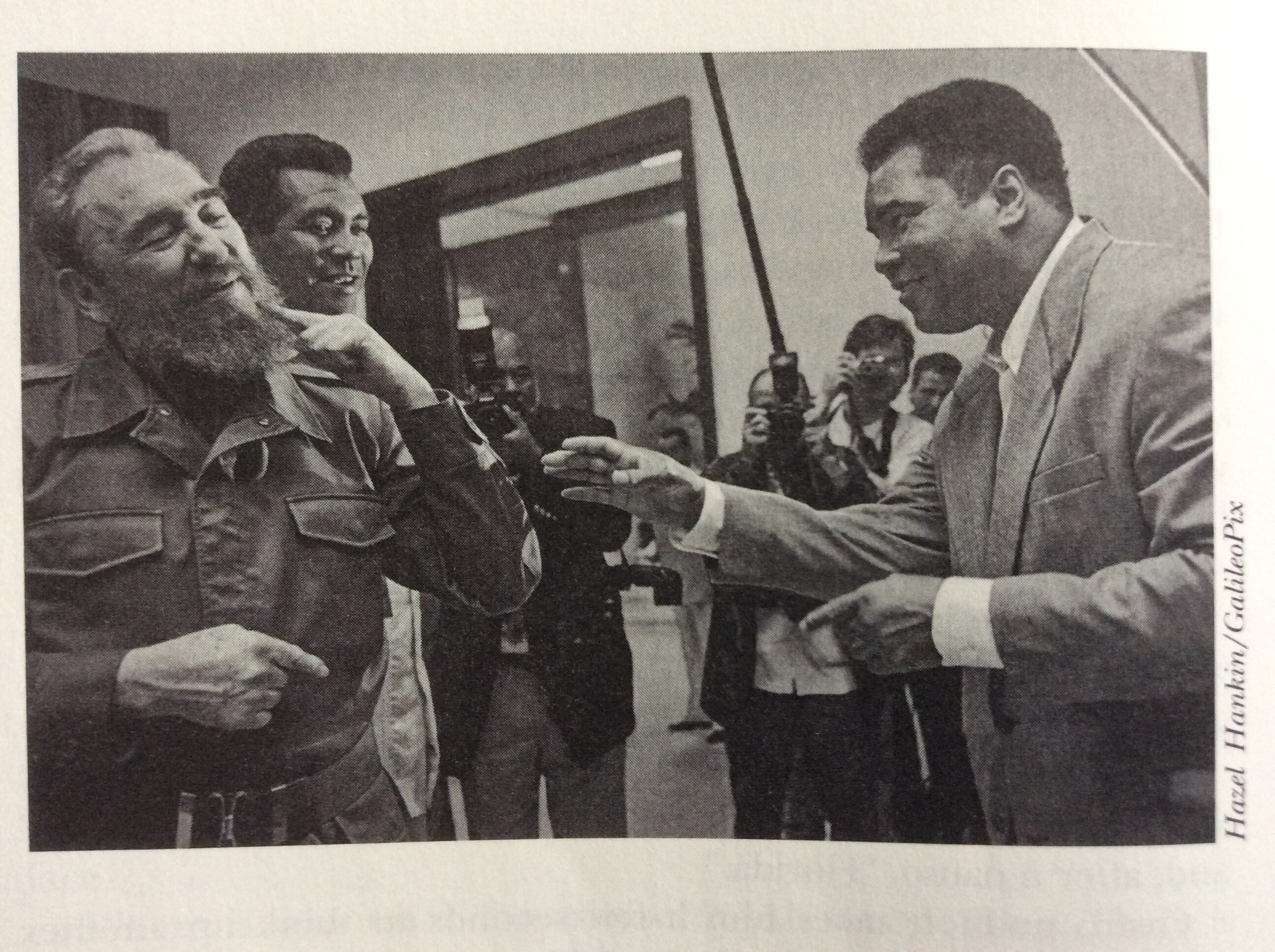
Bingham met Ali thirty-five years ago in Los Angeles, shortly after the fighter had turned professional and before he discarded his “slave name” (Cassius Marcellus Clay) and joined the Black Muslims. Bingham subsequently became his closest male friend and has photographed every aspect of Ali’s life: his rise and fall three times as the heavyweight champion; his three-year expulsion from boxing, beginning in 1967, for refusing to serve in the American military during the Vietnamese War (“I ain’t got no quarrel with them Vietcong”); his four marriages; his fatherhood of nine children (one adopted, two out of wedlock); his endless public appearances in all parts of the world–Germany, England, Egypt (sailing on the Nile with a son of Elijah Muhammad’s), Sweden, Libya, Pakistan (hugging refugees from Afghanistan), Japan, Indonesia, Ghana (wearing a dashiki and posing with President Kwame Nkrumah), Zaire (beating George Foreman, Manila (beating Joe Frazier)…and now, on the final night of his 1996 visit to Cuba, he is en route to a social encounter with an aging contender he has long admired–one who has survived at the top for nearly forty years despite the ill will of nine American presidents, the CIA, the Mafia, and various militant Cuban Americans.

“Ali in Havana” by Gay Talese (Best American Essays)

“Hating people because of their color is wrong. Andit doesn’t matter which color does the hating. It’s just plain wrong.”

The Quiet One I Watch Over

It wasn’t easy telling her how I felt used and taken for granted,

all the while fighting self-judgment for sounding needy and guilting.

Do I tell her how I feel, even though there’s nothing she can do about it,

especially knowing that she will feel she has to do something about it?

Do I just silently accept our condition–she not relating to me, not

wanting to be with me, me wanting to be with her but not knowing how

to reach her, make her happy, engaged and connected?

She needs my money, advice and time.

She needs my permission, approval and signature.

I pay for whatever she wants and requires.

I take her where she must go, pace the sidelines and cheer her on,

encourage her, give her feedback and teach her how to live now and beyond us.

We make each other laugh and share sharp wit and sardonic smiles.

She seems appreciative for us, for all we are and do.

No one writes a more heartfelt loving, grateful text.

I don’t doubt her love, she not mine either, I hope.

She’s neither unhappy nor oppressed, just disinterested.

Tied in obligation knots, we–without violence, anger or volume–co-exist,

each with our silent confusion, angst and helplessness, resentment perhaps.

If she could only speak her mind.

Is it bullying to speak mine, a unilateral outpouring inevitably producing reactive

toxic anxiety or worse yet, guilt?

If she would shout, complain and demand, I would know what to do.

But quiet responsibility-assuming aimed at relieving me burden, one fewer needy time-taker,

a sign she’s stepping independently aloof into burgeoning adulthood, leaves me flustered.

No one wins, even when we’re not vying for an upper hand or competing in a contest.

As our relationship gestates, becomes what it will be for years to come, then changes

again, waiting, speaking and abstaining are the hardest parts.

Just one more of the many skills, mothering this one, I may never master.
image

In Love…


“In love there are two things–bodies and words.” Joyce Carol Oates

And her rejoinder to me: “Our two bodies are our words–hello and good bye.”

Never Saw You Coming (Yes I did)

image
NEVER, no

I never expected you, never saw you coming, not at all,

but there you were, wearing all the wrong clothing:

horizontal striped collared button down shirt, like

colored bands ringing a thick, redwood tree trunk.

Middle aged folk fallen prey to time and gravity

don’t wear bold-colorful advertisements to widening

perimeters, especially for one with no boundaries,

sexually speaking, of course, not morally or politically.

And logo’d button down polos reek conservative bean 

counter, occupation-ally bound to count kisses, time and

orgasms, sans deductions for the unholy of holies among the

fiscally, vaginally vigilant.

And there I was, a raven, coated and shiny like wet ink newly

splotched on your parchment paper computer screen, dark

and waiting to be lit, turned and transformed beyond the

shadowy picture created in your imagination, confessions

and slick-wicked liquid words sliding thick viscous

through your keyboard fingers, just like we wrote, painted

pictures in sentences spelling out, enumerating, if you

will, voracious mimicry, want and want some more, only not

wanting all that just can’t have, not then, not now, but

something else arose, grew from our impossibility, your

straight laces strung tightly, fronting the devilry in your

daydreams, drooly lasciviousness set free, not freely given.

Yeah, we really did it for each other, whatever it was that

needed doing, and still do to both no one’s and yet everyone’s

surprise, including us who love so much so little of the

time, no time all the time, we who live separate lives

lived in broad daylight secrecy, while we storybook

pieces and patches of once upon a time we were other

people than we are and were then who could be us now.

You often ask, “Who knew you’d still be around?” And

“How could I have known? I didn’t see you coming.”

No, we didn’t see each other coming but we sure do now.