Bhavana: How we grow as knowledge cultivators

shutterstock_141965581 (1)

Bhavana, meaning to cultivate or develop but commonly used in Buddhism as a word for meditation, once again flashes before my mind’s eye. Despite researching the term, the exact sense of the word often escapes me. Does it simply mean to grow understanding? Are meditation and bhavana the same? I have not yet reached that place where my life experience and the word’s essence combine to flesh out the bones of meaning—not in its spiritual sense.

Cultivating takes time: crops grow over…See more

Give me back my hour!!

To die, to sleep.

To sleep, perchance to dream—ay, there’s the rub


credit: thephilfactor.com
 

I feel tired, resentfully tired. Like I’ve been robbed. It’s not just an hour. It’s my life!

What Difference Could an Hour Make?

By Michael J. Breus, PhD

WebMD Feature Reviewed by Michael W. Smith, MD

The daylight-saving time change will force most of us to spring forward and advance our clocks one hour. This effectively moves an hour of daylight from the morning to the evening, giving us those long summer nights. But waking up Monday morning may not be so easy, having lost an hour of precious sleep and perhaps driving to work in the dark with an extra jolt of java. How time changes actually affect you depends on your own personal health, sleep habits, and lifestyle.
 
Moving our clocks in either direction changes the principal time cue — light — for setting and resetting our 24-hour natural cycle, or circadian rhythm. In doing so, our internal clock becomes out of sync or mismatched with our current day-night cycle. How well we adapt to this depends on several things.
 
In general, “losing” an hour in the spring is more difficult to adjust to than “gaining” an hour in the fall. It is similar to airplane travel; traveling east we lose time. An “earlier” bedtime may cause difficulty falling asleep and increased wakefulness during the early part of the night. Going west, we fall asleep easily but may have a difficult time waking.
 
How long will it take you to adapt to time changes? Though a bit simplistic, a rule of thumb is that it takes about one day to adjust for each hour of time change. There is significant individual variation, however.
 
How will you feel during this transition? If you are getting seven to eight hours of sound sleep and go to bed a little early the night before, you may wake up feeling refreshed. If you are sleep-deprived already, getting by on six hours, you’re probably in a bit of trouble, especially if you consume alcohol or caffeine close to bedtime. In this situation, you may well experience the decrements of performance, concentration, and memory common to sleep-deprived individuals, as well as fatigue and daytime sleepiness.

 GIVE ME BACK MY HOUR!

Six Bee Poems

image

Six Bee Poems

I Tell The Bees

He left for good in the early hours with just
one book, held tight in his left hand:
The Cyclopedia of Everything
Pertaining
to the Care Of the Honey-Bee; Bees, Hives,
Honey, Implements, Honey-Plants, Etc.
And I begrudged him every single et cetera,
every honey-strainer and cucumber blossom,
every bee-wing and flown year and dead eye.
I went outside when the sun rose, whistling
to call out them as I walked towards the hive.
I pressed my cheek against the wood, opened
my synapses to bee hum, I could smell bee hum.
‘It’s over, honies,’ I whispered, ‘and now you’re mine.’


The Threshold

I waited all day for tears and wanted them, but
there weren’t tears. I touched my lashes and
the eyewater was not water but wing and fur
and I was weeping bees. Bees on my face,
in my hair. Bees walking in and out of my
ears. Workers landed on my tongue
and danced their bee dance as their sisters
crowded round for the knowledge. I learned
the language too, those zig-zags, runs and circles,
the whole damned waggle dance catalogue.
So nuanced it is, the geography of nectar,
the astronomy of pollen. Believe me,
through my mouth dusted yellow
with their pollen, I spoke bees, I breathed bees.


The Hive

The colony grew in my body all that summer.
The gaps between my bones filled
with honeycomb and my chest
vibrated and hummed. I knew
the brood was healthy, because
the pheromones sang through the hive
and the queen laid a good
two thousand eggs a day.
I smelled of bee bread and royal jelly,
my nails shone with propolis.
I spent my days freeing bees from my hair,
and planting clover and bee sage and
woundwort and teasel and borage.
I was a queendom unto myself.


Going About With The Bees

I walked to the city carrying the hive inside me.
The bees resonated my ribs: by now
my mouth was wax, my mouth was honey.
Passers-by with briefcases and laptops
stared as bees flew out of my eyes and ears.
As I stepped into the bank the hum
increased in my chest and I could tell the bees
meant business. The workers flew out
into the cool hall, rested on marble counters,
waved their antennae over paper and leather.
‘Lord direct us.’ I murmured, then felt
the queen turn somewhere near my heart,
and we all watched, two eyes and five eyes,
we all watched the money dissolve like wax.


CCD

My body broke when the bees left,
became a thing of bones
and spaces and stretched skin.
I’d barely noticed
the time of wing twitch
and pheromone mismatch
and brood sealed in with wax.
The honeycomb they
left behind dissolved
into blood and water.
Now I smell of sweat and breath
and I think my body cells
may have turned hexagonal,
though the bees are long gone.


The Sting

When the wild queen leads the swarm
into the room, don’t shut the door on them,
don’t leave them crawling the walls, furniture
and books, a decor of moving fuzz. Don’t go off
to the city, alone, to work, to travel underground.
The sting is no more apis mellifera, is a life
without honey bees, without an earful of buzz
an eyeful of yellow. The sting is no twin
waving antennae breaking through
the cap of a hatching bee’s cell. The sting
is no more feral hive humming in the stone
wall of the house, no smell of honey
as you brush by. No bees will follow, not one,
and there lies the sting. The sting is no sting.

About this poem

First published in 2011.

Jo Shapcott

Jo Shapcott won the National Poetry Competition in 1985 and 1991. Her collections include: Electroplating the Baby(1988), which won the Commonwealth Poetry Prize for Best First Collection, Phrase Book (1992), and My Life Asleep (1998), which won the Forward Poetry Prize (Best Collection). Her Book: Poems 1988-1998 (2000), consists of a selection of poetry from her three earlier collections. Her latest book of poems, Of Mutability, (Faber, 2010) was shortlisted for the Forward Poetry Prize and won the Costa Prize for Book of the Year. She was awarded the Queen’s Gold Medal for Poetry in 2011 forOf Mutability. She is also co-editor (with Linda Anderson) of a collection of essays about Elizabeth Bishop and co-editor with Matthew Sweeney of an anthology of contemporary poetry, Emergency Kit. She teaches on the MA in Creative Writing at Royal Holloway, University of London.

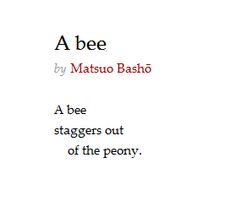
Basho’s Bee Meets Monsanto

basho bee

…Monsanto’s contribution to the vanishing bee population is detailed. From genetically altered corn, Monsanto produced an insecticide called Bacillus thuringiensis (Bt), which once ingested by bees, Bt binds to receptors within the bee’s stomach lining that keeps the bee from eating. Of course this weakens the bee, causing the breakdown of the inner stomach wall, which in turn makes the bee susceptible to spores and bacteria. To further compound the problem, for years the lobbying power of the chemical giant denied causing damage to the bee’s internal immune capacity for resistance to parasites, which of course only continued to kill off the bee population worldwide. Thus, continued chemical use, especially in America, only exacerbates this growing problem.

Death and Extinction of the Bees

By Joachim Hagopian

Global Research, March 07, 2016


Before there was Bernie, there was Peter.

singer

Peter Singer, an Australian-born ethical philosopher, writes in his essay, “The Singer Solution to World Poverty,” that ‘wealthy’ (living beyond basic needs) people should donate to world organizations that feed the hungry so as to eradicate world hunger:

In the world as it is now, I can see no escape from the conclusion that each one of us with wealth surplus to his or her essential needs should be giving most of it to help people suffering from poverty so dire as to be life-threatening. That’s right: I’m saying that you shouldn’t buy that new car; take that cruise, redecorate the house, or get that pricey new suit. After all, a thousand-dollar suit could save five children’s lives.

He even provides in his essay a toll free number to call Oxfam with a donation.

Singer asks elsewhere (or maybe it wasn’t Singer), if every person in the developed world donated the cost of his or her third pair of shoes (Do we need three pairs?) to the world bank, which would effectively end world hunger, are we morally obligated to so donate? If morality is defined as right behavior as in doing right by another, then yes, to be considered moral, each person is morally obligated to donate.

But what if ending world hunger results in overpopulation and the disappearance of planetary resources to feed everyone like water, clean air and soil, for example? Is it then moral to donate?


credit: pbstwimg.com

Life in the Gap


Understanding is a process of contemplating and confronting mysteries. It’s like we have two selves, the observant and the enlightened. One ingests with absorption while the other processes by simmering. Their timing is not always the same. Sometimes understanding arrives much later than input data. But it is our pricking drive of curiosity and our slow-cooking insight that comprises learning–and living.
 
Frank Conroy, writer and musician, says in his essay entitled “Think About It,” that “Education doesn’t end until life ends, because you never know when you’re going to understand something you hadn’t understood before.” This elasticity of understanding, the distance between input and processing, is the expanse of the canvas of our lives, covers the whole painting. Conroy so aptly puts it, “The physical body exists in a constant state of tension as it maintains homeostasis, and so too does the active mind embrace the tension of never being certain, never being absolutely sure, never being done, as it engages the world. That is our special fate, our inexpressibly valuable condition.”
 
We doubt. We feel insecure in ignorance–some of us–and so we look for answers. Sometimes we find them in our immediate search, like when I ask my students to Google a word, ‘avuncular’, for instance, when that word turns up in their reading. Other times, we don’t find the answer or solution until much later–or never.
 
I remember one ex-client explaining his divorce. Of his wife of 30 years, he said, “I did not hear what she said–or I did not understand her words.” He told me his wife complained that he didn’t work hard for the family, which baffled him since he was putting in 12-hour days and weekends, socking away retirement and college money. He could not understand how that was not working for his family–until he did. “Now I know she wanted me to look at her, to work hard at being there for her and our boys each day by spending time and focus on them, not my work,” he confessed. He shuttered out simple words spoken to him before his experience allowed him to “see”.
 
That lag time between learning and understanding is the human condition. Some would even say that inside that gap–between ingestion and digestion–is rubbery, elastic life itself. Maybe.
 
credit: wikipedia

Winter in Surf City


The wind rousts the waves, whipping up a spectacular show of nature’s force and beauty to those witnessing the tossed foam-topped ocean performing under a late winter sun. From across a busy mid-day Pacific Coast Highway, I play poet peering through the glass of an upscale oceanfront cafeteria serving curry roasted cauliflower salad and vegetarian chili–my odd lunch pairing. I enjoy the view thanks to a brand new construction, Pacific City, which is the latest installment of gentrified downtown Surf City.
 
Downtown Huntington Beach (aka Surf City) has come a long way since I first took up residency in 1977. Back then, the spot upon which I write in this clean, stark-modern restaurant with solid white, kelly green, lemon-aid yellow and teal faux art deco tables, chairs and leatherette booths, was probably a run down gas station or liquor store back then. An outlier of Main Street where the original Jack’s Surfboards and the YMCA youth hostel sucked up a city-like block with its ramshackle broken down brick front and faded letters, my current location was a strip of highway fodder to drive past on the way to more happening places like the arty Laguna Hills or more-widely known for its naval installation, San Diego.
 
If memory serves, my dining spot sidles the former location of the Golden Bear nightclub, which drew significant music-loving crowds. Featuring artists such as Janis Joplin, Arlo Guthrie, Jimi Hendrix and Jerry Garcia, the Golden Bear cafe, turned restaurant turned music hall hosted serious madcap concert-going experiences for a good 63 years before it closed in 1986, probably at the advent of the city’s huge facelift planning phase–even before the Waterfront Hilton and Hyatt moved in to accommodate tourists venturing into this former sleepy beach town.
 
Only I would not characterize the downtown of the 70s and 80s as sleepy so much as sleazy. Yes, the surf culture pervaded, which in itself did not account for the run-down, neglected downtown even local folk felt slightly wary of at night. No, between the oil drills along the beach by the dozens and the off shore rigs peppering the ocean front view, there did not seem to be reason for investors to take note. And lease holdings were tied up tightly at that time to oil contractors and developers.
 
So, with the world-renown U.S. Open of Surfing’s arrival each year for the last 60 or 70 years (and its 9-day festival), only one of about 50 surf competitions that take place in Huntington Beach annually, I’m sure many chop-licking promoters, developers and real estate moguls begrudged the wasted, unexploited prime realty. Probably about the same time some of those long-term lease holdings expired and the oil drills disappeared, money rolled in and Huntington Beach began its slow 20 year upgrade.
 
So here I sit, thinking about that grungy YMCA with its “dirty hippy” (as my friend’s parents would say), drug-addled or merely down-and-out on their luck clientele, where my best friend stayed while he visited me a few months after I moved to Southern California from the suburbs of Long Island, New York that winter of 77. We were dirty hippies back then too so didn’t think twice about the sub-par accommodations. It was affordable, and I did not feel the “unsavoriness” of the place until a well-intentioned passerby informed me that the place was a dangerous dump full of criminals.
 
My best friend was no criminal unless you consider smoking pot and under-age drinking criminal rather than mere exploratory indiscretions of teens being teens. We two criminals or adventurers (depending on your rigid adherence to the law) flop-housed at the Y and dug the ocean’s roiling and rolling, its contrasting aqua marine to the Atlantic’s sea salt brown, and the frisbee-throwing 65-degree winter weather (from an east coaster perspective).
 
Disheveled downtown was our town back then–for that week anyhow–a place to kick around and watch the placard-waving, end-of-times barkers and strung out sun-and-booze blanched surfers splayed here and there against downtown restaurant or head shop walls, or near the Golden Bear, probably scene of the last sober moment before getting tossed or passing out. We walked the length of the city’s beach front and all over the town, miles of it, as tourist-residents.
 
A far cry from this pleasant, well-dressed, muted-pretentious, upscale open-air strip mall on steroids with its second tier cushioned lounge chairs parked alongside a balcony view of the ocean dancing before a paying audience. It’s clean. It’s orderly. And it smells better than the vomitous former downtown stench emanating from alleyway pockets, but somehow not quite as personable and dauntless.
 
Taking one last look at the rarely clear outline of Catalina Island jutting into the horizon, creating the illusion of the ocean-as-bay from my limited human perception, I pull out the parking ticket for validation. The $12.00 parking fee, yet another reminder that I am, yet again not, in my own hometown, is a first for this town. I know of no other place in the city with comparable parking fees. But hey, I could have walked the mile to get here too. Just like I did in 1977, the last time I pal’d around with my best friend, just being us.

Fuck Contentment

A moniker for good living, 

this fear of discomfort, 

ever drifting toward ever-comfort,

called contentment. 

Just give me this or that–

this president, 

this career, 

this amount of money, 

this family, 

lover, 

mother, 

neighborhood–

and everything will sail, 

Cadillac shocks across

the fresh asphalt forest floor.

If I can be comfortable,

just end this struggle,

this pain and anguish,

strife, 

this ambitious striving,

I will be content. 

I once knew this

 instinctively. 

“Contentment is death,”

I said at solitary 14.

 The day I am content, 

all juices have dried. 

The day I surrender, 

turn from struggle, 

un-face the tick of the clock, 

is the time to lay down,

take peace to a deep hole,

dug in my own backyard,

or in an abandoned dirt lot.

I am neither hero nor warrior. 

Just thirsty, 

a third rate ecstasy vampire,

seeking small electric bites, 

a taste of the powerful, 

the blissful, 

and the sublime. 

To touch the electrified wire 

to tolerate the charge, 

where it sparks,

risking pain and death,

beats the static hum

sounding the heated surge,

only the pulsing effects,

not the beat itself. 

I remember reading the poet:

“I want to write what marks me,

gets me killed.” 

I wondered if I did too:

stop fearing, I thought,

stop warning safety, 

stop honoring caution 

and forego the refrain,

letting shit fly and scatter, 

roam and bust, 

fling and crust 

and curdle like dying, 

like spoiled cream, 

like decay and wither,

the words, let them

paralyze, plunder and poison,

let them arrest a heart, 

gore truth from a bloody lung,

a festering bullet hole to the brain,

let them burn

and gnaw

and lacerate;

let them disrupt dreams

and torture sleep.

Let them brand flesh,

singe hair and spew bile.

Let them upturn content-

meant to pacify and please.

Let them fist screams

and tear at vacant stares.

Let them drown dun breasts

and poetic gentility.

Let them beat the fuck out of you

–and me too.

Blind Fingering Dates

  
Illustration by Frances Waite via instagram @franceswaite.
 

Yes, they exist. A woman, unclothed from the waist down, stroked by a fully clothed stranger (man, so far) to orgasm is called orgasmic meditation. The purpose is not just to get the woman off, but to exercise mutual focus on one spot–literally–that becomes meditative for both, I assume. There is no information from the the doer’s perspective, only the do-ee’s vantage point in the Dazed article “Blind ‘fingering’ dates are London’s Latest.”

“Learning how to handle her pussy is equally important as learning how to handle the rest of her. Imagine what would be possible if you learned to do both?”

The fifteen minutes of orgasmic meditation costs about £147 for the first session with the exploratory aim of an intensely meditative-orgasmic shared experience–which makes sense if you think about it. What is the hardest part of meditating? Keeping the mind chatter quiet. Getting stroked to body and mind submission–you know that focus that orgasm takes–is a kind of cheat shortcut way of silencing the mind for brief minutes anyhow. And as to the orgasm part, for those who find it difficult to orgasm with a significant other (don’t want to hold lovemaking hostage, fear of hurting someone’s feelings, total lack of knowledge or experience), this seems like a solution.

The other advantage here is the association of orgasm and meditation. I think the author lightly touches on it (pun intended), but my own experience at least proves this true. My meditation practice tails my daily yoga session. So the routine practice, including DR.DREZ music and burning incense, triggers the meditative disposition and my mind quiets quicker due to the association. So imagine the possibilities of an orgasm-meditation reflexive association.

According to the accompanying TEDx talk, speaker and method founder, Nicole Daedone, claims the practice is not merely liberating but culturally transformative, given how women are typically unable to access orgasm for a host of reasons not some of which are schizophrenic societal expectations and unrealistic or harmful portrayals and treatment of women, especially female sexuality. Tapping into orgasm feeds the “hunger” many women feel. Daedone believes if more women were tuned in and turned on, they could change the world.

To my mind, however, just as to Dominque Sisley’s, the writer of the article, the binary underpinning of this practice is exclusionary, and quite frankly, mystifying. If isolating a fifteen minute orgasm into the mechanics of beingness, of the meditative moment, is also a lesson in the mechanics of female parts to orgasm, then what difference does it make whose fingers work the parts? I’m also curious about the giver’s experience, an unfortunate lack in the article. What’s in it for him?

Despite the gaps, the 15-minute TEDx talk is worth watching as Daedone is clear, clever and charming. Enjoy and happy finger-ful Sunday!

Writing to Know Me

writer

I, like many, write to grow myself and grow knowledge not only of all that’s out there but also of all that’s on my mind.

Novelist Judith Guest in the Foreword to Natalie Goldberg’s Writing Down the Bones writes: “It is easy to lose sight of the fact that writers do not write to impart knowledge to others; rather, they write to inform themselves.”

That may seem egocentric, but isn’t that all that anyone can be? I read writing advice daily: write for others, give readers something to chew on; enrich them. Well I, for one, know that I may never sit down to write with my readers’ benefit in mind. That I could not do. I would write not one word (and did not for decades) with so much burden, so much expectation.

Besides, it’s presumptuous to believe I have anything to offer my reader–knowledge, advice, tips, beauty–beyond my human experience. I offer one person’s view of one person’s observations.

After I have sent something out there–to be read–then, that is when I send my hopes and wishes that someone somewhere finds something in my words, something worth the time spent reading them. But if I wrote with that same desire, that my recollections reach a reader, I would not write for fear of disappointing.

Anyone out there? (sound of crickets)