Quote of the Day

  
I really have no idea what that means, but after reading this wonderfully packaged quotation by someone I know not, I considered that my day actually did struggle with me for control.

I awoke at 4 a.m. with a total of four hours sleep, after which I suffered in bed awaiting daylight. When I finally surrendered to the day, I went off to teach my 7:20 a.m. class only to discover I left the pile of essays I corrected til midnight the night before, on my dresser. The absurdity of that condition annoyed me but did not throw me into despair as it might have on any other day. Notable.

After my husband graciously agreed to deliver the papers to me, all seemed to be righted again, like tipping the corner of a crooked picture. My two cups of coffee were sustaining my teaching mind, and class went fairly well considering it was an unusual day of mostly grammar lessons. That is not what occurs on any other day of the semester. I preside over a writing class full of students assumed to be competent writers (assumed, anyhow).

But then I went home to write an article with a three hour deadline that was already on extension. My tired brain could not muster up the 1500 words in three hours, and I was about to miss the deadline or ask for yet another extension when I realized I had already missed the deadline 12 hours before. Oh shit! But wait, the missed deadline was somehow overlooked as my project was not automatically terminated as it would be on this site. Oh shit! okay.

So I asked for another extension, not actually caring whether I got it or not, pretty zen about it, and made my way to the DMV appointment to replace my lost license, expecting at least a couple hour wait. No sweat, since I had yet another batch of essays to correct for the next morning’s class with me. Amazingly, however, I filled out my application for my license, handed it to the gentleman behind the government issue desk, who promptly handed me a number I glanced at just as I heard that same number called to window 21. Wtf? Could it be? I completed my entire transaction in less than 9 minutes, a first in my five and a half decades. 

Then I worked my third job of the day, dreading the drudgery of holding up on my feet on four hours’ sleep until 11 p.m., ending a 19 hour day. But a surprise impromptu training session arose, and time swallowed up my shift with me none the wiser, even as I glanced at my phone every half hour waiting for it to be over.

Days are like that occasionally, pushing and pulling me along with fortunate and unfortunate events, or good turns from bad ones back into bad, then good again. Kind of like today. And all the while, I took it all pretty well, rather evenly, notable in itself. 

I think the above quote by the person about whom I am not curious enough to Google, should read, “Sometimes the day runs you and you run the day too.”
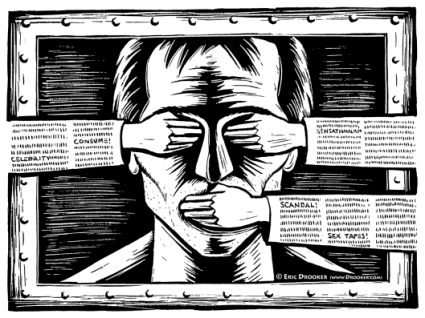
On PC and Censorship: “Why This Radical Leftist is Disillusioned by Leftist Culture”


credit: blog.baladi.com
 

I like this essay, succinct and vehement about non-censorship, two qualities I cherish. As a college instructor and mother of two socio-politically conscious teenagers, I flinch at shutting anyone out, up or off. My job as teacher and mother is to foster thinking and feed young people a steady diet of food for thought. Censorship directly conflicts with those efforts whether the censor’s intent is benevolent or malignant. 

Most censors simply want to craft a world better conforming to their own comfort level, and many believe protecting the sensibilities and exposure to harm of the vulnerable–children, the wounded, or ill–outweighs prohibiting thoughts/words/symbols of the able, a seemingly charitable and compassionate endeavor. But though well-intentioned, intolerance and censorship buds from the well-meaning as well as the malicious, and from the right and the left, the latter with their pretensions of superior tolerance, disregarding opinions of others on the grounds of sensitivity, i.e., controlling words that hurt others’ feelings or trigger traumatic memories, is no less intolerant and censorship than right wing fascists trying to outlaw the words “global warming.”

Noam Chomsky and Bailey Lamon, who quotes Chomsky in “Why this Radical Leftist is Disillusioned by Leftist Culture”, say it best:

“If we don’t believe in freedom of expression for people we despise, we don’t believe in it at all.”

Encouraging my children to seek the heights of compassion and sensitivity respecting others’ sensibilities somehow ran aground when they interpreted that as outshouting or blocking others they deem insensitive on social media, or even in real life. One of my daughters quit her boyfriend over his disbelief that a disproportionate number of African Americans are incarcerated in America. 

They, like their peers, go too far. And like Lamon concedes, no one advocates racism and bigotry as acceptable. But opinions should not be feared and those who differ shunned just because they are not leftist-approved. 

History, something few college kids remember, teaches us that freedom of speech is the very embodiment of U.S. suffering, rebellion and founding ideals. Better to hurt someone’s feelings than give up that battled-for right.  

Happy National Sticky Bun Day!

  
Whoa, almost missed it. So glad I could sneak in before day’s end and wish everyone a happy national sticky bun day.

Not sure why I check what the nation is honoring on any given day from time to time, but sometimes it really pays off in amusement, inspiration, curiosity and bafflement. Who comes up with these days?

Apparently I am not the only one to wonder:
 
There are random and off-beat national days almost every day of the year. This prompted one of our podcast listeners, Katie Rowles, to send a question all the way from Australia for our series, “I’ve Always Wondered.” How do these days get declared? Who’s in charge of the list of days?
We start with International Talk Like a Pirate Day, one of the days Katie mentioned in her question. It’s celebrated across YouTube each September 19, and it turns out a couple of guys declared the day a few years ago because, well, they’re fond of talking like pirates…
“Because once you say something, it’s out there, you can’t call it back,” he says. Carnell submitted his idea back in 2006 to Chase’s, the yearly almanac that acts as a sort of loose gatekeeper for national days and months.
But not all national days are listed in Chase’s — the more extensive resource is the website nationaldaycalendar.com.
“There’s a couple ways it can happen,” says the site’s co-founder, Marlo Anderson. “Of course, a company or an individual can just declare it, and a lot of people do.”
Point being, really anyone can make up a national day, and there’s no accreditation process or government agency. Though Anderson says they don’t approve just any old day that comes across their desk.
“In the last year we’ve received over 10,000 requests for national days,” he says.
Out of the 10,000, he says they typically take about 20 to 25 days each year. They’ll focus on iconic items over brands — say, National Coffee Day as opposed to National Starbucks Day (which, as far as we know, hasn’t been declared). And they look for things everyone can enjoy or be a part of.
The most common request they say no to?
“You know, it’s my girlfriend of three months and she’s changed my life forever, can I have National Heather Day … that’s a very very popular thing,” Anderson says.
But most of these national days are recent inventions that have spread around on social media. As far as we can tell, only one of the June 1 celebrations goes back to before the internet: National Heimlich Maneuver Day.
“I do not know who wrote the article on it that made it come about,” says Dr. Henry Heimlich. He’s 95 and living in Cincinnati. Heimlich published an article about his life-saving maneuver on June 1, 1974. “Immediately lives were being saved.”
At some point, a day was declared, though he’s not sure exactly how. Heimlich is pretty amused to learn that he’s now competing with National Hazelnut Cake Day.
“I guess people could choke on that too,” Heimlich says, laughing.
Well, hazelnut cake might not be for everyone, but it’s your day — go celebrate! Take off your shoes, say something nice, help out a choking neighbor, and meanwhile, start polishing up on talking like a pirate.

(See marketplace.org)

I have a few suggestions: National string up your cat day, or pick a fight with your relative days. What about pick a random presidential candidate day or plain old honor the stupid day? Recognizable, noteworthy and celebratory, my entries ought to win the day.

Umberto Eco

  
“I have come to believe that the whole world is an enigma, a harmless enigma that is made terrible by our own mad attempt to interpret it as though it had an underlying truth.” 

― Umberto Eco, Foucault’s Pendulum

I first learned of Eco after reading The Name of the Rose in graduate school, though I cannot remember whether it was the first round in 89 or the second in 2003. I saw the movie of the same name and cannot remember whether I saw it before reading the book or vice versa. I do know I enjoyed both immensely, so much so that I read a second book, the one from which the above quote comes, which I also enjoyed, though I believed that the text was far more about the title namesake than it was before reading it. I had read Michel Foucault, who I found as intriguing as mystifying, so naturally was drawn to the title. 

The text, like all Eco works, is complex and dense with plot and erudite history, lore and textual references–not your read on the beach in paradise. Eco demands you grapple. And while many details of both books I read are long forgotten, the words and specific scenes remain etched in the beautiful keepsakes section of my brain.

Like many faithful readers, I seek treasure–that unique turn of phrase or universal truth that hangs with me, bubbled to the surface when I need a lift, a reason or insight. Countless times the belief in mystery became and becomes my mantra. Some people often sigh, “It’s God’s will” when at a loss to explain the inexplicable and I just as often say, “Bow to the mystery.” Though both signal surrender, one does far less resignedly. 

That the “world is an enigma” satisfies, becalms and relieves humans of the burden of making sense of chaos and that which we cannot understand due to the size of our brains, undiscovered truths or components necessary to solving riddles, or both–or neither. That we madly “attempt to interpret” the world smacks of vanity or fruitlessness but not necessarily. Human’s drive to know, to understand and control is itself an enigma, one with benign origins though sometimes malignant intent or results. 

This quote counters another oft-pronounced snippet pulled out of pocket at the cause-effect chain’s logical end with no solution: “Everything happens for a reason.” Eco obviously disagreed and wrote legions against that idea, wracking ordered plots with disordered interferences from magic, evil intent, human contaminants and other messy interlocutors, all in historically altered (small and large) and imagined context. 

One thinker, writer and human I mourn, Umberto Eco died yesterday, a significant loss or gain for the mystery.

Level and Plumb


When the leaves blow

and coffee spills, cup atilt,

slosh goggle floored, splayed 

legs out wide like a downed 

ballerina, stunningly embarrassed, 

pictures hang askew, traffic piles

up, coincidental clash meetings

arise, and all goes awry, topsy

spinning turvy, electrified.
 

But if you plant your feet firmly,

tilt your head just so, right the

angle (forget the level and the 

plumb), bend to slanting, twist 

around dead center, steady and

strong, new perspective threatens

comfort yet tickles a notion clear–

if you let the turning in–

that all you held confirmed,

earth bound solid, statically 

removed, churns, burns and grinds

a new plateau, status quo evenly

spread, awaiting dissipation and 

drip-lye transformation. 

Change. 

The Last Night Shift?

  
It’s a Thursday night at the sugar shack, quiet 

for the 5 to 7 hours, slow enough for me to 

inventory, tidy and re-stock. 

The day shift rarely covers all.

Like a morsel left for Elijah, the day shift–

my daughter, in fact–left me chores to do

like cutting up strawberries, cleaning up

counters coated sticky caramel or fudge, cherry

juice or chopped Reese’s peanut butter cups

dust, among the other jobs of smiling, wiping,

re-filling, lifting, swiping, shifting, and money-

tending, motions threaded into my days and

nights lo these past two years, 20 to 40 hours

a week, after the class room or with the lap top.
 

Thursday night, like most other nights of the

week brings in the small, smartly dressed 

woman who does not like people, especially small

ones, their cackles and laughter reverberating

madly from tile floor to painted wood ceiling;

nor does she deign sanitary all those dotted

dried yogurt drips on the scale upon which

she weighs her nightly yogurt, always the same,

the half dozen or so rainbow pareils atop chocolate 

obsession (her froyo choice and aptly so)

a lid and a bag. I get it all ready for her once

I spy her entry. Anxiety riddles her face so 

that her smile forced comfort in my familiar 

face transforms her, cracking ice panes.

She warms to me; I know her tics and peeves.
 

Following nervous Nelly, affectionately dubbed,

enter the Thursday night family four just out of 

church (there are three nearby churches) who

each ask in turn, “Is there whipped cream tonight?”

We make it fresh here, liquid cream and the nitrous

oxide I am often tempted to inhale on especially

dreary nights of “what am I doing here and how 

will I bear another menial, meaningless night?”

Until mop dancing, when all seems to flow, tears

and motion, two-stepping and sludgery, the end

near, a night almost over, near complete.
 

When then arrives the female version of 

SpongeBob who plops down 16 dollars of

yogurt and toppings while complaining of 

stomach pains, a gone gallbladder and 

a boyfriend who does not even deserve the

two chocolate chip cookies she adds to her order.

“He’s so mean,” she says, shaking her head 

so that the just-put-it-up-any-which-way bun

flops side to side, loose and threatening to fall.
 

Her appearance sparks a laugh and a text to 

my day shift counterpart–my daughter–

who earlier remarked that she hadn’t seen quart-lady

lately and wondered if she was all right.

Quart lady once complained the tart machine freezes

up, protested so fervently about its unavailability

since tart was the only flavor she could eat, 

given her gall bladder problems, prompting me

to move tart two machines down, thinking of her ire,

and when I proudly showed her on her next visit

the new location, which she herself suggested, she

smiled and promptly filled her cup with dulce de leche.
 

“Remember that lady made such a stink and then 

didn’t even get tart after all?” my daughter laughed

just today, this afternoon, at our passing of the baton,

shift change. She too has loved and hated the job.
 

And just yesterday, the young, energetic blonde with

savings, ready to own something (his girlfriend aside),

with his queries and interrogations–“What is your favorite

flavor? And how do you like working here? And which is 

the most popular items in the store? And which machines

are your favorite?”–may be, perhaps, looks like, and so if

he really does want to buy the store, what then?
 

 This job, a helping hand and gift after a bad life trip and fall,

a stop on recovery’s road, for which I thank cousins and sweets

and sweet cousins, father and son, and daughters,

and all who seek comfort in colorful swirls and turrets, 

gems and decor, sugar coated and sugar free, reward and 

punishment for all those bodies small, square, squat, thin,

lanky, lean, old, young and in between that have passed

through and paved my practiced presence, order, patience 

and humility these last couple years, sometimes failing at all 

or some, sometimes succeeding at all, some or none.

These sentimental seeds I sprinkle like rainbow and chocolate

on a quiet Thursday night’s spurring these 

final thoughts, final words and future memories.

Bee Heists


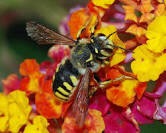
It is not enough that bees are vanishing: sick, stressed, overworked or poisoned. No one source of colony collapse and disappearing bees can be pinpointed by consensus. Now, due to vanishing supply but unrelenting demand, bee hives are the latest coveted commodities to steal. 

The Washington Post reports in As bees vanish, bee heists multiply the following:

The bee economy in California is immense. Eighty-two percent of the world’s almonds are produced within a 400-mile stretch in the state. There are hundreds of thousands of acres of un-gated almond orchards in California, all of which need to be pollinated in the span of a few weeks in February — by an ever-dwindling bee population. Beekeepers come in from across the country to fulfill contracts with farmers and brokers, moving hives to and fro on forklifts and flatbed trucks. And they come with a steep price that’s getting steeper every year.

At the start of pollination season in 2010, the average hive cost $130 to rent. Rental fees are $200 this year, and will continue going up as hives continue to die off. The industry is becoming increasingly volatile, increasingly expensive and thus, increasingly criminalized.
 
Bee keepers forego income most of the year, banking on readying themselves for payday when the season arrives. When their hives are stolen, they cannot recoup their losses and despite the article’s keen detective (a beekeeper himself) on the trail of these thieves, few of these crimes get solved. This business runs on slim profit margins, so keepers are unlikely to break tradition and invest a whole lot on gps and other tracking, stamping and registering technologies. 

The answer lies in saving the bees, not in tracking and imprisoning the criminals (though that too should happen). Finding the cause(s) of the bee scarcity to eliminate roots out the entire chain of victims and perpetrators. Banning known pesticides that weaken, confuse and/or blind (mutes sense of smell) bees, breaking down colonies and affecting bee populations seems like a logical start–globally. 

Investment in and cultivation of local beekeeping so that a variety of bee species thrive rather than feeding traditional worker bees like honey bees on intense single crop diets, i.e., all almonds or fruit trees, is another solution. Keeping local native bees to pollinate a variety of local crops has been known to grow bee populations

Bees are responsible for over 75% of our food supply. I am baffled why more attention, funding and efforts are not thrown at their plight. The bees’ lament is our own: industrialized agricultural production is killing us. We are too far from nature, mother and human.

Two Years


Two years ago, life was as different as it was the same as it is now. While so much has changed, not much has either:

Two years ago, my mother could speak and recognize me fairly often. She does neither now, or rarely. But she is still here.

And both daughters were in high school then, the older just having turned 18, a senior and the younger a freshman. They both played soccer for their school, which took up much of our time between playing, attending and enjoying games, volunteering and fundraising, etc. Now neither does. One left home and came back. The other continues on without and now with her sister. We spend time doing other things now, like talking in coffee shops, shopping, bookstore browsing and eating. Sisters are still sisters, daughters, daughters.

And about that same time, I was teaching six classes and running–and not just exercising. Too busy to think about anything. Two years later, I teach two classes and refuse to run.

People have moved in and out of my life yet somehow all still remain, though the live connections grow more tenuous and infrequent. 

Stronger, thinner, and lighter then but calmer, wiser, and slower now, I am, all for the better and worse, in just a matter of days, weeks and two years.

Two years ago I started this blog with no other intention than to write, no expectations. That has not changed. And though WordPress reports hundreds and thousands of posts and views and followers attributed to this blog, which has grown in words, mine, yours, and others’, the daily writing discipline over the months has not changed–I write. 

I am still happy then as now to have shared words for all eyes who have cared to read–and am grateful for any morsel of insight, amusement, pleasure or education I may have bestowed upon a passerby here; touching another is the aim and hope. 

Peace and blessings.

Thank you,

Gaze    

Dayenu

  
Just like any other mother, naturally I did not want to make even minor let alone crippling mistakes in child rearing. So when it came down to the uncomfortable decisions that arose daily as my children grew, I examined my own childhood to weed out the unwanted inheritances. 

While I had an unremarkable childhood, pleasantly healthy and largely uneventful (a good thing), there are certain cultural traditions I would have eliminated. In hindsight, I wish I was mollified less and respected more as a child. I had a great need to be seen, not for attention (though that too probably) as much as for recognition of what I was capable. As the middle child of five, that was my specific plight–invisibility. I did not feel unloved, just unrecognized.

I bristled at statements like, “Oh you’ll understand when you’re older” to my exasperation at illogical or unfair reasons or causes, for example, why my father was allowed to call my mother mean names while she served him hand and foot. She was right. I would not understand then the subtleties of relationships, but I wanted someone to try me nevertheless, see if I could grasp complexities. I wanted honesty and direct explanation. Still do.

So when it came to decisions my husband and I made about imaginary beings like the tooth fairy and Santa Claus, I was adamant that we not build a relationship of lies at the outset. I did give in, however, to the argument that kids thrive on fun, and these fantasies were fun. Also, I did get to explain to my now mostly adult children what I wanted for them and the reasons for our decision to build their reality in the way we did.

So much in childhood goes unexplained and we blindly carry pieces of childhood with us, never examining them, never even looking at them, just wearing them like skin. Memories, information, habits and beliefs are all carried without notice. One battle I won is the one for deferring religion until a time the children grew old enough to choose. Religion is inherited for most of us. My children have since thanked me for giving them that option to decide for themselves.

I was raised Jewish, a culture more than a religion. Seder songs and Chanukah rituals patterned my days and years, just as a sliver of them pattern my own children’s life. While I did not pass down ritual, I did my part for the economy by indoctrinating them in the gift-giving commercial holidays like Chanukah with its alluring candle-lit solemnity and awe, and Christmas with its bright celebratory colors and good will. They knew when the getting was going to be good, counting the days to a secular consumption feast.

One song I know from my own childhood as well as candle-lit menorahs, Chanukah gifts and chicken soup was Dayenu, the passover song. Passover was not a fun holiday until after the ceremony, requiring young children to sit for far too long at a table where unintelligible words and actions played out, mystifying and boring. Until the singing of dayenu, a catchy tune that signaled eating and then running off with cousins to play.

Forty-five some odd years later, on this very day, I learned the meaning of this Hebrew word. Not that I was curious and looked it up out of the blue. No, it happened by chance. Last night I enjoyed a Valentine’s Day dinner on a stool at a local bar around the corner. I had a long day slinging sweets at the shop and craved a beer. So, while in the throes of feel-good satiety (seafood soup and roasted artichoke) and a slight buzz, I looked to the words written over the entry to the establishment, which read,  “if you are lucky enough to drink wine by the sea, you are lucky enough.”

I raised my glass to the thought and the written words and did what anyone would do: I posted a bastardized version of it to fit my current circumstances–drinking an IPA–on Facebook: “Drinking an IPA by the sea. It is enough.” The next morning’s comment from a friend was “dayenu.” After lamely asking if the word was the name of a beer as well as a song, I googled the word before receiving a response only to find the word means something like “it is enough.” 

Who knew? I obviously did not. While this may be a case of syncronicity, kismet or mere coincidence (no major planetary alignment), it should remind and caution all of us of an interesting psychological and cultural phenomenon: we are products of much we do not understand or even think about. 

And this I have often argued is how racists and bigots form most often: through mindless heredity, unthinking but powerfully instilled. This is how a culture perpetuates–unknowing, unheard, and undetected. We do not know why we know what we know or do what we do, unless we make the effort to understand, observe and mind. How else do we make changes local and global?

It is obvious from the wacky state of U.S. politics this election season that Americans hunger for drastic change and reject the mindless status quo business as usual, regardless of the wisdom or catalyst of that change: Trump the savior or Sanders the socialist, if you believe campaign rhetoric and vitriol. But this hunger is good. Feeding automatic feel-good responses, age-old prejudices and knee-jerk reactions dredged in a rotten history of exclusion, bigotry and fearmongering is not. We must examine where our frustrations and reactions derive. Are they mere mimicry? inborn? calculated? truth? Riotous urges to shout and defy are necessary sometimes but not without mindfulness. Otherwise, we are mere primates.

Being vigorously and mindfully curious, now that is enough.
 

There is no Word 


A word run rough shod over

centuries long rendering it

nearly vacuous, the emotion

contained within reduced to 

pithy sayings and pathetic poems,

some I have penned myself,

and pretty memes inspiring

less than more by over exposure,

how can this word be explained,

described and painted accurately?

Perhaps a paragraph filled with

affectionate acts is enough:

a driver slamming the brakes

screeching at a near miss cat kill, or

the 80 year old’s collapse at his sixty

year marriage’s cease upon awakening

to his wife’s motionless body, or

the wide open daddy arms anticipating

embrace at the first steps’ trail’s end?

Too Hallmark, Facebook sentimental?

What about soldiers or police officers

arm in arm in solidarity, peril-pals

undying, or prom dates in wide grins,

shy shoulder-slumped and side glance

photos or sunset hand-holding clips

or tears and aching hearts and darkness

as corollary preceded by its inverse,

heart-pounding, heady ecstasy-like

near nausea and enervating hysterical

joy found only in the scent, touch and

sound of the key to a lock match tight,

the yes to the life-long approval sought?

Too banal, trite, common, overblown?

Try this:

What is the square root of a 24-hour

day that begins in darkness with a howl,

signaling the death knell to the dying wish

of a martyr–just one more hour’s peaceful

sleep–a howl that electrocutes nerve

endings everwhere, that only patient 

tender care will quiet a defenseless being

suckling, emitting the sweet aromas of

new warmth baking mother’s milk like 

raisin toast popping sweet and savory,

and a once eyes-for-only lover cum

zombie escaping grey-eyed and sallow

briefcase in hand out the door shut-grunt

leaving only wispy cool air in a dim den’s

stale morning stuffy exhausted eye-burn,

bone-weary sympathy for the life made

and lived now, nostalgia and hope stew 

simmering on the stove daily, all repeat,

all gone now the glimmering show in 

new leather pumps price-tag clicking 

and tailored skirts tucking in silk blouses

hanging dusty in closed closets blear-eyes

catatonically fix on blindly automatonic as

day ends where it began, only now the 

briefcase rests against the chair close

to the snores emitted from the dead man’s

sleep craved more than the man who

made this life leaked out exhaled in the

other’s breath and yours, theirs, ours hourly,

daily, yearly and ever so in smiles and frowns,

razored sight and heart, grim boredom and

coffee steam morning’s quiet contentment

and grasping an idea finally that endings

and beginnings are the same and conclusions

are illusions and passion is stillness while 

death has always meant living, the chaos of

it the only order ever it was, patterning 

a day-long life? The square root of it.

That, my dear, generates, defines and

encapsulates the engine and caboose.
 

Happy pledge, notice and honor to what makes us, us.