The Teacher


A soft touch and a hard hand, the teacher speaks in incantations, dronings of esoterica to mystify and satisfy his own urges to expel. Behind office hour doors he is hand full of slick hair clutched at the scalp mummified despair leaving its traces along the spiked tufts that resist gravity’s pull to his ears, one of which is pierced with a diamond stud. Only a knock, a student’s hand, a backward glance or a shy inquiry can shift his mood. His smile smeared on with putty lips, he ogles the words typed for him, pausing long over an improper punctuation or diction switch up. His eyes’ return are shuttered behind thick dark lashes that paint his pupils dark, the velvet of brown specked with black and stroked with soft charcoal malleable leniency and persuasion. The burning does not show. The coursing rage racing up the alleys of his cortisol-laden cerebral landscape, pathways to his libidinal longings for a leg, the hem of a skirt, a bite in the pen cap, tongue caressing the indentation, remains repressed against his spine, thrust shut in his pelvic dance of storming scribblings in marker red, furiously punctilious and benignly compliant. He is grade A swallowed fear in disgust, disguised as propitious transitioning. Everyone passes through and by the teacher while he remains, steady like the axis of a planet, a cross road or dawn’s return.

The Ache of Decay: a Eulogy for a Friend


Though you have softly haunted me in the last 37 years,
your disappearance a mystery and logical consequence 
at the same time, last night you pulled me aground to you
reaching out with a bony grasp I could not escape to run
just as you did on your very last day when evil found you
a fair haired lovely of kind eyes and dulled senses drifting.


Why did no one know your name to pin a tag to your toe?
Where were your broken hearted mother and brothers?
The 70s dichotomy, full of marauding psychotics and love
free spirits and walking malignant tumorous contagion too.
I had seen you last on Venice Beach sidling ocean waves
from a distance as we smoked and sang a freedom song.


All was light then and love searching, seeking–a dreaming.
No one could hold you down but what roots had you then?
Did you have a father and did your mother try to keep you?
I barely knew you as a latecomer to my hey day pre-parting.
Part of my flowering teenage society in full bloom just then,
I had to leave for another coast and on a whim you did too.


I remember you cooked enchiladas in a pan for us one day
and I had never eaten anything called Mexican food before.
My mouth burned, tentative tongue swimming in odd spices.
You brought the sun and a recipe home from your California.
You, who wore brown suede moccasin boots fringed in love,
a traveling spirit of unleashed, unending desire to live freely.


Restless and fiercely unleashed you were locked in impulse
and the lull of hazy high of whatever was passed your way.
No trace of fear or caution, you were a stretch for my wary.
You sat down to pilot life and enjoyed the height of clouds
while I was the lip biting pumping hearted passenger blind.
Like the wind you caught to fly, you passed on through me.


But today you seep in my bones and pinch my thoughts dry.
It could have been me or my daughters or sisters strangled
the hands of murderous savagery abysmally wide tentacled.
Insatiable lust for life you had matched his in mass murders.
A rover like you searching, seeking and finding youth’s sins
road-songs of impenetrable lightness against a dark’s deep.  


No one completes you, a part of the composite space-time.
A forever child will never know the truth of scarred wisdom
the full compendium peace of surrender that is not defeat
like we thought it was burning out not burning through it all.
A chip of the cosmos, all we ever were and will be for now
I know you sign the silent words to me in my restless sleep.


Your human traces tattoo synaptic sheathed memory’s skin
recombinatory particulate ossified bone and detrital kindred
melding in minds where curiosity, fear and mortal angst sit.
Those who carry you bouyant as your spirit ever was and is
float a child’s bay abutting the seas of misfortune and strife
smiling liberation song’s perpetually moving feet of hunger.    


Remains do not matter, mere material remnants of a body,
a shell symbol of connection to a race of radical reactivity.
Bury you deep in soil of your mother that earth never held;
no soul or idea chained you to the moment of your making.
No touch of a hand or kiss on the nape of your neck stilled
spirit so wildly untethered attached only to windless decay.


Held in a life loss unspoken, unnamed too long unknown,
torch carrying family and friends, acquainted to a tragedy,
oh murderous mistress memory mine let her flee binding;
devotional clinging was never hers to believe such perqs.
Only mask rivulet stain of stony faces crusted in creases
wipe ache from ears of those who never heard her cries.

Derek Walcott ‘ s “Love on Love”

LOVE AFTER LOVE

image

The time will come
when, with elation,
you will greet yourself arriving
at your own door, in your own mirror,
and each will smile at the other’s welcome,
and say, sit here. Eat.
You will love again the stranger who was your self.
Give wine. Give bread. Give back your heart
to itself, to the stranger who has loved you

all your life, whom you ignored
for another, who knows you by heart.
Take down the love letters from the bookshelf,

the photographs, the desperate notes,
peel your own image from the mirror.
Sit. Feast on your life

Love is not a Rose but a Choice


The marriages that last are the ones in which the two members regularly develop (but do not act upon) extramarital infatuations.

I read that today in Maria Popova’s review of The Folded Clock: A Diary by Heidi Julavits in Brain Pickings. What is it about love’s excess that it cannot be contained in one person, for one person, that we need to spread its spillage on to still others and other things in so many shapes and forms? What is this thing that we toss at humans, materials and ideas indiscriminately? I love my children, my new car and Shakespeare’s sonnets with strength and passion and tenderness. Yes, the car too (when I had a new one). Love is the excess, the overflow, always needing outlet. We live in the throes of love. Anti-love is its darker side though no less derivative of love. 

This, of course, makes sense — we know that love is a mode of “interbeing” and a “dynamic interaction” in which the opportunity to choose each other over and over is what sustains the longevity of a couple’s bond.


Love is a choosing
not a rose so named
a choice of days
one which I choose 
and you choose
hopefully together
maybe the same day
to select you, me
as your moor and mate
coddle and cure
each day every day
when the mood strikes
smiting sense and pride
plucking at frayed seams
with disdainful eyes
yet believing still
in inversion’s conversion
a matter of mind
in the seeing eye
inside the skull
crossbones of ill
to parallel sides
arm in armed
concave to convex
a tilt of the head
changing the slant
of the inner sight
so that you see
me seeing you
we two knowing
hearing the sign
buzzing our nerves
caring as showing
inside out wearing
learning unlearned
a parent’s sharing
poking a shoulder
warning a glance
ruling an unruly mind
guilt and pain aside
teaching an oath
swearing a lesson
picking a courtesy
bowing a head
in shame we learn
in obedience we sit
before a flag and stares
the history of living
the meaning of love
the trick of getting by
love is learned 
and then unlearned
and truly it is
the equation of love
I love you and me
I understand me
understanding you
since love is this
this understanding
that to love so
is to love me 
loving me
loving you
who are all
of us.

Happy Anniversary!

Here’s to delightful surprises! May your lives be full of them.
 
A toast of good cheer I have made many times, sober or not, today I toast a special anniversary–mine.
 
I married my charming good friend 35 years ago. I loved him then, one of a couple of jackass kids we were back in 1980. Flippantly striding through college campus defying accepted authority and unearthing sacred ground, we were irreverently youthful. So when he asked me to marry him for a practical solution to an impractical problem of late registration and the French military, I did. After all, he was my good friend-sometimes lover. I did love him.


To this day I am unsure of the depth of our love–even if he loved me–to what degree or intensity. It did not matter. We galavanted through the crazy years together as a pair. And when my car blew up and my job went south, I moved in with him, only to move out nine years later and then move back in 6 years after that. 


To our sometimes amazement, sometimes knowing nod, we have lasted this long together, through the soaring and sinking. To our surprise, we built and destroyed things together without destroying each other. To no one’s surprise, we have tried our best to be good friends, lovers, parents, children, siblings, friends and citizens of the local and larger world we inhabit. 


Even more surprising than our lasting is our having met in the first place. What were the chances that we would meet at Golden West College in Mrs. Strauss’ World Literature class and start a conversation, me, who never initiated conversations with anyone, whispering that first opening line: “Where’re you from?”


I was an awkward, self-conscious, earth-shoe-wearing 18 year old poor student with visions of backpacking through Europe some day and a sucker for an accent, while he was a suave, self-assured, French-accented European of means with a late 70’s expensive shoulder-length haircut, collar-less shirt and American boorishness critique. We were caricatures of Romantics–righteous anger, cynical disdain and ironic amusement–back then.  


When I married him, I was aware his eyes turned for delicate boned petite beauties with eyes the color of the sea set in sand-polished skin while I adored tall, dark-haired brown-skinned rugged bad boys who seldom smiled. I was a tall, clunky hippy, a brown-eyed brunette with freckles who hugged her knees into her chest while conversing in wild waves of gesticulating hands. He was fair-haired, small-framed metro with polite manners and a sense of decorum. 


Somehow we found our meeting. Somehow we have survived the mountain of small frictions of daily living atop the chasm of disappointment, misunderstanding and alienation that one human being can produce in another. Steadiness steered us through the rocket ride up and back as it does now.  


We share a steadiness, a vibration like the P wave of the electrocardiogram, where the spikes are measured against the dips to tell the story of a heart’s patterns and rhythm. Call it history, maturation, transcendence, or regeneration like severed nerve endings in the brain organically reaching out and reconnecting, we share a communal past and an ongoing present. We grew up together.
 
To my daily delight, we survive days that lapse into years. We co-exist, unconsciously in each other’s often silent presence puppeteering the motions and emotions of two people conducting a marriage, a family, and a life as we wander through moments, sometimes colliding, clashing and crashing, other times melding and mooring, uplifting upon the same softly rocking sea of a cul de sac world we look out to sitting on our lawn chairs in the sunny warmth bathing our suburban front porch.
 
There is peace in constancy. I am surprised to write that, me, whose constant throughout my kick-ass twenties and thirties was the belief that contentment was a fate worse than death, a killer of creativity and therefore life. Without the itch, the striving, I thought, there was only collapse into the hum of the daily, the numbing hum of contentment. But constancy is not always contentment. 
 
The average, the mean and the median are constants, not so much as compromise but as perspective. The sum total of existence is the graph of heart palpitating thrills of victory measured against the torpor of stultifying loss. Quality of life, in retrospect, is calculated by that range of emotion, the depth of terror and rage against ecstasy and bliss. My husband-partner-mate and I have reached, stretched the limits together, and so have bonded, grown neurological tendrils of connections in the doing.
 
And we stumble over and with each other still, amazed that we awaken to yet another shared morning, that we grew two healthy, happy humans despite ourselves and manage to move through time and space as we do–mindlessly mindful of the beat that syncs us, he sometimes the high and me the low while other times he the wide and me the far. Wondrously, unexpectedly, we make it–together.
 
Happy Anniversary, to you who will not read this tribute to endurance. If you did, however, you would find in this lovely duet, a surprise akin to our own song. Cheers!

The Art of Becoming the Latest Me

“Your perspective on life comes from the cage you were held captive in.” 
― Shannon L. Alder

  
credit: upload.wikimedia.org

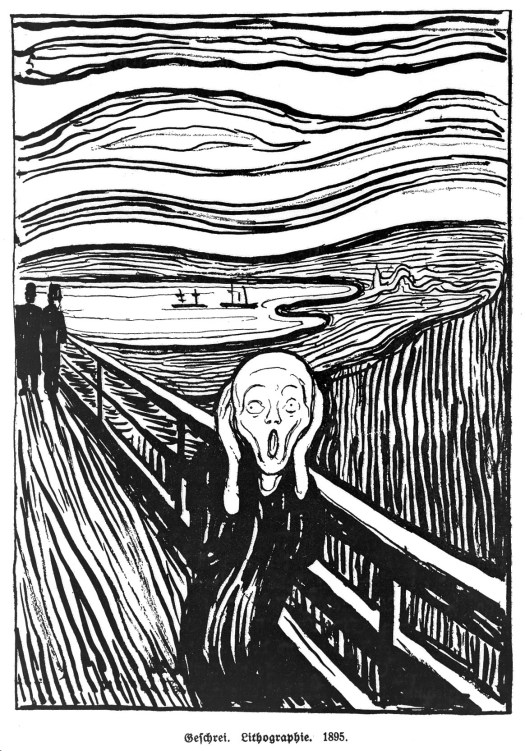
Pure sound, entirely un-mattered, 

voice and air I was, intoned grief
laughter inverted all-in deranged
9th dimensional twisted despair 
shattered lines in flecked powder
bruised cilial cringe at the edges
ears only producing me, my being.

The howl I had become was vast
as wide as a woman’s crumbling
cry thro’ ancestry pierced endless
millennial fear of falling in losing out.

Coming undone, not always so sexy
by another’s fullness, sentient sea, 
the wailingly frothy palpable spume 
when the other subsumes, absorbs
light and time, screams in unfolding.

When I disintegrated, a pupil mirror,
you witnessed naked sound as sign
death knelled body downed into dust
no thud when the shrieks hit ground.

You hold me now, recombined anew,
not in tubes of echo or image’s flash
the grimace of dying inside etched in,
but in re-sight devoid of formed words,
broken past filtered through particles
ionic and clear, trampled and repaired
in memory as manifest born, a human
with skin sensate to the pelted stones
now mere flesh weighted walking on
descended far from aural awakening.

The Beauty Myth–Think About it.

  
While I’m in favor of encouraging women to feel confident and happy, I worry that today’s body positivity focuses too much on affirming beauty and not enough on deconstructing its necessity. Spreading a message that everyone is beautiful reinforces the underlying assumption that beauty matters.


So writes Lindsay King Miller in Taking Beauty Out of Body Positivity. While she lauds the ever inclusive embracing of all female body types, she believes that reinforcing beauty as a value criterion is detrimental. She discusses what “body positivists,” those trying to change the accepted notions of beauty, are currently doing to change current conceptions but cites the dichotomy of beautiful versus ugly as problematic to such a cause, how beauty always implicates ugly. Ultimately, however, she finds the expansion of beauty beyond Victoria’s Secrets models refreshing, and as a mother of two teenage daughters, so do I.


Raising girls in 21st Century America is complicated. Raising girls probably has always been complicated, but in this world of consciously and commercially reinforced stereotypes about body imagery, where young girls are vulnerable to the obsessive compulsion to conform to culturally dictated beauty standards, it is particularly troublesome. 


Unquestionably, there is too much emphasis on the female body as artifact of beauty and sexuality. It is also undeniable that many walk the earth unconscious of their inherited values and aesthetics, what culture has produced in them:  their tastes, predispositions and prejudices. Historically, women have been treated poorly as citizen bodies, practically erased representationally in the arts, for instance (See Syreeta McFadden’s The lack of female genitals on statues seems thoughtless until you see it repeated). So women grow up in a vacuum of realistic body portrayals to challenge social “norms.”


In my early mothering years, I didn’t want to raise two daughters without at least attempting to defy norms. When they were little, I bristled at the pink and purple princess culture vulturing girls on commercial television, so I attempted to shelter them, feeding them a steady diet of commercial-free Public Broadcasting educational television. However, living smack dab in the suburbs of Southern California, I found I could not blind them to imagery that I did not agree with or even downright feared. And though I wanted to run counter culture, I was actually driving home the very ideas I wanted to avoid. 


I knew what I vociferously avoided would be the very thing to lure my children. By avoiding princesses, I was drawing the curiosity of princess-dom to two children not living in isolation but among blossoming princesses.


So I decided the best tact was to expose them to all that I believed would indoctrinate them, commercial television and radio, the internet, Justice clothing store ads and other girly-centered media, and then use the exposure as opportunities to discuss options and causes. 


I have always spoken to my children with words to make them reach rather than me sink. I would often remark that the store Justice was painted in colors that draw prebuscent girls of their age, pinks, purples and pastels, and then ask them who decided those were girl colors. They may not have understood the questions then, but now as teenagers, they are vocal feminists and advocates for the non-conformists, especially defying normative behaviors expected of them as women. Their dress and actions do not always affirm their words, but there is a consciousness of the conspiracy that captivates their style impulses.


I remember the trickiest issue of parenting two girls was body referencing and diet. To tackle the thorny body image issue, I steered them early from identifying anyone by body type or parts, skin color or size. I modeled pointing someone out by location, i.e., that guy in jeans and a tee shirt next to the cereal boxes–not by body traits–that tall white dude down there, explaining that no one wants to be identified by something that marks them at birth, something they did not choose. I thought it was the clearest path to disassociating their body as their only avenue of identity–at least as a starting point. Of course it was more complicated than that.


Before my children could think and prefer, I had them enrolled in classes:  art, dance, gymnastics, soccer, science, theater and whatever else I thought would expose them to opportunities and practice habits and hobbies healthy for them, a path to learning. It was no surprise that two daughters of a soccer playing mom would love soccer. 


With soccer they learned about their bodies’ needs, dietary, sleep and exercising. It was a no brainer to let them eat a begged-for donut before a game and then ask them how they felt during the game compared to say a pre-game banana with peanut butter. They figured it out. They also learned about competition and their bodies, fueling for better performance. We never talked about their diet but fueling choices. We talked about what they ate as promoters of good feeling and health, not body shape.


As a result, neither have been overheard to speak of one another’s weight when the taunting insults fly in their daily needling and razz-rationing. I don’t know what they say when I am not around, but I suspect they rarely judge beauty on the basis of weight, at least. I have witnessed their scolding their peers for doing so.


When they were young, my message about body-intensive focus would be lost, I feared, in a society that prizes beauty as exceptional whether the craze is body shape svelte or zoftig, Twiggy or Marilyn Monroe. The tidal wave of social stigma was too forceful, I thought. They would find out winning the lottery of a culture’s beauty award, one has to have the right metabolism and bone structure, the right chromosomal admixture. One has to measure the self against others on arbitrary dice rolls of anatomy. I desperately wanted them to understand that where body beauty is often the goal for young women, intrinsically achievable happiness is sidestepped or forsaken.


I’m troubled with using “beauty” as a synonym for feeling valuable and powerful and magnificent. It’s not far removed from nominally inspiring, but ultimately shallow, slogans like “Confidence is sexy” and “Nothing is more attractive than happiness” that treat emotional well-being as an accessory. I seek happiness because it feels good, not because it makes my hair shinier. Happiness, confidence, self-esteem—these things should be ends, not means.


Yes, and so how do we teach our daughters about the relationship of beauty and happiness, ends and means? How do we keep the word in our vocabulary without having it used as a weapon or a criterion for worth?


It is not enough to say that “everyone is beautiful in their own way,” to quote an insipid, grammatically inferior Ray Stevens’ song lyric. Some “body positivists” would have media drilling the empowerment of all body types into cultural consciousness.To do so, expands the definition beyond meaning, dilutes its aesthetic etymology and weakens it as a tool for evaluation of non-humans. Beauty is not merely in the eyes of the beholder as there are objective criteria for evaluating beautiful art or poetry, for instance.


Miller offers another conception:


Instead of insisting that beauty is necessary for everyone, more body-positive activists are working toward making beauty optional—something we can pursue if it matters to us, but also something we can have full and satisfying lives without. We should affirm our bodies for what they can do, how they can feel, the tribulations they’ve survived, and the amazing minds they carry around, without having to first justify their existence by looking pretty.


This is not merely a manifesto for those perceived as old and ugly to feel better about themselves. It takes a body fullness that does not need outward validation, a self-sufficiency that manifests contentment and dispassionate awareness of cultural tagging. Critical thinking skills help to distinguish self from selling, what is sold to and through women.


Whether or not I have succeeded as a parent in a myriad of ways from teaching them to clean up after themselves to balancing a bank account, I have given it my all to encourage my children–all of them (daughters, nieces, nephews, students)–to think. And why I love my careers as teacher, writer and mother–for the seemingly insignificant but wholly critical contribution I attempt daily at raising awareness, teaching analytical skills by which to destroy the inherited, constructed world. It’s the least this world citizen can do.

Marriage: the Conventional, the Unconventional and the Facts


credit: http://i2.wp.com (No, this is not my family; it’s just weirdly entertaining, kind of like my marriage)


April 19th is my wedding anniversary. In four days I will have been married 35 years–to the same man. Though we have an open marriage, enjoy physical intimacy no longer, I consider our marriage meaningful and committed. We have created and continue to raise two incredible human beings while caretaking two others safely through their twilight. Barring unforeseen calamities, including death, I see no reason for our marriage not to last.


Perhaps my years as a divorce attorney fueled the longevity of my marriage. Witness all day–so many days–to so much grief and acrimony, the willful and unwitting destruction of lives small and big, I avoided arguing when I came home at night. The running joke was always, “If we argue, I have to charge you,” while glancing down at my wrist to the non-existent watch timing billable hours. From clients to opposing attorneys, court clerks, and even my own staff, I was argued out by the time I got home and wanted conciliatory peace. And we did live peacefully in those days, most of our days, for the most part.

My marriage has not been without huge dips in the fairly steady, even road. There were times of grave disappointment and betrayal, cheating and lying, exasperatingly long periods of financial deficits and child rearing disparities. Though most of the big ticket items to tear at the seams of a marriage were little or non-issues for us–religion, in-laws and politics–there was still enough shared life to rend our lives into separate camps, feeling isolated and alone, the union itself contributing to that loneliness, for me anyhow. I confused belief in our couplehood, being on the same team, with sameness. I thought we should never be at odds to such an extent that we bring one another down.

Yes, we have laid each other low at times, blew out our ugliest selves at each other, guts a’spew, but we have also propped each other up, been the very scaffolding of each other’s lives at other times. My husband rescued me in my lowest days and shared in my greatest moments too. And I suppose that is the crux of it: we share history. The one thing that is nearly impossible to divorce is history. Observing hundreds of divorcing couples over the years, I believe that is deepest cut–slicing away the shared past. Many divorce tears shed are in mourning a communal past.

Concluding from my own marriage, those who can simply last–endure disappointment, suffer patiently and hope daily–are those who benefit most from marriage. My husband loathes change and I inherited blind optimism, which provides some of the glue of our togetherness. But apparently additional factors contribute to marital success or failure, according to Woman’s Day and its 10 Surprising Divorce Facts: parental influence, education, location, income, religion and age at marriage. 

If your parents’ marriage lasted, you’re college educated, enjoy a substantial income, are Catholic or Protestant and don’t live in Alabama, your marriage is likely to last, surprisingly. I have never lived in Alabama. My parents have been married for 61 years, which would explain my 35-year marriage but not my sisters’ three divorces between them, one of them having lasted only one year–twice. But it would explain my brother’s 29-year marriage, my one sister’s 23-year marriage before it went south, but not my still another sister’s never having been married yet in her 44th year.

So take it for what it’s worth, an “ah, that’s interesting” reading that may supply your ten minute coffee break with entertainment. This short fact list provoked in me a pondering over the definition of marriage: What makes a marriage? What makes a good marriage? Longevity certainly is not the litmus test for quality, though one might assume so. People can be unhappily married most of their lives. 

Trite as it seems, a good marriage consists of two people with realistic attitudes about the institution specifically and human beings generally. My marriage was a convenience in its inception but grew into the shapes it has taken over the years: love, family, loyalty, convention and the inverse of all of those too. Perhaps the lack of expectation going into it explains in part the “success” of my marriage. Unfulfilled expectations did not root itself in the initial contractual arrangement. Certainly they arose organically as my husband and I developed expectations over time. 

Perhaps it’s because we didn’t believe in the institution as much as we believed in each other. Marriage formulas or divorce statistics abound in the news and in the confines of counseling offices, but ultimately, the unique chemistry and conversing, the melding of two people’s lives, people harkening from separate beginnings, nature and nurture, are the core components of the mysterious making of a marriage. Each marriage rises and falls accordingly. Belaboring the obvious? Yep.