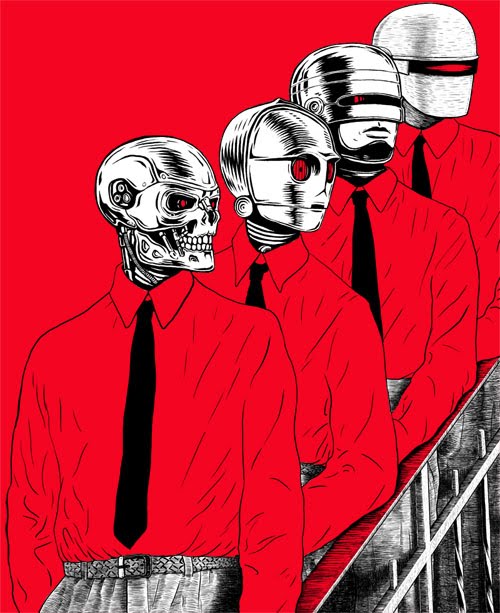
Helping Men be Men Despite Technology


credit: http://www.djfood.org/wp-content/uploads/2012/02/Men-Machines.jpg

…men usually have what they term “single-cue arousability”. Give a man the image of a pair of attractive breasts or a curvy backside and they are half-way to happiness, where women need multiple cues: they are aroused by men who are “attractive and nice to children and self-confident….

I have been wanting to read this text when I first came across the title and recognized the author for his previous studies. However, scanning a few reviews of a new book, Man (Dis)Connected: How Technology Has Sabotaged What it Means to be Male, and What Can be Done, by psychologist, Philip Zimbardo, who “argues that technology, online porn, gaming and sedentary jobs are causing terrible damage to the male psyche,” I cannot help but once again bemoan the insidious perpetuation of stereotypes that net individuals into the indoctrinating tidal wave of culturally predetermined roles.

While I am well aware that psychologists observe human behavior and make prognostications, the collateral effects of Zimbardo’s conclusions in his latest book, although an admirable contribution to the conversation of gender roles amidst social climate change, is to reinforce sedimented stereotypes. 

Zimbardo, known for his famously criticized Stanford Prison Experiments, asserts in his book that men are biologically susceptible to falter in a world that promotes less physical work, more sedentary entertainment and less in-person interaction due to technology. Male reliance on online gaming, dating, and pornography in addition to less physically demanding office work has socially retarded men and made them not only obese but ineffective as social beings. He also blames the shift in roles due to feminism as well as other social “ills” or challenges for men as The Telegraph’s Chris Moss summarizes.

It’s when you combine absent fathers, staying at home into early adulthood, video gaming, overreliance on internet porn, obesity (with its associated decline in testosterone and increase in oestrogen) and lack of physical activity, educational failure, joblessness and lack of opportunities for interaction – plus a women’s movement that continues to empower that gender and thrust positive female role models into economic and political arenas – that you have the makings of a screwed-up masculinity with all the wider social consequences that implies.

While I can appreciate Zimbardo’s work, my sensibilities are a bit ruffled at the suggestion that empowering women disempowers men and thereby ominously causes “social consequences” implied by that disempowerment. But why do the implications necessarily bode ill?  Intelligent, resilient men, of which there are plenty, certainly realize the freedom from sole breadwinner responsibility results not only in less pressure to perform and be their careers, but also more opportunity to develop other neglected skills and traits long scorned by social necessity due to inherited cultural predispositions. 

Just like the current shifted economy squeezes out old patterns of work formulas like the corporate career that ends in a gold watch retirement and forces individual innovation and creativity for survival, so too the breakdown in traditional role models can lead and has led to opportunities for growth emotionally and psychologically through the loss that naturally occurs in evolution. All transitions are an equation of cost and benefits, the pre and aftermath of change.

But the reiteration of steretypical male expectations to be physical and in control, and the remorse suggested in the loss of that attribute and power position, all bundled in a cause and effect legitimacy (we all trust cause and effect, right?), ominously confirms both the stereotypes and the doomsayers who look for feminism to blame for harming men. Pointing the finger at feminism, even as a co-contributor, couched in scientific clout–the psychologist–serves to confirm the current suspicions piled on feminism by some factions as harmful, a disturbance of a centuries old patriarchal order. For some, the byproduct fear and hatred results in injury to women. 

The country does not need any more binaries, dichotomies and polarization. Blaming feminism even under the guise of scientific observation does not help men. Bringing men the positive about change that has inevitably occurred and will continue to occur–technology and empowered women–benefits men. 

I am hopeful that when I read his text, Dr. Zimbardo will conclude his observations with helpful insights on how to help men adjust.

The Music of Ménage a Trois

In reality, it was an unusual but mutually agreeable menage a trois, whose intimacy is reflected in that extraordinary scene of the three of them, side by side in bed, sheltering from Hitler’s aerial bombardment.
Ursula was, in her own words, “fathoms deep in love”, but Williams told her he would never leave Adeline.

So she could only be the “icing on whatever cake he had, and not a disruptive influence”.

The fascinating story of poet Ursula Wood and British composer Ralph Vaughan Williams was the subject of news in 2007 when she died at age 96, having succeeded her once-lover-then-husband by 50 years. She was 38 years his junior when they met at her prompting. At the time, Vaughan Williams was married to Adeline Fisher, cousin of Virginia Woolf, and Ursula to Michael Wood, an officer in the British army. Ursula Wood’s fascination and passionate love at first sight for the composer not only flattered the composer’s naturally roving eye for pretty women, but fueled his dying spirit as caretaker for his inherently cool natured wife who was eventually rendered immobile by rheumatoid arthritis.

When Wood entered the composer’s life, it was not long before the affair between them started. Her presence at the Vaughan Williams household was first legitimated under the auspices as young assistant and caretaker, but Adeline was shrewd enough to be credited with knowing the score. Thus, the excerpt above, which is detailed in The Daily Mail’s article by John Bridcut, as depicting Wood holding the hands of both the composer and his wife during a raid in 1944 by Hitler’s army.


Indeed, on one occasion, Ralph and his wife and Ursula and her husband all met up at the opera for what must have been a most uncomfortable evening, particularly as the opera (Williams’s own Hugh The Drover) was a romantic story of rivals in love.

After Vaughan Williams’ death, then Ursula Vaughan Williams kept the affair discreetly within her memory until her death in 2007 at which time the details were revealed by her own desire to have the true story told. Wood’s biography of her husband also provided the basis of the documentary by Bridcut, released shortly after her death.

Though it is unknown how Adeline felt about the affair right under her nose, by all appearances, however, she tolerated her husband’s relationship most likely knowing that he was a man of passion that she herself could not reciprocate whether due to her own nature or her illness or both. So, it is not far fetched to assume that rather than lose her husband, she accommodated.

Of all three, the story of patience is the most magnificent human attribute fleshed from their ménage a trois: his for caring for the wife he vowed he would not leave despite his love for Ursula, Ursula’s patient caring for both while she longed to be with him, and Adeline’s patient endurance of the love affair right before her eyes that had to hurt. Of the three, I admire Adeline the most for her practical concession of her exclusive rights to her husband’s monogamy, whether that was calculating to her own advantage or wise and charitable love in consideration of her husband’s needs, or both. 

I have maintained before that the mistress role is not easily doffed off with vilified stereotypes of cheating and deception. Sometimes–oftentimes–it is far more complicated with subtleties that reveal the intricacies of human nature adapting to circumstances, a fascinating anthropological, psychological and sociological study.


Support Others Supporting Others: Infidelity Counseling Network Drive

  
Posted on Infidelity Counseling Network yesterday, Praveen Kumar’s Reasons Why Couple’s Cheat on Each Other in boldsky limitless living cites the statistic that ten percent of marriages are headed for divorce due to infidelity. Though unverified in the article, I don’t doubt that is true. Anecdotal evidence from my former practice conforms to that reality. Kumar goes on to state that most cheat before they separate and then lists the reasons for cheating in relationships: neglect, dissatisfaction and boredom, essentially. 

While these reasons are no revelation, some of the statements the author makes are rather surprising. For one, she distinguishes male from female patterns:

The cheating patterns of men tend to be a bit different than that of women. Some men would perceive cheating as just having fun outside the relationship.

And women don’t? I am curious as to the basis of the author’s conclusions. Which studies differentiate men and women’s cheating patterns on the basis of fun? Seems to me the validity of the article’s conclusions would be more compelling and interesting with some foundational support and less bias. In Kumar’s brief summation, men are presumed to be superficial weasels–of which I am sure there are plenty–and women victims. 

Some of those cheating men don’t even feel guilty unless they are cornered. When it comes to women, most of them resort to cheating when they are emotionally dissatisfied or feeling lonely in their relationships.

However, attributing dishonesty and overall bad behavior to one gender strikes me as a hasty generalization. Shortcutting the work of proof and relying on stereotypes perpetuated by cultural lore or media does no one any good. Moreover, it makes fluff of some serious consideration: the causes of infidelity and its immediate and collateral devastation to spouses and children.

One non-profit organization that focuses on those life-altering effects of infidelity is the aforementioned Infidelity Counseling Network, which is having a fundraising drive today. While I have balked at some of the articles on their website as genderist, favoring women, I have since come to realize that their services would logically benefit those who come forward to seek help from the heartbreak and trauma of cheating and resulting divorce: most prominently women. 

There is currently debate in the field of evolutionary psychology whether an innate, evolved sex difference exists between men and women in response to an act of infidelity; this is often called a “sex difference”. Those that posit a sex difference exists state that men are 60% more likely to be disturbed by an act of sexual infidelity (having one’s partner engage in sexual relations with another), whereas women are 83% more likely to be disturbed by an act of emotional infidelity (having one’s partner fall in love with another) (Buss, et al., 1992). Those against this model argue that there is no difference between men and women in their response to an act of infidelity.

This excerpt from Wikipedia citing The Journal of Personality and Social Psychology suggests there are sound reasons to believe that women are more affected by infidelity than men, and thus, it would seem, along with socially constructed beliefs men hold about confessing emotion and weakness, women are more likely to avail themselves of counseling services for their pain.

And so, I believe there is a necessity to support nonprofits like Infidelity Counseling Network, a group of professionals that inform and support those suffering from the pain borne from betrayal, loss, and rejection, some of the profound suffering resulting from any broken relationship but especially from one irreparably or remediably damaged by cheating. 

An invaluable public service focused on healing and compassion thrives only on the support of the many who believe in spreading the wealth of giving, caring and sharing.

Here is the link for this Cinco de Mayo support drive:  Infidelity Counseling Network May 5th drive.
Peace.

Penises in Men’s Fashion


Here’s something you don’t read every day? Why the penis is having a moment in men’s fashion. Simon Chilvers explores this tantalizing title in today’s Guardian.


In January, at Rick Owens’ Paris fashion week show, penises swung gently down the runway. The designer – who has a made a career out of creating highly expensive leather jackets – sent out several models minus underwear in tunics featuring peepholes, cut to reveal their genitals.

There is nothing like the mention of genitalia in a headline to draw a reader in. No words other than maybe an f- bomb will pique curiosity as much. Penises, in particular, however, are not often blatantly dangled before the public eye compared to the endless preoccupation over women’s body parts, how they work and why they won’t work when they are misunderstood, in particular. Now place penis in the same sentence as “fashion world” and no one can resist sparing the ten minutes to read on.


Rick Owens’ motives are questioned and critiqued in this article:  Is this penis-peephole style production a publicity stunt or truly thought provoking work? Unquestionably, I am ignorant, but in the fashion world that I am hard pressed to believe values intellectual or activist stances in clothing styles over promoting profit-making, I lean toward the former, not the latter.

Owens, for one, claims his motivations were pure: “I was just questioning why we keep penises concealed and why exactly it’s bad to show them,” he tells me. “The social rule to keep the penis hidden just gives it a power I’m not sure it merits. But isn’t it great when something is sacred and profane at the same time?”

The bigger question: Why do Puritannical attitudes toward nudity still exist in this country? And does over exposure to penises and vaginas desensitize viewers to the intimacy associated with those parts or is that a line just to keep the pornography biz going strong–you know, forbidden fruit and all? The author characterizes “male full frontals” as “the last taboo in an otherwise hyper-sexualised society” with “power to shock and even anger.” Why the anger and whose? Not surprisingly, men’s anger about having to look at other men’s penises or have their own penises looked, that’s whose and why.

McLellan, who also shot the naked story for Fantastic Man, which featured men aged between 22 and 52, and was accompanied by an essay on the ageing process of the male body, said the shoot was about creating characters who were appealing but “not necessarily in a fanciable way”. Jop van Bennekom, co-founder, creative director and editor of Fantastic Man, says that as well as showing diversity, the shoot offered “an unbiased look at the male body without it being sexualised”.

Irony: the fashion world with its built in bias toward women cares about the exploitation of men. I guess this is why I am cynical. The industry’s product is the ubiquitous imagery of women whether exploitive or celebratory and it literally makes money off the backs of often undernourished or photoshopped female bodies. So now designers and photographers are trying to step up on behalf of men and their sexualized bodies while perpetuating practices that reinforce sexually discriminatory practice.

Top female models are often inured to nudity. “If you ask a female model to take her clothes off, you don’t really have to get permission from the agent,” says McLellan. “But if you ask a guy to take his clothes off it suddenly becomes a big deal.” Andrew Garratt, a model booker at Select Model Management, confirms that male nudity is always discussed before a shoot, and no naked shots of the model would be supplied to the photographer in advance. Many male models, he says, have turned down very successful international photographers because they didn’t want to get naked.

In so far as peep holes bring the discussion of objectified bodies into light, any body’s body, I am all for them. Exposing the industry practices, its perpetuation of gender and body myths and the concomitant consequences of stereotyping is enough justification for the collateral cynicism and backfire of turning men’s attitudes toward their own anatomy into gold–clearly commercial objectification. 

The penis shouts: Look at me and look at yourself feeling uncomfortable or amused! Shocking an audience to buy product is nothing new, after all. It’s just more entertaining when the often ironic, illogical yet complex human conditioning and responses are exposed in doing so. 
As men’s fashion continues to break out from the shadows of women’s, there is increasing scope for stylists and photographers to push the idea of what masculinity means. Could we see more objectification, too, bringing menswear closer to the women’s fashion industry?

I hope so.

Love is not a Rose but a Choice


The marriages that last are the ones in which the two members regularly develop (but do not act upon) extramarital infatuations.

I read that today in Maria Popova’s review of The Folded Clock: A Diary by Heidi Julavits in Brain Pickings. What is it about love’s excess that it cannot be contained in one person, for one person, that we need to spread its spillage on to still others and other things in so many shapes and forms? What is this thing that we toss at humans, materials and ideas indiscriminately? I love my children, my new car and Shakespeare’s sonnets with strength and passion and tenderness. Yes, the car too (when I had a new one). Love is the excess, the overflow, always needing outlet. We live in the throes of love. Anti-love is its darker side though no less derivative of love. 

This, of course, makes sense — we know that love is a mode of “interbeing” and a “dynamic interaction” in which the opportunity to choose each other over and over is what sustains the longevity of a couple’s bond.


Love is a choosing
not a rose so named
a choice of days
one which I choose 
and you choose
hopefully together
maybe the same day
to select you, me
as your moor and mate
coddle and cure
each day every day
when the mood strikes
smiting sense and pride
plucking at frayed seams
with disdainful eyes
yet believing still
in inversion’s conversion
a matter of mind
in the seeing eye
inside the skull
crossbones of ill
to parallel sides
arm in armed
concave to convex
a tilt of the head
changing the slant
of the inner sight
so that you see
me seeing you
we two knowing
hearing the sign
buzzing our nerves
caring as showing
inside out wearing
learning unlearned
a parent’s sharing
poking a shoulder
warning a glance
ruling an unruly mind
guilt and pain aside
teaching an oath
swearing a lesson
picking a courtesy
bowing a head
in shame we learn
in obedience we sit
before a flag and stares
the history of living
the meaning of love
the trick of getting by
love is learned 
and then unlearned
and truly it is
the equation of love
I love you and me
I understand me
understanding you
since love is this
this understanding
that to love so
is to love me 
loving me
loving you
who are all
of us.

The Beauty Myth–Think About it.

  
While I’m in favor of encouraging women to feel confident and happy, I worry that today’s body positivity focuses too much on affirming beauty and not enough on deconstructing its necessity. Spreading a message that everyone is beautiful reinforces the underlying assumption that beauty matters.


So writes Lindsay King Miller in Taking Beauty Out of Body Positivity. While she lauds the ever inclusive embracing of all female body types, she believes that reinforcing beauty as a value criterion is detrimental. She discusses what “body positivists,” those trying to change the accepted notions of beauty, are currently doing to change current conceptions but cites the dichotomy of beautiful versus ugly as problematic to such a cause, how beauty always implicates ugly. Ultimately, however, she finds the expansion of beauty beyond Victoria’s Secrets models refreshing, and as a mother of two teenage daughters, so do I.


Raising girls in 21st Century America is complicated. Raising girls probably has always been complicated, but in this world of consciously and commercially reinforced stereotypes about body imagery, where young girls are vulnerable to the obsessive compulsion to conform to culturally dictated beauty standards, it is particularly troublesome. 


Unquestionably, there is too much emphasis on the female body as artifact of beauty and sexuality. It is also undeniable that many walk the earth unconscious of their inherited values and aesthetics, what culture has produced in them:  their tastes, predispositions and prejudices. Historically, women have been treated poorly as citizen bodies, practically erased representationally in the arts, for instance (See Syreeta McFadden’s The lack of female genitals on statues seems thoughtless until you see it repeated). So women grow up in a vacuum of realistic body portrayals to challenge social “norms.”


In my early mothering years, I didn’t want to raise two daughters without at least attempting to defy norms. When they were little, I bristled at the pink and purple princess culture vulturing girls on commercial television, so I attempted to shelter them, feeding them a steady diet of commercial-free Public Broadcasting educational television. However, living smack dab in the suburbs of Southern California, I found I could not blind them to imagery that I did not agree with or even downright feared. And though I wanted to run counter culture, I was actually driving home the very ideas I wanted to avoid. 


I knew what I vociferously avoided would be the very thing to lure my children. By avoiding princesses, I was drawing the curiosity of princess-dom to two children not living in isolation but among blossoming princesses.


So I decided the best tact was to expose them to all that I believed would indoctrinate them, commercial television and radio, the internet, Justice clothing store ads and other girly-centered media, and then use the exposure as opportunities to discuss options and causes. 


I have always spoken to my children with words to make them reach rather than me sink. I would often remark that the store Justice was painted in colors that draw prebuscent girls of their age, pinks, purples and pastels, and then ask them who decided those were girl colors. They may not have understood the questions then, but now as teenagers, they are vocal feminists and advocates for the non-conformists, especially defying normative behaviors expected of them as women. Their dress and actions do not always affirm their words, but there is a consciousness of the conspiracy that captivates their style impulses.


I remember the trickiest issue of parenting two girls was body referencing and diet. To tackle the thorny body image issue, I steered them early from identifying anyone by body type or parts, skin color or size. I modeled pointing someone out by location, i.e., that guy in jeans and a tee shirt next to the cereal boxes–not by body traits–that tall white dude down there, explaining that no one wants to be identified by something that marks them at birth, something they did not choose. I thought it was the clearest path to disassociating their body as their only avenue of identity–at least as a starting point. Of course it was more complicated than that.


Before my children could think and prefer, I had them enrolled in classes:  art, dance, gymnastics, soccer, science, theater and whatever else I thought would expose them to opportunities and practice habits and hobbies healthy for them, a path to learning. It was no surprise that two daughters of a soccer playing mom would love soccer. 


With soccer they learned about their bodies’ needs, dietary, sleep and exercising. It was a no brainer to let them eat a begged-for donut before a game and then ask them how they felt during the game compared to say a pre-game banana with peanut butter. They figured it out. They also learned about competition and their bodies, fueling for better performance. We never talked about their diet but fueling choices. We talked about what they ate as promoters of good feeling and health, not body shape.


As a result, neither have been overheard to speak of one another’s weight when the taunting insults fly in their daily needling and razz-rationing. I don’t know what they say when I am not around, but I suspect they rarely judge beauty on the basis of weight, at least. I have witnessed their scolding their peers for doing so.


When they were young, my message about body-intensive focus would be lost, I feared, in a society that prizes beauty as exceptional whether the craze is body shape svelte or zoftig, Twiggy or Marilyn Monroe. The tidal wave of social stigma was too forceful, I thought. They would find out winning the lottery of a culture’s beauty award, one has to have the right metabolism and bone structure, the right chromosomal admixture. One has to measure the self against others on arbitrary dice rolls of anatomy. I desperately wanted them to understand that where body beauty is often the goal for young women, intrinsically achievable happiness is sidestepped or forsaken.


I’m troubled with using “beauty” as a synonym for feeling valuable and powerful and magnificent. It’s not far removed from nominally inspiring, but ultimately shallow, slogans like “Confidence is sexy” and “Nothing is more attractive than happiness” that treat emotional well-being as an accessory. I seek happiness because it feels good, not because it makes my hair shinier. Happiness, confidence, self-esteem—these things should be ends, not means.


Yes, and so how do we teach our daughters about the relationship of beauty and happiness, ends and means? How do we keep the word in our vocabulary without having it used as a weapon or a criterion for worth?


It is not enough to say that “everyone is beautiful in their own way,” to quote an insipid, grammatically inferior Ray Stevens’ song lyric. Some “body positivists” would have media drilling the empowerment of all body types into cultural consciousness.To do so, expands the definition beyond meaning, dilutes its aesthetic etymology and weakens it as a tool for evaluation of non-humans. Beauty is not merely in the eyes of the beholder as there are objective criteria for evaluating beautiful art or poetry, for instance.


Miller offers another conception:


Instead of insisting that beauty is necessary for everyone, more body-positive activists are working toward making beauty optional—something we can pursue if it matters to us, but also something we can have full and satisfying lives without. We should affirm our bodies for what they can do, how they can feel, the tribulations they’ve survived, and the amazing minds they carry around, without having to first justify their existence by looking pretty.


This is not merely a manifesto for those perceived as old and ugly to feel better about themselves. It takes a body fullness that does not need outward validation, a self-sufficiency that manifests contentment and dispassionate awareness of cultural tagging. Critical thinking skills help to distinguish self from selling, what is sold to and through women.


Whether or not I have succeeded as a parent in a myriad of ways from teaching them to clean up after themselves to balancing a bank account, I have given it my all to encourage my children–all of them (daughters, nieces, nephews, students)–to think. And why I love my careers as teacher, writer and mother–for the seemingly insignificant but wholly critical contribution I attempt daily at raising awareness, teaching analytical skills by which to destroy the inherited, constructed world. It’s the least this world citizen can do.

Marriage: the Conventional, the Unconventional and the Facts


credit: http://i2.wp.com (No, this is not my family; it’s just weirdly entertaining, kind of like my marriage)


April 19th is my wedding anniversary. In four days I will have been married 35 years–to the same man. Though we have an open marriage, enjoy physical intimacy no longer, I consider our marriage meaningful and committed. We have created and continue to raise two incredible human beings while caretaking two others safely through their twilight. Barring unforeseen calamities, including death, I see no reason for our marriage not to last.


Perhaps my years as a divorce attorney fueled the longevity of my marriage. Witness all day–so many days–to so much grief and acrimony, the willful and unwitting destruction of lives small and big, I avoided arguing when I came home at night. The running joke was always, “If we argue, I have to charge you,” while glancing down at my wrist to the non-existent watch timing billable hours. From clients to opposing attorneys, court clerks, and even my own staff, I was argued out by the time I got home and wanted conciliatory peace. And we did live peacefully in those days, most of our days, for the most part.

My marriage has not been without huge dips in the fairly steady, even road. There were times of grave disappointment and betrayal, cheating and lying, exasperatingly long periods of financial deficits and child rearing disparities. Though most of the big ticket items to tear at the seams of a marriage were little or non-issues for us–religion, in-laws and politics–there was still enough shared life to rend our lives into separate camps, feeling isolated and alone, the union itself contributing to that loneliness, for me anyhow. I confused belief in our couplehood, being on the same team, with sameness. I thought we should never be at odds to such an extent that we bring one another down.

Yes, we have laid each other low at times, blew out our ugliest selves at each other, guts a’spew, but we have also propped each other up, been the very scaffolding of each other’s lives at other times. My husband rescued me in my lowest days and shared in my greatest moments too. And I suppose that is the crux of it: we share history. The one thing that is nearly impossible to divorce is history. Observing hundreds of divorcing couples over the years, I believe that is deepest cut–slicing away the shared past. Many divorce tears shed are in mourning a communal past.

Concluding from my own marriage, those who can simply last–endure disappointment, suffer patiently and hope daily–are those who benefit most from marriage. My husband loathes change and I inherited blind optimism, which provides some of the glue of our togetherness. But apparently additional factors contribute to marital success or failure, according to Woman’s Day and its 10 Surprising Divorce Facts: parental influence, education, location, income, religion and age at marriage. 

If your parents’ marriage lasted, you’re college educated, enjoy a substantial income, are Catholic or Protestant and don’t live in Alabama, your marriage is likely to last, surprisingly. I have never lived in Alabama. My parents have been married for 61 years, which would explain my 35-year marriage but not my sisters’ three divorces between them, one of them having lasted only one year–twice. But it would explain my brother’s 29-year marriage, my one sister’s 23-year marriage before it went south, but not my still another sister’s never having been married yet in her 44th year.

So take it for what it’s worth, an “ah, that’s interesting” reading that may supply your ten minute coffee break with entertainment. This short fact list provoked in me a pondering over the definition of marriage: What makes a marriage? What makes a good marriage? Longevity certainly is not the litmus test for quality, though one might assume so. People can be unhappily married most of their lives. 

Trite as it seems, a good marriage consists of two people with realistic attitudes about the institution specifically and human beings generally. My marriage was a convenience in its inception but grew into the shapes it has taken over the years: love, family, loyalty, convention and the inverse of all of those too. Perhaps the lack of expectation going into it explains in part the “success” of my marriage. Unfulfilled expectations did not root itself in the initial contractual arrangement. Certainly they arose organically as my husband and I developed expectations over time. 

Perhaps it’s because we didn’t believe in the institution as much as we believed in each other. Marriage formulas or divorce statistics abound in the news and in the confines of counseling offices, but ultimately, the unique chemistry and conversing, the melding of two people’s lives, people harkening from separate beginnings, nature and nurture, are the core components of the mysterious making of a marriage. Each marriage rises and falls accordingly. Belaboring the obvious? Yep.

One Man’s Pornography….


…is another’s erotica.  Considered pornography in 1918, Biederer’s photography depicts erotica or pornography, depending on your tolerance for whips and chains, striking portraiture of fabulously outlandish poses and brimming emotion. 

Risqué for its time but rather tame for today’s show-all-leave-nothing-for-the-imagination flat porn, Biederer’s stills and stags are delightfully playful imprints of the imagination, sexy and daring. From nasty snarling dominatrix whip yielders to women on women S & M to plain old funky fun spankings (click on the more daring photos in the text link). I especially love the smirk on the face of the woman, riding crop poised to snap, as she, atop the man on all fours with the hourse head, is about to strike. 

The most striking part of this short piece in dangerousminds.net is the shockingly sordid fact of the article’s last sentence, so poignant, so moving in consideration of the preceding photos of creative enjoyment and the artist’s  genuine celebration of lust for the bizarre and outlier’s reach.