Being Joni


Credit:  http://upload.wikimedia.org/wikipedia/commons/c/cd/Joni_Mitchell_(1975).png


Gathered from a search on Facebook, apparently I first logged on sometime in 2008. Not more than a year or two after I joined my first group, which was a Joni Mitchell page. When I discovered that I could belong to a group centered around a communal interest, that was my immediate thought: Joni fans! 

Joni was my first real musical love, the one with passion that never waned even through her phases I could not relate to; I loved so much of her music so deeply that it did not matter what she produced. I was attracted to her spirit: creative, independent and strong. I envied her life of freedom evidenced by her pursuing creative whims regardless of critical acclaim and the artistry of her words that wooed me from teens til today some forty years later.

Adoring fans of the Joni group have always been really cool, posting memorabilia, personal and published, of Joni music, pictures, album covers, news bites, interviews and just anything Joni. The fans truly keep her present from her distant highly pronounced and productive past to her quiet selective present. I have enjoyed seeing the occasional post on my wall to remind me to return, which frequently results in hearing a song, evoking a memory, a smile and a tune to hum or ruminate in for the rest of the day.

So, when I finally decided to post something of my own on the fan site, as I had never done before in my silent witness of the love, a stalker, I was rather taken aback at the reception of my contribution. Maybe I had not paid attention to any of the comments under the pictures and songs to prepare me for the backlash or to prevent me from posting anything in the first place.

I had written my short reaction to The Guardian article about Joni’s illness through the lens of what it means to her, Ms. Grant, to be a Joni fan, as long, it seems, as I have been, and thought it would be great to share with adoring fans. While my writing is not as polished as it is honest, I thought the few paragraphs about my own vision of Joni’s illness, mortality, and immortality, ending in a declaration of my undying devotion and a toast to her good health and long life, was a positive tribute from a lone fan.

So I posted my blog post on the Facebook site and the first comment was a lambasting exasperation with doomsayers like me about Joni’s illness and imminent death. Yes, my title is misleading, “The Last Time I Will See Joni”, which is riffing on her song, The Last Time I Saw Richard, one of my favorites. But the commenter admitted he had not even read my piece, and would not read such “sensationalism.” Soon another commenter chimed in about the doomsayers who should be wishing her good health and not predicting her death, even insinuating my “piece” (she objected to my ascribing that term to what I wrote) was self-indulgent (actually used) crap (insinuated).

I was stunned. Sure, whenever I put myself out in writing to a public space, I expect criticism of my content, point of view or writing. But I was rather surprised when the first commenter would criticize without even reading what I wrote. The second chimer was even more vociferous in her utter repulsion that I would write what she and others deemed a dirge, a hex, a bad vibe, when I should be wishing her good health, as it was too premature to talk of her death.

Admittedly, I mentioned in my post that she was 72, a dedicated smoker and ill, inevitably mortal, which did not bode well for longevity.

There were others who were supportive of my fan post on a fan site, but the experience had me perturbed and then ponderous. There seemed to be a protocol to fandom I was missing, and some fans appear so much more invested in the person of the adored than the persona, the latter of which was my confessed interest. Aside from the few on that site who actually did meet and have a relationship with Joni Mitchell, the rest, I assumed, merely love her music, her image, her history, and actions. 

Celebrity worship is not a new phenomenon, but I never paid attention to it, despite my own daughters’ obsession with boy bands and boy idols. For them, I regarded excessive preoccupation a healthy distraction from real boys and drugs and other far more detrimental obsessions. But my “negativity” as it was deemed by the same commenter who did not read the post before condemning it, was eschewed from a protective standpoint, fans wanting to keep positive so that Joni could heal, a great notion but one that is sorely mis-calibrated if exercised as censorship. 

Had I been insensitive? Had I intruded upon someone’s family and callously cited the mortality of the matriarch? If a stranger visited my home, took one look at my mother and told me she was not going to last long (she is in fact dying), I would feel injured, even though it is the truth. 

But I had not, as far as I know, disregarded the sensibilities of a relative or friend. If the ruffled fans who commented so strenuously are her friends, like real life friends who shared laughs and sorrows, and so reacted in fear and hurt, I can reconcile the reaction with logic. But if not, then these are fans who would defend Joni’s sensibilities over those of real life people in their presence, disrespecting those present living beings in their space.  After all, I was merely offering my version of appreciation for she who produced the music they all love. 

I am as guilty of fantasizing as anyone else. We think we “know” her through her music, right? Even if we read everything about her, we do not actually know her if we have not even met her let alone spent time with her.

I read about celebrity worship syndrome in an article on webmd. Sure, some people go overboard and fantasize a relationship with their adored celebrity. Most, though, are just overzealous fans who displace some of their own boredom or inadequacy, projecting themselves into someone else’s life, a “fascination with celebrities” as “a substitution for real life–with the focus on a celebrity replacing the focus that should be on our own lives.”

Apparently, we are biologically inclined to idolize celebrities, in our DNA.


“What’s in our DNA, as a social animal, is the interest in looking at alpha males and females; the ones who are important in the pack,” says Fischoff. We are sociologically preprogrammed to “follow the leader,” he says, and notes we are biochemical sitting ducks for the Hollywood star system; even the stars themselves get caught up in the mystique.”

However, not everyone succumbs to their encoded instincts to the same degree.


“In research published in the British Journal of Psychology, psychologists established a “sliding scale” of celebrity worship — one in which the devoted fan becomes increasingly hooked into the object of their attention, until their feelings begin to resemble addiction.”

The fans who characterized my writing as a premature eulogy were annoyed, fearful of losing Joni. They cared for the health and longevity of the person of Joni Mitchell while I was writing about her as symbol as an idea I inscribed in my flesh, as a musician who filled the gaps in my confused youthful yearning and disappointments–just an imaginary presence living inside the music. 


“In this respect, a celebrity can act almost like a support group — helping us to see that life is OK, that I can do this, you can do this…”

Yes, I fantasized countless times about being her, being desired for my talents and beauty. Her voice was my siren song long before I knew of sirens. But since growing in and out of relationships–boyfriends, breakups, marriage, children and friends–my feel-good dream of being loved for my talents and beauty borrowed from someone else evolved. I later craved to be loved and adored for being me. 

“Indeed, if there is a key to being a ‘healthy’ fan, experts say it is in our ability to enjoy what a celebrity brings to our life, without them becoming our life.”

Joni helped me become me, like an old trusty friend in the lyrics circling my mind and moods, a phrase or passage to accompany most any grief or joy life threw me. She enhanced my life, providing comfort and pathos. I am grateful for her, and the world is so much more enriched in her having been born. But she was never my friend, not sure I would have even liked her as one, and so, while I wish her good health and long life, as I would anyone as a compassionate being, I would not cut anyone else down who did not do so or spoke out against her. The human being that is before me, the one that criticizes and interacts with me, is real, immediate and present. Joni Mitchell is a stranger to me, while her persona fills me throughout, always will.

“If you can just have fun with it, if it’s not replacing emotional connections in your real life, then it’s really all OK…” 

The Last Time I Will See Joni


Last night I dined with a Joni fan, someone with whom I found common ground initially on that fact alone, tossing her words at the appropriate emotion or situation, as if to say, “You know what I mean?” Oddly enough, we did not talk about Joni, though she was there, framing our discussion, our gestures and postures on love, men and the world. We are both children weaned on her music and so look through her lenses, her lyrics and voice, in daily life.

Joni has been on my mind lately for the same reason as Linda Grant has written about her in It’s not always easy to be a Joni Mitchell fan, but her illness devastates me in the Guardian. Joni is ill, has been for a while, and it looks as if life’s accumulations have conspired to bury her soon, if not from this latest episode of falling unconscious, then perhaps not long after. She is 72, a dedicated smoker, and embittered by all accounts. 
 
But it is not the person but the persona of Joni Mitchell that I have adored all my life. She captured the spirit of my youth and has been my creative mother, in some ways, a decade older and wiser, tethering me along on her words and experiences that resonate with and color my own. She is always first, and my footsteps follow in the safety and security of her words and melodies to accompany my heart breaks, my pride and creative yearning.
 
I agree with Grant. When she goes, her music will survive, but something, the undergirding of a culture, a huge part of its iconography, will be lost and will be suffered by some of her daughters, ones like me whose history of love has always been bathed in her coursing stream of heart songs, like the loss of a limb.
 
She has called herself “a scientist of love”; how to love is what she’s trying to get to the bottom of. Like Jean Rhys, she has drawn the anatomy of a woman’s heart, the men we fall for, the loneliness, the fatal choices. The accretion of age, the disappointments of living, are part of the journey we’ve all been on with her, so this life-long fandom can’t have a happy ending. Or even a happy middle. Pity the poor children with an indelible online record of the day they wept when they heard Zayn Malik was leaving One Direction. Perhaps the lifelong experience of being a fan, an admirer, an acolyte or a student of an artist will turn out to have been a fluke, a small window of privilege, and from now on careers will burn up in a year or two, the experience fleeting for the adorer and the adored alike. I don’t think she knows how much she’s venerated. Or maybe she knows and it doesn’t matter. It fulfils nothing. It makes no difference. She’s as alone with her music as we are.
 
 Critical acclaim and personality contest winners have never been criteria for my musical tastes, so I will die a Joni fan no matter the latest news of her quirks and habit–or her death. Here’s to you, Joni, and wishing you good health in as long a life as you permit.
 
Last Time I Saw Richard

by Joni Mitchell

The last time I saw Richard was Detroit in ’68
And he told me all romantics meet the same fate someday
Cynical and drunk and boring someone in some dark café
You laugh he said you think you’re immune
Go look at your eyes they’re full of moon
You like roses and kisses and pretty men to tell you
All those pretty lies pretty lies
When you gonna realize they’re only pretty lies
Only pretty lies just pretty lies

He put a quarter in the Wurlitzer and he pushed
Three buttons and the thing began to whirr
And a bar maid came by in fishnet stockings and a bow tie
And she said “Drink up now it’s getting’ on time to close”
“Richard, you haven’t really changed” I said
It’s just that now you’re romanticizing some pain that’s in your head
You got tombs in your eyes but the songs you punched are dreaming
Listen, they sing of love so sweet, love so sweet
When you gonna get yourself back on your feet?
Oh and love can be so sweet Love so sweet

Richard got married to a figure skater
And he bought her a dishwasher and a coffee percolator
And he drinks at home now most nights with the TV on
And all the house lights left up bright
I’m gonna blow this damn candle out
I don’t want nobody comin’ over to my table
I got nothing to talk to anybody about
All good dreamers pass this way some day
Hidin’ behind bottles in dark cafes dark cafes
Only a dark cocoon before I get my gorgeous wings and fly away
Only a phase these dark café days

© 1970; Joni Mitchell


The Naked Truth: Women’s Bodies


credit: http://www.newstimes.co.uk/

You get what you ask for sometimes (though be careful of what you ask for; you may get it), like answers to unsettling questions or promptings for stalled action, for instance. If you stew long enough and put the fretting out there, wherever there is–occasionally you get what you seek despite your ignorance of the search. For the last two days, I inadvertently found my comfort and resolve in random readings around the net, specifically in elephantjournal.com and theguardian.com, two favorites.


The circle of my recent dilemma was typical for my pattern. A few months ago, I leapt into a project to challenge my fears, something I do occasionally for self-induced growth, only thinking about the consequences afterwards. Time draws the demons to me in hindsight: anxieties fill my head with body-shrinking scenarios, like outsiders’ criticism and mis-construction, and kill the fun I set upon in these let’s-jump-and-see-what-happens adventures when they arise. Often I deal with the discomfort and eventual exasperation of over-thinking, over-worrying by lurching from overly cautious to free-fall diving back to head-in-hands, anguished ruminating over decisions big and small.

In the morning’s perusal of the spiritual injection reflections–journals I frequent such as elephant journal–this passage drew me in with its seductive title:  A Man Can Change a Woman’s Body Image for the Better:

We all want to be seen exactly as we are. Fully exposed, naked—physically, emotionally, energetically and everything in between. And in that place of exposure, to be met with pure approval, gentleness and love can move mountains of shame, fear and insecurity. It’s an act of love.

While the title induced a frown of raised feminist hackles, the simple statement bleeds truth, though cliché–we all want to be accepted. But before we can be accepted, we have to be seen. And to be seen, we have to encounter people who are open, interested, observant and insightful. We can only be seen by those willing to look at who’s there. The rest just want to make something of us that aids them in some fashion–stroke their egos or deny we exist at all in their willed blindness of safe, unencumbered worlds.

That basic truth about acceptance, coupled with yesterday’s McCartney project write-up, began the synthesis. Britain’s Jamie McCartney, artist, created a huge plaster mural of 400 vulvas of various ages, sizes and shapes, inspired to backlash the labiaplasty trend, according to the Guardian’s Mary Katherine Tramontana. McCartney’s response to the trend: “Don’t change your parts, change your partner.” He considers industry practices that pressure women through perpetually idealized imagery of their bodies, as a form of “fascism” that operates by “making women feel shit about themselves,” according to Tramontana. She further states that the “Great Wall of Vagina” (the title of the mural) acts “as catharsis or empowerment for the women who helped create it” by exposing and exploding the belief that there is a singular ideal image of anatomy.

Finally, the big to-do (or little to-do depending on your interest in Rupi Kaur, Tumblr or Instagram) surrounding Instagram’s censorship of menstrual blood, and other avoided male-catered-to cringes, reported in the Guardian rounds out the list of happenstance reading that helped me resolve my doubts about going forward with my project, one that ironically places me in the double bind: putting my own image out in a public space–exposed and untouched–risks wresting from me the very control over my image I seek in publicizing photographs of my body in the first place. 

After this last reading, the story of Rupi Kaur’s censored selfie showing leaked menstrual blood in Is Social Media Protecting Men from Periods, Breast Milk and Body Hair?, I was convicted.  In it, Jessica Valenti surmises that social media reinforces misogyny, shunning women’s normal, functioning bodies while concurrently promoting “sexualized images of female bodies” for men: “thin, hairless and ready for sex.” This imagery, she concludes, must change and women can make that happen.

The upside, of course, is that the very nature of social media has made it easier for women to present a more diverse set of images on what the female form can look like and mean. Selfies, for example – thought by some to be the epitome of frivolity and self-conceit – are now being touted by feminist academics and artists as a way for women to “seize the gaze” and offer a new sense of control to women as subjects rather than objects.

The message appeared aimed at me.

When we have the power to create our own images en masse, we have the power to create a new narrative – one that flies in the face of what the mainstream would like us to look and act like.


That was my intent in agreeing to be photographed and interviewed for a female body consciousness-raising website: to disseminate imagery that does not conform to advertisers’ aka men’s ideals of women’s bodies but defies that coded model. I wanted to put myself out on the internet–in all that I am, unfiltered–to help disrupt that narrative sold to men and women alike, that their bodies should be anything other than what they are, worthy, accepted and loved. 

My body represents 54 years on earth and the genetic combinatory potential of random chromosomal breakage and interchange of two specific individuals as well as the exchanges in a line of people that led to them. The story in its unfolding is all there in every line, mark, tone and texture of my skin and its outgrowths: evidence of a living being, one specimen of billions, all different from me.

My dilemma only grew from preconceived labels and anticipated perceptions that I recognized as the “voices” of others eager to judge, criticize and injure. Even though I recognized those anticipated opinions for what they were, fabricated, inherited and illusory, I still felt the fear of judgment, drowning out my own desires to be the message unfazed about the interpretation in order to “seize the gaze,” be the subject and not the object. The act is for itself–and for my daughters to one day consider their mother’s statement: your body is your own and it is acceptable, even beautiful if you adjust your eyes to the light–just as it is.

The Archeology of an Affair

  
It is a weird feeling day. I awoke with my senses tingling and an inarticulable awareness that something, some idea or fact, was around the corner of my mind waiting to wrestle me to the ground. The first missive to manifest the strange of this April Fool’s Day came thanks to a contributor to my blog whose morning internet crawls often yield blog treasures. The piece forwarded today featured a German married man’s meticulous documenting of his 1969 to 1970 affair, almost in a rudimentary documentary of affairs. 


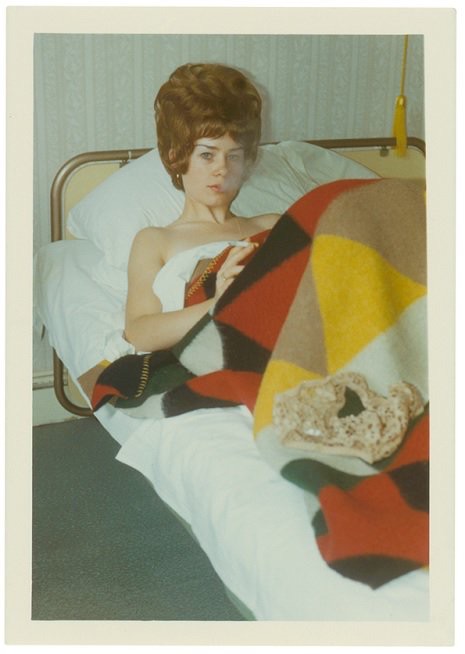
The story on dangerminds.net includes photos that appear as if witnessed circumstantially evident sex acts: indicia of before and after sex. His mistress-secretary peers into the camera, traces of sultry satisfaction hinted in the cigarette and state of partial undress. The spread includes pictures of a dress he bought her and an empty birth control container, artifacts by which we archeologists of his future could infer a story not of a man passionately in love but the age-old story of control and possession, on display–the spoils of the hunt and capture. 


The implicitly contented face of the smoking mistress with the wonderful beehive do, teased to maximum density, in bed, extended in post coital satisfaction, or so the picture hopes to portray from a purely exterior view, showcases the object of the photographer’s gaze, the same man who presumably put that look on her face–the picture of achievement and narcissistic witness to a man’s conquest and testimony to his virility and prowess. The random bits of details surrounding this short affair appear to be important recordings to a man who does not want to forget any detail that he had indeed had this affair.


The power of possession is indeed the story, one of sex as consumerism. The woman is created only as a result of and in control of his gaze, his angle, his lens and his poses. He creates the experience for possession and posterity, and so it will always be captured in the light he chose to produce. No matter that the face of the mistress hides a pretend satisfaction to please the gazer for gain or purposes of her own, if indeed that is the case (the after-sex cigarette as the symbol of the soothing needed after the near-miss or total lack of sexual satisfaction). 


Her story is subsumed in his, overtaken and dissipated into a past disappeared perhaps irretrievably, with respect to this brief affair. Where and how would such a story be told at a time when a mistress meant whore according to the mores of a time less exposed to the real lives of real people, who marry, get bored and fuck others? A portrait of a man falling prey to culturally crafted needs supplants her story: the will to possess women, and emoting through sex, i.e., he cannot please his wife any longer so he will please someone else to make him feel like the socially constructed ideal of a man as provider, conqueror, lover, success, power–all evidenced by his stuff.


Or maybe it is just a curiosity of time and place.


Mistress, a Powerful Word to Waste


Credit: http://art247.com.au/


Margaret Sullivan of the New York Times would like to see the word “mistress” retired as a term past its prime, outdated and sexist (Is ‘Mistress” a Word That Has Seen Its Best Days?). Cued by her readers’ comments, she specifically takes issue with using the term in news stories about women having extra marital affairs, i.e., the Patreus affair. 


She complains the term denotes a woman’s long-term sexual affair with a married man, and, as some readers pointed out, which also suggests financial keeping or maintenance. Sullivan believes the term should be replaced with something less gender exclusive particularly since there is no male equivalent to the term. She also notes her male editor’s response is something akin to “Yeah, it’s outdated and sexist but oh well, what else can we come up with?”

I, however, hesitate to retire a word with such a rich history and multi-faceted application.  

The Oxford English Dictionary has this to settle for the word:

HOMEUS ENGLISH MISTRESS

mistress
Syllabification: mis·tress
Pronunciation: /ˈmistris/ 
Definition of mistress in English:
noun

1A woman in a position of authority or control:
she is always mistress of the situation, coolly self-possessed
figurative work is an unforgiving, implacable mistress
MORE EXAMPLE SENTENCES
1.1A woman who is skilled in a particular subject or activity:
a mistress of the sound bite, she is famed for the acidity of her tongue
MORE EXAMPLE SENTENCES
1.2The female owner of a dog, cat, or other domesticated animal.
EXAMPLE SENTENCES
1.3 [WITH MODIFIER] chiefly British A female schoolteacher who teaches a particular subject:
a Geography mistress
MORE EXAMPLE SENTENCES
1.4 archaic A female head of a household:
he asked for the mistress of the house
MORE EXAMPLE SENTENCES
1.5(Especially formerly) a female employer of domestic staff.
EXAMPLE SENTENCES
2A woman having an extramarital sexual relationship, especially with a married man:
Elsie knew her husband had a mistress tucked away somewhere
MORE EXAMPLE SENTENCES
SYNONYMS
2.1 archaic or literary A woman loved and courted by a man.
3 (Mistress) archaic or dialect Used as a title prefixed to the name of a married woman; Mrs.
EXAMPLE SENTENCES
Origin

Middle English: from Old French maistresse, from maistre ‘master’.

So what could be wrong with a term whose first definition from a much-cited, respectable source is “a woman in authority or control”? Sullivan rebukes the term as old fashioned; a term with implied mercenary kept status should not be attributed to a modern day woman who chooses her own lifestyle and sexuality. However, the word’s true essence conflicts with what she derides, and it is her error in the term’s misconstruction. 


A mistress is self-possessed–going against the grain with her choice of sexual partner. She defies social norms, and in doing so, she carries that culturally instilled burden of shame and conscience subverted for love, power and/or sex. She is all about tough choices that expose her to herself and others, an exposure that continually challenges her control.

In addition, the wellspring of control and ownership from which the term emerges, its earliest significance being head of household, empowers the word. As queen of her castle, the mistress does have a counterpart, the master. In this equivalence, the terms both suggest not only ownership but mastery, the knowledge and competence to operate and own all of the details of a home, including the administration of her staff in running it. 

The predecessor of the modern corporate CEO, the mistress was the operations manager of the home, which may have included serving and cleaning staff in addition to family members. And for anyone running a household, even without staff, that is no menial task. 

As one who has historically taken on the role of mistress of the house, I can assuage any fears of sexism or demeaning intent in that term. Running a household of teenagers, ailing parents with caretakers, dogs and cats, is no mean feat. To keep everything running without a hitch–flawlessly–from paying bills; coordinating transportation to sports, school and other activities; financing the upkeep of the house and the people and pets in it, all while juggling work–paid or volunteer–outside and inside the home, takes the talents of an organized multi-tasker extraordinaire. It takes control.

I used to be better at it, the juggling, when my mind was sharper and my energy level higher, but even then I had to rely on spreadsheets to track everyone’s movements and whereabouts. Running a household draws on a variety of skills inborn or acquired. Though not a long-term planner, my mind is wired to work from three steps ahead backward–necessary to captain the ship. 

When the kids were pre-schoolers, I knew at the outset of any day trip that one of my daughters was going to need a series of five, three and one minute warnings of departure as she was not good with transitions. And just the mathematics involved in planning for the outing, the gear required to anticipate any probable need ordinary or extraordinary (accidents), plus the time factor to shove kids in and out of carseats in time to meet the next appointed destination on the agenda, kept my mind in continual twists and turns of addition and subtraction:  add a few minutes for Jordyn’s resistance or chase before we leave plus a few more minutes for changing Remie’s diaper, which will inevitably be an emergency by the time I round up Jordyn and get her in the car–an exercise in figuring out the smallest movements needed to achieve the greatest effect, something like understanding quantum mechanics. 

The abilities to run, round up–kids and numbers–calculate, estimate, zoom, balance, gather, recoup, resist, stay alert, maintain composure and sanity, all while wondering where pride and sleep went is spectacularly challenging and a tremendous show of competency when done without tearing hair out, my own or anyone else’s. Not a very sexy proposition but one declaring mastery of intellectual, emotional and physical strength beyond compare–power.

Power. Mastery. Sex. To Sullivan’s point about sex, sexism and subservience, I must agree with her editors that the definition nowhere includes financial maintenance, and so the term is not as sexist as she protests. In fact, the illumination cast upon the term from its etymology, derived from the French word maitresse, master, and its name for a teacher, one of the oldest, most widely recognized longstanding, respectable working roles for women (not to be confused with the oldest profession), is the domain of mastering knowledge and communication. What could be more empowering than forming the minds of a population? 

Women are distinct, singular each, work in different ways from each other and from men. Words that carry history as performances past that umbrella performances present should not be discarded lightly, especially in the case of a word that I believe furthers the cause of empowering women–for the informed and language sensitive, that is. I take issue with divorcing ourselves from our past. It is a mistake. We need the reminder, nuanced influence and acknowledgement of who we are, where we come from and where we are heading. 

Keep the mistress as master-ess of her domain.

OMG, nooooooooooo!!!


Yes, it’s tragic. I can tell by the frequent wailing and gnashing of teeth around here. Zayn is leaving.  My daughters are heartbroken.

When all the eye rolling is done, I have to ask myself if this phenomenon, the three, four, has it been nearly five (?) year love affair my children have had with this boy band (now man band), is something to deride. Perhaps the resistant nod to the importance of this group on my part comes from the force feeding I have endured over the years, trapped in a car with screaming teens and pre-teens, windows rolled down as they shouted along with the blaring music,”You don’t know you’re beautiful!!”, at passersby, laughing, arm-waving and car-seat dancing. 

While I have maintained the appropriate role of music critic, one of many as a mother, explaining to my daughters with aplomb that cuteness is not one of the criteria for musicianship, I must confess to knowing most of the lyrics to at least two of the albums and have been caught singing a 1-D song while cooking dinner in the kitchen a time or two…or five. The truth is, I like the band, and my daughters have been warning me that this day was coming, the breakup of the band. 

They would know as they follow every word ever uttered by mouth or in print on Twitter, Snapchat, Vine, text or telephone from fellow fans befriended while waiting in line for tickets, movies, and concerts, or at fan sightings and school about these adored entertainers. My 16 year old has told me during more than one car ride to school or a friend’s house with grave admonition and dread that their five-year contract, made when the band members were her age, is almost up and it is doubtful they will re-up given their rigorous touring schedule lo these many years. She suspected burnout all along.

And now it is slowly unfolding, the story of Zayn’s quitting–or was he fired? My 19 year old gave me the lowdown this morning about how it may actually be a firing from the slave master, corporate, money-grubbing, greedy-bastard managers (her characterization, my words), when he dared to walk off a tour after publicity of Zayn’s cheating on his fiancee, or so it was made to appear by the evil media. She explained that Zayn was the more sensitive one and just got sick of the twisting of his life with all the fan-dom gossip and media lies. 

So says she, who somehow coaxed me on more than one occasion several years ago to drive all over Los Angeles chasing these boys for a possible sighting. One time, I flipped out on her and her friends after a six-hour chase that made me question my sanity–truly. There is a limit to a parent’s indulgence of teenage fantasy addiction, and I had exceeded that limit by legions.

The truth is, I will miss these boy-men should this signal the beginning of the end. All those car rides–and there have been many–with four or five girls screaming in my car every word to every song, windows down, wind whipping through us, and even my steering wheel banging car seat dance in full swing, have been fun and meaningful, girls having fun in music fantasy, me witnessing. My younger still insists only half ironically that she will marry Harry, so there is no need for any other boys in her life.

These singer-musician cuties have played an important role in our lives, in theirs particularly, and not only as an obsession or a place holder until something bigger and better and realer comes along. Their devotion, waiting for hours to glimpse them, purchase tickets, see them in concert, find the latest about their lives, has been not only the commitment of love-sick, crazy teens with no reality that can compete with the fantasy of them, but of the true commitment of fans, caring fans who love something bigger than themselves, something to hang their hopes on for a future relationship with someone truly special, someone with greatness, ambition, good looks, talent and caring for an adoring heart.

For me, these guys have given me opportunity a’plenty to not only serve as taxi driver, crazy mom, and sage adviser about everything from music to love to addiction, but also as friend and adoring fan to these girls, all beautiful in their youth, purity and zealous affection and enthusiasm in their devotion to a lovely even if sometimes embattled over the rights to the story world, something that could be a lot worse than wholesome 1-D. If they have to be addicted, I am okay with it being a handful of benign cutie patooties. 

And quite honestly, it has been interesting to watch these boys grow, musically and personally, amazingly in sync with my daughters’ growth in the same fashion. The music is less bubble gum, evolved, adding a layer or two of musical and lyrical depth and diversity. Similarly, both girls have developed diverse musical tastes over the years that I deem mature and sophisticated, even as I question the talent of some of their selections. 

My car rides are now infected with a wild array of cynical, political songwriter-singers, not so fresh and innocent as 1-D, more so overly whiny, sardonic and anti everything socially accepted, like the Front bottoms–their rebellion phase, kind of like their mom’s Dylan, Doors and Led Zeppelin phase decades ago. But despite their clear evolving musical tastes way beyond the pop pablum of groups like 1-D, or their predecessor Justin Bieber oh so many moons ago (comparably “my” David Cassidy in the 70s), they hold Harry and the boys near and dear, laughing at themselves while seriously loving them too.

But we all move on, even 1-D dudes. Zayn is right to quit. Why not end at the top? Why not try to regain the semblance of a sane life at the ripe young age of 22? It will take another five or more years to get over the post-traumatic effects of rising and sinking so far and wide as unknown to super-star to used-to-be. Although, I somehow doubt the residue, the fractured band, as Brad Nelson of the Guardian dubbed them, “four goofy white guys shouting“, will make it and not only due to the dent in the multi-textured sound that Zayn contributed to creating. 

The fans may not be so forgiving of the Simon Legree (or is that Simon Cowell?) managers they may see responsible for the breakup or may not be able to let go of what was–the perfect quintet of dreaminess. A beloved will always be missing.

In any event, there will be the press stories and the fan stories, the truths of which may not coincide. The best part of the band for most fans is not even the music but the constant back story and just the story making itself, constantly winding in and around the social lives of imaginative teens and pre-teens flexing their minds and hearts into the vast landscape of love, music and social media. What else is there, after all?


Sentimental Morning

Yesterday I read in the Huffington Post the story of A.J.’s 25 year affair with a married man, her divorce lawyer, on whom she had grown dependent for love, money and herself. Her story is familiar. She filled a space that was her, missing most probably due to the abandonment she felt in childhood, with him, but came to realize after two and a half decades that only she could fill that gaping hole.
 
The hole in my heart couldn’t be filled by anyone but me. I had to love myself more than I loved anyone else. Even him. Finally, I understood.


We walked out of the hotel onto Park Avenue, and without another word to him, I turned and walked away.
 
This morning I awoke from a dream the last vision of which was the face of my husband of nearly 35 years, smiling, his head leaning on someone else’s shoulders, completely content. 
 
No one has made me weep more in my dreams than he has.
 
Though we are no longer intimate, we share a connection deeper and more profound than the silence we keep about what went wrong and what is right.
 
Love is more than dependency, but its shape and character are dependent upon lovers. There is no doubt that we fall in love with love and all we imagine it to be, including that leaning, literally and figuratively, on another. Our hearts resound solitarily in our chests, but the primal urge to sync our rhythms to the beats of those hearts walking beside us is unimaginably fierce. We don’t want to be–alone.


Graham Nash — A Simple Man


I am a simple man
So I sing a simple song
Never been so much in love
And never hurt so bad at the same time.
I am a simple man
And I play a simple tune
I wish that I could see you once again
Across the room like the first time.
I just want to hold you I don’t want to hold you down
I hear what you’re saying and you’re spinning my head around
And I can’t make it alone.
The ending of the tale
Is the singing of the song
Make me proud to be your man only you can make me strong
Like the last time.
I just want to hold you I don’t want to hold you down
I hear what you’re saying and you’re spinning my head around
And I can’t make it alone.

Killer Thoughts

It’s been around for a while, but I just saw this delightful Ryan Woodward animation “The Thought of You,” which has made its rounds on Facebook, Vimeo and Youtube ad nauseum. And my fresh look adds yet another interpretation among the hundreds of others mostly fawning observations and applauding. The difference in interpretive tone–positive or negative–is probably affected by the accompanying song. In one version, Nick Lovell’s “Cradle in my Arms” is the backdrop, which is slow, severe and mournful, whereas the other version is accompanied by the Weepies’ “The World Spins Madly On,” a much more upbeat though just as disillusioned song.
 
In the short animation, I see thought, airy nothing, on display. I see the “lost in the world” lyric, with two ideas dancing around each other, illusive in the acting out: he grabs her but she evades him, slips from him but then there she is again, and they dance and she caresses him but he ducks away, also slippery.  
 
And the lyric, “woke up wishing I was dead…the night is here the day is gone,” floats into my consciousness as the scene changes to dream sequence, a longing, where she is an angel, the feathers falling as she flies from him. Is he about to kill her off? When they finally spin together as they and “the world spins madly on,” she suddenly becomes real to him, her clear yearning to touch him, there standing in all of her need–real–and he lets her go.  She is real, depicted with shading and fullness, depth, and he is still an idea. He lets the real go. Dreams and fantasies are far more interesting, full of potential.
 

Nick Lovell’s “Cradle in my Arms”

I don’t mind
Where I wake this morning
I will only be misjudged


You are here
But your mind is elsewhere
You have battled for so long


Just call me when you feel like coming home
Call me when you feel like coming home


Have I changed?
Or do my eyes just see things
So much differently now?


Lay the blame
Only if you have to
But it’s you who brought you here


The animation suggests thought as the figures are mere sketches until the woman acquires shading, a touch of reality, when she is more concretely identifiable as herself and not the projections of the male configuration’s imagination: as angel as the feathers that fall suggest or even a dancer. When she stands there just herself in want of him, not playing chase, at the end, he leaves her. He loses interest or runs in fear or both.


I want to peel off my skin and roll myself in salt when I see this where others–Youtube and Vimeo commenters–look to the beauty of the dance and feel warmth and loveliness. The projection of my own thoughts on someone else, making that person an extension of my own desire and will is a life-long habit and a doom to so many relationships.Too often have I wished another to fill the expectations of my imagination, which is powerfully creative and unrealistic as if totally unleashed from senses.


The result: not actually seeing or finding the person standing before me because I have never been there–present–in the first place to notice. Wrapped up in my mind’s eye, not my physical eye that sees not envisions, causes blindness–and eventual loss.
 
When she is an idea–a thought–it is easier to hurt her. Experiencing another as flesh and blood makes it more difficult to hurt that human being, compassionately and empathically sensed as one senses him or her own self. 
 
That is how genocides or near genocides have been possible in the past–making whole populations an idea, a problem needing a solution, the Jews of pre-War World II Germany as only one example. No human being but the most unfeeling, the sociopathic, could be convinced that the economic solution for a failed economy and the woes attending such is to kill another singular, seething human fleshly being standing right before one’s eyes. No, that person would have to become an idea–the economic drain, the problem, caused by immigration, greed, religious destiny, or some other idea.


For me, fantasy has always been greater than reality and my heart is a painter. Those who show up to be my canvas often cry out, insist on themselves as I sketch and color them brighter, fuller bloom. 
 
The Weepies’ “World Spins Madly On”
 
Woke up and wished that I was dead
With an aching in my head
I lay motionless in bed
I thought of you and where you’d gone
and let the world spin madly on

Everything that I said I’d do
Like make the world brand new
And take the time for you
I just got lost and slept right through the dawn
And the world spins madly on

I let the day go by
I always say goodbye
I watch the stars from my window sill
The whole world is moving and I’m standing still

Woke up and wished that I was dead
With an aching in my head
I lay motionless in bed
The night is here and the day is gone
And the world spins madly on

I thought of you and where you’d gone
And the world spins madly on.

 
“And the world spins madly on…” The world of the imagination is a mad spin, crazy making in its delusional world making.


How many of us do this–imagine what we want rather than experience what we have?

Vibrators and Misinformation Again


The Guardian article, “A vibrator is not a substitute for a partner. But how do you tell men that?” by Tracy Clark-Flory fortuitously appears this relaxing Saturday after a week focusing on the vibrator and women’s orgasm on the blog (here).

The article’s content in large part has been covered on this blog previously, the major take home ideas being as follows: sex toys are still a taboo subject despite 43% of heterosexual men having used one with a partner, men feel intimidated by vibrators while women feel insecure about speaking up in light of men’s insecurity, and the unwillingness of couples to speak honestly about introducting the vibrator into the bedroom is due to culturally-reinforced misconceptions of penetrative sex as the cornerstone of sexual fulfillment.  

In light of that last persistent, patent lie, the most significant reason for repeating material is to disseminate sexual truth and keep the discussion ongoing, so that some day that report–that there exists “the cultural expectation that women orgasm during and as a result of penetrative sex” despite the ample research that “shows that most women simply do not climax from penetrations alone”–will no longer be fact. The “culture” needs to stop expecting that. Such misinformation leads to couple insecurities, which Clark-Flory writes “makes for really terrible sex.”

Get over yourself America (though the article is directed to a wider audience, American attitudes about sex are majorly dysfunctional). Men, stop thinking a penis is all you are, the end all and be all. Women, stop thinking your role in life is to be “pleasers and soothers, above all else.” 

Vibrators are not replacements for men, not necessarily intercourse substitutes, and men who think so need to be disabused of that notion by curative cultural “normalization” of the facts. Women, take the lead on this (except for those women who really do prefer vibrators to men). You are the life bearers, the stronger sex. Be bold. Be honest. Tell him what you need, respectfully. Or else, keep supporting the sex-toy industry. Apparently, the options for bigger, bendier and both-partner accommodating vibrators are abundant. 

Above all, have fun. 

Peace,

the Gaze

Is that a vibrator in your pocket or are you just happy to see me?


What I treasure most about blogging is the many contributions from readers whether in thoughtful or supportive comments, or suggestions of what to “gaze” at as today’s content donor put it. It makes my day when someone sends me a bit, a piece, an image, video or an article, some snippet topical to the blog’s thematic interests. Today’s gift is an article in the New York Times paying tribute to Dell Williams, former actress, advertising executive and army WAC, who started Eve’s Garden, a Manhattan sex boutique opened at a time when openly flaunting female sexuality took some daring. 

The story goes that she opened her sex shop after a humiliating experience at the hands of a young “pimply faced” clerk/interrogator when, in 1974, she purchased a vibrator. This spurred her mission to establish a place where women could purchase sex paraphernalia in peace. This kick-ass entrepreneur spent a majority of her life defending the right to open acceptance of women’s sexuality, something perhaps taken for granted today as more of a given than in her lifespan. 

Though it is still not a given even today.

While attitudes about female sexuality have progressed from denial by the patriarchal societies of Western Civilization to acknowledgment that it exists, there is still some distance to go before female sexuality is fully, openly celebrated, let alone discussed, by men and women. 

Thanks to vibrators, and women like Dell Williams who fought for freer access to them, there is an interesting history from which to start a conversation about women’s sexuality that does not seem so contrived, cliché or awkward. In fact, I used today’s research to pique the interest of my 15 year old, a sly engagement of her unsuspecting provincial sensibilities, to talk about sex, something she is loathe to do with her mother.

It turns out the vibrator is the tool that has not only traveled well through the centuries but also one that has propelled female sexuality and feminism into its current state of the question I have heard of late: Do we even need feminism any more? While the answer is yes, for many reasons, economic equality access being only one of them, that is a story for another day. The advent of the vibrator is a story of patriarchy, capitalism and power.

It begins with Hippocrates in 4th Century Greece, or at least he was the first on record to theorize that hysteria, a condition ascribed to women who displayed symptoms such as fainting, nervousness, and bad temper, more commonly known as “dry womb disease,” which seems to me as overall unhappiness most probably due to a lack of sexual excitement (read: not pumping out the lube) or fulfillment with men and the “normative” practice of penis-penetrating-vagina sex, what Rachel P. Maines in her book The Technology of Orgasm terms the “androcentric standard” of acceptable sexual practice.

The medical treatment Hippocrates and generations of physicians thereafter–until 1952 when hysteria was no longer diagnosed–for women experiencing hysteria and dry womb, was manual manipulation of the vulva by physicians to hysterical paroxysm, the medical condition better known as orgasm–in other words, getting women off. This treatment, an ongoing therapy, took up too much time for doctors to make enough money from other patients and was a routine and rote task that clearly could and should have been the work of midwives but for physicians not wanting to forego the income, prestige and power over the female body. As such, devices were developed to facilitate that “chore.”

Coupled with attitudes that women should not be touching their own bodies or have pleasure outside of marriage and what men could provide–androcentric sex–the vibrator was kept in the hands, so to speak, of the medical establishment until 1902 when Hamilton Beach patented the first take home vibrator, a large and noisy (we can heeeeaaaar you) apparatus. The hush of sexual repression quietly deposited these household objects from the hands of doctors into locked drawers, despite their popularity. According to trojanvibrations.com, these early vibrators emerged as one of the most common household electrical appliances invented even before the electric iron:


By 1917, there were more vibrators than toasters in American homes, claiming to cure everything from headaches to polio, deafness and impotence. Some ads for vibrators even claimed to be able to put a glow on your face.


In the radical feminist 70’s, the vibrator came out of the closet and into the hands of women trying to bring all things woman into the forefront, but particularly her sexuality as her power and her own.  Today, approximately half the American population uses or has used a vibrator, according to a survey of statistical findings I conducted on the web, only one of which is livescience.com.

Maine’s first chapter of her book mentioned above is available online and is a fascinating detailed history of the vibrator in context of sexual history from 4th Century B.C. through the Victorian era til modern times, citing wonderful hysteria treatment tools like horse simulators and other early curative devices designed for women’s orgasm, wickedly delightful apparatus to an unappreciative audience, my guess.

The covert manipulation (pun intended) of attitudes toward women’s sexuality–sexual pleasure that demanded more than male vaginal penetration as well as women’s ownership, participation and education (To know why, see Huffpost’s 13 Reasons Every Woman Should Masturbate Regularly)–derived from what Michel Foucault, French philosopher and author of the History of Sexuality, deemed the male medical establishment’s “hystericization of sexuality” (using their authoritative power to keep women’s sexuality as well as homosexuality in the realm of disease vis a vis the normative sexuality of the culture), patriarchy and capitalist greed.

Thank you Hippocrates for taking the time to notice, for kickstarting the vibrator’s journey to women, promoting sexual health for both men and women, and for getting all those women off, a trend that persisted even if disguised as medical treatment (wink, wink). He was hip to the truth he and his cronies kept mum, I suspect: most women, producers of the only organ designed for pure pleasure, maybe don’t need men so much to get off once they figure out what they have and how to use it.