
A little something I worked up from an essay I wrote here a while back was published today in The Mindful Word. A little late for Passover but early for next year 🙂
Enjoy it here, and feel free to comment.
Peace,
Gaze

"My mistress' eyes are nothing…"
A little something I worked up from an essay I wrote here a while back was published today in The Mindful Word. A little late for Passover but early for next year 🙂
Enjoy it here, and feel free to comment.
Peace,
Gaze

Perhaps you have to be a teacher or know one to smile at this article a good friend sent me today, but I enjoyed seeing myself typecast as a certain type of teacher. Though I have taught my share of literature courses and may have been Libris Scholaris, especially in grad school as a Teacher’s Assistant, guest lecturer or contract lecturer at the university, but I am quintessentially Scribus Mundanus all the way these days, as I stare down a pile of ungraded essays beckoning me to my desk even at this late hour.
John Minichillo on Timothey McSweeney’s blog writes “How to be a Better Teacher-Person Through Apathy: On the Heirarchy of English Professors, a Nonmenclature: Scholar-Type, Teacher-Type and Artist-Type” to illustrate and caricature teachers on this very week of the teacher. I have been all three, but teaching three composition courses this semester and some semesters four or more, I relate to this description:
The second type of English professor is the composition scholar, or teacher-type, Scribis mundanus. They use the word “text” with far less frequency and their obsession lies in “pedagogy,” a word never uttered outside of universities, but a catch-all title that means, broadly, “teaching.” While Libris scholares teach to make a living, so that they can study texts, Scribis mundani have always wanted to teach, and they have a way of resenting other professors who don’t engage in the frequent self-examination of their own teaching practices. They believe in a growth model for teachers, so that they are involved in teacher training and/or disseminating self-assessment tools, and they command their classrooms with a dynamic flair. They are forever pondering goals and outcomes, and will dole out experimental assignments, so that during any given semester the class content, approach, or grading methods of Scribis mundanus may have completely changed from previous semesters. The field of composition developed out of necessity and it’s the new kid on the block. At the beginning of the twentieth century students were interested in literature, and classes were introduced where these students would write “themes” each week, so that these primitive papers became what was graded in the course. Over time, English classes were separated into literature classes and writing classes, and composition was the methodology that grew up around paper writing, which became the subject, whole and entire, of composition classes.
I am a teacher. I am in it to teach. I use the word pedagogy, yes. Reading “texts” and creating art are collateral benefits that go with and develop from the art of teaching. Becoming an expert on others’ writing and teaching others to write, I have improved my own writing. The reciprocity has quite satisfactorily evolved into paid self-enrichment.
Mundanus? Sure, the comp grind, as it is referred to in the biz, has its mind-numbing moments, for example, that pile on my desk that promises endlessly winding, often pointless poor prose as well as the surprise satisfaction of a well-turned phrase. I’m happy merely to find the few that followed the assignment directions. But then I remember that my own writing, discipline and substance have developed over a life-time, several decades. What can I expect in mere weeks?
Maybe the next professor down the comp chain will have better luck weeding out the disorganization in this semester’s crop of students’ harried developing minds and the bad habits cemented over the years. In three weeks, my tenancy with them will be up (except for those who choose to try again with me). And then it’s summer school!
Image Credit: http://www.edweek.org

I visited my father at the hospital this morning right after teaching my Tuesday morning class. In small talk, he asked me if I enjoyed teaching. When he is not at the hospital, which is always, he lives with me, so we have had this conversation before, I am certain. But this is how it is with him. He idles in conversation, never moving forward nor backward.
I said, “Yes, I love teaching.” To which he replied,
“Maybe that’s what you were born to do.”
I had to think about that for a moment. It’s probably true. I don’t believe he was accusing me of being too pedantic. The context did not warrant it. I’m sure I have been accused of that one before. Sure of it.
But he may be right. I have been a teacher or tutor or coach just about all my life from having younger siblings to helping out the kindergarten kids when I was a sixth grader to tutoring sociology in college for pay to side jobs through college as a Berlitz School of Languages instructor to a high school English department reader to a high school English teacher fresh out of college as my job while I finished law school.
I thought I should be a lawyer (my mother always said I should be), but as it turns out, I was always a teacher and returned to it after practicing law for 12 years and have done so ever since.
I have had the great good fortune to teach so many classes, so many, many of them from composition and writing, to American and British Literature, to paralegal and law courses, to creative writing and life story writing, to art and cooking. I coached soccer for nearly 20 years.
So yeah, maybe it’s true. Maybe I was born to teach. I certainly do enough of it. After all these years, I have a knack for it, maybe even a certain talent, though I am equally certain that I am not the best. There are far more organized and structured college instructors than I am. And my ratings on ratemyprofessors.com are an average of mixed reviews. I have been accused of being a tough grader. That is true. One reviewer wrote: “If you’re stupid and you know it, don’t take her class.” I’m not sure what to make of that.
But it’s National Teacher Appreciation week. My students aren’t aware of that, and I am not bound to tell them. But I don’t need to. I am still friends in real life and on Facebook with students I taught in their senior year of high school 32 years ago, professors, business owners and lawyers themselves now. Folks I taught writing tips to ten years back in a class entitled “Writing the Story of Your Life”at a few senior citizen centers down the road 45 minutes are still friends. And dozens of students I see from time to time around town who I’ve taught at the local community college in the last fifteen years have popped up in that amount of time. Kids I coached when they were little are now showing up in my college class room.
I know they appreciate what they learned. Somehow I do. But I don’t think teachers are appreciated enough and in fact, are often ridiculed and belittled as the children they are charged with educating. They certainly are not respected given the status and pay afforded to them in this country. Perhaps that is one reason I felt–against my better instincts–that I should become a lawyer rather than “merely” a teacher when I graduated college. And I have vivid memories of teacher friends having to defend themselves from the old “you have summers off and I wish I had your job” patronizing.
Yet how many of us can remember at least one teacher that influenced them, taught them something and gave them stories to pass on to their own children? We take their continued existence for granted. We take them for granted–except for the one obligatory nod mandated by celebrated days of a week each year in May, primarily in grade school, when kids bring in flowers, apples, mugs, cards or chocolate to their teachers, who smile and fuss in return. I remember my years as room mom in my kids’ classrooms, having to coordinate that event each year as well as the holiday gift in winter and the parting gift in summer.
And I often get Starbucks gift cards or gilded thank you notes at the end of the winter, spring and summer sessions. These are lovely tokens of appreciation. But I also get shorted a class and thus lose my family’s health insurance every five years when the district, state or country suffers budget crises. I’ve been through three of those cycles in fifteen years, sometimes at perilous times in my family’s health history. I am also never guaranteed a class as I do not work under contract, just the good will built over time of performing my job.
This semester was the first in fifteen years that I was paid for office hours, though I hold them throughout the day and night outside my classroom when it ends, at tables on campus, on my way to my other job via telephone and at night when I return via laptop. And I am happy to do so. I love my job. I just wish teaching were as respected and well paid as other jobs with comparable education and training. And the more I teach, the better I am at it, though there is always something to learn as a teacher.
Teaching is in my bones. No doubt. I’m fortunate to do what I love. Remember your teachers this week, most all of them givers–in the spirit of the profession. Hugs to all my teachers, good and bad, for helping build my life and teaching me to pay it forward.
Sitting across the table from my oldest at our favorite eatery, I could not help seeing what others must have seen in me 36 years ago: a tall, lean vibrant girl with a hyperactive, inquisitive mind and over burdened sense of responsibility for the buoyancy of the conversation.
I love to watch her gesticulating hands, the petulance in her sea green eyes and the force of her concerns and wishes. She is all youth and wonder, strength and conviction.
My own youth is like an old 35 mm flickering reel, some parts skipping in fractured movement. The plot always seems to nearly unfold just as the threads run wild and loose. Just like me to crave the missing cracks, what lies in those stuttered jumps in the movie, however slight and seemingly insignificant.
If I could make a real movie of my teens to twenties, I would splice together actual footage of all the moments, days and weeks of laughter. So much laughter. My friends and I knew how to chuckle and wheeze ourselves into spasms, once we broke the ironic smirks broadcasting our quick savvy and adoptive world weariness.
The range of emotion exaggerated on a face, the wide-open eyes in surprise or indignity, the outstretched fingers flung from the span of taut exasperation palms, I recall to fleeting memories evoked by my daughter’s questioning advice on relationships, friendships and the state of the world.
She asks me who in their right mind would have a kid with our sadly looming future. And at the peak of her voiced question mark, I hear my own 20 year old voice chiming in, silently mouthing the words with her in grainy film footage.
If I squint my reality a tad, she is me.
But on the eve of yet another birthday, one of those off years signaling no milestones, no edges to encroaching decades or mid-split 5’s, I find myself repeating to her: “If I could give you one thing, my most valuable gift, I would export the revelations I gained both wasting time and suffering, just to push your learning curve so far back your starting point advantage would increase the laughing years twenty fold.”
Which always draws a blank green-eyed stare of indulgent tolerance.
By the time she gets it, hopefully I won’t be mere flickering light through film base covered in gelatin emulsion.

Today a student handed me a note purportedly written by his mother, excusing him for leaving class early a couple of days ago. I teach college English. In the 20 plus years I have taught, this was a first.
In the last 2 years teaching at the same college I have taught for 16 years, my plans for at least one class per semester have been interrupted to remind students that they are in college. They don’t have to be in class like they had to in high school by state law, though it is probably a good idea, especially in my class. I do lots each class to justify my existence–that is, graded assignments and answers to eventual final exam questions–and missing a class is not recommended.
However, students who must miss class are assumed to be adults responsible enough to find out what they missed and resourceful enough to recoup their losses. Big assumptions. They still ask me questions like, “Did we do anything while I was gone?”
Though less disturbing, I cannot count how many times students ask me permission to leave early, arrive late or miss class altogether. At first I believed they were simply not mentally out of high school, where their attendance was strictly required though their attention to the class while attending was not so strictly required. I can only assume so from the in depth, lengthy text messages I have received from my children while they were in class. Many students have confirmed the same, and judging by the persistent, nearly obsessive habit of texting or gazing into their phones–activity banned in my class–I believe the phone habit is a long-instilled layover from high school, or merely the product of living now.
Ironically, high school mandates attendance but not attention while college is just the reverse. Since I teach freshman, their education includes breaking the high school habits and convincing them that they truly are free now, free to succeed or fail–whether I give them permission or not.
I’ll admit that my jaw dropped and my face clearly had “wtf?” written all over it when I read the penciled note on a sticky note sized paper that asked to excuse her son for missing class the other day. Have I gotten much, much older recently or have my students gotten much younger? I am now convinced that the number of coddled college kids have increased and they have a tougher time growing up, thus the odd permission requests and absence notes. Or is it simply time for me to retire?
Credit: http://www.babiesonline.com

Always astounded by the lack of historical fluency of college students, I once again found myself defining terms like ‘conservative’ and ‘progressive’ and giving history lessons on the Constitutional context–revolution, tyranny and power. Most students did not even know from whom America gained its independence judging by the quiz on the first day of class. It’s always a big job to explain the story of America.
But now it’s research paper time and the readings turn political, especially advantageous in an election year: essays on gun control, torture, colonialism, free speech, economics (subprime mortgage debacle) and poverty, to name a few. My hope is that students will attach history to current events, find relevance in the story behind the polarization of just about every issue: guns-no guns, pro-life/pro-choice, as well as examine the apologists for just about everything from torture during the second Iraq war to complaints of reverse discrimination in school admissions policies.
But after my history and vocabulary lessons, I asked my students about voting. Very few said they would vote this election on the grounds of apathy and disengagement from the process. None felt it made a difference. Where were all the enraged college students riled by the rogue candidates on both sides of the political spectrum? I was hoping to find a few Bernie Sanders enthusiasts in particular to question. From newscasters and social media accounts of his popularity, I was certain I would find a few supporters among college students. I did find one.
She liked his free college and single payer universal health care solutions and felt he was for the people and not big corporations nor Wall Street. Unfortunately, she did not stand up to gentle questioning about how she thought congress would vote regarding free college and universal health care. But she had reached the end of her thoughts on the subject and so I was on my own to speak on behalf of revolution, which is how Bernie Sanders’ words and ideas have been characterized.
In the end, I worked myself into a lather detailing some of the best known revolutions in American history from independence to unionization to the Vietnam War’s end. They all took people getting hurt, risking life and liberty. They took numbers on foot, in the streets. Short of that, revolutions do not happen, just gradual shifts by attrition, erosion, desensitization and devolution or evolution. The pendulum keeps swinging. But Bernie’s revolution, as inviting as it sounds, is one for the streets, not the ballot.
I am skeptical about what will happen should he get to the White House and meet with an intransigent congress as has been the trend in recent years. Will he disappoint those youth who came out to get him elected and thereby give them reason to stay home next election? I suppose that is the risk of any campaign’s success–failure to make good on promises.
We read Garrett Keizer’s “Loaded” about guns for today. Keizer is a gun-toting progressive by his own admission. After outlining the traditional camps and characterization of the two sides as either NRA gun violent nuts or tree hugging pacifists, he decries the lack of revolutionary fervor in defending rights, ideas and the Constitution. His last paragraph segued nicely into my drifting English, history and political lecture:
The harvest is great but the laborers are few. Still, if asked to choose between an urban guerrilla armed with an Ak-47 and a protester armed with a song sheet and a map showing how to get to the designated ‘free speech zone,’ I would decline on the grounds of insufficient faith and negligible inspiration. Rather, give me some people with very fanatical ideas about the sanctity of habeas corpus and the length of time an African American or any other American ought to have to wait on line to vote. Give me some people who are not so evolved that they have forgotten what it is to stand firm under fire or even to squat near the fire in a cave. Give me an accountant who can still throw a rock.
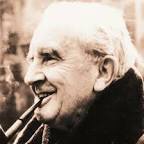
Guess I missed it yesterday, the day devoted to reading Tolkien. And while I would not have read any Tolkien, I would have paid honor in some way as he is one of my most influential writers. Not so much for style or even content as timing.
My earliest reading memory is tied to him. In sixth grade, the reading light went on. Somehow it struck me that with a dictionary and determination, I could read just about anything. I had proven it by trudging my way through The Hobbit, an assigned reading by my ambitious sixth grade teacher, Mrs. Allgrove. Though I begrudged that woman many things while sitting long days in her class, reading Edgar Allen Poe stories to us was not one of them–nor assigning us Tolkien.
She was ambitious for us 11 year olds, and I took up the challenge. Reading The Hobbit was painstakingly difficult but I had a profound sense of accomplishment and enlightenment after finishing the book. Not so much for the story, which reached me in mere wispy shadows at the corners of my imagination, thin strands of plot but thick with magical atmosphere and mystery. More so that I had cracked some code or found the secret password and entered the club. I could read hard books.
After that I ventured into many books, too many to count. I am a reader. I attribute that love to Tolkien who lured me with mystery. My attempt to do the same for my own children did not work as well. I found an amazing illustrated text of The Hobbit for kids, drawings that plucked the fright out of the spider scene or the eerie from Gollum. But it bored and frightened my kids. They were not six graders yet. Maybe premature. They did not even see the movie when it came out. I surely did.
Tolkien totally enveloped my world when I was fifteen, the year I read the trilogy. The Lord of the Rings not only captivated my imagination, but yanked at the seams of longing and teenage angst. The darkness of that book was my own darkness, deep and well traveled. The torture of that darkness produced by the most majestically fabulous language spoke everything to me: horror and beauty.
I lived in Middle Earth, at the edge of Mordor, in the realm of invisibility that was becoming more and more addictive. The landscape was my own insecurities and sorrow as I traveled through the tunnel from sad teenager to savvy teenager. By the time the ring was tossed into the abyss, I had come out of my own cave to see that the world was brighter than I imagined. I lost some of my perpetual glum, which I wore like the makeup other girls wore to make them–in their minds–more socially acceptable and attractive.
I learned to speak Elvish. My best friend and I spent one Halloween in a cemetary drinking Schmidts beer (a little over a buck a six pack back then) and smoking hash scaring the shit out of each other with visions of Mordor. I lived this world not only while I read the books but in the long aftermath of its lingering imaginative aroma. I hated finishing the books, my long, long absorption in the world coming to an abrupt end.
My love for The Lord of the Rings and Tolkien stayed with me like a first love. The untainted visions and preserved excitement of total disappearance into another world were sacred to me, so much so that when the movies came out, I refused to see them. I did not want my own mental creations of the characters to be displaced by someone else’s casting. I wanted nothing to do with that.
Until I entered graduate school for the second time at the age of 43. I went back to school to get a PhD in Comparative Literature at the University of California at Riverside on a fellowship. One professor in the program took a special interest in me and invited me to a small group of three students to do an independent studies course in flash fiction under her tutelage. After I agreed, the course turned out to be a delving into the holocaust and feminism, two subjects I wanted to avoid.
Interestingly, the course reading list included The Lord of the Rings. When I saw that title, I became both excited and anguished. Did I want to spoil the specially preserved place of that book that I read purely for pelasure and out of curiosity by dissecting it until the juices were totally bled out of the words?
The same books from 1975, yellowed with decades of shelf time, came to my aid in 2003. It was like a time warp. I read the books as if for the first time and enjoyed them without critical interference, which was my wont 28 years later with a couple of literature degrees under my belt and several teaching years. As is often the case with acquired analytical expertise, the innocence of a subject under analysis is lost when the invisible lines of creation are exposed.
But that did not happen with The Lord of the Rings. And even after taking some wild bent roller coaster ride of a term paper outlining the underlying sexual tension of the menage a trois between hobbits and gollum-like creatures (Oy, don’t ask), I had fun reading the book even while destroying its innocence with interpretive analysis. It was the easiest paper to write, and I had the most fun writing it, unparalleled to any before or after.
But I still refused to see the movies for months afterward–until I did. I had the director’s cut of all three of them. I sat down in pj’s for the weekend and dove in. And yes, my initial impressions and imagined beings have been displaced but the movies were faithful and enchanting. I admired Jackson’s devotion to the spirit of the text. I was once again immersed in the world with its strange and wonderful journey, mine once again.
Tolkien has taken me far, stretched me through the years. I am forever indebted to him and his creations far more than I can express in my own plebian words. And though I am not a dedicated fan of fantasy adventure novels (though I have read a fair amount of them), I attribute Tolkien to both my love of reading and my disinterest in most fantasy adventure stories. I had trouble getting through all of the Harry Potter books. In every fantasy story I have read since, I recognize some “borrowing” from Tolkien.
He was the master after all. He set the prototype. Everything after cannot be but some poor imitation, switch-up or clear avoidance of everything he imagined. The greats do that: pull us along and then intimidate the hell out of us. Thanks J.R.R. I am always reading you, regardless of book in hand or not. Cheers!
“If the multiverse idea is correct, then the historic mission of physics to explain all the properties of our universe in terms of fundamental principles–to explain why the properties of our universe must necessarily be what they are–is futile, a beautiful philosophical dream that simply isn’t true. Our universe is what it is because we are here. ”
Alan Lightman, “The Accidental Universe”
Astronomy week, when the class and I read two essays, one about the relationships of the sun, moon and Earth–and one human to another, and one about the aim of science to figure out who we are, why we came to be, is an exciting week for me.
I wax on about the mysteries of the universe, the idea of the multiverse, Big Bang, Intelligent Design, Newton and the Theory of Gravity, Darwin and the Theory of Evolution, Einstein’s Theory of Relativity, ten or more dimensions of space, quantum theory, quarks, string theory, Inflation theory, dark energy and matter, the complete absence of a theory on how the human brain creates consciousness, and the overall pursuit of a fully coherent cosmos that adds up to us–what scientists had hoped to achieve through speculation, calculation and logic, beginning with observing natural laws, up til recent history when the Hubble deep field experiment revealed the probability of a multiverse.
The project to discover the cause and effect chain to everything had to be abandoned with thrown up arms, seemingly also abandoning the aims of the preceding thousands of years’ work. Alan Lightman writes about this interrupter known as the multiverse in “The Accidental Universe.” And when I ask students, who look at me as if I am on a 70’s psychedelic trip, what this all has to do with them, their reality right now, no one can answer–not even the ones who desperately want to answer something, anything.
Like history, the cosmos is just too far away. They cannot feel it, not even as a dream they may have had and can recall in that hazy sense of remembering a distorted reality deeply imprinted in another realm of consciousness.
“Not only must we accept that basic properties of our universe are accidental and uncalculable. In addition, we must believe in the existence of many other universes. But we have no conceivable way of observing these other universes and cannot prove their existence. Thus, to explain what we see in the world and in our mental deductions, we must believe in what we cannot prove.” Lightman
And so students interpret that faith in the unknown not as the spurs to discover what is out there but as the sigh of futility. It has so little to do with their immediate aims–surviving school, work and social media.
But it is human arrogance to require relevance to the human condition. Or that the multiverse is created in our own image, running round ourselves like the orbiting moon to Earth, Earth to the sun.
“The disposition of the universe–that crazy wheelwright–designates that we live on a wheel, with wheels for associates and wheels for luminaries, with days like wheels and years like wheels and shadows that wheel around us night and day; as if by turning and turning, things could come round right.” Amy Leach, “You Be the Moon”
I miss the eloquence, enthusiasm, sincerity and passion of this scientist to make the real imaginable and the imaginable real:

Oddly enough, I smelled cigarette smoke today, and for the first time in many, many moons, it smelled good to me. I used to smoke cigarettes–an on again off again affair. I started in elementary school, forcing myself to trade un-labored breathing and clean smelling clothes for cool. I stayed with the habit throughout junior high and high school, developing a full-blown half a pack to full pack a day habit back in the late 70’s. Cigarette packs cost less than 50 cents then.
When I moved from New York to California, the cool changed and so did my habit. Californians did not smoke like New Yorkers did. And I met a non-smoker who encouraged me to quit to avoid the kissing an ashtray repulsion he wished to avoid. So I did, many times in as many years, sometimes for months and other times for years at a time. I had not smoked for 5 years when I enrolled in a summer school graduate school program back in 1989. The first day of the semester brought on a half a pack a day habit instantly. But the last day likewise signaled the last cigarette. The longest non-smoking stretch spanned ten years or so, the child-rearing years.
All in all, I tally the smoking years against the non-smoking years and the latter wins out handily by a 4 to 1 ratio (yes, I include infancy in that calculation). Mollifying my conscience about healthy aspirations is one reason for the calculation. The other is the sneaking suspicion turned confirmed of late.
My father’s smoking ratio is about 1:2 smoking to non-smoking. He quit tobacco 31 years ago after visiting an old friend dying of emphysema, leaving behind a wife and kids. Watching this formerly cool, tough Italian macho tote an oxygen machine like a child’s security blanket was not so much what did it as the look on his wife’s face, knowing she would be left to take care of it all. My father quit after that Florida visit and never smoked again, despite a three-pack a day habit. My first cigarette was one I snuck from his maroon soft Pall Mall (he pronounced pell mell) pack and lit on the school playground–during recess!
He was my inspiration to both quit and not-quit. If he could quit a 30 plus year habit cold turkey, I could quit a smaller habit. But the thought was always: any day I could just up and quit like my dad did. He just decided to do it, and then quit. And so did I. But I didn’t stay quit.
I haven’t smoked in a long while, not sure how long. I don’t like to count. I don’t like to think about it at all, though I often have a twinge of angst about the damage done. I have heard and seen those pictures of dirty and clean lungs of cigarette smokers. I have read that the deleterious effects immediately begin to dissipate as soon as you stop. But it seems to me there would be some residual damage, some frayed edges somewhere for the abuse. The subject has never brought me even close to researching. I probably don’t want to know or trust what I read.
Yesterday I sat in the doctor’s office with my 81 year old father and questioned the doctor about the tumor discovered inside his bladder. I asked why he needed surgery rather than a biopsy if the tumor was just discovered. The internal medicine specialist matter-of-factly turned to me as if I were on fire with ignorance and replied, “because with his smoking history and the location of the tumor, these tumors are almost always malignant.” Malignant and tumor in the same sentence made my jaw slack and eyes widen.
Funny thing about looking up the National Day (a habit of mine)–National Kick Butts Day–I did not automatically think of cigarettes. My immediate understanding was kicking butt as in overcoming or winning or beating. The notion made me smile. I like kicking the butt of obstacles, like just today submitting an article due at 7:22 right on the dot at 7:21 after my day got away from me and I toyed with extending the deadline. I also re-negotiated a couple of contracts to more favorable terms, turned a few students on to poetry and astronomy (two current passions of mine) this morning in class, and whittled down a stack of essays needing grading. I’d say it was National Kick Butt Day today for me if not for the nation.
But also for my dad. The doctor did add that this type of malignancy–located in the bladder–is one that commonly spreads. The surgeon removes it and done, out patient even. At least that is my hopeful understanding. Though I have no desire to research this one either, I am going to take this news as equally kick-butt as enlightened 18 year olds to poetry and astronomy, hard to believe but absolutely, positively plausibly true.
Happy National Kick Butts and Kick Butt Day!
credit: scoutingmagazine.org

Peter Singer, an Australian-born ethical philosopher, writes in his essay, “The Singer Solution to World Poverty,” that ‘wealthy’ (living beyond basic needs) people should donate to world organizations that feed the hungry so as to eradicate world hunger:
In the world as it is now, I can see no escape from the conclusion that each one of us with wealth surplus to his or her essential needs should be giving most of it to help people suffering from poverty so dire as to be life-threatening. That’s right: I’m saying that you shouldn’t buy that new car; take that cruise, redecorate the house, or get that pricey new suit. After all, a thousand-dollar suit could save five children’s lives.
He even provides in his essay a toll free number to call Oxfam with a donation.
Singer asks elsewhere (or maybe it wasn’t Singer), if every person in the developed world donated the cost of his or her third pair of shoes (Do we need three pairs?) to the world bank, which would effectively end world hunger, are we morally obligated to so donate? If morality is defined as right behavior as in doing right by another, then yes, to be considered moral, each person is morally obligated to donate.
But what if ending world hunger results in overpopulation and the disappearance of planetary resources to feed everyone like water, clean air and soil, for example? Is it then moral to donate?
credit: pbstwimg.com
 In the gaze of the other