Argue!

  
Should vivisection on animals be universally banned?

California’s gun control laws are the strictest in the nation and do not need tightening.

Costa Rica’s Preventia policies are unjust and inhumane.

The papparazzi need to be reigned in from their reign of destruction.

Coed education beats same-sex education miles high.

Long Beach police officers are doing a great job despite the public outcry against police brutality.

The higher divorce rate among military families compared to non-military familes cries out for resources.

Street art is not graffitti!

Torture has its place in terrrorist prevention.

Inception is not a coherent thriller.
 

It’s end of the summer semester research term paper time. So many arguments, so many readily available resources, and so many fallacies.  My students, weaned on the Internet, both master and destroy logic. Familiar with the bounty that is the network–social, educational and otherwise–they can research. They find stuff. However, likewise products of the world wide of webbings, traps for the unweary, they believe without discernment. 

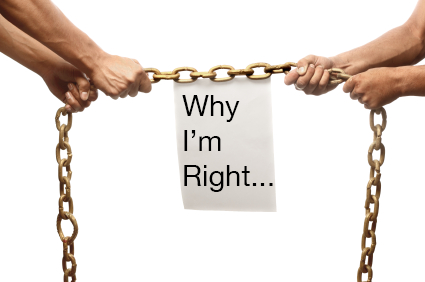
Teaching young minds to think in verticals and horizontals tasks the impatient and weary. Entitlement does not only measure ownership attitudes; the right to be right falls in the heap of our stuff. Ours. Mine. Not yours.

How else does the abounding madness of polarizing non-sense stop: me vs. you, right vs. wrong, with us or against us? Isn’t that the major premise of Saul Alinsky’s Rules for Radicals--keep the pressure on with conflict so power can slip in its agenda? 

I responded to a social media prompt on a relative’s Facebook page about the minimum wage not being about bickering over which unskilled worker should get two dollars more than the other. Two good responsive posts about the issue over dignity of work, skilled vs. unskilled worker…and then it came: the post about me, me, me and what I do and don’t blame me for trying to work and make money. 

Buzz kill. There is no response to a hijacked discussion of a public issue by someone’s feelings about his or her life or imaginary persecution–a failure to read and understand a public forum’s purpose in the shades of meaningful and polite interaction. 

Teach a mind to think, reason and discern: rule one of a civilzed nation.
 

credit: http://static.squarespace.com/

The Gift of Writing in the Mindful Word

  
My first piece published as a contributing writer for this wonderful journal, The Mindful Word, came out today. Please enjoy this esssay about writing and teaching students old and young about the craft I attribute as salve for what ails us in the human condition of illusory separateness.
Peace, 

the Gaze

Stupid Ashley Crime

  
So help me out here because I don’t get it. The hackers of the Ashley Madison site and other Avid LIfe Media subsidiaries, CougarLife and Established Men, purportedly declared that they attacked the site not for moral grounds, not for sheer mischief, not for extortion, not for revenge nor for a specific social or political cause. No, the hack, along with the threat to reveal member names, fantasies and nude photos as well as company bank account information, resulted in protest of the sites’ unfulfilled “full delete guarantee.”  

The Impact Team, as they call themselves (nothing like themed criminal activity), appear to be disgruntled ex-users. Why else take such extreme action in protest to a failed guarantee that has no relevance to them? Did they think they were the Edward Snowden‘s of the dating site world? I mean, the charges for this crime must come with lengthy prison terms, so the risk must be worth the outcome. 

Or maybe they merely join the ranks of dumb criminals, assuming a public stunt on such a grand scale will go unpunished and undiscovered. Perhaps they count on the public’s disdain for cheaters to get them a pass on the full efforts of the law enforcement agencies called in to investigate this cyber crime.

They must be stupid. Money and reputations stand to be lost, and who knows who risks exposure? Perhaps monied folk, who will not take too kindly for the exposure, a sure generator of pressure to make arrests. 

But the puzzler for me is the lack of logic. Exposing the site’s participants for the site owner’s failed “full delete guarantee” seems like beating the prisoners to expose the abuse of the jailers. 

The hackers complain, according to the Inqisitr write up the other day, that Ashley Madison, et al., charge $19.00 to members for deleting information from the site, but do not actually do so, leaving credit card information with real names attached to them as well as other incriminating information to the cheating spouse. 

Ashley Madison, advertised as a discrete dating site for married adults, with the slogan, “Life is Short. Have an Affair, boasts over 37 million members. According to krebsonsecurity.com, this hack follows an earlier hack on AdultFriendFinder, though the connection has not been established to date. Krebs also reports that the hackers worked from inside, not as employees but people who had access to information working on site.

The hackers demand Ashley Madison shut down, unconcerned about the “dirt bags” who risk exposure:

“Avid Life Media has been instructed to take Ashley Madison and Established Men offline permanently in all forms, or we will release all customer records, including profiles with all the customers’ secret sexual fantasies and matching credit card transactions, real names and addresses, and employee documents and emails. The other websites may stay online.”
So tell me again why the hackers risked their lives as free citizens to protest the breach of promised privacy by which this site profited? 

I hate incoherent crimes.

The Painters of Love: Loving a Married Woman


I adore Anna Pulley’s story ache of loving the married woman, which appeared in Salon yesterday. She not only captures the essence of the thin-tissue-beauty of love, the compulsion of the affair, the ever-turn of the heart toward love, but also the crafter’s gift of the memorable passage. Like this one, for instance:

Ours was a love that hinged on possibility—what we could offer each other was infinite potential. Reality never stood a chance against that kind of promise. I loved her in a way that felt both inexplicable and inevitable. She represented a singular perfection, she had to because she contained none of the trappings of a real relationship, the awkward, the beautiful, the sweet, the ordinary, the holding hands in public, the quiet walks, the bickering at Trader Joe’s. She was perfect in part because she was an escape, she seemed always to offer more.
 
After an enticing lead-in about long-distant love and steamy encounters, she delicately moves us along the strip tease of her narrative, the movement from reflection to memory slip-sliding her narrative along with the tensile desire of an abandoned lover simmering sleight over time. She does not call herself a lesbian until two thirds in to her lovely essay. She wants to soften us to love first, to focus her reader. A concerted effort to steer her  reader’s mind from irrelevant drift she anticipates–detours like same-sex relationships, polyamory and the like, she withholds. Her story is of love, despite the title–all love. And imagery.
 
Fantasy. The addiction (cynical), the lure (soft), or the attraction (clinical) to the love of a “taken” one lies in the fantasy and the primal urge to create more compelling than procreation (fewer responsibilities to the aftermath).
 
We love to idealize love, to be in love, to make it and create it even where it does not exist. I am not suggesting that the love of a married woman ignores the woman, the being, for the objectification of love itself. People mostly fall in love with people, their features, physical or otherwise. However, the framing of love inside the circumstances of the beloved–the out of reach object–often plays a larger role in the picture of love we paint.
 
The interdiction (legal), the forbidden (moral), and the circumscribed (situational) of the affair seduces the painter in us. We who urge the perfect love, inch closer to its never realization by placing love in an outline, form or box with walls of pristine ideals and requirements. I love my lovers because they are who they are–funny, sarcastic, sensible and sexy; because they love me the way they do–with abandon; because they engage in the most intimate acts with me, thrill my very being and inspire me to create, live and aspire to contribute to humanity–go to work, raise my kids, change people’s minds. They make me feel.
 
They never sour, fall from grace before my eyes in the daily practices that make us all abject beings: ever cleaning the rotting flesh we are in the pettiness of hourly living. We belch, shit, blame and deflect responsibility. We lie, cower and deny. The human.
 
Not for the mistress of our getaways. Whether the encounter is a sleazy hotel sex hour or a week at a resort in Cancun, we project our ideal loves in that other we cannot keep, probably do not want to keep except to indulge surrender to the painful satisfaction of longing. Weaned on love stories and poetry (okay, maybe that’s just me), we grow to yearn, throb and grieve. Pain, like love, reminds us what we are. Affairs bring all of that and more.
 
I once read that our memories change each time we recall them, that we are constantly editing what happened. In the end, we can’t hold onto anything, not love, not even our own truths, because everything moves. Nothing is ever written just once.
 
Yes, we are artists, all of us. Human nature, the essence of frailty, tells the fallible story of its tellers wrapped in the egos of an imagination. We want. That is our condition. Our art is our necessity. We love to be loved in the art of love. And it is an art.

9 infidelity ‘things’ and more…

     
Salon’s  9 things you might not know about infidelity is one of those numbered titles that packages tidbits of information from the significant to the pandering. And though the author does a fine job of gathering, presenting and contextualizing (sort of) the information, there is never a question in my mind about the transparent motives of articles like these: seduce readers with and for the numbers.

It is all in the packaging. Lost leaders abound.

Opening sentences handshake the readers to the tone and subject:

Monogamy is a nice idea in theory, but in practice, humans are less adept at it than they might admit. 

Yes, so we have read. The author, Kali Holloway, then launches into the biology of two of the nine “things” such as the correlation between ovulation and frequency of infidelity as well as a lesson on spermatology: the race to the egg is a competition including beating the opponent out of the race altogether. 

Next up, sociology. Having participated in society only in the last 100 years, women surpassed previous records of infidelity running a closer race to cheater men:   

A 2010 study from the National Opinion Research Center found that over the last 20 years, the number of married women who admitted to affairs rose a staggering 40 percent. Which we can all agree is a lot. Nearly 22 percent of men copped to sex outside of marriage, a number that’s remained fairly consistent since 1991. For women, that percentage rose to 14.7 percent. A number of theories are floated for this change, including increased financial independence for women, the fact that women spend more time in co-ed working environments (most affairs begin in the workplace) and changing attitudes around women’s sexuality.

Now this next came as a surprise:

Most cheaters, across the board, don’t get caught. A recent survey found that 89 percent of spouses engaged in extramarital affairs are able to keep their infidelity on the down-low. But women are better at keeping their affairs a secret than men. 

Though it somehow does not surprise me. My theory: most spouses do not want to know (read: denial) or silently sigh a relief in the face of infidelity. I have no numbers to back up that hunch. All I know is, sex is complicated, monogamy or not. Conflicting sexual appetites, ebbing and flowing of phases of the moon as well as the decades, and a hundred and one sexual hangups originating from family, society and biology, all contribute to the complications inherent in trying to maintain interest in, let alone quality or quantity of sex in the long term relationship.

Holloway cites a Forbes interview for the following statement by a dating site CEO in item number 6: 

“You often don’t catch the women. Because women naturally think more contextually. They consider long-term vision and potential consequences much more thoroughly before acting.”

Based on which evidence: anecdotal? experiential? statistical? A CEO?

People who make $75,000 and up are 1.5 times more likely to cheat than those whose annual salaries are $30,000 or less. Those with graduate degrees are also more likely to seek sex outside of marriage, being 1.75 times more likely to have an extramarital affair than people who haven’t graduated high school. Living in a city also ups one’s chances for cheating by a factor of 1.5 times.

The take home from these statistics? The struggle to survive financially takes up too much time–none to spare for the affair. No doubt social values of a society in which the measure of an individual is in the size of his or her wallet has something to do with it. The equation of money to power weighs heavier on those with lower salaries and affects confidence, logically. 

As we near ages that end in zeroes, the chances for infidelity increase.

Mortality. Enough said.

…people who use Twitter every day tend to have shorter relationships than those who don’t, regardless of age. And not that it’s totally germane, but daily tweeters were also more likely to masturbate on a daily basis

Ok, how in the world does one measure that last info-bit and who even thought to ask?

And along the same vein (pun intended), appealing to salacious appetites for the sexual, inane, absurd and obvious:

…penis fractures and extramarital affairs may correlate according to a too-small-to-be-significant study that the author includes–just because–in an otherwise responsible gathering of information on recent infidelity findings. The study authors appear credible, at least, and if they are not as strong as the National Opinion Research Center out of the University of Chicago, the author comments upon that fact.

And while the trend for the numbered article annoys me, caters to the soundbite mentality of pop readership, I too cannot resist the draw of itemization, the buffet of tidbits of data big and small, serious and amusing, but most of all, the back story of the findings, the minds of the surveyors who seek quantification and categorization of minutae and the commonplace. 

The story, for me, breathes in the cracks of the facts, the why’s and wherefore’s.

She’s Leaving Home

Not the right lyrics but the refrain is the same. We live like clichés: daughter leaving for college, we weep, we anguish, and we sever ourselves from ourselves to get past the pain. We cheer ourselves with thoughts of new beginnings and circle of life and metamorphoses, butterflies growing beautiful, upward flight past us.

It feels trite and real at the same time. Our lives have been captured in too many Hallmark poem-lets for sale.

I have anticipated this moment in my dreams (nightmares) since she was born, different shapes and scenery, but all the same theme: leaving.

She’s leaving home. Off to college, which will be her new temporary home in a new state. Whether the leaving is temporary or permanent is yet unknown.

In the meantime, I will be shoring up for the next one’s departure, estimated time of departure, two years or twenty.

Published on #RebelleSociety: Learning How to Shift Our Anger Out of Overdrive and Into Freedom

image


Please visit RebelleSociety.com and read the complete version of an essay I sketched on the blog a few days ago: Read it here.

Blogging has been a fruitful enterprise for me creatively speaking, and I am happy to have maintained my initial pursuit and purpose for it as a sort of notebook of ideas and writings, both complete and incomplete, wholly raw or somewhat polished.

When I find myself in mid-spasm of angry spume, I calm myself with a gratitude checklist, one item being the opportunity to write. This blog has facilitated that.

Thank you all for reading.  Here is a treat:


Independence

  
Happy Independence Day! I suppose I will be celebrating something like that–the roundabout essence of it, anyhow–next week when I drive my daughter up north a couple states to college. I imagine the scene of having unloaded the last of her belongings from the car into her apartment and saying goodbye: my oldest child off to begin a new phase of her life–independence.

She and I have been preparing for this moment all of our lives.
 
And while she has suffered no grievances that have necessitated her leaving, no unbearably unfair treatment or restrictions like those American colonists who could not assemble, receive speedy justice or a fair wage living by the tyranny of a distant king, she must leave to seek her independence. There is no other way to grow into the human she will become. 

We both know it. And while we understand the leaving will behoove us both, stretch us both into the next phase through the forces of fear, anxiety and excitement of new spaces, we mourn something passing permanently: our time together up til now.

She and I realize that independence begets great freedom and the commensurate responsibility arising from that liberty, on the part of both the liberator and the liberated. My first born will bear the responsibility of tapping into all of the resources she has at her disposal, the inborn and acquired, to leverage her mistakes and maximize her growth, pleasure and education in books and in the streets. My responsibility is letting her, watching with faith that I did my job the best I could, teaching to and modeling for this moment of severing the cord. 

For in keeping her tied–whether by finances, guilt or need–is a far greater responsibility, one I am not prepared to take on. Those who would keep another in need or greed will eventually pay a steeper price than of losing that dependent other. And so it is with a nation.

America celebrates its freedom today, marking a day of great deeds by a population led by fearless, brilliant men  in an awe-inspiring act of bravery: foregoing personal interest for the greater good in the name of freedom, a principle far more important than life and limb. And not mere oppression moved these future citizens of a new nation to act. It was something more compelling, deeper within the human spirit that spans the heights of ultimate honor and goodness to the very depth of devilry and satanic cruelty. We are a strange duality of a species that way.
 
I am sure no one was more surprised than Frederick Douglass, an ex slave, to be called upon to speak to the nation’s celebration of freedom and independence in an era when slavery still existed. The irony was not lost on him. He mentions that strange fact in the bewilderment of his having been called upon to speak. But the amazing man is if not merely discreet, magnificent in his tact, bravery and circumspection while rousing the call that the opportunity brought him at that strange moment of addressing his mostly if not entirely white audience, I would guess, at Rochester, New York, in a speech called “History is a Weapon: the meaning of July Fourth for the Negro”, nothing short of masteful in prose and passion.
 
Douglass first assures his respect and acknowledgment of great men and great deeds, for so uncontested in greatness a cause as lofty as freedom:

Fellow Citizens, I am not wanting in respect for the fathers of this republic. The signers of the Declaration of Independence were brave men. They were great men, too-great enough to give frame to a great age. It does not often happen to a nation to raise, at one time, such a number of truly great men. The point from which I am compelled to view them is not, certainly, the most favorable; and yet I cannot contemplate their great deeds with less than admiration. They were statesmen, patriots and heroes, and for the good they did, and the principles they contended for, I will unite with you to honor their memory. 

They loved their country better than their own private interests; and, though this is not the highest form of human excellence, all will concede that it is a rare virtue, and that when it is exhibited it ought to command respect. He who will, intelligently, lay down his life for his country is a man whom it is not in human nature to despise. Your fathers staked their lives, their fortunes, and their sacred honor, on the cause of their country. In their admiration of liberty, they lost sight of all other interests. 

They were peace men; but they preferred revolution to peaceful submission to bondage. They were quiet men; but they did not shrink from agitating against oppression. They showed forbearance; but that they knew its limits. They believed in order; but not in the order of tyranny. With them, nothing was “settIed” that was not right. With them, justice, liberty and humanity were “final”; not slavery and oppression. You may well cherish the memory of such men. They were great in their day and generation. Their solid manhood stands out the more as we contrast it with these degenerate times. 
How circumspect, exact and proportionate were all their movements! How unlike the politicians of an hour! Their statesmanship looked beyond the passing moment, and stretched away in strength into the distant future. They seized upon eternal principles, and set a glorious example in their defence. Mark them! Fully appreciating the hardships to be encountered, firmly believing in the right of their cause, honorably inviting the scrutiny of an on-looking world, reverently appealing to heaven to attest their sincerity, soundly comprehending the solemn responsibility they were about to assume, wisely measuring the terrible odds against them, your fathers, the fathers of this republic, did, most deliberately, under the inspiration of a glorious patriotism, and with a sublime faith in the great principles of justice and freedom, lay deep, the corner-stone of the national super-structure, which has risen and still rises in grandeur around you. 
 
However, the irony of asking an ex-slave living in the time of institutionalized slavery newly confirmed by a legislative decree that commanded the nation to honor the slave owner’s rights to gather up escaped slaves and return them to slavery, to speak about independence on a national celebratory day, cannot but scream not only irony but cruelty, the kind that bedevils the human constitution also.

Behold the practical operation of this internal slave-trade, the American slave-trade, sustained by American politics and American religion. Here you will see men and women reared like swine for the market. You know what is a swine-drover? I will show you a man-drover. They inhabit all our Southern States. They perambulate the country, and crowd the highways of the nation, with droves of human stock. You will see one of these human flesh jobbers, armed with pistol, whip, and bowie-knife, driving a company of a hundred men, women, and children, from the Potomac to the slave market at New Orleans. These wretched people are to be sold singly, or in lots, to suit purchasers. They are food for the cotton-field and the deadly sugar-mill. Mark the sad procession, as it moves wearily along, and the inhuman wretch who drives them. Hear his savage yells and his blood-curdling oaths, as he hurries on his affrighted captives! There, see the old man with locks thinned and gray. Cast one glance, if you please, upon that young mother, whose shoulders are bare to the scorching sun, her briny tears falling on the brow of the babe in her arms. See, too, that girl of thirteen, weeping, yes! weeping, as she thinks of the mother from whom she has been torn! The drove moves tardily. Heat and sorrow have nearly consumed their strength; suddenly you hear a quick snap, like the discharge of a rifle; the fetters clank, and the chain rattles simultaneously; your ears are saluted with a scream, that seems to have torn its way to the centre of your soul The crack you heard was the sound of the slave-whip; the scream you heard was from the woman you saw with the babe. Her speed had faltered under the weight of her child and her chains! that gash on her shoulder tells her to move on. Follow this drove to New Orleans. Attend the auction; see men examined like horses; see the forms of women rudely and brutally exposed to the shock ing gaze of American slave-buyers. See this drove sold and separated forever; and never forget the deep, sad sobs that arose from that scattered multitude. Tell me, citizens, where, under the sun, you can witness a spectacle more fiendish and shocking. Yet this is but a glance at the American slave-trade, as it exists, at this moment, in the ruling part of the United States.
 

How could he not but be appalled, amazed and agonized by the hypocrisy of a nation in celebration of freedom? Those who chose him to speak at this great hall before free people, scant few, if any, who were black in that audience, most probably saw him as a symbol of freedom and independence, a man who escaped slavery, self-educated, self-determined, an abolitionist working tirelessly for the freedom of all enslaved men, women and children, having to argue that black men are men. They undoubtedly saw him as a beacon of rugged individualism, ignoring the indignity of such irony in the existence of slavery. 

The same spirit of absolute sacrifice and bravery that recalled a nation that risked life for liberty was needed to free the rest of the population, and yet, there was not enough solidarity, sheer numbers to stand behind the black population to do so. It would take white people, privileged and empowered to cede some of that exclusive power and risk security for themselves and that of their families in the name of conscience. That cause was not as compelling nor urgent as the institution of slavery that existed far longer than it should have in this country largely consisting of so called God-loving people. The ultimate divide in the human composition, the extremes of polarities comes to light on this day we celebrate one of the poles.
 
Americans! your republican politics, not less than your republican religion, are flagrantly inconsistent. You boast of your love of liberty, your superior civilization, and your pure Christianity, while the whole political power of the nation (as embodied in the two great political parties) is solemnly pledged to support and perpetuate the enslavement of three millions of your countrymen. You hurl your anathemas at the crowned headed tyrants of Russia and Austria and pride yourselves on your Democratic institutions, while you yourselves consent to be the mere tools and body-guards of the tyrants of Virginia and Carolina. You invite to your shores fugitives of oppression from abroad, honor them with banquets, greet them with ovations, cheer them, toast them, salute them, protect them, and pour out your money to them like water; but the fugitives from oppression in your own land you advertise, hunt, arrest, shoot, and kill. You glory in your refinement and your universal education; yet you maintain a system as barbarous and dreadful as ever stained the character of a nation-a system begun in avarice, supported in pride, and perpetuated in cruelty. You shed tears over fallen Hungary, and make the sad story of her wrongs the theme of your poets, statesmen, and orators, till your gallant sons are ready to fly to arms to vindicate her cause against the oppressor; but, in regard to the ten thousand wrongs of the American slave, you would enforce the strictest silence, and would hail him as an enemy of the nation who dares to make those wrongs the subject of public discourse! You are all on fire at the mention of liberty for France or for Ireland; but are as cold as an iceberg at the thought of liberty for the enslaved of America. You discourse eloquently on the dignity of labor; yet, you sustain a system which, in its very essence, casts a stigma upon labor. You can bare your bosom to the storm of British artillery to throw off a three-penny tax on tea; and yet wring the last hard earned farthing from the grasp of the black laborers of your country. You profess to believe “that, of one blood, God made all nations of men to dwell on the face of all the earth,” and hath commanded all men, everywhere, to love one another; yet you notoriously hate (and glory in your hatred) all men whose skins are not colored like your own. You declare before the world, and are understood by the world to declare that you “hold these truths to be self-evident, that all men are created equal; and are endowed by their Creator with certain in alienable rights; and that among these are, life, liberty, and the pursuit of happiness; and yet, you hold securely, in a bondage which, according to your own Thomas Jefferson, “is worse than ages of that which your fathers rose in rebellion to oppose,” a seventh part of the inhabitants of your country. 

Fellow-citizens, I will not enlarge further on your national inconsistencies. The existence of slavery in this country brands your republicanism as a sham, your humanity as a base pretense, and your Christianity as a lie. It destroys your moral power abroad: it corrupts your politicians at home. It saps the foundation of religion; it makes your name a hissing and a bye-word to a mocking earth. It is the antagonistic force in your government, the only thing that seriously disturbs and endangers your Union. it fetters your progress; it is the enemy of improvement; the deadly foe of education; it fosters pride; it breeds insolence; it promotes vice; it shelters crime; it is a curse to the earth that supports it; and yet you cling to it as if it were the sheet anchor of all your hopes. Oh! be warned! be warned! a horrible reptile is coiled up in your nation’s bosom; the venomous creature is nursing at the tender breast of your youthful republic; for the love of God, tear away, and fling from you the hideous monster, and let the weight of twenty millions crush and destroy it forever! 

Lest we forget our history…