Marriage: the Conventional, the Unconventional and the Facts


credit: http://i2.wp.com (No, this is not my family; it’s just weirdly entertaining, kind of like my marriage)


April 19th is my wedding anniversary. In four days I will have been married 35 years–to the same man. Though we have an open marriage, enjoy physical intimacy no longer, I consider our marriage meaningful and committed. We have created and continue to raise two incredible human beings while caretaking two others safely through their twilight. Barring unforeseen calamities, including death, I see no reason for our marriage not to last.


Perhaps my years as a divorce attorney fueled the longevity of my marriage. Witness all day–so many days–to so much grief and acrimony, the willful and unwitting destruction of lives small and big, I avoided arguing when I came home at night. The running joke was always, “If we argue, I have to charge you,” while glancing down at my wrist to the non-existent watch timing billable hours. From clients to opposing attorneys, court clerks, and even my own staff, I was argued out by the time I got home and wanted conciliatory peace. And we did live peacefully in those days, most of our days, for the most part.

My marriage has not been without huge dips in the fairly steady, even road. There were times of grave disappointment and betrayal, cheating and lying, exasperatingly long periods of financial deficits and child rearing disparities. Though most of the big ticket items to tear at the seams of a marriage were little or non-issues for us–religion, in-laws and politics–there was still enough shared life to rend our lives into separate camps, feeling isolated and alone, the union itself contributing to that loneliness, for me anyhow. I confused belief in our couplehood, being on the same team, with sameness. I thought we should never be at odds to such an extent that we bring one another down.

Yes, we have laid each other low at times, blew out our ugliest selves at each other, guts a’spew, but we have also propped each other up, been the very scaffolding of each other’s lives at other times. My husband rescued me in my lowest days and shared in my greatest moments too. And I suppose that is the crux of it: we share history. The one thing that is nearly impossible to divorce is history. Observing hundreds of divorcing couples over the years, I believe that is deepest cut–slicing away the shared past. Many divorce tears shed are in mourning a communal past.

Concluding from my own marriage, those who can simply last–endure disappointment, suffer patiently and hope daily–are those who benefit most from marriage. My husband loathes change and I inherited blind optimism, which provides some of the glue of our togetherness. But apparently additional factors contribute to marital success or failure, according to Woman’s Day and its 10 Surprising Divorce Facts: parental influence, education, location, income, religion and age at marriage. 

If your parents’ marriage lasted, you’re college educated, enjoy a substantial income, are Catholic or Protestant and don’t live in Alabama, your marriage is likely to last, surprisingly. I have never lived in Alabama. My parents have been married for 61 years, which would explain my 35-year marriage but not my sisters’ three divorces between them, one of them having lasted only one year–twice. But it would explain my brother’s 29-year marriage, my one sister’s 23-year marriage before it went south, but not my still another sister’s never having been married yet in her 44th year.

So take it for what it’s worth, an “ah, that’s interesting” reading that may supply your ten minute coffee break with entertainment. This short fact list provoked in me a pondering over the definition of marriage: What makes a marriage? What makes a good marriage? Longevity certainly is not the litmus test for quality, though one might assume so. People can be unhappily married most of their lives. 

Trite as it seems, a good marriage consists of two people with realistic attitudes about the institution specifically and human beings generally. My marriage was a convenience in its inception but grew into the shapes it has taken over the years: love, family, loyalty, convention and the inverse of all of those too. Perhaps the lack of expectation going into it explains in part the “success” of my marriage. Unfulfilled expectations did not root itself in the initial contractual arrangement. Certainly they arose organically as my husband and I developed expectations over time. 

Perhaps it’s because we didn’t believe in the institution as much as we believed in each other. Marriage formulas or divorce statistics abound in the news and in the confines of counseling offices, but ultimately, the unique chemistry and conversing, the melding of two people’s lives, people harkening from separate beginnings, nature and nurture, are the core components of the mysterious making of a marriage. Each marriage rises and falls accordingly. Belaboring the obvious? Yep.
Define Love

Curious about the love-relationship labels beginning with the prefix “poly”? Here is an amusing and informative Youtube video to answer some of the basic definitional distinctions between polyamory, polygamy, polyangyny, and other polys.  Enjoy.

Pass the Fudge, Alice


This is the food of paradise — of Baudelaire’s Artificial Paradises: it might 

provide an entertaining refreshment for Ladies’ Bridge Club or chapter 

meeting of the DAR. In Morocco it is thought to be good for warding off the 

common cold in damp winter weather and is, indeed, more effective if taken 

with large quantities of hot mint tea. Euphoria and brilliant storms of laughter; 

ecstatic reveries and extensions of one’s personality on several simultaneous 

planes are to be complacently expected. Almost anything Saint Theresa did, 

you can do better if you can bear to be ravished by ‘un évanouissement reveillé‘.

Alice B. Toklas’ introduction to the recipe for “hashish fudge” in her 1946 Alice B. Toklas Cookbook.

Read the rest of the recipe and trip once again on the heart-of-the-art love story of Gertrude Stein and Alice B. Toklas here.

Being Joni


Credit:  http://upload.wikimedia.org/wikipedia/commons/c/cd/Joni_Mitchell_(1975).png


Gathered from a search on Facebook, apparently I first logged on sometime in 2008. Not more than a year or two after I joined my first group, which was a Joni Mitchell page. When I discovered that I could belong to a group centered around a communal interest, that was my immediate thought: Joni fans! 

Joni was my first real musical love, the one with passion that never waned even through her phases I could not relate to; I loved so much of her music so deeply that it did not matter what she produced. I was attracted to her spirit: creative, independent and strong. I envied her life of freedom evidenced by her pursuing creative whims regardless of critical acclaim and the artistry of her words that wooed me from teens til today some forty years later.

Adoring fans of the Joni group have always been really cool, posting memorabilia, personal and published, of Joni music, pictures, album covers, news bites, interviews and just anything Joni. The fans truly keep her present from her distant highly pronounced and productive past to her quiet selective present. I have enjoyed seeing the occasional post on my wall to remind me to return, which frequently results in hearing a song, evoking a memory, a smile and a tune to hum or ruminate in for the rest of the day.

So, when I finally decided to post something of my own on the fan site, as I had never done before in my silent witness of the love, a stalker, I was rather taken aback at the reception of my contribution. Maybe I had not paid attention to any of the comments under the pictures and songs to prepare me for the backlash or to prevent me from posting anything in the first place.

I had written my short reaction to The Guardian article about Joni’s illness through the lens of what it means to her, Ms. Grant, to be a Joni fan, as long, it seems, as I have been, and thought it would be great to share with adoring fans. While my writing is not as polished as it is honest, I thought the few paragraphs about my own vision of Joni’s illness, mortality, and immortality, ending in a declaration of my undying devotion and a toast to her good health and long life, was a positive tribute from a lone fan.

So I posted my blog post on the Facebook site and the first comment was a lambasting exasperation with doomsayers like me about Joni’s illness and imminent death. Yes, my title is misleading, “The Last Time I Will See Joni”, which is riffing on her song, The Last Time I Saw Richard, one of my favorites. But the commenter admitted he had not even read my piece, and would not read such “sensationalism.” Soon another commenter chimed in about the doomsayers who should be wishing her good health and not predicting her death, even insinuating my “piece” (she objected to my ascribing that term to what I wrote) was self-indulgent (actually used) crap (insinuated).

I was stunned. Sure, whenever I put myself out in writing to a public space, I expect criticism of my content, point of view or writing. But I was rather surprised when the first commenter would criticize without even reading what I wrote. The second chimer was even more vociferous in her utter repulsion that I would write what she and others deemed a dirge, a hex, a bad vibe, when I should be wishing her good health, as it was too premature to talk of her death.

Admittedly, I mentioned in my post that she was 72, a dedicated smoker and ill, inevitably mortal, which did not bode well for longevity.

There were others who were supportive of my fan post on a fan site, but the experience had me perturbed and then ponderous. There seemed to be a protocol to fandom I was missing, and some fans appear so much more invested in the person of the adored than the persona, the latter of which was my confessed interest. Aside from the few on that site who actually did meet and have a relationship with Joni Mitchell, the rest, I assumed, merely love her music, her image, her history, and actions. 

Celebrity worship is not a new phenomenon, but I never paid attention to it, despite my own daughters’ obsession with boy bands and boy idols. For them, I regarded excessive preoccupation a healthy distraction from real boys and drugs and other far more detrimental obsessions. But my “negativity” as it was deemed by the same commenter who did not read the post before condemning it, was eschewed from a protective standpoint, fans wanting to keep positive so that Joni could heal, a great notion but one that is sorely mis-calibrated if exercised as censorship. 

Had I been insensitive? Had I intruded upon someone’s family and callously cited the mortality of the matriarch? If a stranger visited my home, took one look at my mother and told me she was not going to last long (she is in fact dying), I would feel injured, even though it is the truth. 

But I had not, as far as I know, disregarded the sensibilities of a relative or friend. If the ruffled fans who commented so strenuously are her friends, like real life friends who shared laughs and sorrows, and so reacted in fear and hurt, I can reconcile the reaction with logic. But if not, then these are fans who would defend Joni’s sensibilities over those of real life people in their presence, disrespecting those present living beings in their space.  After all, I was merely offering my version of appreciation for she who produced the music they all love. 

I am as guilty of fantasizing as anyone else. We think we “know” her through her music, right? Even if we read everything about her, we do not actually know her if we have not even met her let alone spent time with her.

I read about celebrity worship syndrome in an article on webmd. Sure, some people go overboard and fantasize a relationship with their adored celebrity. Most, though, are just overzealous fans who displace some of their own boredom or inadequacy, projecting themselves into someone else’s life, a “fascination with celebrities” as “a substitution for real life–with the focus on a celebrity replacing the focus that should be on our own lives.”

Apparently, we are biologically inclined to idolize celebrities, in our DNA.


“What’s in our DNA, as a social animal, is the interest in looking at alpha males and females; the ones who are important in the pack,” says Fischoff. We are sociologically preprogrammed to “follow the leader,” he says, and notes we are biochemical sitting ducks for the Hollywood star system; even the stars themselves get caught up in the mystique.”

However, not everyone succumbs to their encoded instincts to the same degree.


“In research published in the British Journal of Psychology, psychologists established a “sliding scale” of celebrity worship — one in which the devoted fan becomes increasingly hooked into the object of their attention, until their feelings begin to resemble addiction.”

The fans who characterized my writing as a premature eulogy were annoyed, fearful of losing Joni. They cared for the health and longevity of the person of Joni Mitchell while I was writing about her as symbol as an idea I inscribed in my flesh, as a musician who filled the gaps in my confused youthful yearning and disappointments–just an imaginary presence living inside the music. 


“In this respect, a celebrity can act almost like a support group — helping us to see that life is OK, that I can do this, you can do this…”

Yes, I fantasized countless times about being her, being desired for my talents and beauty. Her voice was my siren song long before I knew of sirens. But since growing in and out of relationships–boyfriends, breakups, marriage, children and friends–my feel-good dream of being loved for my talents and beauty borrowed from someone else evolved. I later craved to be loved and adored for being me. 

“Indeed, if there is a key to being a ‘healthy’ fan, experts say it is in our ability to enjoy what a celebrity brings to our life, without them becoming our life.”

Joni helped me become me, like an old trusty friend in the lyrics circling my mind and moods, a phrase or passage to accompany most any grief or joy life threw me. She enhanced my life, providing comfort and pathos. I am grateful for her, and the world is so much more enriched in her having been born. But she was never my friend, not sure I would have even liked her as one, and so, while I wish her good health and long life, as I would anyone as a compassionate being, I would not cut anyone else down who did not do so or spoke out against her. The human being that is before me, the one that criticizes and interacts with me, is real, immediate and present. Joni Mitchell is a stranger to me, while her persona fills me throughout, always will.

“If you can just have fun with it, if it’s not replacing emotional connections in your real life, then it’s really all OK…” 

The Last Time I Will See Joni


Last night I dined with a Joni fan, someone with whom I found common ground initially on that fact alone, tossing her words at the appropriate emotion or situation, as if to say, “You know what I mean?” Oddly enough, we did not talk about Joni, though she was there, framing our discussion, our gestures and postures on love, men and the world. We are both children weaned on her music and so look through her lenses, her lyrics and voice, in daily life.

Joni has been on my mind lately for the same reason as Linda Grant has written about her in It’s not always easy to be a Joni Mitchell fan, but her illness devastates me in the Guardian. Joni is ill, has been for a while, and it looks as if life’s accumulations have conspired to bury her soon, if not from this latest episode of falling unconscious, then perhaps not long after. She is 72, a dedicated smoker, and embittered by all accounts. 
 
But it is not the person but the persona of Joni Mitchell that I have adored all my life. She captured the spirit of my youth and has been my creative mother, in some ways, a decade older and wiser, tethering me along on her words and experiences that resonate with and color my own. She is always first, and my footsteps follow in the safety and security of her words and melodies to accompany my heart breaks, my pride and creative yearning.
 
I agree with Grant. When she goes, her music will survive, but something, the undergirding of a culture, a huge part of its iconography, will be lost and will be suffered by some of her daughters, ones like me whose history of love has always been bathed in her coursing stream of heart songs, like the loss of a limb.
 
She has called herself “a scientist of love”; how to love is what she’s trying to get to the bottom of. Like Jean Rhys, she has drawn the anatomy of a woman’s heart, the men we fall for, the loneliness, the fatal choices. The accretion of age, the disappointments of living, are part of the journey we’ve all been on with her, so this life-long fandom can’t have a happy ending. Or even a happy middle. Pity the poor children with an indelible online record of the day they wept when they heard Zayn Malik was leaving One Direction. Perhaps the lifelong experience of being a fan, an admirer, an acolyte or a student of an artist will turn out to have been a fluke, a small window of privilege, and from now on careers will burn up in a year or two, the experience fleeting for the adorer and the adored alike. I don’t think she knows how much she’s venerated. Or maybe she knows and it doesn’t matter. It fulfils nothing. It makes no difference. She’s as alone with her music as we are.
 
 Critical acclaim and personality contest winners have never been criteria for my musical tastes, so I will die a Joni fan no matter the latest news of her quirks and habit–or her death. Here’s to you, Joni, and wishing you good health in as long a life as you permit.
 
Last Time I Saw Richard

by Joni Mitchell

The last time I saw Richard was Detroit in ’68
And he told me all romantics meet the same fate someday
Cynical and drunk and boring someone in some dark café
You laugh he said you think you’re immune
Go look at your eyes they’re full of moon
You like roses and kisses and pretty men to tell you
All those pretty lies pretty lies
When you gonna realize they’re only pretty lies
Only pretty lies just pretty lies

He put a quarter in the Wurlitzer and he pushed
Three buttons and the thing began to whirr
And a bar maid came by in fishnet stockings and a bow tie
And she said “Drink up now it’s getting’ on time to close”
“Richard, you haven’t really changed” I said
It’s just that now you’re romanticizing some pain that’s in your head
You got tombs in your eyes but the songs you punched are dreaming
Listen, they sing of love so sweet, love so sweet
When you gonna get yourself back on your feet?
Oh and love can be so sweet Love so sweet

Richard got married to a figure skater
And he bought her a dishwasher and a coffee percolator
And he drinks at home now most nights with the TV on
And all the house lights left up bright
I’m gonna blow this damn candle out
I don’t want nobody comin’ over to my table
I got nothing to talk to anybody about
All good dreamers pass this way some day
Hidin’ behind bottles in dark cafes dark cafes
Only a dark cocoon before I get my gorgeous wings and fly away
Only a phase these dark café days

© 1970; Joni Mitchell


The Naked Truth: Women’s Bodies


credit: http://www.newstimes.co.uk/

You get what you ask for sometimes (though be careful of what you ask for; you may get it), like answers to unsettling questions or promptings for stalled action, for instance. If you stew long enough and put the fretting out there, wherever there is–occasionally you get what you seek despite your ignorance of the search. For the last two days, I inadvertently found my comfort and resolve in random readings around the net, specifically in elephantjournal.com and theguardian.com, two favorites.


The circle of my recent dilemma was typical for my pattern. A few months ago, I leapt into a project to challenge my fears, something I do occasionally for self-induced growth, only thinking about the consequences afterwards. Time draws the demons to me in hindsight: anxieties fill my head with body-shrinking scenarios, like outsiders’ criticism and mis-construction, and kill the fun I set upon in these let’s-jump-and-see-what-happens adventures when they arise. Often I deal with the discomfort and eventual exasperation of over-thinking, over-worrying by lurching from overly cautious to free-fall diving back to head-in-hands, anguished ruminating over decisions big and small.

In the morning’s perusal of the spiritual injection reflections–journals I frequent such as elephant journal–this passage drew me in with its seductive title:  A Man Can Change a Woman’s Body Image for the Better:

We all want to be seen exactly as we are. Fully exposed, naked—physically, emotionally, energetically and everything in between. And in that place of exposure, to be met with pure approval, gentleness and love can move mountains of shame, fear and insecurity. It’s an act of love.

While the title induced a frown of raised feminist hackles, the simple statement bleeds truth, though cliché–we all want to be accepted. But before we can be accepted, we have to be seen. And to be seen, we have to encounter people who are open, interested, observant and insightful. We can only be seen by those willing to look at who’s there. The rest just want to make something of us that aids them in some fashion–stroke their egos or deny we exist at all in their willed blindness of safe, unencumbered worlds.

That basic truth about acceptance, coupled with yesterday’s McCartney project write-up, began the synthesis. Britain’s Jamie McCartney, artist, created a huge plaster mural of 400 vulvas of various ages, sizes and shapes, inspired to backlash the labiaplasty trend, according to the Guardian’s Mary Katherine Tramontana. McCartney’s response to the trend: “Don’t change your parts, change your partner.” He considers industry practices that pressure women through perpetually idealized imagery of their bodies, as a form of “fascism” that operates by “making women feel shit about themselves,” according to Tramontana. She further states that the “Great Wall of Vagina” (the title of the mural) acts “as catharsis or empowerment for the women who helped create it” by exposing and exploding the belief that there is a singular ideal image of anatomy.

Finally, the big to-do (or little to-do depending on your interest in Rupi Kaur, Tumblr or Instagram) surrounding Instagram’s censorship of menstrual blood, and other avoided male-catered-to cringes, reported in the Guardian rounds out the list of happenstance reading that helped me resolve my doubts about going forward with my project, one that ironically places me in the double bind: putting my own image out in a public space–exposed and untouched–risks wresting from me the very control over my image I seek in publicizing photographs of my body in the first place. 

After this last reading, the story of Rupi Kaur’s censored selfie showing leaked menstrual blood in Is Social Media Protecting Men from Periods, Breast Milk and Body Hair?, I was convicted.  In it, Jessica Valenti surmises that social media reinforces misogyny, shunning women’s normal, functioning bodies while concurrently promoting “sexualized images of female bodies” for men: “thin, hairless and ready for sex.” This imagery, she concludes, must change and women can make that happen.

The upside, of course, is that the very nature of social media has made it easier for women to present a more diverse set of images on what the female form can look like and mean. Selfies, for example – thought by some to be the epitome of frivolity and self-conceit – are now being touted by feminist academics and artists as a way for women to “seize the gaze” and offer a new sense of control to women as subjects rather than objects.

The message appeared aimed at me.

When we have the power to create our own images en masse, we have the power to create a new narrative – one that flies in the face of what the mainstream would like us to look and act like.


That was my intent in agreeing to be photographed and interviewed for a female body consciousness-raising website: to disseminate imagery that does not conform to advertisers’ aka men’s ideals of women’s bodies but defies that coded model. I wanted to put myself out on the internet–in all that I am, unfiltered–to help disrupt that narrative sold to men and women alike, that their bodies should be anything other than what they are, worthy, accepted and loved. 

My body represents 54 years on earth and the genetic combinatory potential of random chromosomal breakage and interchange of two specific individuals as well as the exchanges in a line of people that led to them. The story in its unfolding is all there in every line, mark, tone and texture of my skin and its outgrowths: evidence of a living being, one specimen of billions, all different from me.

My dilemma only grew from preconceived labels and anticipated perceptions that I recognized as the “voices” of others eager to judge, criticize and injure. Even though I recognized those anticipated opinions for what they were, fabricated, inherited and illusory, I still felt the fear of judgment, drowning out my own desires to be the message unfazed about the interpretation in order to “seize the gaze,” be the subject and not the object. The act is for itself–and for my daughters to one day consider their mother’s statement: your body is your own and it is acceptable, even beautiful if you adjust your eyes to the light–just as it is.

The Archeology of an Affair

  
It is a weird feeling day. I awoke with my senses tingling and an inarticulable awareness that something, some idea or fact, was around the corner of my mind waiting to wrestle me to the ground. The first missive to manifest the strange of this April Fool’s Day came thanks to a contributor to my blog whose morning internet crawls often yield blog treasures. The piece forwarded today featured a German married man’s meticulous documenting of his 1969 to 1970 affair, almost in a rudimentary documentary of affairs. 


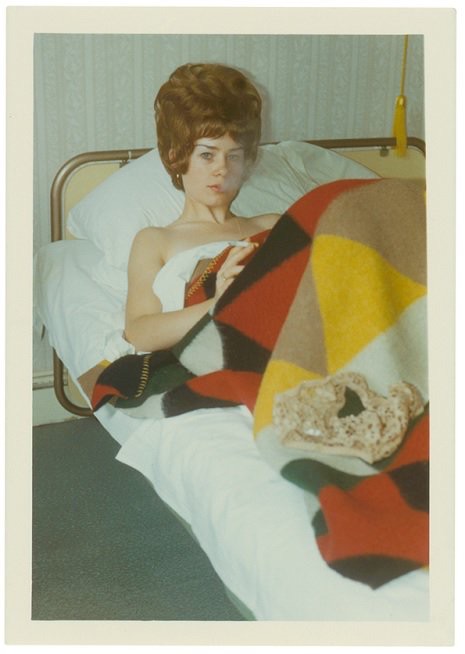
The story on dangerminds.net includes photos that appear as if witnessed circumstantially evident sex acts: indicia of before and after sex. His mistress-secretary peers into the camera, traces of sultry satisfaction hinted in the cigarette and state of partial undress. The spread includes pictures of a dress he bought her and an empty birth control container, artifacts by which we archeologists of his future could infer a story not of a man passionately in love but the age-old story of control and possession, on display–the spoils of the hunt and capture. 


The implicitly contented face of the smoking mistress with the wonderful beehive do, teased to maximum density, in bed, extended in post coital satisfaction, or so the picture hopes to portray from a purely exterior view, showcases the object of the photographer’s gaze, the same man who presumably put that look on her face–the picture of achievement and narcissistic witness to a man’s conquest and testimony to his virility and prowess. The random bits of details surrounding this short affair appear to be important recordings to a man who does not want to forget any detail that he had indeed had this affair.


The power of possession is indeed the story, one of sex as consumerism. The woman is created only as a result of and in control of his gaze, his angle, his lens and his poses. He creates the experience for possession and posterity, and so it will always be captured in the light he chose to produce. No matter that the face of the mistress hides a pretend satisfaction to please the gazer for gain or purposes of her own, if indeed that is the case (the after-sex cigarette as the symbol of the soothing needed after the near-miss or total lack of sexual satisfaction). 


Her story is subsumed in his, overtaken and dissipated into a past disappeared perhaps irretrievably, with respect to this brief affair. Where and how would such a story be told at a time when a mistress meant whore according to the mores of a time less exposed to the real lives of real people, who marry, get bored and fuck others? A portrait of a man falling prey to culturally crafted needs supplants her story: the will to possess women, and emoting through sex, i.e., he cannot please his wife any longer so he will please someone else to make him feel like the socially constructed ideal of a man as provider, conqueror, lover, success, power–all evidenced by his stuff.


Or maybe it is just a curiosity of time and place.


An Old Favorite Mistress Song

When once we lived the juicy life
the summer baked
the autumn fades
you pirate you
to steal away with me
I remember well
you’re drunk again
sweet heart you’ll say
careful there, wipe off your sleeve
don’t go searching very hard
for your other half in me
I recall your first kisses

hiding in the closet from your mrs.
the stern old sage and sensible
is what you see by day
the darkness made you cautious too
but I stopped by anyway
now you’re getting hazy
falling far into a film
I guess I’d better move along

leave you to your private realm

I recall your first kisses
predawn imagination

is all that this is


http://youtu.be/WEAfH85LgBw