The Hunger


Silent morning crashed by knuckled knocking–

“Do you want breakfast?” he asks like clockwork.

A man who eats to fuel his quest for the next meal.
 

I remember the bed and breakfast crawl we made

visiting New England in late fall of the festival trees

the first snow of Vermont outside a barn-turned pub.

 
The magic peppered with the strafing questions like

“Do you want pizza? Are we getting soft serve?”

And we just finished breakfast not even an hour ago.
 

We laughed and sighed heavily too mocking the man.

Mom was herself then and could join in the jeering.

This man she married from birth delivering herself too.

 
Broken windows, airless in vomitous heat of rat breath

this sweat shop he worked in nearly all of his adulthood

feeding too many mouths that barely spoke to his image.
 

He convinced himself from so fateful a day–stay boxed

when only he tripped on the rug pulled under his feet

by friends joy riding days to sweet steals, jobs or dying.

 
A mind goes empty in the cabin of fear dank and dark

communing with foreign tongues, solemn shells of skin.

Like solitary confinement for 48 years, no one remains.

 
So we dwell on the asking, the feeding, breaking bread

we two who watch our center fold in on herself slowly

eking death out slow-steady for lack of a conversation.

 
“No, I already ate,” he hears expectantly but undaunted.

“Come on. You’re too skinny and you need to eat more.”

Words endlessly cut and pasted on a screen of our lives.

 
Other words fly scatter shot red-orange like those trees

the ones in New Hampshire that year we traveled miles

from my rage-ful grimace, head banging steering wheel.

 
Remind me of a father’s daughter teetered on seesaws

lifted by the weighted desire dreamed in obedient love

and grounded earth bound to shackled birthright chains.

 
Invisible strands heated like electric coils of metallic sin

knit our knotted ties seemingly eternal yet dust shallow

as we journey the branches we are and make complete.

 
The insatiable consumption of air heats the moving parts,

wills an engine movement to carry bodies across lands  

upon which fathers and daughters feed the mime of time.


Yo’ Mama

Daddy makes you dance still though brittle bones merely shake not shimmy.

When you were full bloom and wider than the sprig crouch you are now,

you could swivel your hips light on your feet and in sync with the song.

I didn’t inherit your body’s rhythm but I followed the beat of your words,

those words, shiny and adored, I could tell from the way you caressed them

pouring sweet-tongued in pristine ears framing fresh faces of your charges.

And while sparks sizzle out in your eyes cycling the dead grey matter zones

the heat of your humor and the glee of ironic days are frozen inside your skin,

a dead pan face with little recognition and remembrance of those words sharp,

flying shot gun but pinpoint targeted to prick, tickle and touch those of the world,

not the one you inhabit now, some filmy inchoate plane from once you lifted us,

your children whose words now breathe yours in silent days of stiff witness past.

A silent language heard timelessly is a nurturer’s toil and care, archetypal love

coating countless centuries streaming through bodies perpetuating in birth.

Ripped and rattled, torn and repaired, spited and sorrowed, she reawakens

each day renewed from sleep of the dead spirited with ancestral compulsion

and primal tenderness of urgency, survival, the burden of her species’ thruway.

And when she has been sucked dry of her duty, she sinks in immortal cliché.

Happy Belated Birthday Adrienne Rich

An honorable human relationship — that is, one in which two people have the right to use the word “love” — is a process, delicate, violent, often terrifying to both persons involved, a process of refining the truths they can tell each other.

It is important to do this because it breaks down human self-delusion and isolation.

It is important to do this because in doing so we do justice to our own complexity.

It is important to do this because we can count on so few people to go that hard way with us.

BrainPickings


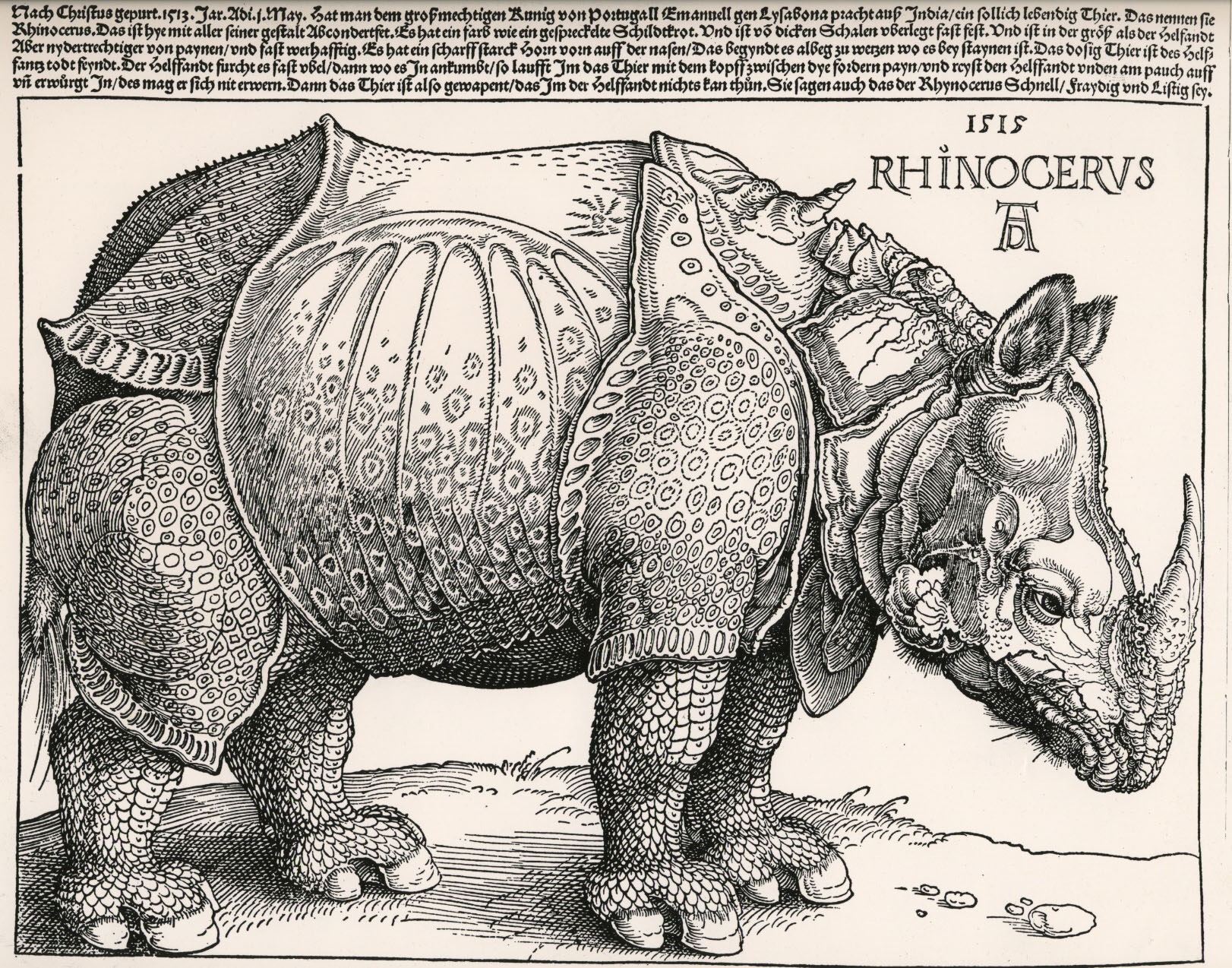
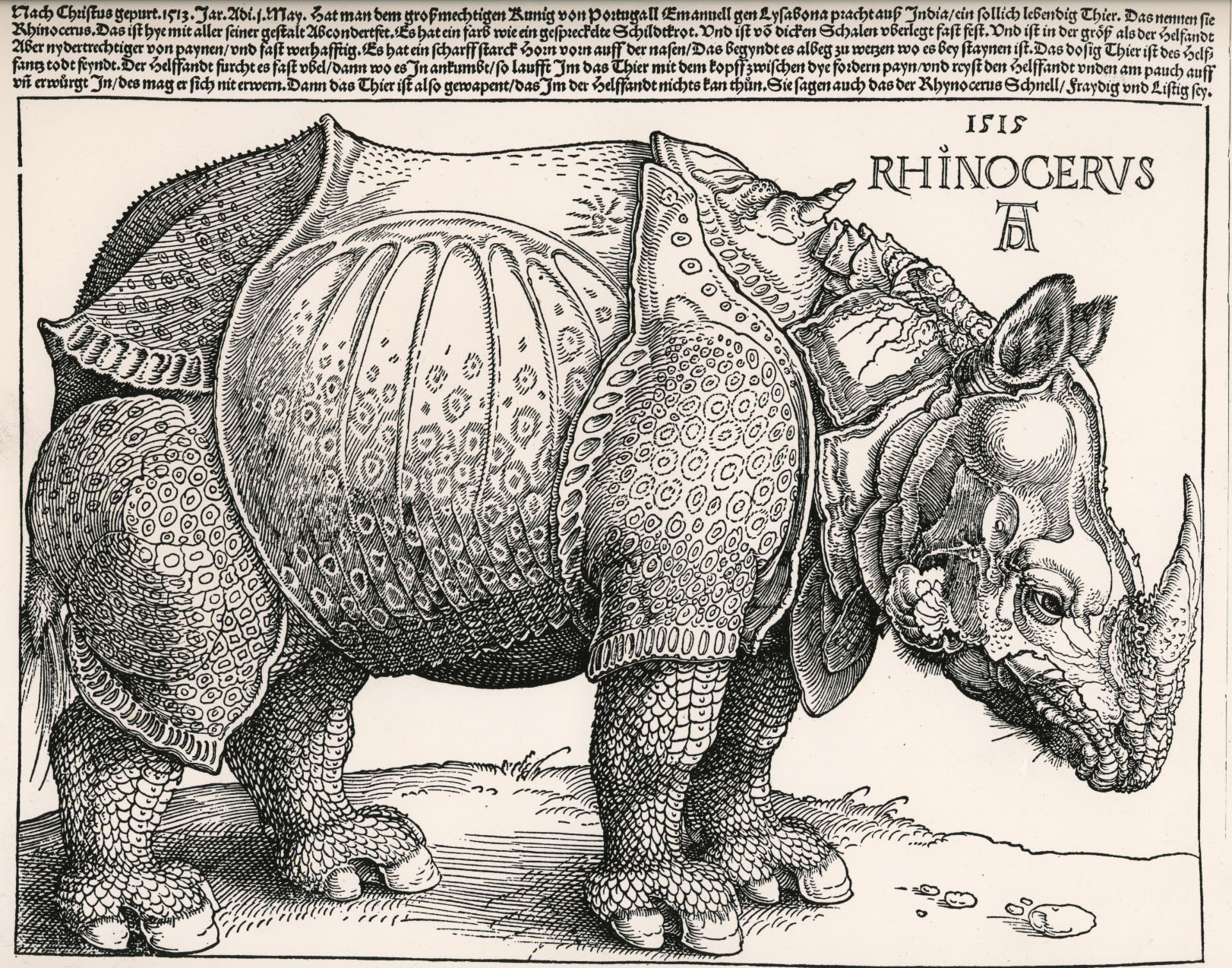
The Will and Testament of the Last Living Fortress 


credit: http://www.rhinoresourcecenter.com/pictures/o/1218990307/Durers-rhino-1515.jpg

Hunkered down, head hung low in modest consternation,

a lonely ever lost lover has forgotten the link to his future.

Huge burden for squat shanks sunk in steely toed hooves

–the line of his kind–for the heart-white tank rests stilled

uncomfortably complex for a survivor’s fatigued fortunes.

The will to seed his fate is buried beneath a tragic query,

the horn of desire splayed as aimed weapon and snared

drum beats pound defeat and despair of all whose greed

swallows a species in unsurrendered satanic usurpation, 

a reply to which singes will: Why do we kill what we love? 

The Music of Ménage a Trois

In reality, it was an unusual but mutually agreeable menage a trois, whose intimacy is reflected in that extraordinary scene of the three of them, side by side in bed, sheltering from Hitler’s aerial bombardment.
Ursula was, in her own words, “fathoms deep in love”, but Williams told her he would never leave Adeline.

So she could only be the “icing on whatever cake he had, and not a disruptive influence”.

The fascinating story of poet Ursula Wood and British composer Ralph Vaughan Williams was the subject of news in 2007 when she died at age 96, having succeeded her once-lover-then-husband by 50 years. She was 38 years his junior when they met at her prompting. At the time, Vaughan Williams was married to Adeline Fisher, cousin of Virginia Woolf, and Ursula to Michael Wood, an officer in the British army. Ursula Wood’s fascination and passionate love at first sight for the composer not only flattered the composer’s naturally roving eye for pretty women, but fueled his dying spirit as caretaker for his inherently cool natured wife who was eventually rendered immobile by rheumatoid arthritis.

When Wood entered the composer’s life, it was not long before the affair between them started. Her presence at the Vaughan Williams household was first legitimated under the auspices as young assistant and caretaker, but Adeline was shrewd enough to be credited with knowing the score. Thus, the excerpt above, which is detailed in The Daily Mail’s article by John Bridcut, as depicting Wood holding the hands of both the composer and his wife during a raid in 1944 by Hitler’s army.


Indeed, on one occasion, Ralph and his wife and Ursula and her husband all met up at the opera for what must have been a most uncomfortable evening, particularly as the opera (Williams’s own Hugh The Drover) was a romantic story of rivals in love.

After Vaughan Williams’ death, then Ursula Vaughan Williams kept the affair discreetly within her memory until her death in 2007 at which time the details were revealed by her own desire to have the true story told. Wood’s biography of her husband also provided the basis of the documentary by Bridcut, released shortly after her death.

Though it is unknown how Adeline felt about the affair right under her nose, by all appearances, however, she tolerated her husband’s relationship most likely knowing that he was a man of passion that she herself could not reciprocate whether due to her own nature or her illness or both. So, it is not far fetched to assume that rather than lose her husband, she accommodated.

Of all three, the story of patience is the most magnificent human attribute fleshed from their ménage a trois: his for caring for the wife he vowed he would not leave despite his love for Ursula, Ursula’s patient caring for both while she longed to be with him, and Adeline’s patient endurance of the love affair right before her eyes that had to hurt. Of the three, I admire Adeline the most for her practical concession of her exclusive rights to her husband’s monogamy, whether that was calculating to her own advantage or wise and charitable love in consideration of her husband’s needs, or both. 

I have maintained before that the mistress role is not easily doffed off with vilified stereotypes of cheating and deception. Sometimes–oftentimes–it is far more complicated with subtleties that reveal the intricacies of human nature adapting to circumstances, a fascinating anthropological, psychological and sociological study.


Love Dance Ritual


Love dance ritual
downright habitual
hello, a kiss
reply, a miss
a mental hiss
Why resist?
the game on
a wink, a stare
returning glare
another beer?
Why not?
It’s clear
you’re here
to pluck my pride
take that ride
think of it now
driving that plow
rich fantasy
in bed with me
skin off my back
oily ass smack
tense smile
stay for awhile?
bar stool bitch
making his pitch
Come play with me?
so good you’ll see.
nothing better for free.
smile in secret
will her submit
what you want
Come on cunt.
Give it up already.
Wait, hold steady.
She’s loosening. 
not leaving
eyeing my crotch?
turn it up a notch
She’s so hot.
need what she’s got
How about dinner
with a winner?
Come on, come on
Let’s get it on.
This play’s too long.
And now she’s gone.
no biggie
She wasn’t pretty.
This one’s hotter
not such a rotter
How ya doin’ tonight?
See the moonlight?
What a great smile.
Been here for awhile?
Buy you a drink?
a leer, a wink
the dating game
just a frame
for the mighty lame
a sad mime
silly rhyme
painted velvet kitch
the love switch
turn me on turn me off
I’ve had enough.

Roses of Song and Myth: the Love Lie

 
Credit:   http://assets2.madewithcolor.com/2014/08/11/17/57/30/934/Marigold_Rose_3.jpg

The rose is not flattery, nor flattered can she be.

Her colors never brighten so with admiration.
Her white is white and pink is pink regardless.
Sun is her food, water her delight and nurture
she needs nothing from hands, no clip or two
no more than her nature designed so provides.

A stem releases bloom from inside itself formed
its patterns deep and wide configured long ago
running through time like speed of sound-light.
The evolution of her growth and being precede
all hands that pluck her bloom from bony bush.
She needs no more than nature draws from her.

For when she is clipped, she poses as love sigh
tall, thorny languor along the chilled lip of glass,
a vase for her thoughts to showcase her beauty.
But hollow and thin she starves on water alone
no earth to feed her fibers, her soft petal velvet 
of colors destined to rot, odiferous swill of death.

The rose bleeds not from thorns as do your gods
for she needs protection from prey; all who harm
love in the name of hunger forcefully feed on her.
The host of vines and verdure are not loving kind
but raw and real as the rain that beats her roots, 
suffers her drowned to make her stand woody by.

Patience and virtue and kindness do not clothe her.
She hangs no myrrh between her breasts to lure.
Nature is not a song for her nor an allegory rhyme.
She fails as ideal and lasts only so long as her DNA.
For her name is rose not love by human confusion
and sings a song the words unknown to mankind.

Leave her an earth that grows her feet strong-free
and make her not your words a sign of loving,
for she is not an idea, symbol or object, no agent.
Neither is she subject or lust or desire or longing.
She is not inspiration, romance or pheromone but
life stuff, permeation, breath, not your philosophy. 

Living by the Numbers

 
credit:  https://danutm.files.wordpress.com/2013/05/big-data.jpg


I am a woman who wades in numbers,
soak myself in abstract configurations;
I jet-stream massage statistics to know,
find the answers, solve the riddle of it,
the non-numerical, innumerable queries
cried in words, a seemingly literary call,
but responsive to figures and values one
of twenty-four-seven and three-hundred
sixty-four in sixty times fifty-two or so set 
give or take, plus or minus, more or less.

“I’ve got your number,” no one ever said,
but clichés are like that, ubiquitous stain
on creativity’s spine like the cafe au lait 
spot on the leg or neck, a birth mark blot,
red, brown or invisibly zero’d out erased.
Countless ones perched in memory slate
have added up the sum total of me, mine,
all I ever was and will be with smug sure 
black and white like chalk on the boards
while flunking 365 true or false quizzes.

But not you, caresser of amassed details,
not data strokes, the airy waves of ideas
you throat-throw in fast, furious pitches
speeding in, aimed as weapon or homer,
at me batting less than top ranking 1000,
an average way below that .264, a mean,
the high and low of its streak of 9 no-hits;
I can never catch up, analyze every word
to track your wins from losses and defeat
the purpose, our aims on par, hole-in-one. 

We sport and play, linger and dally over
tenderous scars and spots, skin wounds
that narrate each misstep, spill or crash
we each separately, singly, absorbed in
seconds of lost sight, a blink of timeless
clicks of the clock in a silent living room
when we were youth without any history
past an endless future of anything goes.
But now, in lengthening hours, sun light
of sinless spins marks us immeasurably.

When you and I are old enough to know
that the feet we were, those inches along
the road miles we never traveled in truth
did not matter as many or few glimpses, 
insights into the relativity of relationships
fleeting and forever moving us in spaces,
places of perspectival generosity, a glee
of open doors, 1, 2 and 3, any alphabet
of understanding what counts, laughter,
touch, dream, a lantern glow in the mist.

I am a woman who drifts by the numbers,
ten by ten, mostly, often two by two-some,
just to tease the moment with complexity,
a game too many of us weak minded play.
“Age doesn’t matter,” you say, yet it does
to those who count; we count on them too
to whisper wordless songs in even tempo,
carrying the tune of eons engraving aural
flesh in a lilting lullaby, humming mindless
motion that apes the arrows of linear time.     

Derek Walcott ‘ s “Love on Love”

LOVE AFTER LOVE

image

The time will come
when, with elation,
you will greet yourself arriving
at your own door, in your own mirror,
and each will smile at the other’s welcome,
and say, sit here. Eat.
You will love again the stranger who was your self.
Give wine. Give bread. Give back your heart
to itself, to the stranger who has loved you

all your life, whom you ignored
for another, who knows you by heart.
Take down the love letters from the bookshelf,

the photographs, the desperate notes,
peel your own image from the mirror.
Sit. Feast on your life