

Rousseau walks on trumpet paths. Joni Mitchell, “The Jungle Line” in Hissing of Summer Lawns.
I always wondered what Joni meant in that line from the “Jungle Line.” At first I thought she meant Jean-Jaques Rousseau, the philosopher of Confessions and The Social Contract fame. In college I read the former and only remember the book as a journal of the man’s affairs, extra marital and political, and wondered why he ranked as an important philsopher since the content seemed trivial. I later revised my opinion after reading The Social Contract, the underpinning of early social justice and democratic government theories.
I once searched for a Rousseau painting with trumpet paths when I realized she referenced the painter not the philosopher/author. I had never seen nor recalled seeing a Rousseau painting and the internet was not at my disposal then. The Hissing of Summer Lawns album came out in 1975. I checked books and found Rousseau’s work, which I found pleasing, colorful and fun. The man appeared to have a sense of humor, squeezed joy from days. Unfortunately, I broke the limited art world I knew then at the ripe old age of 16 as serious and unserious art, Rousseau deemed too childlike to be serious.
Today I read the following:
With a kind of perverse timing, the child’s paradigm emerged in art at just the moment when Newton’s mechanical view of reality was most triumphant. The Chinese yin and yang symbol is a graphic representation of this relationship between opposing principles. The rival viewpoint makes its first tentative appearance at the height of the power of its complementary obverse.
How very appropriate that just before Einstein’s discovery, a naïve artist like Rousseau, whose paintings could be the settings for fairy tales and who routinely distorted forms, would be hailed as one whose view of the world was a valuable contribution! It is an amusing exercise for anyone to specualate upon the reception Rousseau’s work would have received at the court of Lorenzo de’ Medici. Then the Humanists were proclaiming that man was the measure of all things. For a long time, children were not to be trusted to measure anything. Leonard Shlain, Art & Physics
At the tender young age of 55, I understand Rousseau with his child-vision. The world he paints for his audience is important to see, again and again, not just as counterbalance to the cynical, practical world of the adult in politics, technology, science and economics, for instance. But to remember the special conception of space and time that children hold. They experience lengthened time and unconfined space compared to their parents’ lived time-space. Children know the science of happiness instinctively.
Earlier in class, before I read the above Shlain excerpt, I reminded students about child time vs. adult time, temporal elasticity, and technology’s time effects. Hopefully, my stories illustrated time’s illusion, for example experiencing child time as a dragged-along, unwilling captive of Mom’s department store shopping as a 7 year old or an 18 year old sitting in a two-hour lecture course at 7:20 a.m. (mine) as opposed to sleeping or playing/partying with friends for the equivalent time. Time slows or speeds accordingly even as time ticks unceasingly in even increments.
I was not much younger than my students now when I first heard Joni’s lyric and then went searching for Rousseau. And it was only a matter of hours between narrating child-like time visions in the classroom and reading Shlain’s commentary on Rousseau’s yin to Newton’s yang or vice versa, the innocent artist and sophisticated astronomer, ending with the situationally ironic children as the measure of nothing.
I love that the world and mine are round.

credit: wikiart.org
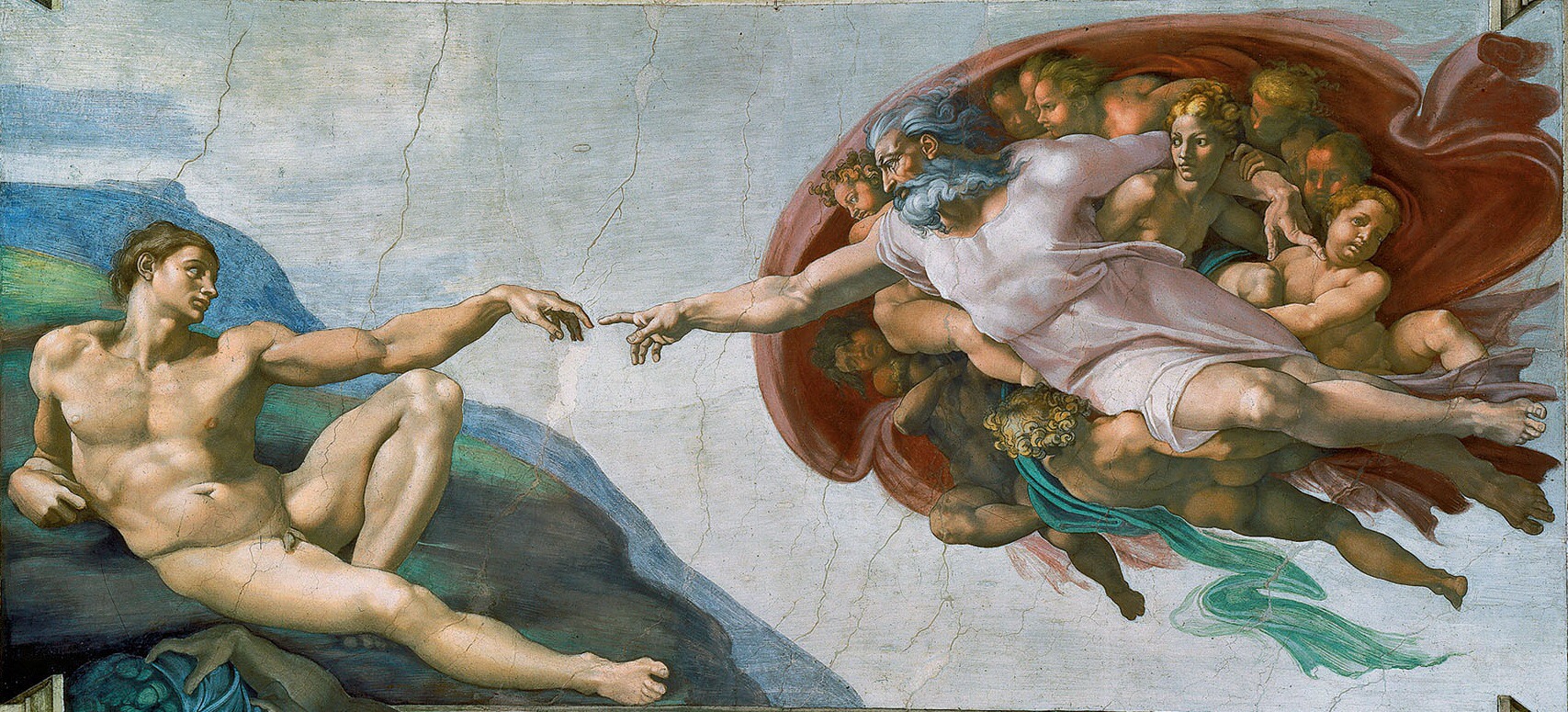
 In the gaze of the other