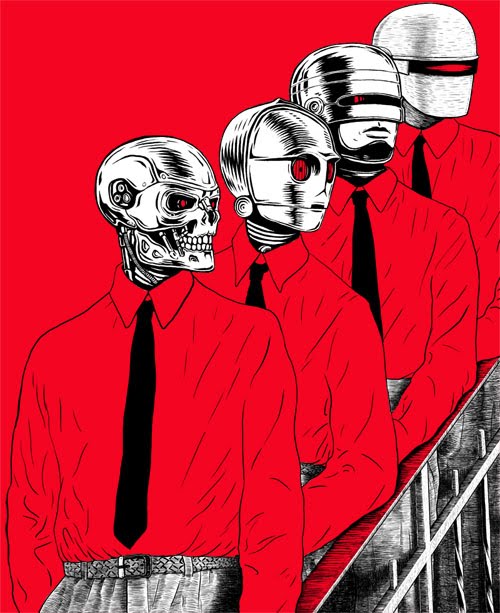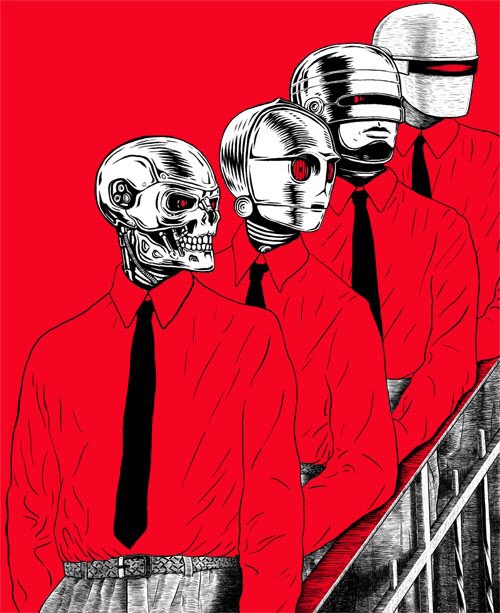
credit: http://www.djfood.org/wp-content/uploads/2012/02/Men-Machines.jpg
…men usually have what they term “single-cue arousability”. Give a man the image of a pair of attractive breasts or a curvy backside and they are half-way to happiness, where women need multiple cues: they are aroused by men who are “attractive and nice to children and self-confident….
I have been wanting to read this text when I first came across the title and recognized the author for his previous studies. However, scanning a few reviews of a new book, Man (Dis)Connected: How Technology Has Sabotaged What it Means to be Male, and What Can be Done, by psychologist, Philip Zimbardo, who “argues that technology, online porn, gaming and sedentary jobs are causing terrible damage to the male psyche,” I cannot help but once again bemoan the insidious perpetuation of stereotypes that net individuals into the indoctrinating tidal wave of culturally predetermined roles.
While I am well aware that psychologists observe human behavior and make prognostications, the collateral effects of Zimbardo’s conclusions in his latest book, although an admirable contribution to the conversation of gender roles amidst social climate change, is to reinforce sedimented stereotypes.
Zimbardo, known for his famously criticized Stanford Prison Experiments, asserts in his book that men are biologically susceptible to falter in a world that promotes less physical work, more sedentary entertainment and less in-person interaction due to technology. Male reliance on online gaming, dating, and pornography in addition to less physically demanding office work has socially retarded men and made them not only obese but ineffective as social beings. He also blames the shift in roles due to feminism as well as other social “ills” or challenges for men as The Telegraph’s Chris Moss summarizes.
It’s when you combine absent fathers, staying at home into early adulthood, video gaming, overreliance on internet porn, obesity (with its associated decline in testosterone and increase in oestrogen) and lack of physical activity, educational failure, joblessness and lack of opportunities for interaction – plus a women’s movement that continues to empower that gender and thrust positive female role models into economic and political arenas – that you have the makings of a screwed-up masculinity with all the wider social consequences that implies.
While I can appreciate Zimbardo’s work, my sensibilities are a bit ruffled at the suggestion that empowering women disempowers men and thereby ominously causes “social consequences” implied by that disempowerment. But why do the implications necessarily bode ill? Intelligent, resilient men, of which there are plenty, certainly realize the freedom from sole breadwinner responsibility results not only in less pressure to perform and be their careers, but also more opportunity to develop other neglected skills and traits long scorned by social necessity due to inherited cultural predispositions.
Just like the current shifted economy squeezes out old patterns of work formulas like the corporate career that ends in a gold watch retirement and forces individual innovation and creativity for survival, so too the breakdown in traditional role models can lead and has led to opportunities for growth emotionally and psychologically through the loss that naturally occurs in evolution. All transitions are an equation of cost and benefits, the pre and aftermath of change.
But the reiteration of steretypical male expectations to be physical and in control, and the remorse suggested in the loss of that attribute and power position, all bundled in a cause and effect legitimacy (we all trust cause and effect, right?), ominously confirms both the stereotypes and the doomsayers who look for feminism to blame for harming men. Pointing the finger at feminism, even as a co-contributor, couched in scientific clout–the psychologist–serves to confirm the current suspicions piled on feminism by some factions as harmful, a disturbance of a centuries old patriarchal order. For some, the byproduct fear and hatred results in injury to women.
The country does not need any more binaries, dichotomies and polarization. Blaming feminism even under the guise of scientific observation does not help men. Bringing men the positive about change that has inevitably occurred and will continue to occur–technology and empowered women–benefits men.
I am hopeful that when I read his text, Dr. Zimbardo will conclude his observations with helpful insights on how to help men adjust.


 In the gaze of the other