So Many Ways to Lose a Daughter


When they were little, headless operations I called them, 

toddling about with no motion detection sensors, 

oblivious to the science of mass in flight against

the immovable object, cause and effect, win and lose, 

I feared losing their pristine purity, their soft roundness

drenched in new flesh, irradiant, to rocks and bumps

in the playground grass or sandbox, opening into

split lips or knobby eggs on their foreheads. I feared

losing them to cars in free fall, driven by madness 

up on my lawn, taking my children with them, like 

the newspaper clipping in the local Starbucks report.

I feared flus and asthma, pneumonia, broken bones

and stitches they could contract or suffer with 

complication and then die in my arms or in their sleep.

I dreamed of kidnappings and wanderings off in 

supermarkets or department store aisles, lost, lost, lost.

I walked them to school the block and a half every day.

And when they were in middle school, I dreaded

the treacherous row of absent-minded, harried

dropping-off moms vs. the brainless, twit t’weeners on

bikes, laughing and careening their wheels into traffic,

caring little for mortality the daily drive threatened

like that boy and his friend on a bike, on the same road,

on the way to school two days before the school year

start, picking up his schedule, leisurely, laughing, 

peddling, looking back at his lagging friend just before

the swerve, the truck, the texting driver, the hit–gone.

I never let them ride their bikes to school, not with that.

I did not want to lose them to twenty somethings’ texts.

Just like I did not want to lose them to drugs, drunk

drivers and AIDS, cancer, concussions or accidents.

I did not want to lose them. And I lost them any way.

To friends, trends, music and driver’s licenses, to

social media and idealism, fierce loyalty and pride of

a generation angry in the wake of destruction their

parents have left them to navigate, chlorinate the gunk

of polluted finance and corrupt opinions and falsity, 

falsity everywhere. I lost them to independence and

opportunity elsewhere, greener, colder, blue-skyed

distant and lonely, free and home away from home.
 

credit: arthistoryarchive.com

The zen of shop mopping

  
Nope, I will not write yet another wax-on-wax-off tale of patience and fortitude–not exactly. I can declare neither hate nor love for mopping to wring a lesson from the chore. And it is a chore, one that ends the night at the frozen yogurt shop after a long or short shift late at night. 

After turning off the “open” sign, I commence the real work of the night: twenty or thirty large and small tasks, including bagging trash, counting money, wiping counters, refrigerating perishables and washing dishes. 

There are tables, chairs, sinks, counters and machines to be wiped down; trash cans to be emptied, collected and dumped; and monitors, lights and signs to be turned off. Food needs to be collected, capped and stored. Money needs counting, sometimes re-counting, and the morning’s drawer calculating. Each of these tasks is not difficult or time-consuming but the sum total of task-to-task and back-to-front activity wears a body down, certainly sucks a mind’s attention down the drain with the dirty dishwasher. On auto-pilot.

So by the time the final chore of the hour before locking the door behind me to the other side where the cool, nearly-midnight air refreshes my sweaty face and tired bones, I am both excited and exhausted at the thought of mopping the entire store, the longest, most arduous chore of the clean up. 

Nearing the finish line, the mind takes the bloodiest beating in a marathon run. Roughed up for miles but patiently ticking the feet and hours away, the mind waits while the body mindlessly erodes. And just when the body gives out, its last shred of fuel expended, grindingly painful, the mind kicks in hard to turn the cogs, shovel the coal of the engine by sheer might and will so the machine will turn and one foot wil continue to be placed in front of the other to inch away toward the most beautiful words ever sported on a banner: “Finish Line.”

The most dangerous place, finish line in sight, is the likeliest place for injury. I want to get it done, sprint past the pain to grab the sweet god-like goal of stopping–to be done actually, not the mental done-ness of being over the whole run, race, challenge, training, preparation and completion thing that occured miles before then. 

But sprinting is foolish. Mistakes are made: a tired sloshy ankle gives way, dizziness or nausea may end the race at the medical tent, or longer recovery time incited by even more ligament and tendon strain than has already been inflicted by the previous 26 miles.

No, the better choice is to keep steady, rein in the mind’s anticipation and body’s blind adrenaline. When I have resisted the lurch–the mad dash to freedom–and kept my pace even and weary-strong, lifting my agonized thighs just a tad higher to lighten my cement feet for a slight spring to my chugging trot, I feel better, less miserable, and more attentive to the faces and cheers around me (a thinned crowd by then). Relishing the moments, I call it.

I do not relish mopping, especially after the mind stultifying hours of lulls and frenzies of retail that leave me aching to go home, actually anywhere far from slung frozen dessert. 

But mopping has its up side. 

Surprisingly, mopping involves a bit of know-how, technique, and physicality. Without a bit of coordination, the mop does not swirl, curl and swoop rhythmically and capaciously. Without the meditative steadiness of pace, space and motion in a dance of short-stepping, weight shifting, forearm tension and bicep propulsion, all in a swivel and sway of calculated spatial coverage, mopping feels and probably looks more like a wrestling match with an unwieldy, dead-weighted dragging opponent. 

Mopping too quickly expends too much energy, produces too much perspiration and inevitably leads to missed spots, besmirching reputation, calling workmanship and thereby a worker’s integrity into question–no pride in her work.

More importantly, however, rushing a mop across a ceramic tile floor deprives the mopper a pleasingly measured assessment of work in progress, a confident chipping away at an expanse, the satisfying glide of wet cloth strands across a slick surface and focused scrutiny of tile by tile smudges. Moreover, the muscle and dance of the mopping, a duet of synchronized synapse and lead-and-follow, is also lost. 

Attention to detail, to each inch of the mop’s path, unfolds appreciation for disappearing dirt slid to clear clean, and the running catalog of muscles fired in the process from wrist, ankles, balls of the feet, toes, calves, thighs, upper and lower back, buttocks, fingers and neck. 

All mindful movement yields connections to the eternal, a presence of doing and being. The deep listening of notice, of attuned awareness tricks time, averts the mind’s eye from pain to stillness–a sort of suspension–suffering to studied observation, a diversion ending in momentary neutrality and connection to the sideways slanting of life. 

Mopping–when the mood is right–takes me there.

Traveling On 

  
Emerging from the mountain forests, Dunsmuir.
 
A few hours’ sleep at a rest stop north of Eugene and we rise early to greet the day bleary-eyed. Hard travel brings back the days of recent college graduate pals taking a road trip across country on $300.00, Michael Jackson’s Thriller playing on cassette the whole way. It was the 80s. 

Passing through Redding, CA, I thought of you Holly and wondered how you fare. I saw your telephone listing for a massage therapist in the Redding White Pages a long time ago, which has not changed–no email address, no Facebook or Twitter listing. Maybe you no longer exist except in a journey I dreamed. 

That trip marked me, the wonder and adventure of freedom: two young girls setting off to see beauty up and down the west coast and across the Rockies to DC where Holly’s pastry chef boyfriend awaited and our fabulous meal at the Watergate Hotel with chef Jean Louis pulling out the culinary stops to impress him. Best meal of my life up til then (not hard given my humble beginnings). The VolksWagen bug Don had us drive, the one built by a friend, gave us hell, but I would not have it any other way. That VW thematizes the adventures and misadventures of youth without plans or time to savor–just doing. 
  
We laughed getting high and chasing deer in the Rockies until Holly got altitude sickness and I was tasked to figure out how I was going to get her out of the field and back to the car. I was so thin then, her too, which was unusual for her. She tended toward the thick. Her green eyes were fierce cat eyes, her brows perpetually shaped in perfect arches, a gift of her mother’s singing praises of electrolysis. 

I still see her putting on lipstick, covering the thin bottom lip and then using that lip to coat the nearly non-existent upper lip. I watched that so many times. I coat my lips the same way, when I wear lipstick, which is not often. And I think of her doing that each time. Amazing how time sticks to the bones of memory, especially from youth. I recall reading that those early incipient memories recall to mind the clearest due to their being memory-etching first-timers, before much clutter dulls a mind to narrowing newness.

  
The green of Holly’s eyes are unmatched to the green everywhere outside Southern California, which refreshes always. Flying into LAX continually reminds me that I live on a desert, brown and brimming in short scrubby smatterings of life thrust. The effusion of greenery near Portland contrasts starkly. Of course the cloudy skies also remind me of why. 

We search for breakfast. Driver’s choice so I prepare myself for sweet, blanched flour French fine pastry.

I have married my father, someone always looking for the next meal, the gourmand’s preoccupation. Only my father feasts at the other end of the culinary spectrum: Burger King hamburgers and fries.
   
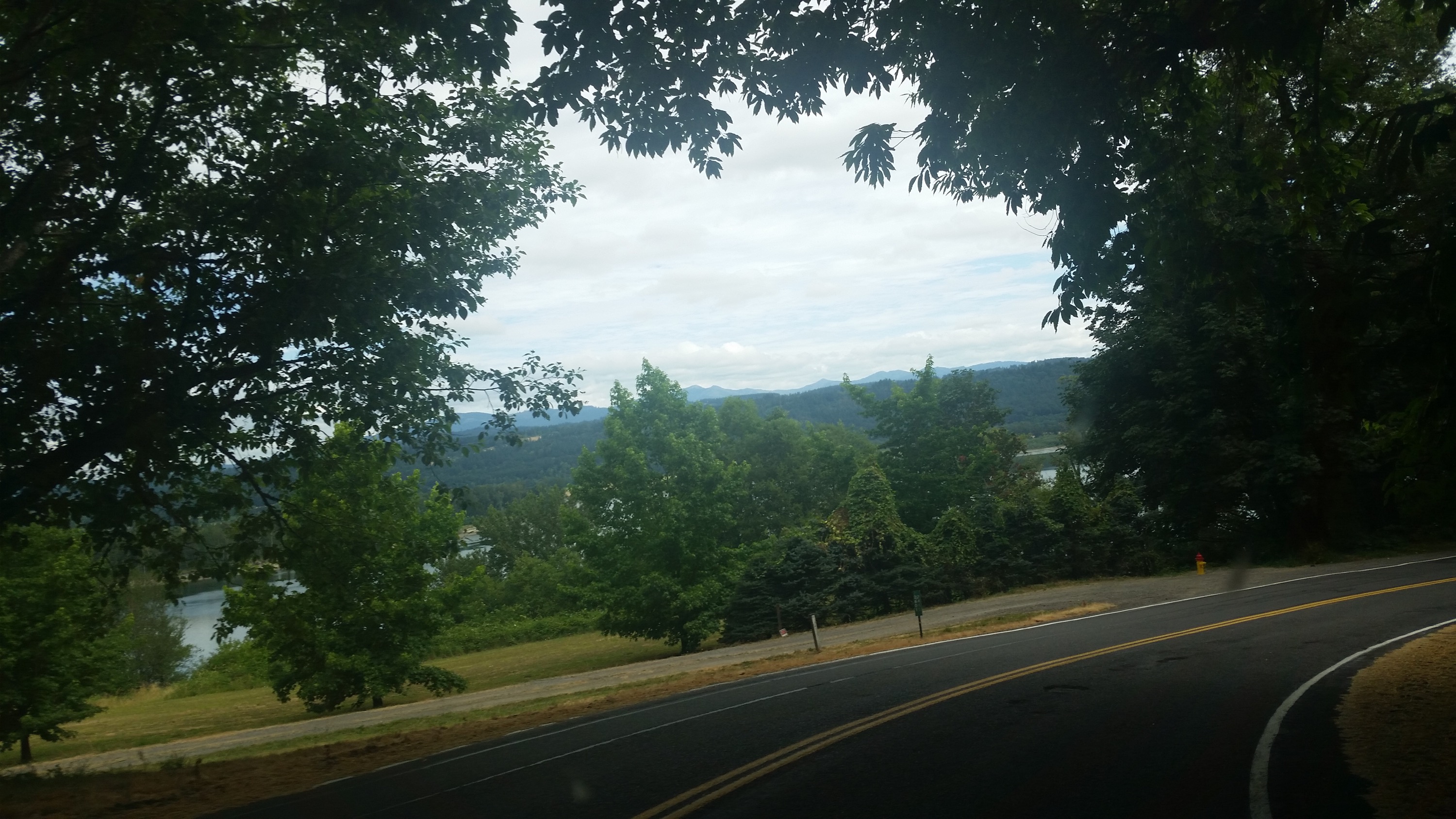
The Columbia River pours by in majestic pines, thick lush Douglas fir lined highways guided magisterially by the Cascade mountain range overlooking its charges. Keep green. Between the Dalles and Hood River, the sun bathes the trees, big leaf maples, Ponderosa pine, cottonwood and Oregon white oak, green glossy frost. The heaviness of the dense foliage leans in to the road with a threatening call. 

Crossing Bonneville dam, the daisies line the road spotty white among the tall wheatland grass and Western hemlock. Mountain crags, humps of black rock jutting through the pines decorating its crown like liberty, pop from nowhwere. Stone walls line a country road nearing the cobblestone bridge. And the clouds hover and stare.

  
Deforestation scars the mountain tops, golden grass exposed through the sparse trees, soldiers left standing in the war against industry, disrespect for the land, chunks of the grab gone for timber. Small vineyards orderly tucked behind a hill also pen the hand of man on nature’s back.

Hairy rocks, like my old man’s shoulders. What grows there on the spiny rocks fungus stained hard knocks of geological story?

4 hours outside Spokane.  

The four hour rest at the truck stop outside of Eugene refreshed what little remains of our spunk and patience. Traveling with two teens and their corny-humored father wears the patience of even saints. I am no saint. I am not remotely patient.

The mugs and the fire burnished hills, repaired by time and patience, sprigs determined to fulfill their seeded destinies. 

The Columbia Gorge, a myriad of textures and vertical measures, scrubbed to ethereal. 

  
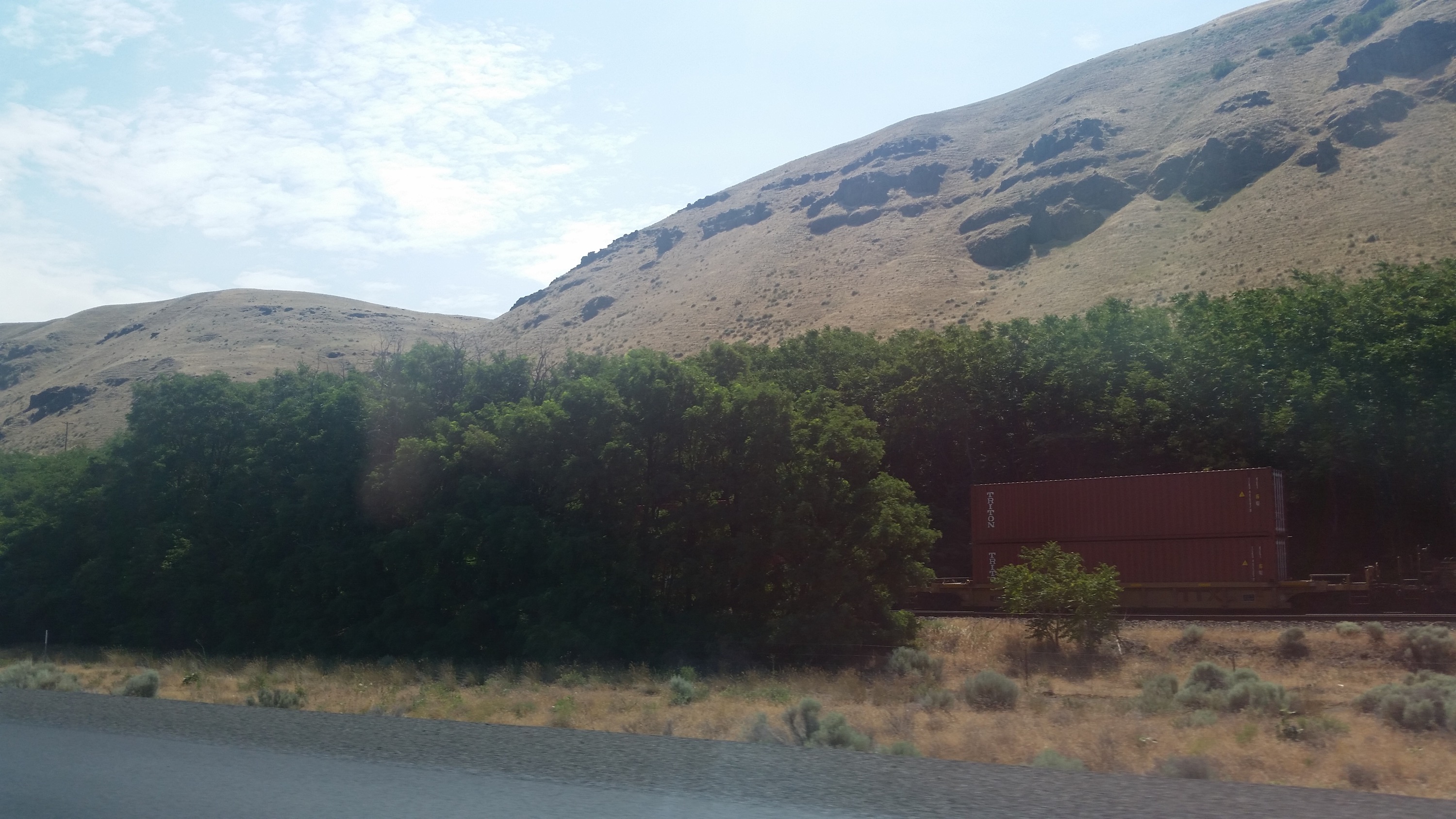
And the sterile blanched wheat colored hills remind us that altitude changes flora. The high desert provides stark contrast to the lush landscape of the Gorge. We must be headed to Spokane soon. 

A huge expanse of farmland and chaparral heading east to Spokane peppered with silos and green houses on near barren landscapes under a great polka dot open sky. The clouds form cotton balls. Water sprinklers look like sin here in a drought. Perhaps Oregon has forgotten our drought. California certainly has not. Water will drive the next world or civil war, I am reminded.

  
And the car ahead contains my two daughters speeding up and leaving us behind. Somehow that seems destined.

The hills are dusted with aqueous green scrub, mid-high interspersed with deep forest greens and kelly greens, hunter and sage too. The nature paint protrays delightful. Somehow I think artifical irrigation is the cause.

Umatilla Irrigon region.

And she is gone. Her sister will wean her these two weeks before returning as the lone twin of upstairs living.

  
He complains of the enormity of it, the lack of planning, the endless driving non-stop, sleepless roadside napping round the clock and the expense of renting a van with its out of state costs, yet the real vastness of disbelief is in her leaving. While nothing is ever permanent and kids go off to college and come back, live back at home, the leaving and living on her own is an indelible shift forever away from the cocoon years that stretched from conception to that first departure. 

She has left her childhood behind for good as the step back in will always be from a distance, a retrospect. Like unringing a bell, she cannot ever live the purity of those flexed years of growing up seamless from birth to first steps, first walking away to another’s hands in school, first kisses, first heartbreaks, and first flights of freedom. Thoughts of self, identity and independence color a life once only colored in coloring books, backyard swimming pools, trips to the candy store or tear-stained shoe box coffins for small beloved hamsters named Hammie. 

  
No, your beef, man, is not with us, our slap dash, rag tag impromptu impossible road trip, the one with endless miles of road bearing insights among the natural sights and blights of countryside and cityscapes of the northwest, sorely needed respite from the daily doldrums of grinding work hours and spatial deprivation you also complain about as likely to kill you. 

And here we are speaking lightly of the shame of it all, the clear cutting demoralizing the Oregon hills along the Columbia, deforestation in the Amazon rain forest and water wasted on the open expanses of thirsty crops along the Washington thoroughfare while our first born worries about being good enough to last, to make it under the pressure of intense competition and her own perceived weaknesses. 

  
Struggle coats our innards, the outside world only the mirror and consequence. 

But I caught a glimpse of wince in you yesterday, the pinched frown of devastating knowledge held in check–but not enough. Despair leaked from your downward cast lower lip and fallen eyes, a momentary slip of the heart spill. 

“You okay?”

“Yeah, it’s just Jordyn leaving.”

“I know.”

And we each look to our respective windows for escape into the landscape upon which we hurl our pain masked in observation, a costume of the fearful. Tears haunt us. Afraid to unleash the avalanche of suffocating cold loneliness threatening to smother us.

9 infidelity ‘things’ and more…

     
Salon’s  9 things you might not know about infidelity is one of those numbered titles that packages tidbits of information from the significant to the pandering. And though the author does a fine job of gathering, presenting and contextualizing (sort of) the information, there is never a question in my mind about the transparent motives of articles like these: seduce readers with and for the numbers.

It is all in the packaging. Lost leaders abound.

Opening sentences handshake the readers to the tone and subject:

Monogamy is a nice idea in theory, but in practice, humans are less adept at it than they might admit. 

Yes, so we have read. The author, Kali Holloway, then launches into the biology of two of the nine “things” such as the correlation between ovulation and frequency of infidelity as well as a lesson on spermatology: the race to the egg is a competition including beating the opponent out of the race altogether. 

Next up, sociology. Having participated in society only in the last 100 years, women surpassed previous records of infidelity running a closer race to cheater men:   

A 2010 study from the National Opinion Research Center found that over the last 20 years, the number of married women who admitted to affairs rose a staggering 40 percent. Which we can all agree is a lot. Nearly 22 percent of men copped to sex outside of marriage, a number that’s remained fairly consistent since 1991. For women, that percentage rose to 14.7 percent. A number of theories are floated for this change, including increased financial independence for women, the fact that women spend more time in co-ed working environments (most affairs begin in the workplace) and changing attitudes around women’s sexuality.

Now this next came as a surprise:

Most cheaters, across the board, don’t get caught. A recent survey found that 89 percent of spouses engaged in extramarital affairs are able to keep their infidelity on the down-low. But women are better at keeping their affairs a secret than men. 

Though it somehow does not surprise me. My theory: most spouses do not want to know (read: denial) or silently sigh a relief in the face of infidelity. I have no numbers to back up that hunch. All I know is, sex is complicated, monogamy or not. Conflicting sexual appetites, ebbing and flowing of phases of the moon as well as the decades, and a hundred and one sexual hangups originating from family, society and biology, all contribute to the complications inherent in trying to maintain interest in, let alone quality or quantity of sex in the long term relationship.

Holloway cites a Forbes interview for the following statement by a dating site CEO in item number 6: 

“You often don’t catch the women. Because women naturally think more contextually. They consider long-term vision and potential consequences much more thoroughly before acting.”

Based on which evidence: anecdotal? experiential? statistical? A CEO?

People who make $75,000 and up are 1.5 times more likely to cheat than those whose annual salaries are $30,000 or less. Those with graduate degrees are also more likely to seek sex outside of marriage, being 1.75 times more likely to have an extramarital affair than people who haven’t graduated high school. Living in a city also ups one’s chances for cheating by a factor of 1.5 times.

The take home from these statistics? The struggle to survive financially takes up too much time–none to spare for the affair. No doubt social values of a society in which the measure of an individual is in the size of his or her wallet has something to do with it. The equation of money to power weighs heavier on those with lower salaries and affects confidence, logically. 

As we near ages that end in zeroes, the chances for infidelity increase.

Mortality. Enough said.

…people who use Twitter every day tend to have shorter relationships than those who don’t, regardless of age. And not that it’s totally germane, but daily tweeters were also more likely to masturbate on a daily basis

Ok, how in the world does one measure that last info-bit and who even thought to ask?

And along the same vein (pun intended), appealing to salacious appetites for the sexual, inane, absurd and obvious:

…penis fractures and extramarital affairs may correlate according to a too-small-to-be-significant study that the author includes–just because–in an otherwise responsible gathering of information on recent infidelity findings. The study authors appear credible, at least, and if they are not as strong as the National Opinion Research Center out of the University of Chicago, the author comments upon that fact.

And while the trend for the numbered article annoys me, caters to the soundbite mentality of pop readership, I too cannot resist the draw of itemization, the buffet of tidbits of data big and small, serious and amusing, but most of all, the back story of the findings, the minds of the surveyors who seek quantification and categorization of minutae and the commonplace. 

The story, for me, breathes in the cracks of the facts, the why’s and wherefore’s.

Pajama Strangle


Barely there, I lurked minutes, days, and hours

pretending meaning lay in dark, around a turn,

ever on the edge of understanding or knowing;

the condition of life, they say, that stretching on.

 
Naked I slept, too roused in a strangled sleep,

a mind refusing to rejuvenate in still idle stop,

pajamas abandoned for safety in the passage

to dreamscapes blind, conspiracy plot defused.

 
Exposed in button down, collared pajama shirts

to snuff a peaceful sleep in twisted neck tubing,

constricting dry breath with a cobra flannel grip,

plastic bullets embedding skin imprinted targets.

 
So, nude I slept, exposed in unsuspecting hours 

by day, vulnerable to negotiate the middle path,

invisibly drawn with white ink on scalloped seas

foamy, colorless and frigid for all the life it holds.
 

There you slept with me hanging on for dear love

afraid to let go even in death to loosen your hold,

your legs enwrapping mine in immobilized sleep

beckoning childhood’s grip on a pajama strangle.


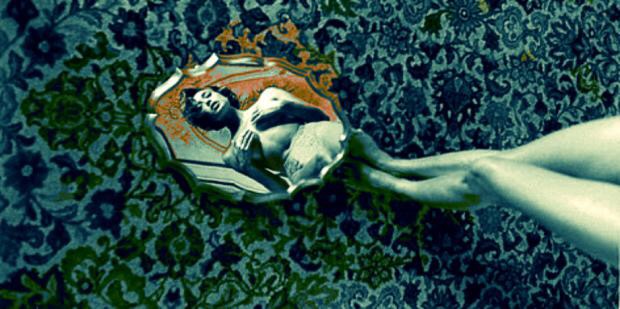
credit: image04.deviantart.net

The Lover’s Leap


I am sorry.
 
I brought her into bed with us again, she who worries 
too much about her breath and her b.o.
 
all the wrinkles of offense, she who cringes at the thought,
the very idea that she may be seen,
 
imperfect as the smoke hiding the fireworks the other day,
left a trail of sooty stink looming,
 
threatening to mar our view, dim the shiny glee of us.
And now you know.
 
Though the end is not the all, not the being or culminating cause,
we were groomed to believe so,
 
such that her presence stays me, stems the flow, ebbing waves,
impenetrable shield, a barrier, firm and illusory, still
 
and empty as the notion that we need to be THE image
the key to keyhole fit
 
when with a flick of a switch, lights on to view the truth
veins and skin and twisted mouth
 
invisibly drawn to be erased in one full sweeping hearty sigh
honestly gut-of-the-mind uttered
 
by body belief in beauty larger than sight
holier than the mountain
 
we delve in for deliverance in undeniably desirous delight
release and respite, fulfilling
 
in its wholeness, this acceptance, this release, 
this trust in blind care
 
for the principle, for the knowledge of us we share 
enfolded, in threaded limbs
 
that nothing but fear she wedges between permeable doors
open-shut as the thought leaping over the falls
 
cascading down an embracing grip caught in the pupils’ deep
in careful sense, fragile fortitude as the spine of a lover.
 
 
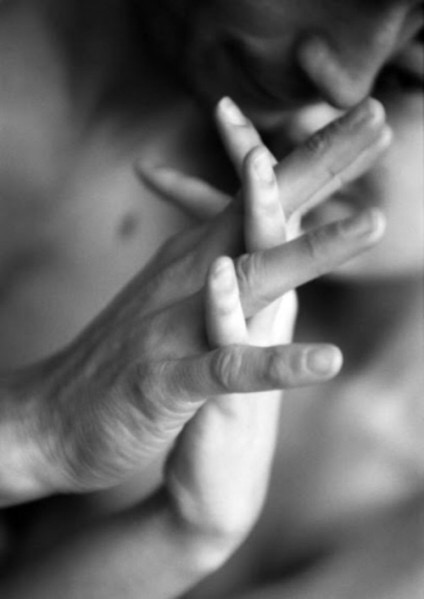
photo credit:  static.yourtango.com 

When You’re a Grown up


My daughter and I were at the frozen yogurt store the other day when we overheard a boy about five years old say to presumably his mother, “I can’t wait til I’m a grownup!” Not exactly sure of the context, but I believe his mother had just conditioned his frozen yogurt choices on being old enough to know what was good for him.

Though the exclamation produced a smile on my face, my 19-year-old-off-to-college-this-week daughter quickly turned to the boy and said, “Don’t rush it, kid. You don’t know what you’re asking for.” And she laughed so as not to terrorize the boy.

I turned to her and asked, “Is it that bad?” She nodded, yes.

I know the anxiety of living away from home for the first time preys on her nerves, playing a checklist of to-do’s and what-if’s in her mind on endless repeat. I feel her.

She and I differ that way. When I left home, I had no thoughts. I left on the sheer will of want: whatever I wanted. It was only after I left that I began to worry as I realized I had no idea how to write a check let alone balance a checkbook. I had only one experience with a bank: a savings account my mother opened for me when I was in junior high, one with a little blue, firm-covered, palm-sized bank book in which to register deposits and withdrawals. I remember how grown up I felt then. But that bank book, regulated by my visions of large purchases and the change in my mother’s purse divided by four, did little to teach me about pooling money in time to pay rent, feed myself and pump gas into my car. 

I learned, especially after a few months of barely living on graham crackers and cottage cheese or peanut butter. A visiting uncle, a psychologist  from Texas, remarked to my mother at one family gathering during that time, “Does she have anorexia?”

Burning by my own mistakes was my way. Still is. So long as they were mine. My mother did little to prepare any of us five children for the world as she protected us–wittingly or unwittingly–from the responsibilities of grown-ups, cocooned as we were in our middle class suburban neighborhood.

Maybe it was the time too. She stayed at home and cooked for us, washed our clothes and poured our milk for us. I remember telling her one day in sudden astonished awareness, “Mom, I’m 12. I can pour my own milk.”

My children did not grow up the same way. Their parents worked and so had to fend for themselves more. Even when I worked from home when they were small, I advocated for their independence. As soon as they were old enough to complain about what was for dinner, I let them know they could make their own if they did not like what was on the menu and then showed them how to use the stove. 

I am not suggesting my kids are not over protected or spoiled in other ways, however. While my parents had no means to buy their children things we nevertheless asked for, my kids have had more money given to them than I had. Growing up in a one-wage factory laborer family, we became accustomed early on to the idea that any material items we wanted would have to be purchased by our own means. I worked mowing lawns, helping my brother deliver newspapers and babysitting from the time I was 8.

My daughters, on the other hand, were raised to believe their grades and sports were their jobs, that they had too many years ahead for the paying jobs that they would eventually have to report to daily. “Don’t rush into working,” I always said.  

So my 19 year old has had a job for a year now; she worked part time while attending the local community college to pay for her car, books, concerts and clothes. I know it has been a stretch, the responsibility, though I know it hasn’t been a shock. She is used to budgeting her time and her resources, having been over-scheduled since she was 6 with soccer practice, piano lessons, school, and whatever the day’s playdates or parties brought.

But it is not the practical how-to’s or what-to-do’s that have her worried about moving out. I know it. She can figure things out, and it isn’t as if she is completely cut from the cord. Smart phones have kept us connected for years now anyhow, near or far. I group text my daughters to come down from their upstairs perches (more like second-story caves) to dinner (when I cook).

Nope. What she fears, I imagine, is what we all do. Doing it herself–whatever it is. The psychological state of being on her own, which prefigures the time when she will be truly on her own, no parents to call upon for a word of advice or a few bucks (or few hundred) to carry her over til payday, is the foundational fear–of death, first others and then her own. 

Not to be too dramatic, but Freud did not get everything wrong. Death and sex are primary human motivators. Everything that drives us is rooted in either or both. 

When my daughter goes off to college, it will symbolize that eventuality (hopefully far down the line) of being on her own without the umbrella of parental love. She will experience it as a mix of anxiety and excitement. And even as she will be making her own love, whether parenting or not, which will occupy enormous space in her mind and heart, she will one day yearn–even if it is just for a moment—for a time when the burdens, seemingly too heavy to bear, were barely perceptible just as they were lurking, unnoticed, above her childhood, as she splashed in an inflatable pool in the backyard and wondered what was for lunch and if she would ever not be bored on endless summer days.

I know I have.

And perhaps my mother, sitting among us near motionless in the skin of a fading light, silently reminds her, also symbolically, that connections run deeper than the physical–etched like the voice that called her to dinner at night all those years of play and idle dreaming. Even when the voices are silenced into memory, beginnings and endings forge life forward even as they fall backward in the marching on. 

Beagleman

  
A man with a short face, not from chin to forehead but tip of the beaky nose to upper lip–not enough distance. The topography of his face is flat as if the effort of blooming a nose and plumping some lips was abandoned half way to finished. The eyes are photoshopped Cancun ridge of the sea blue, but paler, far too brilliant for his age in a hand’s decades, no dullness to the liquid gaze, like polished museum or Madison Avenue marble flooring–a splendorous richesse of gloss. The face is proportionate to the rest of him, distant soccer player traces of a cut angle just below the scapula, a rounded sternum suggesting the brim of a broad chest but for the expansion below that arcs convexly far more than it should beyond the belt. But the semblance of a prime physique resides, the residuals of fitness imports a belated youth to his figure. His name is Beagleman. 
A recent return from the edge of a self-inflicted, imploding dual-minded fury left him enervated and his tawny fatigued suitcase paupered.

On Rebelle Society–my intimate journey to self acceptance

Please visit Rebelle Society to read “my intimate journey to self acceptance” which has been published today. I hope you enjoy it.

Peace

Evan was not my first love. My heart framed in poetry books, I sought love early. By fourteen I had had my first heartbreak and by sixteen, I was initiated to the world of embattled sex my mother fear-burned into me: woman as fortress and men as invader.

It was the 70s and free love was the slogan but not the practice. I was not the only young woman who paid the bodily price of losing what I did not understand I had–self-love, real love.

So when I fell in love with and married a French man a few years later, love was permeated with heady visions of Romantics like Byron and Wordsworth, but sex was informed by the attitudes of Plath and Sexton, hardened and cynical.

In my mind, love and sex were distinct and only the former was indispensable.

I loved Jean-Marc, but we were not so much “in love” as we were good friends. To me, that was more important.

Besides, it was clear I was not his physical type. He had had a girlfriend when I met him in college, a French goddess of natural beauty, as if she emerged from the heather, golden smooth skin delightfully coating her delicate bones and showcasing her eyes of sea blue.

She was the essence of what I deemed poetic femininity at the time. And I was nothing like her, not delicate, soft, supple, petite or graceful. I wasn’t French. I was New York, bookish and big.

But several years into our marriage, I grew thinner, more athletic. I struck a lean, tall figure with improved grace and balance from running and tennis. I had transformed the book worm smoker of pubs and diners around New York to an outdoorsy athletic competitor in California.

When I separated from my husband, I was in the best shape of my life, 28 years old with a hard body everyone noticed but me.

That is when I met Evan.

Evan taught me to love my body. I met him after my husband confessed that he was in love with someone else, a friend he had grown up with in France. Even though that relationship did not pan out, both of us needed time to sort things out.

In reality, the separation between us occurred long before, had been growing inside me. Jean-Marc’s vision of me affected my own. I was a rebound, the consoler and good friend when the goddess dumped him one New Year’s eve.

I was no beauty, but I was comfort.

His eye for aesthetics and style were distinguishing features of my attraction to him but also the very features that attracted him to others, beautiful, lean, olive-complected men I later came to find out.

So why did I choose someone who could not love my body? Over the years, I have considered that question.

Perhaps the body-mind division I fixed early on, prioritizing the intellectual over the physical sublimated my bodily emotions–etched the picture of an unlovely woman in my mind.

But I imagine, poor body image grew out of many seeds: my parents’ relationship, genetics, cultural dictates, social influences and my own love relationships.

Though Jean-Marc and I shared a love that made us grow in the comfort and safety of that umbrella love of young adults, he could not love me intimately, the way a lover sighs at the sight of his beloved’s nakedness. And we couldn’t talk about it for the pain and the guilt. But the elephant in the room nearly crushed me.

Eventually, I was flattened. I no longer had desire–until Evan.

I fell in love with him in a cafe in New York. He spoke soothingly about presence–being present in each moment–and though I had read my zen and Heidegger, I was witnessing the words rather than thinking about them.

He warned me beforehand and then he touched my hand and said, “You’re a writer; describe the experience of my hand.” Of course I didn’t know what he meant; I only said I wanted to be a writer–not that I was–and I was off balance with his touch.

So I described how I felt uneasy with a near stranger’s touch. To which he asked, “Does it feel warm? soft? rough? Can you feel the arced tips of the nails unforgiving yet pleasantly smooth?”

I hadn’t even thought of the physical sensation. I never did. All passed through my mind first and the physical was always sublimated, denied or ignored. Probably why I rarely saw a doctor, going about my business trying not to think of what ailed me.

Later, his first touch of studied tenderness opened my eyes and aroused passion I buried long before I knew its heat, its colorful flavors. He touched me, what was before his eyes, not a projection of me.

And then he took me on a tour of the secret vales and rich verdure of my body. It blazed real love.

Love–true love–is presence in touch; it needs no longing, fantasy, style, grace or poise–merely acceptance in being.

When I embraced my own beauty, uniquely my biological experience, replete with singular angles and curves, scars and splotches, I learned to be heart-wise loved by someone who could love me–all of me–and confirm I was worthy of another’s hand softly sweeping the hair off my brow.

My feminine, I learned, was desire—being—in touch.

How can we ever know how others sense the world? The question should evoke a yearning to find out without the hope of ever doing so. However, it is the practice–the focused being of and with others–that matters. It’s how we connect, avoid loneliness, while maintaining our own integrity.

It is how we find love, real love.

Touch led me from interpreting the world to experiencing it. Getting out of my mind, possessed with others’ formulations of love and sex, and into the moment–breathing presence; it brought me the fullness of acceptance, as a body, my body, with someone else’s.

No, Evan did not teach me acceptance by his touch; eventually, I was able to receive his touch by my own clarity–of space, moment, nearness of another’s presence becoming my own.

He taught me to “see” like the scientists and philosophers and lovers we are–empirically, intellectually and emotionally.

I wasn’t rushing headlong into someone else’s story for me. I had learned to better integrate my body and mind, which took examining inherited perceptions: those of my mother, husband, authors, and culture.

It took practice to own my body. It still does.

And being in the precise moment recalled by someone’s touch–healing in its grounding.

Evan lies next to me now, his pillowed head in the shadow of mine. I am reading, elbow-propped, turned away.

We are prone, bare, having just settled into bed for the night. Humid heat of a New England summer makes flannel impossible and silk torturously sticky. We sleep this way most nights four seasons long.

His body is serpent shape mirror of mine with inches of space between us, creating the comfort of a cooling air canal. We are art in symmetry.

His hand, open palmed, smooths across the contours of my hip, waist and shoulder, smearing heat like oil upon the line of curvy seas in the imagination of his hand–port to starboard to port again. The slow rhythm of his caress lulls my lids to half mast as the warmth and tingling skin sensors combine, dance me to lullaby languor. These are the moments.

I stop reading to softly lower my head to the pillow, ever so slowly, avoiding the slightest ripple in the water of his soliloquy wave. I hold my breath the whole way down.

Releasing, exhaling in measured silent wisps of warm air through my teeth and the pebble O my lips make, anchor hits bottom, the sync of his hypnotic oar undisturbed; it continues to brush the still of my anatomy’s ebb and flow.

I breathe just enough air to live, causing not so much as a flutter-by in the sheets. If I fill my lungs too deeply, selfishly, I will signal sleep’s onslaught, killer of this powerfully peaceful moment of breath, body and hand. No dream could be better than this. I own it–to the coral depths of fibrous memory.