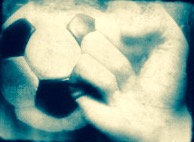
Soon Day

  
A potpourri day of flying bits propelled by a plump sleep’s spell

like a witches incantation, eye of newt mixed with chicken broth,

a bought book long-sought no right-minded would buy on a no frills schedule–

and budget,

a leisurely dine on organic inspiration packaged in creativity’s cellophane–

a culinary conversion,

the bonding built on a daughter’s refined gustatory and intellectual tastes–

a car-ride, stool-side, angular conversation,

a juggle of pockets: dream, work, Rx, plan, execution, to-do, and vitamin D.

Promise pokes a gut-tickle brain as runners aglow recounting prayers of pause rush by. 

Will to Forgive

  
You just bombarded my world, shattered my sheltered piece,

unexpectedly patronizing the safe haven of an employing

menial job away from my usual world of impotent pledges,

places that belonged to another life, another me, and you say,

“Hey, I remember you. I saw you there…from the court”
 

Memorizing the cold inside smile like a lightbulb flash, burnt in air,


scalding the fingernail of an infant size will to forgive.
 

Just pop me back there why don’t you? I’m long sprung now–

for over a year and minding my business, picking up the pieces,

and here you go dragging my ass backwards, sliding me down

there in the dankness and graveyard dreams, the hole of holes.
 

I could hear my heartbeat in my eyes but somewhere receding


like a mote under the metal mattress of my will to forgive.
 

I know you were reprieve, a nice girl, honestly asking, earnest,

wanting to be what I was, aspiring while I was spiraling down,

you upward with your youth, all possibility ahead, to recover, 

re-coup, pop yourself up from a crack-split of a morning that 

caused you to fall, while I was on the downslide, much older

career-weary and worry of the world, on my way out of it.
 

Crushing reason pounded my back and sides of a silhouette stare


piercing the baton flesh of your powerful thump on my will to forgive.
 

But I too have regained my step some and gathered my thin-self.

Only you jarred me out of pretending nothing is or ever was wrong

and “I will forge ahead,” make it like it never happened, reinvent 

myself, my life, and call it a new beginning replete with hope.
 

To the place where I first met you and left you in half smiles


on the sooty bench of ash, our smoldering embers of I will forgive.
 

Until you walked into my store, my place of candy cave-shelter 

to kick me in the flashback and remind me that I am still in it.

In Our Againstness

image

It is easy to be anti.

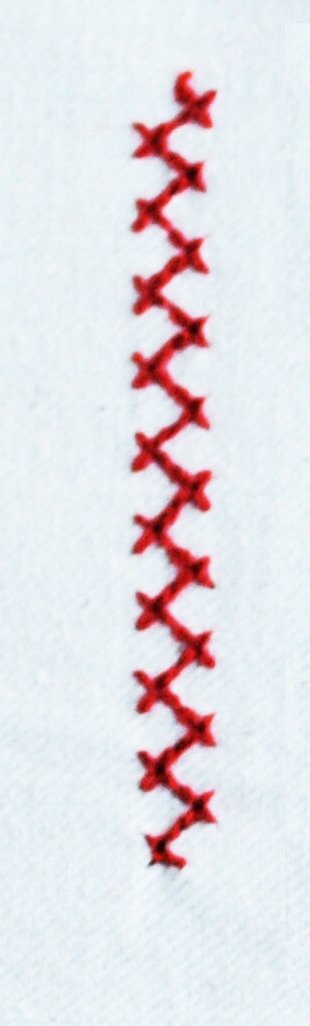
Sew any position,

idea,

suggestion,

politics,

plan,

stance,

ideology,

life-choice,

selection,

belief,

imagination,

project,

offering,

words,

lifestyle,

body,

work,

design,

opinion,

promise,

intuition,

product,

opportunity,

advice,

action,

money,

art,

sensibility,

interest,

heart,

and/or decision;

then find the furthest pole—

the apogee to the perigee,

south to north–

and clothe yourself in it,

wear it like a challenge

and fight, live and die for the right to be it–

cloaked in against-ness.

Far easier than crafting a conscious cushion,

considerately embroidered,

seated somewhere in between,

not necessarily half-way

but somewhere along the imaginary stitching

that traces the path from me to you.

Not compromise but creation.

Lamia Love 

  
I want to draw a picture of what you mean to me 

but I’m a piss poor artist, even with word-brushes.

I want to tell you I cherish you in horrible rhymes 

and uneven meter, broken up with old caesuras,

some lines even you wouldn’t read, you, who open

like a lover’s thighs upon a kiss so sweaty sweeping

one arm that you wrap around my neck like a question.

But there are no images I could draw that would satisfy,

none that would show you in corseted simmering glee,

no photograph of you remembering me remembering 

and reminding me of those lilting moments in chance, 

like when I watched your toes, painted pastel greens,

sink in the sand, like clutching a dream-almost-daylight,

even as you imagined sharks beneath the water’s edge.

And the blue of sky-diving eyes straight into mine, rush,

who can paint that color of flame upon the chill of a sea?
 

We breathe but not with our lungs, only our finger tips

like smoldering ice, the heat of the frozen, we two,

like sailors ever-docked, close enough to smell salt

but not near enough to taste it; that is what it is like

sometimes–to love you–a picture of salt and sea, 

ice and smoke, pucker and blow, lips and madness,

like the drilling seagulls nodding at shadows below.

You are safety and warning, primrose and punches

encircled in the harbored haven of wide pillow tides. 

And I want to do you justice like you do me favors, 

gallop my heart in nursery rhymes and terrifying arches

quaking knees and stammering sonnets of hiccuping

trees branches pulled and bent near to snapping, give

over me like you do sometimes with that leering grin

aiming to frighten me with desire, leaning in and on

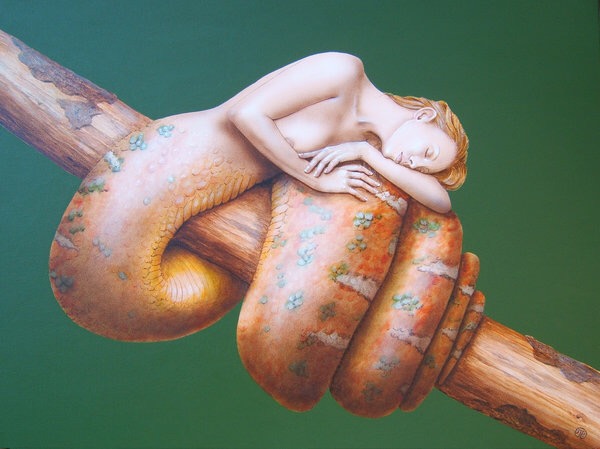
as the sculpted figures of en-marbled lunging Lamia.

 
credit: img12.deviantart.net

Night Reflections: upon returning from the late shift

  
The air smells like parafin, peculiar for a sea town

where the air is thick with briny life, salty and swollen,

a burning candle somewhere aromatizes cottages

suburban slakes of tract homes cut to sidle boulevards.

And the sweat of my back drying astringent-tight

skin shrunken in sere retreat until the morning dew.

It is cool and soothing to be motionless, settling in.

Why the Word ‘Should’ is a Lot Like ‘Stupid’

  
In today’s The Mindful Word appears this personal essay about guilt, obligation and giving, something I started to think about over the week and completed to publication.
 
When are we merely “giving to get something” as Joni Mitchell sings in “People’s Party”?
 
At 55, those delightful yoga sessions that instantly feel delicious deep down in the sinews and muscles, triggering pleasure sensors in the brain, are farther and fewer in between, even in a daily practice. Most days that great good feeling opens up only after slow beginnings, working steadily into full-throttle fluidity and warmth. I treasure those moments of recognizing deep physiological release and mental liberation. My mind soars with my body’s surrender to more, deeper, and longer stretches, everything opening, including …

Read the rest here.

Conversations

  
A woman I know told me, “Do what you love,”
but I loved her and she was taken–with someone else,
so I couldn’t do her.
 
A man with very short hair, shorn I would say, advised,
“Don’t be afraid to let your hair down sometimes.”
My hair was longer than days back then.
 
A fellow friend asked yet again, “If we were lovers,
would we still be friends?”
Friends don’t let friends ask sleazy hypotheticals.


Burned by Tragedy’s Strike

  
Only trying to help, he reached—

with his arms, without his wits, without intention, pure reaction, 

like an impulse, he flew.

And then he landed, crashed.

He came to the rescue but then needed help, 

so much more than anyone could believe, could expect.

Just trying to lend a hand…stop the ball going over the edge, keep the game going, 

everything for the game, the kids, his granddaughter–playing.

Unthinkingly, he, trim-fit-tall and lean for his age, stepped a few, 

lunged, stretched, caught the ball out of bounds, out of the air, 

without hesitation, without strain or struggle, without looking, 

not knowing where he was, how close to the edge, the precipice.

And before the paramedics came, as the game continued, 

the girls playing with wonder, big worried question marks hanging above their heads, 

I slowly, tentatively, nervously peered over the side, 

caught a glimpse.

His crumpled body, or a part of it, I don’t know, 

being too afraid to see what was down below the field, 

down the embankment, he lay there.

And all I could do was shrink back, away, 

and rush to my daughter on the field at the end of the game, 

steer her away, not to go anywhere near there; don’t look.

But whatever I saw stays, 

like destiny or fate or a horror movie scene that really scares the shit out of you, 

so realistic, and yet

this was real, 

his dis-animated figure lying there in some ball or sprawl or head over heels, 

like a toppled monument in the grass, 

Sadam Hussein’s giant statue with the stoic expression on its face unchanging 

as the stone body keeps teetering by the shoving hundreds of hands, tipping, 

and then crashing again and again on replay in the news reels;

I cannot see, can’t summon it up as true, 

like a cartoon soccer grandpa looked frozen in mid-lunge, 

body angled shot from a cannon in goal keeper’s dive for the mid-air ball,

toward the pendulum arc his outstretched arms and the soccer ball configured

against the backdrop of space, sky, 

downward sloping grass and lower-down-the-slope trees,

and then as I saw him there motionless, suspended, 

he disappeared, 

popped into another universe.

A stranger’s shell broken below, 

still and ever so, 

no longer ambulatory, though alive but forever stilled–

his arms, legs, pelvis, neck, chest and heart, 

except for the abysmal ache of regret and enormous question mark:

how to live now, between oh so close to dying and not dead.

Too fucking unfortunately bad for him, the dumb mother fucker, 

his mind still moves–and remembers and remembers. 

Like mine–branded burnt.

And they–lawyers, relatives, investigators, insurance adjustors, soccer fans, and the projectionist

behind my eyeballs–will not let you die in me,

you, a mere artifact, statistic, flattened newspaper clipping, docket number, 

now a symbol, airy thin and translucent like a story never told, 

ancient as memory itself–a living tragedy, chaos confirmed .

Horror and Music


You want horror? I’ll give you horror.
 
You want music? How about a dirge?

How about the feeling of feeling nothing?

Not fear or love or even boredom. Not feeling.

How horrible would that be? Or maybe not.

How about brain tumors and skin cancer?

Who doubts rectal cancer’s horror, rotting from

the inside out, reeking inverted guts exposed?

What about bloat, the Great Dane disease,

their intestines twist-knotting them to death?

And perfect lovers meeting at the worst time,

both stuck inextricably in others’ lifeless lives?

Shattered happiness is horror, potential lost,

Losing a child or a loved one’s murder, terror.

How do you recover from sending your child 

off to school just to find her dead, shot up by

a murderer festering in a room, a closed door

emerging for a brief fatal foray out of alienation?

I cannot write any greater horror. Unimaginable.

How to write horror stories worse than the real?

Controlled horror in letters would play us God.

We can manage and shape–to know the ending. 

To know: Coping with horror is to make it. Write.  

In which we bow and break in bearing it


It’s five minutes before class begins and one student, a mousy girl who twitches occasionally and whispers answers to my questions after I respond to her half-mast upraised tentative hand that must be propped up by the other hand in order to give it any height, says, “I think no one’s here because of the shooting.”
 
The classroom is one third full, not unusual for the hour and time in the semester, about one third of the way through. 
 
I wanted to doff off her suggestion as somewhat silly or illogical to assure her, actually, but as is always the case in teaching college students–or any students–sensitivity is paramount, so I pause a complete second. But in drawing up my response, I immediately flash angrily, “No, probably not. Why wouldn’t they be used to this sort of news by now? After all, mass shootings happen every other day now. It’s just become the new normal.”
 
I immediately regret my callousness.
 
This student has confessed in her second essay written for this class that she suffers from epilepsy, a recent discovery that has left her to picking up pieces, rescuing remnants of her former life that held nothing but unfettered future, the worst day up until then being when an elementary school kid called her a mop-head. She told me her medication affects her memory, slows her.
 
When she confided in me, I thought of my daughter in college two states north from home. She suffers from a recent sport-inflicted concussion, confused and depressed, her mind sluggish and stalling–going on too long now. She fears. I fear.
 
******
Last week at the head of the classroom, I repeated the line from a prose poem assigned for that day, “In the end, we are alone in the house of the heart.” I then asked the students if they thought that was true. Some thought so. Most did not know.
 
I offered my story of watching a cancer patient die, slowly, how, after months of gathering her family around her, then one by one sending each off not to return to her as she got sicker, she hunkered down inside herself the last three weeks, doing the difficult work of dying. It certainly looked like no one could help her do it, that she had to do it alone. To further illustrate, I likened that aloneness to being elbowed in the diaphragm, down on the soccer field, fighting for air. All of the hovering bodies above you as you lie on the ground can do nothing for you–you don’t even see them–as you fight the pain and fear of never breathing, diving deeply inside yourself for that will to bear it, to survive or brave surrender.
 
I thought the dying example was illustrative, poignant. Some stared in reflection, some in emergency-broadcast-test-pattern mode, others in churning liquid emotion. One young man gripped his head in his hands, face hidden, staring down the sheen of the teflon coated desk.
 
My heart winced.