
Science Reveals the Difference Between Ideal, Perceived and Actual Penis Sizes

The best part of this article is the pictures. The rest is pablum. And what’s with the eggplant emoji? Are we really going pseudo science sophomoric on this blog? I ought to be ashamed of myself.
Scribus Mundanus Me

Perhaps you have to be a teacher or know one to smile at this article a good friend sent me today, but I enjoyed seeing myself typecast as a certain type of teacher. Though I have taught my share of literature courses and may have been Libris Scholaris, especially in grad school as a Teacher’s Assistant, guest lecturer or contract lecturer at the university, but I am quintessentially Scribus Mundanus all the way these days, as I stare down a pile of ungraded essays beckoning me to my desk even at this late hour.
John Minichillo on Timothey McSweeney’s blog writes “How to be a Better Teacher-Person Through Apathy: On the Heirarchy of English Professors, a Nonmenclature: Scholar-Type, Teacher-Type and Artist-Type” to illustrate and caricature teachers on this very week of the teacher. I have been all three, but teaching three composition courses this semester and some semesters four or more, I relate to this description:
The second type of English professor is the composition scholar, or teacher-type, Scribis mundanus. They use the word “text” with far less frequency and their obsession lies in “pedagogy,” a word never uttered outside of universities, but a catch-all title that means, broadly, “teaching.” While Libris scholares teach to make a living, so that they can study texts, Scribis mundani have always wanted to teach, and they have a way of resenting other professors who don’t engage in the frequent self-examination of their own teaching practices. They believe in a growth model for teachers, so that they are involved in teacher training and/or disseminating self-assessment tools, and they command their classrooms with a dynamic flair. They are forever pondering goals and outcomes, and will dole out experimental assignments, so that during any given semester the class content, approach, or grading methods of Scribis mundanus may have completely changed from previous semesters. The field of composition developed out of necessity and it’s the new kid on the block. At the beginning of the twentieth century students were interested in literature, and classes were introduced where these students would write “themes” each week, so that these primitive papers became what was graded in the course. Over time, English classes were separated into literature classes and writing classes, and composition was the methodology that grew up around paper writing, which became the subject, whole and entire, of composition classes.
I am a teacher. I am in it to teach. I use the word pedagogy, yes. Reading “texts” and creating art are collateral benefits that go with and develop from the art of teaching. Becoming an expert on others’ writing and teaching others to write, I have improved my own writing. The reciprocity has quite satisfactorily evolved into paid self-enrichment.
Mundanus? Sure, the comp grind, as it is referred to in the biz, has its mind-numbing moments, for example, that pile on my desk that promises endlessly winding, often pointless poor prose as well as the surprise satisfaction of a well-turned phrase. I’m happy merely to find the few that followed the assignment directions. But then I remember that my own writing, discipline and substance have developed over a life-time, several decades. What can I expect in mere weeks?
Maybe the next professor down the comp chain will have better luck weeding out the disorganization in this semester’s crop of students’ harried developing minds and the bad habits cemented over the years. In three weeks, my tenancy with them will be up (except for those who choose to try again with me). And then it’s summer school!
Image Credit: http://www.edweek.org
I’m a Teacher

I visited my father at the hospital this morning right after teaching my Tuesday morning class. In small talk, he asked me if I enjoyed teaching. When he is not at the hospital, which is always, he lives with me, so we have had this conversation before, I am certain. But this is how it is with him. He idles in conversation, never moving forward nor backward.
I said, “Yes, I love teaching.” To which he replied,
“Maybe that’s what you were born to do.”
I had to think about that for a moment. It’s probably true. I don’t believe he was accusing me of being too pedantic. The context did not warrant it. I’m sure I have been accused of that one before. Sure of it.
But he may be right. I have been a teacher or tutor or coach just about all my life from having younger siblings to helping out the kindergarten kids when I was a sixth grader to tutoring sociology in college for pay to side jobs through college as a Berlitz School of Languages instructor to a high school English department reader to a high school English teacher fresh out of college as my job while I finished law school.
I thought I should be a lawyer (my mother always said I should be), but as it turns out, I was always a teacher and returned to it after practicing law for 12 years and have done so ever since.
I have had the great good fortune to teach so many classes, so many, many of them from composition and writing, to American and British Literature, to paralegal and law courses, to creative writing and life story writing, to art and cooking. I coached soccer for nearly 20 years.
So yeah, maybe it’s true. Maybe I was born to teach. I certainly do enough of it. After all these years, I have a knack for it, maybe even a certain talent, though I am equally certain that I am not the best. There are far more organized and structured college instructors than I am. And my ratings on ratemyprofessors.com are an average of mixed reviews. I have been accused of being a tough grader. That is true. One reviewer wrote: “If you’re stupid and you know it, don’t take her class.” I’m not sure what to make of that.
But it’s National Teacher Appreciation week. My students aren’t aware of that, and I am not bound to tell them. But I don’t need to. I am still friends in real life and on Facebook with students I taught in their senior year of high school 32 years ago, professors, business owners and lawyers themselves now. Folks I taught writing tips to ten years back in a class entitled “Writing the Story of Your Life”at a few senior citizen centers down the road 45 minutes are still friends. And dozens of students I see from time to time around town who I’ve taught at the local community college in the last fifteen years have popped up in that amount of time. Kids I coached when they were little are now showing up in my college class room.
I know they appreciate what they learned. Somehow I do. But I don’t think teachers are appreciated enough and in fact, are often ridiculed and belittled as the children they are charged with educating. They certainly are not respected given the status and pay afforded to them in this country. Perhaps that is one reason I felt–against my better instincts–that I should become a lawyer rather than “merely” a teacher when I graduated college. And I have vivid memories of teacher friends having to defend themselves from the old “you have summers off and I wish I had your job” patronizing.
Yet how many of us can remember at least one teacher that influenced them, taught them something and gave them stories to pass on to their own children? We take their continued existence for granted. We take them for granted–except for the one obligatory nod mandated by celebrated days of a week each year in May, primarily in grade school, when kids bring in flowers, apples, mugs, cards or chocolate to their teachers, who smile and fuss in return. I remember my years as room mom in my kids’ classrooms, having to coordinate that event each year as well as the holiday gift in winter and the parting gift in summer.
And I often get Starbucks gift cards or gilded thank you notes at the end of the winter, spring and summer sessions. These are lovely tokens of appreciation. But I also get shorted a class and thus lose my family’s health insurance every five years when the district, state or country suffers budget crises. I’ve been through three of those cycles in fifteen years, sometimes at perilous times in my family’s health history. I am also never guaranteed a class as I do not work under contract, just the good will built over time of performing my job.
This semester was the first in fifteen years that I was paid for office hours, though I hold them throughout the day and night outside my classroom when it ends, at tables on campus, on my way to my other job via telephone and at night when I return via laptop. And I am happy to do so. I love my job. I just wish teaching were as respected and well paid as other jobs with comparable education and training. And the more I teach, the better I am at it, though there is always something to learn as a teacher.
Teaching is in my bones. No doubt. I’m fortunate to do what I love. Remember your teachers this week, most all of them givers–in the spirit of the profession. Hugs to all my teachers, good and bad, for helping build my life and teaching me to pay it forward.
May is National Masturbation Month
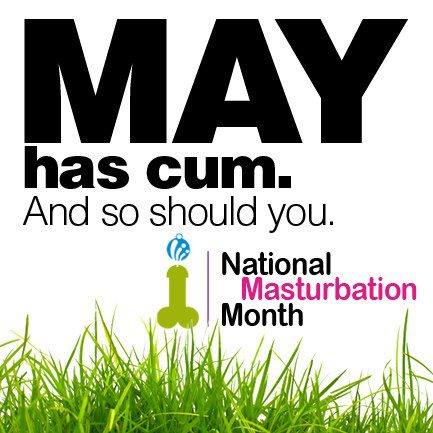
And I wanted to know why. I may be very late on this, but I was not aware of the back story to this national recognition just like great women in history month or Black history month or even yoga month. So how does masturbation earn its month?
So I googled. EmpowHer.com answered thusly:
So how does a hush-hush subject like masturbation get a month of its own? It started in 1995 in San Francisco as a response to the forced resignation of U.S. Surgeon General Joycelyn Elders. After a speech at the United Nations World AIDS Day in 1994, an audience member asked Elders about masturbation’s potential for discouraging early sexual activity. She answered,“I think it is something that is part of human sexuality and a part of something that perhaps should be taught.”
That was the end of the first black Surgeon General’s career, but the beginning of National Masturbation Month. The founders of San Francisco based sex toy and education shop Good Vibrations said, “Enough is enough!” They wanted to do two things: keep up the conversation about Elders unjust firing and make people talk about masturbation.
Good Vibrations recognized many people needed support and advice about the very act of masturbating. One of the first things they had to do is provide reassurance. They made sure people knew it was okay to masturbate in the first place. For so long, shame and stigma have been attached to masturbating. Yet the truth is it is an activity so commonplace, natural, pleasurable and healthy it is said “ninety-eight percent of us masturbate, and the other two percent are liars.”
Not sure about those last stats but the subject does need air time. So how do you celebrate or honor the theme of such a month other than the obvious–doing what cums naturally?
Heritage Now

With fever and chills, my father lies in a hospital bed and
fights invaders ransacking his cells while we, her dad and I,
Share ancestral history over wine and braised Brussels sprouts.
Her father pulls out an album of black and whites painting shades,
Faces that look like his and hers, she who hungrily leafs through
Her fore-figures shepherding precious genetic messages, DNA,
Carried on lines like cargo bins rolling down mining tracks,
Straight to the mountain’s core, our heart’s beating back minutes
Through rock and river, rice paddies and leper camps, continents
And decades all swum, waded through generations of race, religion,
Geography and cultural diaspora, lost at sea; my people roamed.
I tell her we were gypsies and exiles, imperialists and colonizers,
Journalists and piano-tuners, soldiers and artists, musicians
And doctors, lawyers, painters and prisoners; we sailed on ships.
She eats the images page after page flying and flashing ghosts
In pressing drive, primal ranging expansive lust for connection,
An answer to why she is, these cellular haunts flooding her veins.
She wants to know the stories that she belongs to, her threaded
Braide-links to French, Spanish, Vietnamese, Rumanian, Russian, Latvian
and German world walkers. She doesn’t know yet, which link connects them all,
all the grandfather’s fathers and their fathers’ fathers before.
She doesn’t know the whole story and she can never know.
In-Sight

I’ve always been a little far sighted.
I can’t read what’s right in my face
And I can’t face intensely close faces.
It hurts my orientation, my spatiality,
Or maybe it’s intimacy I can’t face,
But I’ve the knack for planning ahead
Far into the future or two moves up.
My sight extends far into the un-here.
Though now, in the waning years, or
Maybe waxing, that is, expanding, my
Sight is delimited, far-sighted and
Near too, somewhere between; really
Not the middle, mean, or average, how
Ever you measure space-time continu-
Um, more like focal clarity of one layer
While the rest blurs snowy opaque and
Blue in relief like sky, sadness or pearls.
I’ve trimmed off layers to the one visible,
My reality carved from seeds and history.
How the rain obscures sight I don’t know,
But I can see clearly how blindness grows.
On the Eve of Yet Another
Sitting across the table from my oldest at our favorite eatery, I could not help seeing what others must have seen in me 36 years ago: a tall, lean vibrant girl with a hyperactive, inquisitive mind and over burdened sense of responsibility for the buoyancy of the conversation.
I love to watch her gesticulating hands, the petulance in her sea green eyes and the force of her concerns and wishes. She is all youth and wonder, strength and conviction.
My own youth is like an old 35 mm flickering reel, some parts skipping in fractured movement. The plot always seems to nearly unfold just as the threads run wild and loose. Just like me to crave the missing cracks, what lies in those stuttered jumps in the movie, however slight and seemingly insignificant.
If I could make a real movie of my teens to twenties, I would splice together actual footage of all the moments, days and weeks of laughter. So much laughter. My friends and I knew how to chuckle and wheeze ourselves into spasms, once we broke the ironic smirks broadcasting our quick savvy and adoptive world weariness.
The range of emotion exaggerated on a face, the wide-open eyes in surprise or indignity, the outstretched fingers flung from the span of taut exasperation palms, I recall to fleeting memories evoked by my daughter’s questioning advice on relationships, friendships and the state of the world.
She asks me who in their right mind would have a kid with our sadly looming future. And at the peak of her voiced question mark, I hear my own 20 year old voice chiming in, silently mouthing the words with her in grainy film footage.
If I squint my reality a tad, she is me.
But on the eve of yet another birthday, one of those off years signaling no milestones, no edges to encroaching decades or mid-split 5’s, I find myself repeating to her: “If I could give you one thing, my most valuable gift, I would export the revelations I gained both wasting time and suffering, just to push your learning curve so far back your starting point advantage would increase the laughing years twenty fold.”
Which always draws a blank green-eyed stare of indulgent tolerance.
By the time she gets it, hopefully I won’t be mere flickering light through film base covered in gelatin emulsion.
I Missed His Birthday, but Raising a Glass to Bill

My mistress’ eyes are nothing like the sun (Sonnet 130)
My mistress’ eyes are nothing like the sun;
Coral is far more red than her lips’ red;
If snow be white, why then her breasts are dun;
If hairs be wires, black wires grow on her head.
I have seen roses damasked, red and white,
But no such roses see I in her cheeks;
And in some perfumes is there more delight
Than in the breath that from my mistress reeks.
I love to hear her speak, yet well I know
That music hath a far more pleasing sound;
I grant I never saw a goddess go;
My mistress when she walks treads on the ground.
     And yet, by heaven, I think my love as rare
     As any she belied with false compare.
Jackhammer Song

An idling chain saw keeps rhythm with my back room dancing patter,
Squaring tables and chopping fruit, two-stepping rectangle long sides
Coloring clear plastic eye-catching berry reds, blues and bumble-black.
Jackhammers turn my thoughts to you, muscle striata crisscrossing
A bare back strained in full throttle and thrust, arms braced at angles.
Broken concrete, that’s what it felt like after I was, you know, set free,
Like nowhere to stand for fear of falling again, in ankle-wrenching cracks.
But there they are to remind me, the construction workers–building–
Repairing the road, pipes or walls, I cannot know from here inside, hearing
And dancing as if I had rhythm or grace, as if I had time to notice and laugh.
Nail guns most certainly sound like giant mutant Swinglines on steroids,
Though no paper stacks so deeply to need stapling, no two-bit bound book,
No, not like the one written to the back of my mind on scraps of bent memory,
Built to last, survive trapped steps danced in a backward line, shot-gun stapled
To the tar in my veins slick and crumble, hardened to the yielding roadway.
The steady machine hum and buzzle constant signal hard hat quitting time.
I hear the spooling of cords and wires rubber squeezed shut like garden hoses
Half circle’d serpentine in yard corners dark and dewy til Sunday mowing comes.
Only hard heads too entrenched in imaginary ditches to quit stay up to feed night
While sweat-stains run down shower drains of fixers and makers gone home.
By the time I turn keys, write pages, push pens on paper, close covers cleaned,
Those early rising sun greeting gritty orange vested denizens of asphalt and dust
Will have set their alarms to pillows, snores, grunts and swear to the sucking stars.
And tomorrow’s dance of rattle and ear-shattering drum will resume without me.
For maybe this night the secrets to staying will keep me there beyond the walls.
 In the gaze of the other