A Letter To My Father’s Mistress

Life as the other woman is just SO hard. You can’t put pictures of your cute little getaways on social media, you can’t brag to all of your friends how awesome your new man is, and you can’t bring him home to meet the folks. Your sleepovers are few and far between and you know you’ll never get that goodnight or good morning text from him because he’s at home with his family. Oh shit — did you forget about those other people? Y’know, his wife? His children? You probably didn’t think it would matter; you probably figured it was just a little affair and we would never find out. We’ll just go on and live the rest of our lives completely unaffected by it, right?

Nope. I am the child of a cheating father and believe me, I’ve been deeply affected by the mistakes you’ve made. In fact the pain that you’ve caused me will follow me for the rest of my life. Soon after my father’s infidelities came to light I struggled with depression, anxiety, and binge drinking — problems that I had never had before you were around. I was in so deep I didn’t realize I was spiraling out of control until I had nearly destroyed my academic career, my friendships and my relationships. The selfish choices you made ruined my whole family. Not just my mom, and not just me or my sister either. But his parents too. His sisters, nieces and nephews. My mom’s sisters and her nieces and nephews. It ruined my relationship with my boyfriend of two years because I couldn’t deal with the stress you caused. People have openly mocked me about my dad being a philanderer and I can’t say anything back because it’s true. Do you have any idea how it feels to come home to your crying, depressed mother and have to be the one to comfort her because of mistakes YOU made? Members of my family (myself included) had mental breakdowns because of the pain that YOU caused. The worst part is that I had to accept you or face the threat of being cut out of my father’s life. Because, after all of this, he’s still crass enough to continue dating you. Yeah, he may have left her, but don’t you dare believe he ever did it for you.

THIS is not a little affair and you’re ruining people’s lives far beyond your own. It’s bad enough to disregard his wife, but the damage you’ve caused me and everyone else will haunt us forever and you will eventually pay for what you’ve done. You can attempt to justify your decision by saying he was unhappy and that, if it weren’t you, he would have probably just cheated with another woman. But it’s not your place to decide “If not me, someone else.” You let it be someone else.

The Coach

An old friend and former lover, the coach laughs with ease and Cheshire grin, inhaling the titters out of me. He is a stocky, dark complected man with large brown eyes gleaming in fear and amusement. He orders his world with hierarchies of God, family, faith and football, with rules and structure, even as he breaks them, breaks others, breaks vows. He is all human. But his heart is mutely echo’d in walls of cotton candied gelatin. The tears well with warm patriotic ardor and weal. Those strong, short arms once enfolded mine, vining around my biceps and wrists, making them fly a simulated soaring flight to the outside of our seedy hotel room, or back of the 79 Mercury or passenger seat of the 73 Beetle, in the park, in my bed. Sucking the world into him like hunger, the coach shouts, stomps, demands, and pushes politely with aggressive passivity, wanting others to love him and resenting them for making him want to impress them. He once said to me with pained realization after I withdrew my hand from his, “You’re cold, ” again proving plays and strategies win the field for the day and lose the love in the long days of getting on with career, raising children and growing old beyond sexual need, into erectile dysfunction and the comfort of the wife who is the worn leather silk of his favorite recliner, the one he couldn’t get out of and so sits way back, softly slouching the last cut, the remnants of the breadth of his shoulders, the line of resolution and absolution his neck and the round of his blades make. Now the coach stands loudly among his charges but has slunk from site from where he sidled up against the trunk of my hips for so long, now receded, ever in retreat. Give the wave, the signal. Hide behind semblance of distinction and cower before the potential exposure of the lie that dresses you up each morning. Yet your killing kindness and funny frailty draw my memories to the temperate comfort of forgotten forgiveness. No words. Peace.

Your Wishes Untrue

image
Be mindful of wishing, careful with wanting.
The love you seek for warmth might overheat,
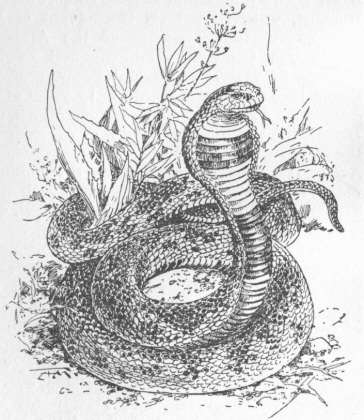
asp you in snuggle, strangling your sleep.
Be careful of what you wish for.
The vision of ever after with one love
may poison your spirit, hamper your peace
to think your own, think your thoughts
about everything from jihad to football to
brushing your teeth while watching t.v.
When wishing for one who windows your heart,
un lassos your long labial lust and
dances your daylight, flexible and loose,
don’t jail up in jealousy, secrete in sulking sorrow
or lay yourself down with loneliness
when she is loving you and the world,
living her life in joy without need, you or
an other, only enwrapping you in wide arms,
mind and heart. She is open.
Like her wandering will, she is free like words
she water colors and the sighs she speaks.
She is. Beware the love you dream in her.

Mecoptera Marxist Mistress (Sex as Commerce)

image

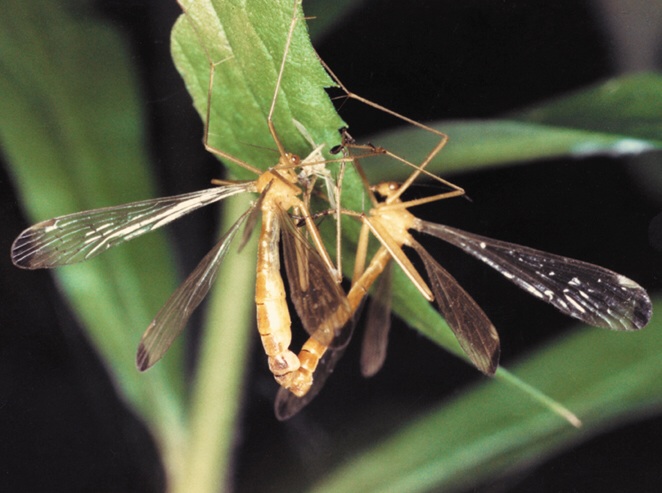
“Food items such as caterpillars, bugs, and flies are offered to be eaten during copulation. The female is first attracted by a pheromone emitted by one or more vesicles or pouches at the end of the male’s abdomen. When the female is near, the vesicles are retracted. The female examines the offering while the male searches for her genitalia with his own. If the gift is rejected, the female flies away. If the gift is accepted, the genitalia of the male couples with that of the female, who lowers herself until she is hanging upside down. She consumes the offering during copulation. The male supports the female by holding her legs or the prey. Field observations show that both sexes mate several times per day. Small or unacceptable offerings result in no or a very short copulation time. Duration depends on the size of the gift. It has been observed that prey 3 to 14 mm long will provide 1 to 17 minutes of copulation in Hylobittacus apicalis. Larger H. apicalis give prey the size of houseflies in return for 20 to 29 minutes of copulation. This results in a maximum sperm transfer, increased oviposition, and a refractory period.” en.m.Wikipedia.org/wiki/Mecoptera

Three and Four

There are three who see me one who has not.
Four lovelorn in glee and sorrow share my lot.
One eyes me in the morning when I awaken.
Another looks to me for lunch time after ten.
Then there is high tea time tender one at four.
But one who meets me in darkness sees more.

Four who wonder where I have been stay true.
Three high limbs of the tree to share the view.
All have always been there prying at the door.
While none stay they sail from bay to shore.
Though two have left for lands far to the north.
Only one dims the light house and sees more.

There are three who bring me corpses to eat.
Four gallant greys who dance me complete.
No others can stand in none take their place.
For there are three to widen my arms’ embrace.
False lovers true friends there are three not four.
Yet one in blind reflective eyes I see me more.

Chekhov on His Mistresses

Medicine is my lawful wife, and literature is my mistress. When I get fed up with one, I spend the night with the other. Though it is irregular, it is less boring this way, and besides, neither of them loses anything through my infidelity.

Anton Chekhov
image

To His Coy Mistress by Andrew Marvell

Had we but world enough and time,
This coyness, lady, were no crime.
We would sit down, and think which way
To walk, and pass our long love’s day.
Thou by the Indian Ganges’ side
Shouldst rubies find; I by the tide
Of Humber would complain. I would
Love you ten years before the flood,
And you should, if you please, refuse
Till the conversion of the Jews.
My vegetable love should grow
Vaster than empires and more slow;
An hundred years should go to praise
Thine eyes, and on thy forehead gaze;
Two hundred to adore each breast,
But thirty thousand to the rest;
An age at least to every part,
And the last age should show your heart.
For, lady, you deserve this state,
Nor would I love at lower rate.
But at my back I always hear
Time’s wingèd chariot hurrying near;
And yonder all before us lie
Deserts of vast eternity.
Thy beauty shall no more be found;
Nor, in thy marble vault, shall sound
My echoing song; then worms shall try
That long-preserved virginity,
And your quaint honour turn to dust,
And into ashes all my lust;
The grave’s a fine and private place,
But none, I think, do there embrace.
Now therefore, while the youthful hue
Sits on thy skin like morning dew,
And while thy willing soul transpires
At every pore with instant fires,
Now let us sport us while we may,
And now, like amorous birds of prey,
Rather at once our time devour
Than languish in his slow-chapped power.
Let us roll all our strength and all
Our sweetness up into one ball,
And tear our pleasures with rough strife
Thorough the iron gates of life:
Thus, though we cannot make our sun
Stand still, yet we will make him run.

Hieronymus Bosch’s The Conjurer

image

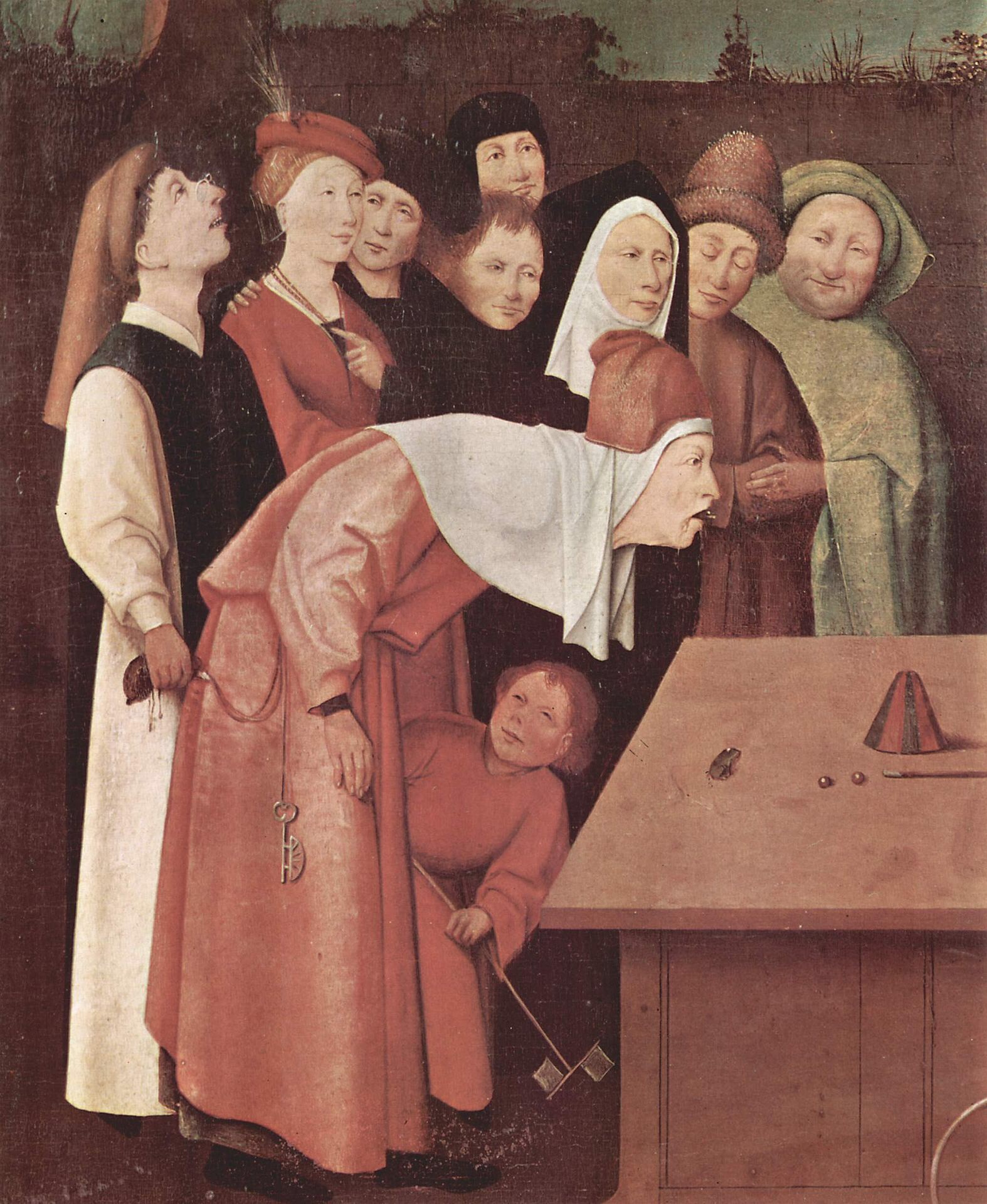
Notice the gaze of the woman in green who watches the gazing subject. This is the moment of capture and insight for the viewer; the awareness of being seen by another and what that brings to mind, though the subject of the gaze here is unaware, is the production of self in another’s gaze. The exchange is palpable.

Words That Matter (the word remains the thing)

Words That Matter (the words remain the thing)

image

You speak my language, my native tongue, English. To lay those English sentences down, it takes a subject, verb and object. That is the structure. That is how we make sense of things, and it is important that we do. Otherwise, we would be wallowing in the morass of uncoded conceptions and emotions. We would act almost always in anger. Words that form sentences matter, create ideas, images and bodies, so it is of upper most importance that the words are formed correctly–with precision and conciseness, following a decipherable and familiar pattern. You get that. And it starts with a subject, or often does, the focus of the missive.

We have tossed around many subjects, some drifting on to paper or keyboard, some merely dissipating into air, but so many subjects of sentences, so many sentences. We talk. We write. Subjects such as literacy and love, war and music, health and art, and all range of matters in between pass between us in breath and beamed icons and pictures. Ideas stimulate our minds and bodies, bodies that matter, words that form bodies that matter, not mere objects.

But getting back to subjects we form, the sentences that begin with the subject “I”, meaning “he” or “she”, “you” or “me”, seize attention. My head turns in the direction of the mouth from which the sentence is about to form. Your eyes widen. What does she want? What does he need? The pronoun produces endless possibility, endless speculation about the mere physical presence and perpetuation of life, another life before each of us, breathing, eating, shitting, sexing, as well as the psycho-emotional, loving, hurting, sensing, dying. What will the sentence bring?

The worst one begins, “I have something to tell you,” especially if it begins with the pronoun and then pauses, freeze framed in fear for the speaker and the listener alike. Like running into a loose dog in the park that you hadn’t seen but all of the sudden spy just at the periphery of your previously straight sight on your path, on the way to your destination, you stop, suspended in time for seconds to turn up those senses you rarely perceive, the acute ones ratcheted up to superhuman strength in order to listen to danger in your finger tips or smell fear with your eyes. Will he strike or let me pass? The seconds of ice sculpted figures in time, you on the path and the narrowed eyes of the supposed beast behind the tree, enlarge space and moment, dive into the essence of living, of human. It means life in so far as it is a suspension of time elapsing at the end of which something will be known, the stretch between the idea of something and the knowing of it. But the knowing does not ease the dread. No one wants to die, be wounded, senseless as that is. Not all sentences that begin with foreboding turn out to be perilous.

The sentences that begin with subjects that are merely nouns are the most entertaining. There is no attachment, or at least there doesn’t have to be. To start a sentence with “The war…” is one that divides, gets listeners prepared to be het up. No matter what, there is going to be engagement, disengagement, injury, surrender, and the like, but no one really needs to get hurt, no one with presence of mind to understand that the killing and dying and injustice are out there in space, even if it is occurring in the neighborhood. I am not saying there is no fear. There is. But the words formed, the mere act of forming those words, means the speaker or writer is with an audience and the war is an idea. Both or all are alive. The rest is in forming the right sentences that contain the most effective verbs to produce the right action. You see? Keep pronouns out of the sentence, and the subject is not real, merely notion, possibility or speculation; sometimes it is a call to action.

Unlike Chinese, English is a verb-oriented language, emphasizing states of action as opposed to a noun-oriented language, which water colors states of being across the silken screen of sentience in vertical word pictures. The verbs in English are thought to be the meat of the English sentence, but I disagree. Verbs are action, doing, even when there is very little movement going on, like being, feeling, postulating and sensing. But I believe the sentence’s weight, what matters, is the body of the sentence, the subject, the pronoun or noun, whether proper, common or gerund. Some would say the body is the predicate, which contains the verb, and the head, the direction or focus, is the subject. I disagree. The sentence could begin and end with “I”, “you”, he”, “she” or “it”. To me, those matter. They do. They are. You are not what you do. You matter there as mass of tendons, sinews and neurons; it matters as brick, mortar and steel. It does.

And sentences with objects, those are tricky. What we do with objects–do to object–and who we objectify is problematic. An object can turn a sentence inside out, turn back on itself, whether passively or actively. “I don’t like you” is a sentence with an object, an object that is distanced from the subject by legions and the division is clear, one of thick emotional boundary. Objects are others, polarizing, because objects that are one with us are only thought of as self; however, ordinary objects, the way we think of them every day, every moment of the day, and the way we think of ourselves is as the self–one thing–separate and apart from others, other people and things, other objects. We objectify ourselves and others, as if they were the earth and the sky, the lake and the dock, the murderer and the victim, the heart and the mind–opposites, contingent, contiguous, adjacent–but sometimes a part, never object and subject as one.

The sentence “I don’t like you” does not make sense without the emoter, without the I. Though we sometimes speak like that, cowering before our own emotion…don’t like you. Eliminating the pronoun forces us to silently hear the pronoun that is not uttered, and the speaker or writer elides it perhaps because the emotion is distasteful to the “I” or the “I” is uncomfortable with the anticipated reaction or feelings of the objectified target of the missile. He feels guilt or projects rejection. The missing pronoun lets him off the hook. There is no “I” who dislikes, just the disliking.

But creating objects shows a failure of understanding. There are no objects. Objects should not be standard for sentences. I like that sentences can be formed without objects: I am. He lives. You sleep. Too many sentences need objects; too many people need canvases on which to spray, drip, brush or project their emotions, ideas, and secretions. Imagine a world without objects, only subjects. Where would our minds go?

I think you know the answer. Or if you don’t, you understand the question. We speak the same language, even though we use the same words only to come up with different interpretations, conclusions and impressions. We misunderstand each other often, you creating me with words, forming my body, my needs, my goals, while I do the same for you. I paint you as the man who needs all three of me, and you draw the figure of curvaceous kitten who drinks the milk of many. We are both wrong, abuse language, and are poor artists, poor proofreaders, though fine editors. I am not embarrassed to revise and neither are you, brave enough not to forego failure. So, I misread, misspeak, misstep. We forgive. Sentences there are a plenty to spew, erase, craft and polish. They are our trade and livelihood.

The question of subject and object preoccupies me, though. The manic attempt to merge, to merge and merge and merge, is futile effort like banging your head on concretions when you should be hammocking in abstractions. You say it is the moment, the glimpse of nirvana, but you have reversed it all, turned it inside out and now the verb is all I can think of. To merge is–and you know this–an acknowledgment that we are not one. Can you be matter, stand there before me, naked or clothed, smiling or frowning, eyes rolled back in ecstasy or fury, and not be my Frankenstein? We meet in a pun, the wink of words. Our tongues touch, licking tips of twists of irony or singeing sarcasm. I create your desire, your will to live. I write you. You speak me. Like genies from the bottle we appear limitless, magical and wish-come-true filled, what we have been waiting for. But fantasy is another story. Only we are the stories that we tell, the matter, you writing yours, me mine in poems, conversations and fiction flashes.

It starts with the sentence–subject and verb. Contractions and commas, flow of phrases and long, listing strands of wispy parts of speech dotting the shoreline, shells in the sand, stars in the sky, they precede, intercede and succeed. The space between each shell, each star, each word, is the mystery, the place without object, the place of matter and no matter, no idea of what it could be, what matters. A place no word can contain, no thought can hold is the reason for the unreality of objects. The empty linguistic space is not nirvana nor is it non-space. There are no words. You know that. We speak the same language. Let’s go there.

42 Years a Secret Mistress

image
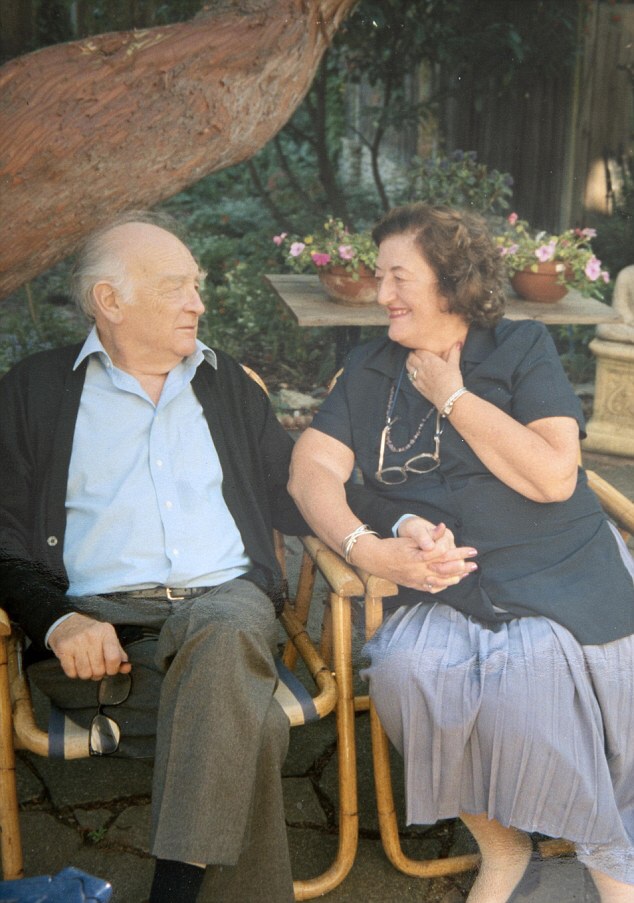
A journalist and mistress of 42 years writes lovingly but not without misgivings about her life as the other to the only lover she had. Look closely at the psyche of the mistress as she grapples with love, pride, joy, guilt and regret. Her role is complex and sheds light on the mistress in all people who indulge in their greatest, most illicit (by society’s mores) loves or lusts whether that be music, poetry, sex, drugs or chocolate, to name a few. The joy that causes pain, the guilt and responsibility to community, to an other, and deep desire cast shadows on a lifetime of love. Truth and honesty are always in the forefront of the sacrifice in being the mistress, expecting and not daring to expect either or both. This author writes herself well.

http://www.dailymail.co.uk/femail/article-2541643/I-secret-mistress-42-years-Why-one-womans-enduring-passion-married-Zulu-screenwriter-John-Prebble-left-haunted-regret.html

Re: Conciliation

image
You are wronged.
You ache so hard your tissue, your blood and beat,
folds in on itself and webs sound,
is the harrowing howl of hammered heart,
the sonorous bass that crashes rhythmic pump,
disrupting the steady, even equanimity,
even dull ticking of your world–
your imagined world–yours and his. Momentarily.
But the rest is long drift, the ebb and flow of hurt and healing.
Some wounds stay raw and open: the scars of lacerated trust,
open and gushing the glutinous lava,
melted rock of your mountain marriage,
the very fount of your avowed–out loud–couplehood.
And the plane of aftermath is sterile, once again stable.
You limp long on broken legged love, on parenthood and promise,
collapsing back into the other when gravity and hormone shifts
make peace appear right in resignation and ennervation.
For you fear no one will hear your last breath.
The hum of the daily feels like presence,
but the cataracts of dream, of your curt kindness,
are but steadying, the leveling of love,
after the fall and the gratitude for life
unending of upheaving insecurity unlived.