
The Power of Empathy

/home/wpcom/public_html/wp-content/blogs.dir/e19/64332962/files/2014/12/img_0306.jpg
credit: http://inspiremykids.com

I enjoyed this short from Collective Evolution featured in a Psychology Today article in April, 2014, on the difference between empathy and sympathy and so share it with readers today.

While most of us know the meaning of the two words and do not need an animated short to teach us, a subtle reminder about the power placement inherent in these two terms is beautifully and simply elucidated in this short.

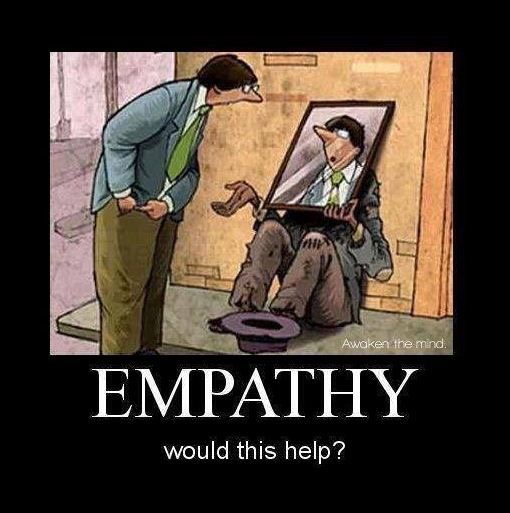
The two terms have always been distinguished in my mind by power. The position of the giver and receiver of sympathy as opposed to empathy is quite different. I picture it as a gazing down at another versus a locking eyes with another.

Sympathy is synonymous to pity. Pity describes an emotion derived from a feeling of superiority, even though the intention of the pitier is to give relief and express care. More often than not, however, the pitied is treated as an object, one that makes another compelled to react as if the object of pity was drawing something from the onlooker. A person who suffers from whatever misfortune of accident or fate or foolishness, is, while in the throes of such misfortune, viewed as less than in some way, less than the one who is not suffering misfortune. The sympathizer distances him or herself from the misfortune and offers sympathy to the other, possibly feeling uncomfortable with the reminder of everyone’s vulnerability to life’s unexpected or expected cruelties.

My associations with the two words is not dispositive, however. Oxford Dictionaries defines sympathy as:

1Feelings of pity and sorrow for someone else’s misfortune:
they had great sympathy for the flood victims

SYNONYMS
1.1 (one’s sympathies) The formal expression of pity or sorrow for someone else’s misfortune; condolences:

2Understanding between people; common feeling:
the special sympathy between the two boys was obvious to all

And empathy as:

The ability to understand and share the feelings of another.

These two definitions are not very enlightening because the terms are defined equivalently; the Urban Dictionary is clearer as to empathy:

Empathy
1. The ability to identify with and understand somebody else’s feelings or difficulties.

2. The transfer of somebody’s own feelings and emotions to an object such as a painting.

Where Oxford fails, Urban prevails. The clear distinction between the two terms is power–sympathizers judge:

sympathy
Sympathy differs from empathy in the following ways:

With sympathy, the helper:

Helps within his/her comfort zone
Makes a cursory judgment of the person’s needs
Often will get upset when it is explicitly revealed that their help is misguided or unwelcome (after a long buildup)
May feel as if he or she is the ‘mentor’, or the ‘superior’

With empathy, the helper:

Relates to the person on a personal basis
Forms a deep emotional bond with the person on many levels
Learns to see the situation from the person’s perspective
Sees the person more as an equal, and ‘walks in their shoes’.

The two should not be confused. More often than not, sympathy is the form of ‘caring’ that is given to those in need, and can be quite misguided, especially in dire situations that most are not used to dealing with. Most therapists, teachers, and unfortunately parents will often give this kind of ‘help’ to a troubled or very upset person. However, if they were willing to step outside their comfort zones, they could learn how to relate effectively.

The two terms should not be conflated as each embodies not only a different emotion but different disposition all together. The importance of understanding the stance “the helper” takes may help the helper to understand what she is trying to do and what she is actually doing. In other words, by feeling someone else’s pain and not trying to solve it, the empathizer puts herself into the other’s skin, stands eye to eye with the one in need of empathy, and not above or at a distance. The subject-object relationship is extinguished, at least in that empathic moment.

Brene Brown in the short RSA talk and article referenced above, outlines the key features of empathy as the ability to see from behind someone else’s eyeballs, to be non-judgmental and to communicate knowledge of the person’s plight by reiterating her position back to her or encouraging the other to speak about it. It takes putting one’s own agenda and feelings aside–and lots of practice, daily.

What Love Is

Love cares what becomes of you because love knows that we are all interconnected. Love is inherently compassionate and empathic. Love knows that the “other” is also oneself. This is the true nature of love and love itself can not be manipulated or restrained. Love honors the sovereignty of each soul. Love is its own law.

So says Deborah Anapol, PhD in The Seven Natural Laws of Love on exhibit in a Psychology Today article, which is a quick, worthy read. She sums up that love is mistaken as sex and marriage and many other things that couch it, but love is its own law.

On this day before Christmas Eve, I made a short list of things–not necessarily people–I like and appreciate, things that make me feel the love in the natural law of loving life.

What I like: joking with my kids, eating in restaurants that have a great variety of vegan foods, when my mother smiles while looking in my eyes, making my great nephews and nieces laugh, laughing, books that I wish would continue on after the last page, books I never want to climb out of, books, when my father says I love you to my mother, writing something with a few well-turned meaningful phrases, writing poems, time to write, making love, being a lover, being a wife, being a mother, being a daughter, being a friend, being a sister, when someone is inspired by what I write, good comments that provoke a stimulating conversation, salmon, art, photography, Stone IPA, fine pinot, a French white burgundy like a merseult or chassagne montrachet, cooking when I have time and ingredients that are exotic and fresh, organic, being home alone, quiet places, long into the night conversations about people, love and life in a car parked at the beach, watermelon on hot summer days, fresh strawberries with fresh cream, pineapples atop soft serve vanilla ice cream, yoga, smoking with a beer, wax, running with Kiah, the ache of loving someone so hard, orgasm, the unobtainable, P’s laughter, my daughters’ laughter, watching my daughters play soccer, being out on a soccer field on a dewy summer morning, snowboarding, swimming in the Caribbean, being a friend, looking at love in someone’s eyes, slow bicycle rides along the water at dusk, finishing a marathon or half marathon, when playing soccer was fun, when playing tennis was fun, when running was fun, when swimming was fun, floating on a waveless warm sea with my ears immersed and eyes closed, Samasati, snorkeling in Tobago Cays, summer camp when I was a kid, warm feet when it’s cold, unexpected gifts in the mail, good strong flavorful coffee, when I was friends with M, Louis CK, movies that make me think about them or feel them for a long time afterward, Joni Mitchell songs from Blue and Court & Spark that I can sing every word to, long movies that go by quickly, teaching, a tender kiss, a strong character, passion, being invisible in a crowd, crossword puzzles, Halloween teen night high at the cemetery that was really Mordar, the pleasant surprise of not being disappointed after seeing The Lord of the Rings, not being afraid, the idea of love at first sight, book stores, people in heroics, the scent of an infant’s head, the epiphany of understanding that the earth, stars, space and humans are made of the same stuff, randomness, that the components and shape of DNA molecules in plants, animals and humans are the same.

The mountain woman sleeps in the forest green.
A mountain of a woman, she is the sleeping green of the forest.
Oh, mountain of my dreams, oh womankind, you are the green of my forest sleep.

/home/wpcom/public_html/wp-content/blogs.dir/e19/64332962/files/2014/12/img_0292.jpg
caption: vuing.com

Wearing the Wounds of War in Relationship Breakups

/home/wpcom/public_html/wp-content/blogs.dir/e19/64332962/files/2014/12/img_0298.jpg
credit: http://schmoesknow.com/war of the roses

“livid, adj.

Fuck You for cheating on me. Fuck you for reducing it to the word cheating. As if this were a card game, and you sneaked a look at my hand. Who came up with the term cheating, anyway? A cheater, I imagine. Someone who thought liar was too harsh. Someone who thought devastator was too emotional. The same person who thought, oops, he’d gotten caught with his hand in the cookie jar. Fuck you. This isn’t about slipping yourself an extra twenty dollars of Monopoly money. These are our lives. You went and broke our lives. You are so much worse than a cheater. You killed something. And you killed it when its back was turned.”
― David Levithan, The Lover’s Dictionary

The breakup of a relationship, for good, bad or indifferent reason, is a death, and like any death is experienced by each singularly yet somewhat uniformly except as to degree or duration. Some breakups are beyond hateful, downright murderous, while some are as near to a handshake and wave goodbye as two acquaintances parting ways after lunch. The degree of hate or hurt or shock seems commensurate with how quickly or slowly someone moves through mourning. I’m sure individual personality also figures in the pacing of the mourning process.

As a lawyer, I used to counsel my divorce clients about the five stages of loss and grief: denial and isolation, anger, bargaining, depression and acceptance. I learned of these stages first by observing and listening to clients, but later by reading about them in pop psychology pieces in books and on the Internet. Often I asked my clients if they had a solid support scaffolding somewhere, either in friends or family, and, if not, to seek therapy in whatever form that took, psychological, physical or emotional outlets. Divorce was death, but a slow death.

Most clients came to me in the anger stage, though I did see a good deal of clients in the denial stage, even some in the acceptance.

White dress. Peach roses with baby’s breath. Long Veil. Happily Ever After. That’s the way it was supposed to be. I believed it. I wanted it. I needed it. Then he lied. Then he cheated. Then he left me.

Those in denial were usually hit with a surprise, a husband who announced his love for another or wife who announced hers, and the other spouse was unsuspecting for whatever reason: denial, blindness, self-absorption, busy, children, work, etc.

He left me! I don’t get left! If anyone’s going to do any leaving, it’s darn well going to be me! The betrayal after 17 years of marriage and 2 children was paralyzing. I felt as though my arms and legs had been brutally torn from my body and everything I knew of who I was disappeared in the instant he uttered the words, “I have something to tell you.” I was lost, bobbing in the waters of what remained of my life, certain that drowning was imminent.

These poor souls would come in needing me to tell them what to do as they felt lost and disoriented. I found my job then not so much as legal advisor as counselor and human being, trying to give them the benefit of my years of seeing couples and families go through the process of breaking down and rebuilding. Mostly, I listened, however–the best consolation I could give.

Some clients with cheating spouses came to me in the planning stages of strategic divorce either in calm revenge mode or blind anger, marking both ends of an emotional spectrum.

Then one day it started to change. About 15 days into my paralysis, the shift began. The sadness and loss gave way to unrelenting thoughts taking me back through the prior year revealing the numerous time his behavior didn’t quite make sense. The lies came into focus and I realized that I had not only been betrayed, but a fool as well. And I became angry. I’m not talking about “mad” angry, I’m talking “hunt-you-down-put-a-fork-in-your-face” angry!!! And it was utterly consuming.

Clients who had known about their spouse cheating for a long time whether by admission from the cheating spouse or by evidence, usually came to me to plan how to extract themselves in the most advantageous way. They were in battle readiness stages, so often they were angry and had already gone through the first two stages of trying to figure out what had gone wrong and what could have been done better.

The anger was with me in the daytime, at my job, during the time with my kids, even in my dreams. I felt it in my chest as a gnawing heaviness that demanded to have a voice, demanded to be validated.

So instead of focusing on my own recovery and being strong for my kids, I found myself stalking his Facebook page, looking for evidence of his misery. I wanted him to be miserable. I found myself outside his apartment, fantasizing about putting a rock through his window and going Carrie Underwood on his car. I fantasized about meeting his girlfriend in a dark alley and going gangsta’ on her ass.

Occasionally I would come across people who saw the inevitability of death and had come to some degree of acceptance, though there can never be full acceptance until the divorce is over since it takes so much rehashing and reliving and negotiating with someone who is already or soon to be an ex spouse, who used to share life, dreams and future. Some were just moving out of depression.

My health deteriorated. I couldn’t sleep, drank too much, and gained 15 lbs.

Even clients who were in acceptance, and both spouses wanted the divorce and were cooperative, that final day of judgment and dissolution, when the papers were signed and the judge’s stamped signature dry, usually brought tears of sadness, perhaps relief for the dreaded manifest death in papers and courtrooms shouted out to the world, reminding the parties of their perceived failure. Then again those tears may also be fear in the mix, the fear of moving on and setting new expectations only to have them turned into dashed hopes–the scars of battle.

The wonderful part of being human is that resilience, that ability to be torn, battered and bruised and still risk the same beating and near death experience in pursuit of love and happiness, the need for connection to another so strong. Or perhaps the wonderful part of being human is the inability to recall to the same degree as once experienced, the pain of heartbreak, divorce or childbirth. Thank goodness for that or the human population would not have made it past a single generation.

The next morning when I opened my eyes, the sun was just a little brighter. The sky was just a little bluer. I even felt a little prettier. I had no idea what the next chapter would hold, but I was ready to put my big girl panties on and find out.

This time of year at the office was typically slow, most keeping their acrimony in check until after the holidays–an exercise both admirable for the self-control, patience and concern for loved ones (other than the one who is the future extraction like a rotten tooth in decay) and hypocrisy of necessity. Many intent on divorcing would seek consultation in November, planning for the divorce such as what papers to gather, where to find money and taking inventory, enduring one last holiday with that rat bastard. Then January 2nd would hit and the divorces would come in, followed by the bankruptcies. Such is the life and death of marriage.

With the exception of two five-year plus divorces in my twenty-four years of practice, most people moved through the divorce process within the six months the California Legislature prescribed for the termination of a marital status. Most, like the writer of ‘The Betrayal After 17 Years Of Marriage And 2 Children Was Paralyzing,’ who clearly survived relationship death, also move through the five stages of mourning within that same six months. The death of a relationship, like the death of a loved one, whether sudden or slow, is a trauma most survive, though not without wounds big and small worn on the sleeve, in the heart, or deep in the recesses of the psyche, for a lifetime.

“Confessions of a Former Mistress”

/home/wpcom/public_html/wp-content/blogs.dir/e19/64332962/files/2014/12/img_0290.jpg
Credit: 1.bp.blogspot.com

A Warning From a Former Mistress: Confessions of a Former Mistress on the site called theindiechicks.com is dressed up as an advice piece (anonymous, it seems) to those considering the mistress role. She starts off: “This is a warning from a former mistress to anyone who thinks it’s worth the risk to get involved with a married man.”

Her effort at the start seems genuine and straight forward. She has a case to make. Her claim is clear in the last sentence of the first paragraph. She also establishes her ethos, her credibility, and accurately assesses her targeted audience, who she knows will be critical. Since she knows most people will be wary of her as a former mistress, she anticipates the guarded reaction and attempts to disarm the reader positing herself as a credible (she knows of what she speaks because she has been there) and self-aware source:

I know this isn’t an easy topic for a lot of people to relate to and surely not one that will elicit a lot of sympathy for me and that’s okay. I am who I am because of the decisions I have made in life. I am not proud of all of them but they are still a part of me. I know that despite how you may feel about my decisions you will at least respect my honesty in regards to this topic, I thank you for that. So here it is, a warning from a former mistress.

She borders on defensive when she declares her own satisfaction with her life decisions but equally sensitive to audience sensibility; she preempts vilification with her own tempered version of light self-flagellation. She is also gracious in thanking her reader in advance for appreciating her gift of honesty. So far so good: protocol of moderate tone and first elements of an argument are met, well done.

Our former mistress then goes directly to the advice she has to give, again courteously and with the gravity commensurate to the urgency of her advice:

If you think that you want to get involved with a man in a relationship or a married man PLEASE realize that you’re gong to have to deal with the following:

You often feel like shit about yourself
One or the other will eventually start to feel “more” and somebody’s feelings get hurt
There is no way that it can last forever. In the end somebody decides it doesn’t work for them anymore
The person not in the “serious” relationship is left alone at the end of this tryst and the “committed” person goes back to their “happy” relationship.
You have no right to be angry when they say they want to “try to work things out” with their significant other.
You are left with no leg to stand on and somehow your feelings don’t seem to matter
There is often a heightened sense of emotion and passion that will not last once the “thrill” of the affair ebbs.
Your tears go unshed until they aren’t around because nobody wants a mistress who sobs all over them, we are supposed to be eternally patient, sexually satisfying, fun, and devoid of the stresses of reality. (Read-unfeeling fuck machines)

And then she loses me. So this is not what it is purported to be after all. It was just a guise, a set up, and I, like other readers, fell for it. She isn’t offering advice to everyone, only for those who are exactly like her and her ex-lover. And if I read the title and introduction correctly, this is purporting to be well-meaning advice for someone–anyone–who even thinks about getting involved with a married man.

Some of her list of mistress woes is mere common truths attributable to any relationship: unequal love between lovers, passion that fades over time, and loathsome cry baby acts of finding out the man she loves is not what she created him to be. The other items, her deal. Not much of her list pertains to any old mistress, and so, in argument terms, her argument is a fallacy of hasty generalization.

This is not a warning but a confession. She chose the wrong man to love because, by adding up the complaints in her account, he was a selfish, callused user. She admits she was allured by need, desire, excitement and passion, probably good looks, and ignored the glaringly obvious: he was married–and not to her.

This is a confession of someone who loved and lost, and it’s an age-old story. She offers nothing to the wannabe mistress here, but she does unwittingly offer general advice to anyone about to fall in love: keep your eyes open and clear. Don’t fall in love using only your heart and loins. Beware of your own susceptibility based on your needs and weaknesses, so that you can protect yourself. Isn’t that the advice a parent gives her daughter?

Not all married men go back to their wives, however, unless you consider divorcing the wife to marry the mistress who is just another wife, and remarkably much like the one he divorced. Not all men are heartless and are unconcerned about the suffering of the mistress, only wanting her to be fun and sexy and carefree. We don’t get the picture from his side. Maybe he felt the double guilt of deceiving his wife and depriving his mistress. Maybe that guilt was too much for him and the story of going back to his wife was pre-textual.

In the article, she admits to being reckless about who she falls in love with. She admits to knowing what she was getting into with a married man, but wasn’t careful. Yet she details how bitterly she endured the teary nights alone when she had a bad day and the joyful moments alone, not even able to share by phone, in her times of triumph and happiness. Even as she excuses herself for being foolish or blind, she wants the reader to both condemn and forgive her; she wants to atone and so offers her advice to spare others. That’s the contrition surrounding confession.

So why am I sharing this?
I know I won’t garner a whole lot of sympathy here. After all, I did know what I was getting myself into. I’m the home wrecker, the destroyer of relationships. I deserve to feel like shit…I should feel like shit for what I am doing to these other women. That’s what anyone who has been cheated on is thinking/feeling and you have every right to. I guess I just wanted to say to those women who are on the edge, considering entering into an “other woman” situation…please don’t. Please think long and hard about it.

I don’t buy it. The unburdening confession relieves the confessor at the expense of the hearer or reader. She feels guilty (not about the wife it seems) and stupid because, ironically, she was deceived. She duped herself into believing something other than what was right in front of her eyes, and so is guilty of emotional self-mutilation. Yes, he was guilty of not taking responsibility for she who he knew was in love with him, but she maintained the tryst until it hurt good enough to quit.

This is her confession. I will make one of my own: I sympathize and empathize with her. Likewise a former mistress but also a wife, I understand the stigma attached to that role, one that threatens social order as well as individual injury. It’s not playing by established rules. It’s unethical and immoral in some minds, often in the mind of the mistress herself. I believe I have presented many viewpoints on this blog from the vulnerable parties in a mistress relationship. This author brought one more viewpoint, that of a specific mistress.

If she were not an admitted mistress but confessed to having fallen in love with the wrong man who made her suffer because of her poor choices, sympathy and empathy would be forthcoming. Readers know it’s human nature to be somewhat self-destructively blind in love. However, because there is sin, social stigma, jealousy and deceit associated with her, judgment overrides sympathy for the mistress. Clearly the wife was unaware of the affair and apparently he was not forthright with the mistress or the wife.

However, there are mistress relationships that scaffold marriages, if not in the short run, then in the long run. I would like to believe I was in one of those mistress relationships that helped two people stay married. The need for passion I fulfilled in my married lover was a charge to keep him going, maybe long enough to realize that his wife, the mother of his children, long-time mate, friend, and partner was invaluable. Or maybe he discovered what some people do: there isn’t all that much out there better than what he had. My trade value was unequal to what he had already.

I met Wayne in grad school when he was married with young children. I was married too, but separated, amicably and consensually. My husband needed to explore his sexuality. And indeed I did my own exploring. However, getting involved with a married man was not my intention. We were in the same class together, goofing around gigglers passing silly notes, and were study partners. And then, after a few beers in a pub one night, it happened. I had gotten my ass kicked in class in a mock trial sort of exercise, and he was friend enough to console me, buy me a beer.

It was irresistible passion in an instant that appeared to burst forth spontaneously, uncontrollably from nowhere. Afterwards, we carried on an affair for the six years or more I was separated with my husband. Wayne and I were all about passion, adolescent rediscovery of sex and intrigue. We had the commiseration of struggling students with stressful sabotaging spouses. He complained about his wife not understanding, thwarting his efforts, bored with sex…the usual. He felt like a desired man again. I was in love. He was in love. He struggled, I think, with leaving his wife, but looking back, I seriously doubt he ever could. He adored his kids and loved his wife of 15 or 20 years at that time too.

At first I was jealous of her. I wanted him to myself, to leave his wife, but never dared to demand that. Such a drastic decision had to be his; I never wanted to be blamed for inducing that. He had to live with his conscience and take care of his own. I was open about the affair with my husband, and I knew it hurt him very much. Even though we were separated upon his suggestion and for his needs, he was deeply hurt by my affair with Wayne and I felt guilty for hurting him, though I did not feel as if I were betraying him.

It was complicated. Perhaps I was self-deluded, but I did not feel my part was wrong. Yes, there was a deceived wife, but I felt that was Wayne’s deceit and I had no obligation to be honest to her, only to my husband and me. Until I met his wife.

The first time I met Wayne’s wife and kids, ages 7 and 11, it was in their home. We had been studying in the library until late in the evening, and I honestly cannot remember why he wanted me to go home with him, but I did. There is something strange about that desire on his part: an almost confession or provocation. Did he think his wife would somehow sense the affair palpably and possibly demand a divorce so the decision would have been made for him? Was he tempting fate?

While his daughter was congenial as was his wife–both have that personality–the son, older, was more wary and brooding about my presence. Children have an inarticulable sense about situations that adults do not, generally. They sense something out of place. Dad brought home a young (I am 7 years younger) woman who is his study friend. Hmmmm…And for a boy, there may have been an unconscious defensive reaction to protect his mom. I could have imagined all of this, but I can state undeniably that I was horribly uncomfortable. I felt I oozed the secret, flashed it in neon.

I later saw his wife and kids on a few occasions, and though my presence was more familiar, and I was more inured to being in the presence of my lover’s family, the huge question mark hanging in the air never disappeared for me. Did I feel guilt? Yes. Did I feel shame? A little. Did I feel as if I were betraying her? No. She was not my responsibility in any real sense, only in the abstract sense of one fellow human being’s duty to protect another from injury. I didn’t believe then that she suffered injury since she didn’t know about the affair. In fact, I thought she was getting both the better and worse end of the deal. She had him every night and every morning, except for rare occasions I could count on one hand that I spent the night with him.

Did I suffer as did our confessor mistress? Definitely. I felt hurt, lonely, aching and jealous when I could not sleep with him at night, when I longed to feel his breathing body on mine. I shed tears of disappointment, fear and frustration, although I had then as I do now friends and family to confide in. I soared the heights of ecstasy too and learned so much about my own sexuality, my own body.

The relationship deeply satisfied my sense of adventure and romance, my need to be consumed and desired that was lost over time or was never there with my husband. But after several years, it was just another relationship that was growing fermented like used car love, the settling in kind, dinged up with lots of negotiated curves of disagreements.

He wanted monogamy, even as he knew he had no right to demand it. But we humans do that sort of illogical dance, don’t we? After realizing he was not divorcing his wife any time soon or ever, I wanted to date others during my separation. It was the year–my 30th–I discovered orgasm. Since I married my husband when I was just turning 20, I had some catching up to do. For a precocious girl with early sexual experience, I knew nothing about sex or my body. My formative years may have been in the sixties and seventies, but my parents’ heyday was the fifties.

Wayne and I did eventually break up. Maybe he thought I didn’t withstand the test of time to warrant leaving his wife for me. Maybe he never told me his intentions about us being more or nothing more than an affair. Maybe I kept my options open, impatient for something more concretely promising from him. In any event, we were growing older. I needed to settle in with a partner or a sperm donor or forego having children forever.

When my husband and I moved back in together, I was four months pregnant with our first born. Wayne and I remained good friends and still are today. Our families have spent holidays and other occasions together since we were later colleagues.

The time Wayne and I spent together was medicine. When we dropped the expectation of a future married us–when we opened our eyes to see what we really had and not what we invented–we enjoyed each other until we could no longer. In six years, we each had moments of mismatched expectation, but when we were aligned, it was good: just two people loving each other.

Gathering all of the evidence and speculation, I believe I helped him survive his marriage by providing the escape valve, relief from frustrating and castrating neglect and loneliness that comes with long term marriages with kids. A wife and lover who becomes a mother often becomes temporarily or permanently less of a wife and lover. Her devotion of time, effort and love shifts from mate to children, forgetting that he gave her those gifts. Much of my own physical need for affection was fulfilled by my children when they were little, so I was touched out by the end of the day with little of me left to spare.

Like so many neglected mid-life husbands, Wayne needed to feel loved and appreciated. He also needed a return to the wild of his glory days, to get it out of his system and to re-realize that all relationships are work and look the same with the seasoning of time. I’m guessing. Maybe those are my projections and conclusions. In any event, his kids are grown with kids of their own, and he is still married twenty years later.

So not every mistress story is about falling for the married man who abuses her, exposing her great lack of self esteem. That may be part of the story, but you can be sure that isn’t the whole story. Any relationship is made of distinct parties that bring a mix of genetics and history unique to that constituted whole of a couple or a triangle.

Contrary to our confessor, I neither advocate for nor condemn the role of the mistress; I merely offer an experience for consideration, to be read, evaluated, and/or judged as the reader will. Some may say the mistress always deals in dishonesty. However, honesty is a virtue that is never exercised indiscriminately, and the trust developed in a relationship is one prescribed by the parties, their specific agreement to acceptable parameters. There is no one size fits all formula for living, loving and learning a long life intertwined with others.

Should a Cheater Confess?

/home/wpcom/public_html/wp-content/blogs.dir/e19/64332962/files/2014/12/img_0289.jpg

Cheating: a lot of people do it, but hardly anyone talks about it.

Now, thanks to Whisper — a free online app where people anonymously share secrets — we have a little more insight into an otherwise private situation.

That is what I read in The Huffington Post the other morning while poking around the Internet. Apparently this anonymous confessing site is not the only one either. This idea has been around for a while on postsecret.com, which asks its participants to send in postcards with secrets–so I learned from my girlfriend.

Now what could be the benefit of an anonymous confessional app or space? I know the power of confession is great, a purging, and the anonymity allows for the confession, but how does that change anything for the confessor, the voyeurs looking on, or the couple? I can understand the voyeur part, as misery loves company is not a cliche for nothing, and perhaps the redeeming factor for such a site is for those who peer into others’ lives not just for vicarious thrills but to shore themselves up to do something about their own cheating or their significant others’ like confront or confess to the real live partner.

But as for the cheater confessing, what does that do other than provide a momentary relief of built up pressure that comes with holding in a really big secret. Does it alleviate the guilt associated with the act by justifying that others have done so too? Does it allow someone to reduce the self-hatred that comes with the act by seeing that he/she is not alone or the only person who has ever cheated? I can see how some would benefit from such a site. But for the serial cheaters and sociopaths, this site may actually be a narcissist’s delight; look at my exploits.

I believe the real need for confession comes in not merely commiseration but in communication and validation. If one carries a dark shameful secret, it works the mind of the carrier into shame and guilt, distorted thoughts of proportions from “I’m a bad person “to “no one has been as evil as I am.” If someone on either end of the scale confesses the secret and the hearer does not run away or burn up in the hearing, or the confessor does not explode, then the test of validation has occurred. He or she thinks in relief, “I said this terrible admission but the other is still looking at me as if I were a human being. Or, maybe, even sympathy or empathy.”

Human beings need continual confirmation that they/we are all together in being human. It’s lonely living in your own skin. There is no perspective, no context sometimes. The human egocentric being will distort the degree of horribleness of his crime or sin commensurate to how he feels about what he risks losing in having done that shameful deed: dignity, moral standing, trust, stature, jobs, friends, lovers, spouse and/or kids. For marital strayers, the need for confession depends upon that experience of projected loss and degree of guilt, whether religiously or secularly framed.

Confession as therapy has a long history from Freud’s “talking cure” and later Jung’s stages of wellness. Jung believed confession was integral to therapy and was one of the specific steps to recovering wellbeing. Others, philosophers like Michel Foucault, saw the confession as an institutionalized demand by society’s officials, the confession recipients. Whether criminal, medical, psychological or religious, confession is an extraction of personal details for the purposes befitting the one with greater power, the confessor’s hearer, i.e., police, doctors, and priests, according to Foucault. By the act of confession, one person is dependent upon the other for the hearing, the pardon, the judgment or non-judgment as the case may be, the punishment. One of the two-party configuration is in a position of power and the other is spotlighted in the gaze of the other, awaiting her fate.

When it comes to ‘straying’ spouses, should the offender confess to his or her partner? The answer to that question will vary according to the agenda or, not so cynically, the orientation of the advisor. Religious advisors may consider the moral character and state of the soul of the offender as paramount, whereas a psychologist may consider the long and short term damage to either or both spouses and the marriage itself.

In the small sampling of articles I perused on the subject from marriagehelper.com, psychologytoday.com, time.com and spiritualityhealth.com, the answer seems to be: it depends. Only one of the aforementioned seems intransigently prescriptive: in other words, here is what you have to do to make this work, regardless of the circumstances. The other articles weighed the grave injury to the non-offending spouse against the need for honesty and seeking for forgiveness of the offending spouse.

Some argued that it may be best not to tell for the irrevocable injury it would cause to the innocent spouse (I use these terms bluntly and descriptively only) not only in context of the marriage, which may well break up, but future going for the next relationship he or she enters, trusting issues, for example. Others advocate risking the injury and the probable breakup for the power and virtue in honesty and the contrition with which the honesty is given. Most agree that each case is different, which makes sense since each couple is comprised of specific individuals, not a common class of people.

Confession in itself is a rich source of contemplation, its ubiquity (Isn’t all social media confession?), its therapeutical properties and ritualistic sedimentation in cultures throughout the world, as well as its artistic value. One of my favorite poets, Sylvia Plath, harkens from what has been termed the Confessional Poets of the 50s and 60s, along with Robert Lowell and Anne Sexton, characterized by very personal subject matter such as domesticity, relationships and sexuality: novel for its time but pretty old hat now. Who doesn’t write the personal?

To delve in more deeply and expansively, I consulted the Encyclopedia of Psychology and Religion and found an interesting morsel in an abstract of an article by Morgan Stebbins titled “Confession”:

The act of confession either begins a process of reparation or affirms the subject’s relationship with the transpersonal. That is, one can confess wrongdoing or confess one’s faith. In most religious traditions, the former is accomplished through ritualized admission, absolution, and repair, while psychologically it begins the formation of therapeutic trust and unburdens the subject of poisonous secrets….The word confess is made up of the Latin com (together) and fateri (to acknowledge), indicating that a process of change begins both with another person and by admitting that which is in error.

Getting back to C.G. Jung, in The Journal of Religion and Health, Elizabeth Todd in “The Value of Confession and Forgiveness According to Jung” describes confession according to Freud’s successor, as one of need by virtue of being human:

Man, a naturally religious being, has a need to confess his wrong and to gain forgiveness of one sanctioned to absolve. The curative effect of confession has been known for centuries. Without confession, man remains in moral isolation. Priests, ministers, and rabbis, as well as psychotherapists, attest to the universality of this human phenomenon. Confession is located in that place where psychology and religion meet-guilt. Jung’s views on confession bridge the chasm between psychology and religion.

Confession is relationship by its very nature. One confesses to an other, human or deity/spirit. Implicit in someone unburdening a wrong committed against the hearer is the hearer’s consequent carrying that burden; confession is a complex configuration of moral, ethical, and personal obligations and considerations of fairness, rights and compassion.

Does one who cheats have the right to feel better by unloading the gnawing secret on the one on whom he cheated or is he nobler to suffer quietly the burden of that dark knowledge and guilt so as to keep the other unharmed? If morality and personal integrity is the sole consideration, then isn’t the secret holder/strayer obligated to be honest regardless of the consequences for the ultimately highest purpose of integrity and rebuilding trust, i.e., if I confess the impossibly difficult, I show you I am capable of being honest going forward? What role does the other play as mere listener, forgiver and rebuker? Is honesty always the best policy? Your thoughts?

Holiday Mistress Blues: Revising Snow White

credit:  deviantart.com
credit: deviantart.com

Gina Barreca, PhD, has a clear agenda writing about the mistress during the holidays in a 2010 Psychology Today article entitled The Mistress at Christmas. It is under the site section “Show White Doesn’t Live Here Any More”. She paints the profile of a mistress (the proffered everyday mistress), who is single and involved with a married man, and relies on stereotypical mistress-life facts to tell the story of a coming to conscience during the holidays.

Barreca tells the story of the circumspect mistress in whom conscience and self esteem triumph over delusional love, repressed empathy for her lover’s wife, and low self-esteem. She portrays the mistress who realizes that the game is not worth the candle–she has sold herself short. Though this holiday epiphany belongs to a recognizable type of mistress, the one of an over 35 year old who is not married herself but wishes to be, it is not a one size fits all moral realignment applicable to all mistresses.

The persona in the article is the conscience of the mistress, but the psychologist behind the persona is a critic making a case for the misguided one’s recovery. Story crafting is a great way to hammer some message home subtly and clandestinely. The reader gets a story–and who doesn’t love a story?–without suffering the heavy handed pedantic writer’s moral. And there is a clear moral to this story.

The author unravels the details of the mistress’s situation slowly; she is not unlike many other “typical” mistresses who are pining away for their men, lonely and disillusioned or hopeful about marrying her lover–eventually. They are also self-deluded in thinking that they have “the best of him” and of all worlds.

If she’s over 35, she probably suspects she isn’t getting that ring.

Maybe she tells herself she doesn’t want it: After all, she already has a full life and why clutter it up with a full-time relationship? Where would she find the time, the energy, the metaphoric and literal space? She gets the best of him and his wife gets the rest.

But this reflection, the reader soon discovers is a trap. The writer will steer the reader down the path of silently nodding in agreement or grimacing in revulsion with this assessment–best of both worlds–before she undercuts the mistress’s mere self-justification, as it turns out.

But holidays make it harder to find a safe place in her head. It’s as if the world conspires against her from Thanksgiving through New Year’s Day.

Innocent enough observation by the mistress, but Barreca’s project is to advocate for the mistress’s rehabilitation, not support her cheating ways. “It’s as if the world conspires against her,” sounds like someone very egocentric and unrealistic. Yes, it is metaphoric and not meant to show the mistress as a paranoid delusional, but it certainly suggests self-absorption, even if as just a passing thought. She feels the outside, uncontrollable forces are responsible for her predicament, her loneliness.

Halloween is her holiday, with masks and disguises, with catsuits and pirate outfits. She’s a shape-shifter, a plunderer, a thief, and she knows it.

Call her all the names you want, and you’ll discover that she’s called herself worse. It’s not like you’re telling her something she doesn’t know. She’s the backstreet girl, the booty call in perpetuum.

She’s Jezebel. She’s Little Suzy Homewrecker.

And there it is: the out-with-it shame and judgment of the mistress by her own internalizing of society’s mores. Yet, while the good doctor is working her reader’s sympathy (not empathy) in reminding the reader that yes, this mistress has a conscience and suffers from it, she is also reinforcing societal notions that the mistress, any mistress, is all of those: shapeshifter, plunderer, thief, booty call, Jezebel and home wrecker. All of those names encompass the socially accepted and reinforced moral dimension of a three-person relationship: deceit, plunder and self-debasement. She cheats the wife of time and money, steals it as her relationship is not legitimated morally or perhaps even legally in the court of public opinion and religious indoctrination, even as she cheats herself of pride, self-respect and open, “valid” public love.

So she makes the round of holiday parties, makes cookies and makes pies, makes jokes and makes new friends. She makes nice. She is nice. It’s not bad, but there’s a blanked-out figure where the man she loves should be.

Why does he need to be there? Is it her need or one she believes she needs because there is a constant bombardment of messages that remind and convince her that the holidays is a time for family and loved ones, and you can not be complete unless you have an other that is acceptably, normatively yours to exhibit. How can you be validated and happy and fulfilled, unless you can show up to holiday parties with a man? Where is the cheer in that holiday cheer?

Now, I am not implying that the mistress is wrong in feeling lonely and lost without a mate she can show up to parties with or that Barreca is profiling a mistress with aberrant ideas and feelings. What I question is how the mistress even knows how much is her belief and picture of herself and how much is her societally derived perception of herself in her unconscious or conscious absorption of the judged self.

Regardless of the speculated cause of her self-vilifying, there is no doubt that the mistress is an outsider and her relationship is inconvenient, frustrating and lonely–in fact.

She can’t call him; too risky. She can’t email him; anything in writing is out. She’s tempted, at her worst moments, to drive by his house in order to catch a glimpse of him through the window when his home is brightly lit after dark. Is his car there? Is she there? The wife?

She is an onlooker from the outside and wishes to be inside. Or does she? What is the measure of the frequency of her wanting to stay on the outside and enjoy the best of him against the frequency of her wanting to give it up for something full time and exclusive? The holidays are a mere smattering of days compared to the rest of the year.

Finally, Barreca shows the weighing mistress mind examining the endearing traits of her lover, what has drawn her to him and had her risk so much to be with him, against the sacrifice on her part to enjoy those alluring qualities.

In the past, she’s always found that little-kid-with-a-secret-look endearing. But today she’s less impressed. Maybe she looks at the wife, a woman more like herself than she’d care to admit. Usually she thinks of her as the woman who has everything and doesn’t appreciate it, but today his wife looks restless, tired, overworked, needy, a little frantic around the eyes. She looks older, but then who doesn’t?

Can this really be her rival? Is this the enemy she cries herself to sleep over on those nights when she can’t convince herself that she has the best part of the deal?

Well, it seems the scales are so obviously tilted that this mistress must be an idiot: “that little-kid-with-a-secret-look” versus crying herself to sleep at night “on those nights when she can’t convince herself” of her good fortune. Her attraction to his cute ways is juxtaposed to her painful self-delusion.

The picture might look different, however, if she quantified how often she lost sleep, one night a year or every night? It would also be another article entirely if the qualities the mistress gloms onto in her crisis of conscience are his traits that complement and fulfill her, like his ability to love her like no other can because of their compatibility in every way except for his being married and not to her. Perhaps she has never met a man who could kiss her in the exact way she could not even have dreamed of before because she didn’t know it existed until he named it with his kiss. Or maybe they love the same movies and find humor in exactly the same situations, let alone that they share the same world vision, values and goals. She may have not met anyone else like him before for the way he makes her feel so deeply loved. Oh, and he has that cute little boy look too.

But this is the doctor’s fiction, her probably anecdotally-derived composite of a certain mistress.. She wants to focus on that mistress who makes poor choices and, in doing the cost-benefit analysis, concludes that the costs to others’ lives and hers are not offset by the benefits because there is no prize–him/marriage–at the end.

She thinks about how the only thing to do when you want to stop going in circles is to stop.

And upon this rational thought, she, like the skaters on the ice before her lonely view on her lonely holiday walk, can joyfully whisk away her troubles and cares to a new life of legitimate love. Which is true, right? She can do better–maybe. But if she wants to have the kids and family like “the wife” has, with all of the drudgery of frictional living as well as the shared painful losses and ecstatic gains that come with coupledom, she needs to move on.

This is a story of a species of mistress, not a specific mistress. It is tailored to fit the message sculpted from the given details, and is merely a thin slice of the mistress pie. What if both were mistresses/misters? Does the distribution of power or deprivation change the equation? The question is not geared to elicit the cliche’d response that two wrongs do not make a right.

If a reader comes to the mistress story, any mistress general or specific, with pre-set notions of absolutes on the question of religiously-induced, societally induced, individually-realized and/or family-enforced rules, the accepted right and wrong of it without further indulgence in details, then those readers are resolved to condemn each mistress without exception. If, however, a mind can meet the material of each case as an unbiased observer of cultural, philosophical, psychological, social, scientific and spiritual facts, she might find that discrete individuals enter into discreet relationships, not types, and that all relationships, legitimate or otherwise, are a cost-benefit analysis.

I want to tell a mistress tale about a woman who is petite and strong with red hair or brown hair and adores both her lover and her freedom, whether she is over 35 and single or 55 and likewise married with children. She understands that the relationship comes with grief, conscience clutches and inconvenience, but she feels the situation is right for her at this time as it adds to her life goals more than it detracts from them. Perhaps she is in a sex-less marriage and her husband secretly or openly wants her to stay with him but satisfy her needs elsewhere because he can no longer do so. Perhaps they have great communication and connection but have outgrown each other as lovers even as they have deepened their well-seasoned friendship.

In this story, the wife of her lover is secretly or unconsciously grateful her husband gets his tiresome sexual needs satisfied elsewhere while she gets the benefit of his name, economic security, friendship and fathering of her children; she closes her eyes to her husband’s dalliances on the side because it takes no noticeable time away from her and the kids. Yes, he is more distant emotionally, but she still gets the day to day rote gestures of affection of the peck on the cheek and pinch of the ass. And from time to time, they do have intensely intimate moments that only marrieds can have by virtue of suffering failures and successes together and raising their kids. She may feel lonely at times, the loneliness that comes with not having all of someone in all ways, but she is not alone.

And he gets the same from his wife and mistress as they get from him. All around, the parties are satisfied for the time being if not for the long run, but none can tell the future, and the kids get to grow up with their parents in truce, or peaceful co-existence if not in marital bliss. The only glaringly volatile risk to everyone involved is the arrangement’s public disclosure with resulting judgement that causes the participants to act according to what is expected of them. Then everyone is screwed.

This is one fictional story of another account that is neither aberrant nor atypical in the human domain of mistress-dom and monogamy. I merely present a competing version to consider. And before I get accused of mere advocacy of a moral relativism, I remind my readers that my campaign, if I can be ascribed one, is for consideration of the specific over the general, the study over the selective moral quipping, and indulgent compassion over unmindful condemnation.

Some people are what they are accused of: a wicked poisonous-apple-toting witch of a stepmother. Some are not, not entirely or not at all. Was Snow White innocent or stupid to trust a stranger? Does she get a free of judgment pass for naiveté, for representing an ideal of innocence pure and sweet? After all, she did steal into the bed of a stranger in an empty house. What was she thinking?

The magic mirror shows you the truth you want to know. The more fruitful option is to question, to work at ‘seeing’ by paying attention to the details as well as the big picture. To withhold judgement until all pertinent facts are present takes strength, a healthy skepticism. The Snow White of my idyllic tale is not the innocent goddess of ignorance but the mistress of doubt, compassion and curiosity.

Those scenarios, hypothetical musings in a magazine or real experiences of the newsworthy, that cause knee-jerk powerful reactions in us are the ones that afford opportunities to test our beliefs and flex our mental, moral and empathic muscles. These muscles need a daily workout to keep them strong and healthy. Stories are the workout gyms in which to sweat it out.

Branden and Rand Together Again?


credit: graphics8.nytimes.com

Apparently I missed the news that Ayn Rand’s former lover and protege, disciple or sycophant, depending upon your tolerance for Ayn Rand, Twentieth Century philosophy and/or cults, died. Luckily, I have friends looking out for me, so I was tipped off to the story, which I found, among other papers’ accounts, the L.A. Times article summary of the life, death and love affairs of Nathaniel Branden (formerly Blumenthal).

Of course, the article focuses on the most famous and all encompassing love of his life, Ayn Rand, best known as author and purveyor of her own brand of philosophy, Objectivism, and someone long embraced and cited by Conservative Republicans, most notably in recent history by Paul Ryan in the last presidential race. In fact, she is one of the “staples of the modern Conservative canon,” according to Beverly Gage of Slate.com in her intriguing August, 2012 article entitled, “Why is There No Liberal Ayn Rand?”

Fortunately and unfortunately for Nathaniel Branden (he changed his name to include “rand” in it), his life’s sum and legacy is dependent upon Rand. His story is only interesting by virtue of his involvement with her as first fan, then disciple, then lover, and finally nemesis. According to the Times, when Branden and Rand found themselves in love, the ever rational Rand insisted that their spouses be sat down and informed:

In 1954, Branden and Rand, who was 25 years his senior, started their affair after summoning their astonished spouses to a meeting.

“We’re not Platonists,” Rand reminded them, in Branden’s account. “We don’t hold our values in some other realm, unrelated to the realm in which we live our lives. If Nathan and I are who we are, if we see what we see in each other, if we mean the values we profess — how can we not be in love?”

How Rand. Reading the above passage in the Times article, I was caught once again in Rand’s net: that simple, affirmative, rational and adult-like composure to fiercely defend natural human want, desires of the flesh and the heart–by the head. I was very drawn to her ideas, her promoting the will of the intelligent, rational being as prevailing above all, when I read the Fountainhead at age 14. I was not aware then of her philosophical agenda.

For Rand and Objectivism, the here and now (the real world, the one that can be perceived with the senses) is all there is and the ultimate moral objective for humankind is each individual’s rational pursuit of his or her own happiness:

My philosophy, in essence, is the concept of man as a heroic being, with his own happiness as the moral purpose of his life, with productive achievement as his noblest activity, and reason as his only absolute (Atlas Shrugged)

She spoke out against anything remotely ‘socialist’, which is what she considered the payment of taxes (one of the three pillars past of Republican principles: taxes, defense, and anti-Communism); she was for anything diametrically opposed to the communism of her descendants’ Cold War Russia. Thus, the Republican lure.

Politics aside, of course it makes sense that two people would fall in love if they are passionate to the point of obsession about a cause, an idea. And isn’t Rand to be applauded for her forthrightness and honesty to tell the spouses, hers and Branden’s, about their intention to engage in a love affair and the reasons? How mature and insightful about the human condition. After all, people get married at specific times in their lives to others who fit their needs. But needs change. Partners do not always change together, keep their goals the same. Those facts should be clear and common sensical. So why not acknowledge that as just another fact of the human condition? Why not acknowledge the unreality of monogamy as a viable institution, right? If folks were just practical…

The couple announced they wanted to be alone in Rand’s New York apartment for one afternoon and one evening each week. Over the next few years, Rand’s husband, Frank O’Connor, started drinking heavily and Branden’s wife, Barbara, began having panic attacks.

Ultimately, both couples divorced; Branden and Rand went through their final, searing rupture after he revealed his intense, secret relationship with Patrecia Scott, a young model and aspiring actress he later married. She acted under the name Patrecia Wynand, a surname drawn from “The Fountainhead”.

Well, there are good ideas, and then there are behavioral realities. How does a philosophy work that is based only on what the rational self can produce? Whose rationality? Rand would dismiss the idea that there is more than one rationality, that there is no such world produced by individual minds, only the one physical world. But that does not jive with lived experience. If you asked my brother and me the story of our childhood, he (2 years my junior, same parents and home) would bemoan the poverty and deprivation, missed birthday presents, whereas I would express gratitude for a carefree, want-for-nothing childhood. Whose reality is the real one?

My egocentric young teenager self was attracted to Rand’s thinking, deliciously indulging my belief ultimately in my own intelligence, strength and determination as the tools for my future success (Tomorrow, Pinky…the world!). But there was an unease, a coldness about that rational world that even I could not fully subscribe to or believe. In fact, Objectivism, it occurred to me later in adulthood, was only appealing to me as an idealistic, selfish adolescent inexperienced in life’s ass kickings delivered by human beings with diverse interpretations or completely devoid of rationality, reason and/or logic.

Even Branden, a psychology student and PhD, finally figured it out: that the world would be great if we could all just sit down like rational adults and reason this affair thing out–but that’s just not the way it works–especially if some other hottie comes along to derail your principles and your rational lover and guru turns irrational (but logically so) in a rage of vindictive jealousy as a result thereof.

I guess that’s why in the articles I read, Branden’s successive work, after Rand, published books on self esteem, gets footnoted almost, with a hint of an ironic wink, a chuckle and a nod.

And I suppose that’s the fate of the mistress, sometimes, when he/she is caught or even up front about the ‘other.’ People may get hurt in the schism between reason and emotion. Certainly society’s eye will sneer and smirk at his/her downfall.

So What if a Couple Agrees to Have a Little on the Side? Chris Ryan on Marriage

IMG_0282.JPG

The loosing of restrictions outside of marriage might help the institution as a whole, argues Christopher Ryan in his Big Think interview. When our culture responds negatively to natural urges, like seeking sexual satisfaction outside marriage, the results can do more harm to marriages than good:

And one more for the revisionist thinking about the marriage institution in this Big Think interview entitled “Income Inequality Helping to Build ‘Generation Single” with Chris Ryan, author of Sex at Dawn: How We Mate, Why We Stray, and What it Means for Modern Relationships. His words are excerpted above, but the three minute response in the video portion is worth a listen as he radically asks, “Whose business is it if a couple decides they’re going to allow a little casual sexual behavior on the side…it lets the pressure off.” He maintains that marriage has loftier aims and satisfies larger needs like child rearing, sharing a life and getting old with someone. The reality of who we are biologically–titillated erotically–and the expectations of lifelong fidelity, he says, are at odds and marriage expectations need to be changed to reflect the reality rather than “shoehorn” lives into the mold of a marriage concept.

He does not intimate that marriage is doomed. In fact, he specifies cogent reasons for marriage, which are the long-standing reasons anyone gets married: to share a life together. I know I will be reading his book to find out more.

“The 9 Most Overlooked Threats to Marriage”

IMG_0280.JPG

Kelley M. Flanagan’s Huffpost article isolating the most threatening issues to a long lasting marriage is interesting, hopeful and thoughtful, even if somewhat obvious and common sensical. I especially like the introduction as she reminds me how humans are short cutters and labelers in nearly everything. She comments that communication always takes the rap for failed marriages, which is untrue.

When I have my students write an essay on marriage and counseling, the parroted mantra is marriage breaks down for lack of communication. Counseling helps couples communicate better. Well, that always seemed to be broad to incomprehensibility as well as reductive. Whenever two people show up in a room it’s more complicated than that let alone show up to a supposed life-long commitment.

I particularly like the point she makes about marriage and loneliness:

Marriage doesn’t take away our loneliness. To be alive is to be lonely. It’s the human condition. Marriage doesn’t change the human condition. It can’t make us completely unlonely. And when it doesn’t, we blame our partner for doing something wrong, or we go searching for companionship elsewhere. Marriage is intended to be a place where two humans share the experience of loneliness and, in the sharing, create moments in which the loneliness dissipates. For a little while.

As a 34-year marriage veteran, I can speak to the greatest advantage of marriage, regardless of the perceived strength or quality of the union, which is the frequent haven from loneliness even as couplehood sometimes increases loneliness or at least puts that human condition in sharp relief. Flanagan reminds her readers that marriage is neither a panacea nor a merging. When she goes on to point out the shame baggage marrieds bring to a marriage, she hammers home that point that–and I’m extrapolating a bit–the union is of two individuals not a solitary unit.

The rest of the article underscores the more obvious and familiar about boredom, blaming, not taking responsibility and the like. She does mention another item that resonates with me, two actually: marriage is life and empathy is crucial to survive and thrive in both. True?