She-dog on She-cat Crime


Two things on my mind today:  pet wars and naked logos.

The not-so-new addition (even the picture above is over a month old), a Husky pup, who, at 4 3/4 months weighs about 35 pounds of massive paws and thick, stocky chest and haunches, loves to “play” with our penultimate addition, a mostly white Japanese bobtail stray, smallish for a full grown cat typical of the breed. 

The latter is wily and clever, eccentrically faithful to her chosen human, my daughter. She abides people amicably. The former is a doofus, aggro, boundary-testing youngster, whose only purpose in life is to play, eat, shit and destroy. She’s pretty, stunning ice-blue eyes with a thick, grey and tan wolf coat, and sweet. She’s also unrelenting.

Willow the cat is curious and heat seeking. She’s also playful. She often comes looking for Goose. She quietly stalks the puppy, who, upon spying her, full-speed gallops in a furious rush. She sniffs (tries to), bites and captures the cat with crushing will and heft. Frustrated by the rebuff–getting her nose clawed–she whimpers, turns her body around, and boom-lowers her massive girth to snuff out the feline, a horrifying domination, as if the small cat 1/8th the other’s size will be bone-crushed smothered in furry cement.

But despite the cat’s frantic struggle on her back, paws and claws air-poised to strategically strike vulnerable nose and eyes (everywhere else is futile with that thick, cushioned hide), her deep, low growl in constant grinding gear, she seems to know what she’s doing. Because despite clearly taking a beating from massive paws and jaw with beastly big teeth, she knows that at some critical pause, some crack in the feeble-minded puppy’s concentration, she can scuttle up a bar stool or leap up a high armoir to safety, wide-eyed glaring down at the dopey, tongue-flapping brute. 

I confess that I watch in both amusement and terror, anxious and hopeful for the underdog kitty’s safety.  I’m unwilling to intercede on her behalf, though, resolved that she asks for it.

The other image teasing me this morning is the picture on my website–a sort of branding logo–for onenakedpoet.com. The picture reveals a naked woman’s back, hands clasped behind her, one arm bent over her shoulder stretched down her back to link the other reaching from below to center of her back. The yoga pose twists rotocuff and bicep, which casts in relief dorsal and bicep muscles and sinew. Her ass is partially exposed, just the twinges of crack and buttocks. 

The photo is also slightly blurred, out of focus. The back is mine. A few years ago, a photographer shot my unclothed yoga practice. I used the picture on a whim to name my author’s website–one naked poet. I deemed crafty the double sense of revealing heart and skin, a doubly exposed confessional poetry. 

Clever as it may have seemed at the time, I now wince at that photo, which collapses the private and public in a way that could be perceived as both celebratory–an aging body contributed to the ongoing conversation of body “beauty” conceptions–and discomfiting. 

Not discomfiting as to nudity or aging. No, the ruffle arises over the hidden face and naked back. The unwitting exposure is the attempt–all writers, all women–to confess, reveal and expose a mind’s “truth” without holding back, but being unable to do so. 

A hidden face is in all writing: the persona or mask. 

Because you can spew words all over a mile long blog about love, ownership, family life, daily doings, heart break, possession, politics, hygiene and belief, everything that makes up a breathing machine called human, one particular human, and never show your face. You can write obscure, viny verses that suggest, tease and seduce but ultimately obfuscate and confound, leaving a reader clearing the rainforest, skin-misted without absorption, without sensing the screeching, raucous hues and pitches of a mad-scramble, raging artist’s pallet. That’s the writer’s plight.

So much color, so little connection. Blank screen. 

But this is also the plight of many. The same kind of angst in complicitly witnessing interspecies battles, I experience eyeing that branding: nakedly hiding a truth–about women, fear, prejudice, the lengths we the civilized go to oppress the marginalized, the subterfuge victims cultivate to survive, configured bodies continuously on public display–utterly exposed without identity, without face. Hiding in plain site always is her lurking predator–in dark alleys of the city and congress.

Women’s problems are just women’s, some believe. I could turn around, show my wrinkled face, my sagging breasts, my pregnancy-ravaged poof belly and crepey legs, a less “attractive” view, but in whose eyes? 

I am concerned about my or anyone’s acceptance or even tolerance for violent, insidious misogyny. I agonize over finding voice. In gendered inherited words, striving to write real from inside a body, I worry that we’re all cowards, immobile before the fray.

Post-human partial participant: ten for today


So much work to do in the next few years, and it’s not about organizing or taking back the country. Taking it back from whom, from what? I can’t identify the enemy, the target. As always, I’ll look to discrete acts, situations and callings to make my move, do what’s right in my own estimation. Others’ fears and interpretations are not my own. Yes, it’s bad. And yes, it’s good. But as my father wisely said as he looked me dead in the eyes, “What difference does it make to your life? Will you change the way you live?”
 
I don’t know if his words are true, right, wrong or indifferent. It doesn’t matter. The compulsion behind his words was/is desire–to see me healed, less worried, less angry, what he would characterize as “back to normal.” Normal for me looks like balanced anger, kindness, and apathy. Normal. But his urgency snapped the alarm off, shut. The blaring horns insistently blowing, ah, ah, ah, ah!, clicked off. I could not stop hating everyone and everything. My trigger-shot temper could not safety lock. I wanted to gun things down, shoot up the world.
 
Ironically, that’s what my father threatened to do not three months before, when his world and cancerous body turned in on him, making daily waking like a whack upside the head. He couldn’t take it one day. His cruel temper, the one I inherited, could not be culled from the near mostly normal he maintained.
 
So, in a way, there’s the same to do as there ever was, even before the world turned riotously dark, sinister-clownish, and despairingly downfallen. Finding my own way never was more than what I was always doing. Being part of the world was always a part time gig anyhow. Not that I didn’t march, protest or speak up. I have. I do. But I don’t have to lose my mind in doing so. That’s the way it has always been. That’s been my normal.

Happy New Year Love: Painting Trees Passion

December 31, 2016
 
“Write for one reader.” I heard that in a movie. Have a face, a personality, a height, even, but only one, so you can craft your story with a voice directed to someone with a voice too, in a conversation about what you two shared–or never shared.
 
So here goes:
 
I couldn’t write about a pure love. There have been many loves. All special loves. I think he insisted I watch this movie (plugged in the headphones, handed them to me, and loaded the movie to the rectangular screen inserted into the back of the seat in front of me) because there are loves that beam a hole in your brain and others in your heart. There is love of the right thing, doing the right thing, even if it is wrong for a part of you, wrong for some wild, abandoned adventure that you’ll never take. The purity lies in never going there. That love is an idea.
 
Ideas are clean, laser light, perfect, not messy like hunger, sex or anguish. Love as idea. Those abandoned are the purest because they are never lived. Those less glamorous, the responsible kind, the right kind, have their own line of righteous good, a purity of sorts, but not like a diamond (more a ruby). Those are reserved for the love so sublime but impossible.
 
If I write to you, will you understand? I think we both know how cut-painful words read starkly on a page. But it will bleed us pure. And that’s what you mean when you say you’ll love me to the day you die, visions that will run through your great fantasy-loving, movie mind when you’re rocking grey-silent inside, peering absently through a dirty window obscuring the winter dance of dusk-lit, flaming trees.
 
And it’s sacred and raw because it’s not messy, not calloused in boredom, sadness, anger, irritation and hate. Fragile love with a tough hide. We carry each other in a deeper pocket. I know you believe. I believe too.
 
The question never answered, I believe that too. Suspension, free floating purity, I can’t write that.

Where it’s at: ten for today


December 28, 2016
 
We missed Paris, but we saw Barcelona. Well, we didn’t see much of Paris, arriving late in the evening, just enough time to grab a bite and walk the edges of the Latin Quarter a mite. But Barcelona, we saw its night and day. And though we opted out of the nightlife bar scene, we did tour el centro de la ciudad, walked a good swath of the city from Barcelona cathedral to Sangria de familia cathedral, and spent hours admiring Picasso’s seemingly endless transformational creativity at el museo de Picasso.
 
We rest heavily, sinking into the cushions of our bullet train seats to nap, write, tune out and glance out the window to see the pastels of fading light cast over the Pyrenees. Over eating, over walking and over sightseeing depletes us like the satiety of a sumptuous meal oh too much. We smile in our pain. That sums up the entire trip so far for me.
 
It occurred to me upon taking a certain step down an unknown curb on a forgotten street in the center of a city recently eye-soaked that there’s nothing wrong with me. It’s my life. Had I encountered half the snafu’s we did on this trip back home, my blood pressure would have ripped my skull open in a gusher of anger and frustration. I’m thin triggered. Not always, but too often. And nothing truly ruffled me this trip, despite jet lag, sleeplessness, homelessness and digestion disasters.
 
Maybe I’m finally there–finally. I’ve reached the center of where it’s at and glimpsed what it could be.

Rounding the Bend: 10 for today


December 27, 2016


The year wanes, eroded like my patience today. How many times can you be reminded to take your passport, tag your bags, get to the train station on time, get up by 8 or you’ll miss all to see in the city and eat your spinach, all in three waking hours?
 
Yes, she means well. She needs antidepressants. Or I do. Life gives us both anxiety, but she panics unceasingly whereas I do less often. Her fear outpaces mine by leagues. “Can we breathe more in 2017?” I asked her son that moments ago.
 
The daughters plugged in and tuned out almost immediately upon finding our seats, an ordeal of considerable magnitude as we had to walk over the seatless encampment of refugees between cars, the one we circled going up and down levels, forward and back aisles, squeezing through the narrow corridors of human passage to find our way through the maze.
 
How hard could it be? Cabin number and seat number. It took ten minutes of mind boggling math and engineering to finally land at the last quad of seats in back of coche 15.
 
A child’s English words catch my attention. The adults respond in French. Flocks of birds circle sporadic homes peppering the rural landscape whizzing by. The TGV doesn’t bullet the way it usually does, like when we flashed by kilometers from Paris to Narbonne 15 years ago. Perhaps after our stop in Perpignan, the train will pick up speed, dashing us to Barcelona. 

Joyeux Noel


Midnight mass in the 12th century cathedral at Narbonne rounded out the Christmas dinner of way too much food–lamb, salad, haricot vert, cassoulet beans, potatoes, figs, foie gras, du pain, pain, pain!–and drink (wine and champagne). It was lovely to walk the stone streets in the brisk, windy night, bundled in heavy winter coats, wool hats and thick scarves, all five of us, into the dank, solemn air of the ancient worship ground and gathering.
 
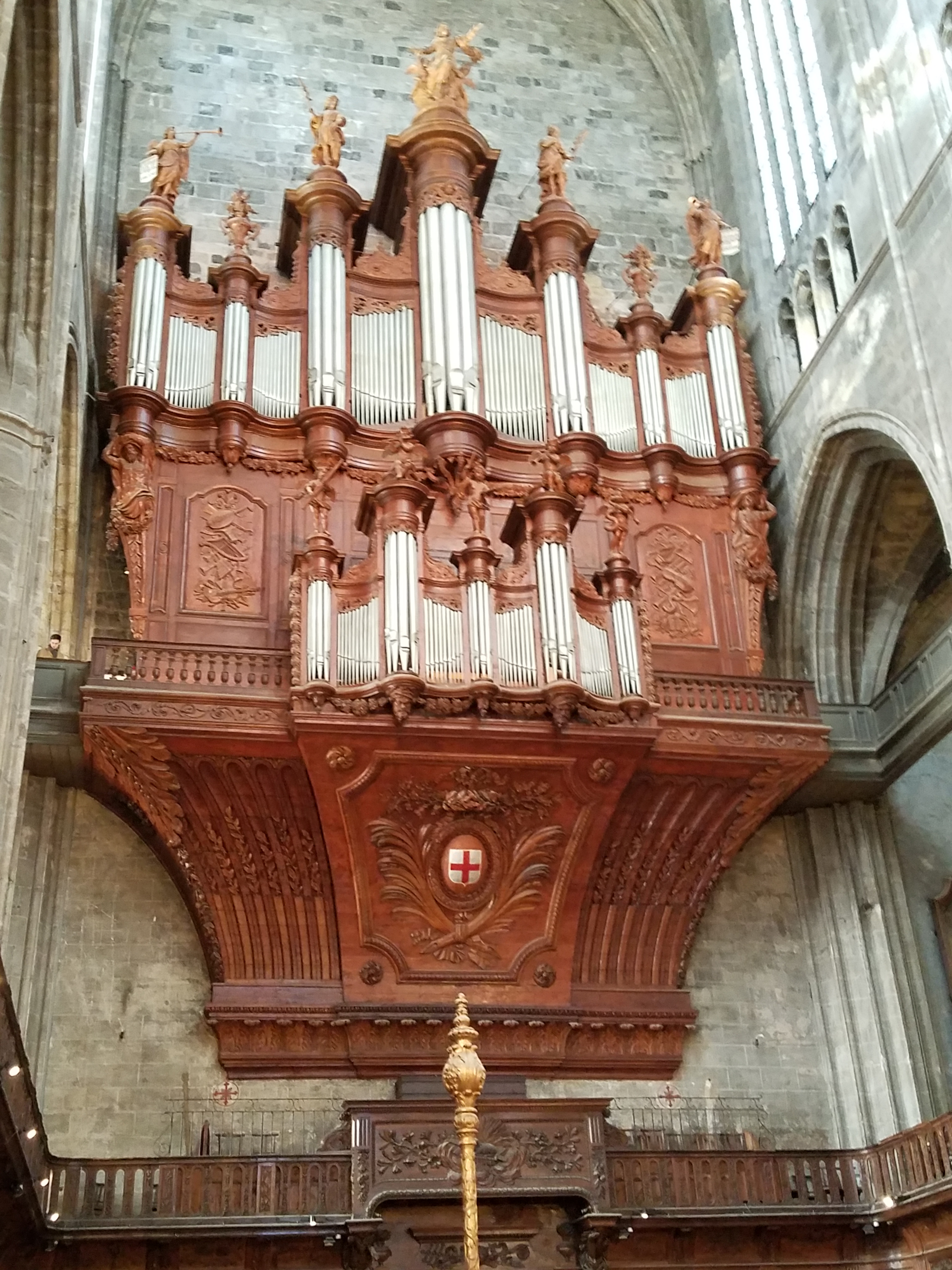
The sound of angelic choruses vibrating with the enormous, ancient, wood-piped organ created a majestic mood, and the parishioners seated in centuries old pews facing the gold-plated, ornate altar where mysterious rites of chanting, bells and smoke took place.
 
The wine helped open up my heart and lungs. I was moved. I stood, sat, stood, sang, sat, stood, sang…for two hours. I sang Christmas songs loudly-passionately (catching the echoes inside the mile high ceiling) in French, a few Gloria’s and hallelujah’s, and all was grateful and grand. 


The experience for my children might have been less engaging. They fidgeted less than I did, but they were clearly unmoved. Having worked in a Catholic high school for four years, I at least was familiar with the procession. They went panicked blank when the offering plate was passed in front of them. They’re obviously not Catholic.
 
And their eyes widened in surprise and then ironic glee to see their father line up to take communion–a first sight for their two decades or so of life. When he and his mother returned to their seats, the universal let’s get out of here side glance and nod of the head had us heading for the doors at midnight–into the cold, then into our impossibly compact car, driving back past the canals and into the dark, lampless, skeletal vineyard lined lane to home. 

Bonnes Fêtes

wp-1482597100891.jpg
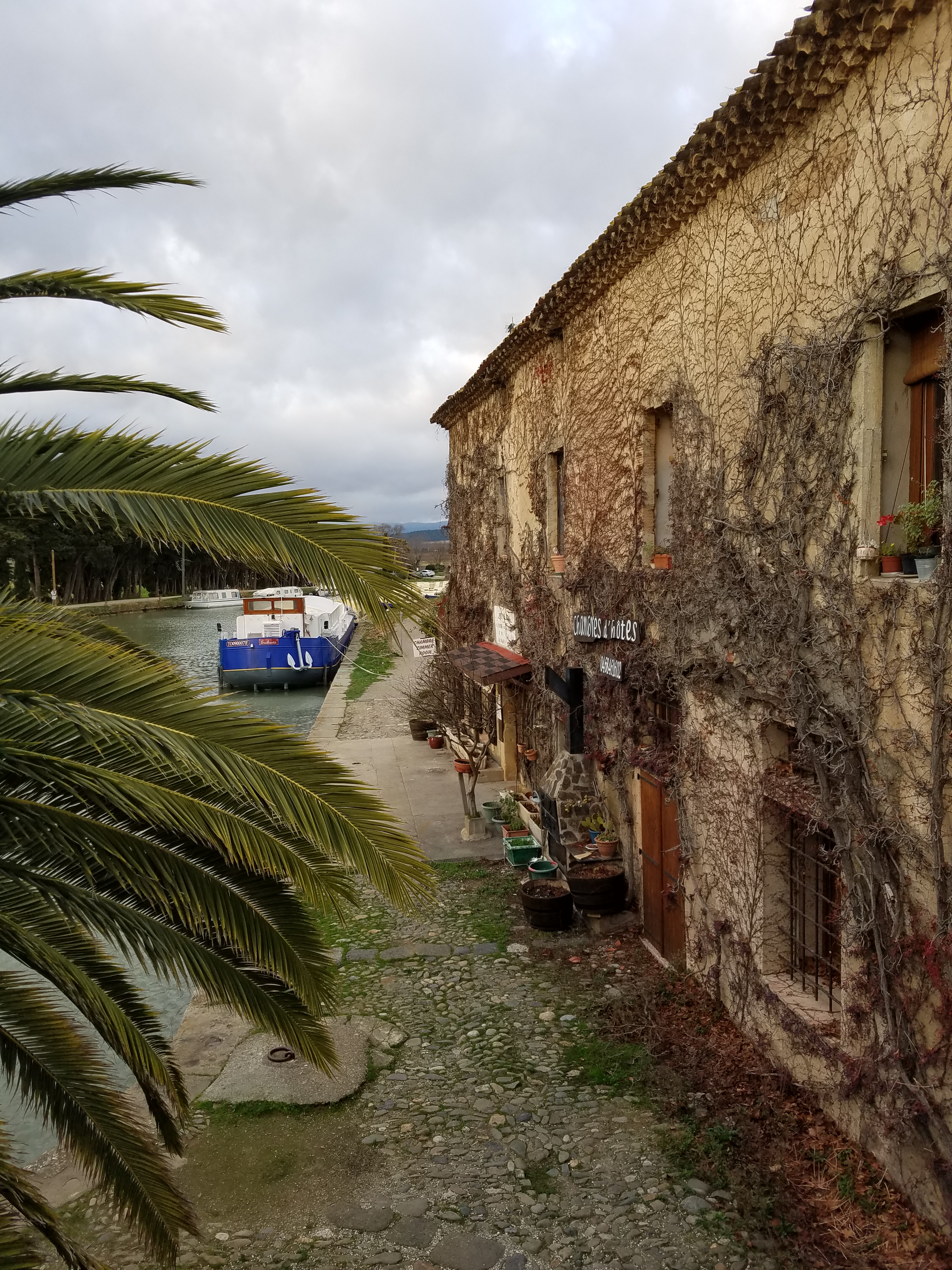
L’Aude is a river that houses three main regions here down south, Salelles d’Aude being one of them along the canals in the South of France. The canals are one of Napoleon’s bright ideas for moving trade through the southern country. That big idea and expanding Paris boulevards and thoroughfares wide and far-reaching were revolutionary, practical and enduring.
 
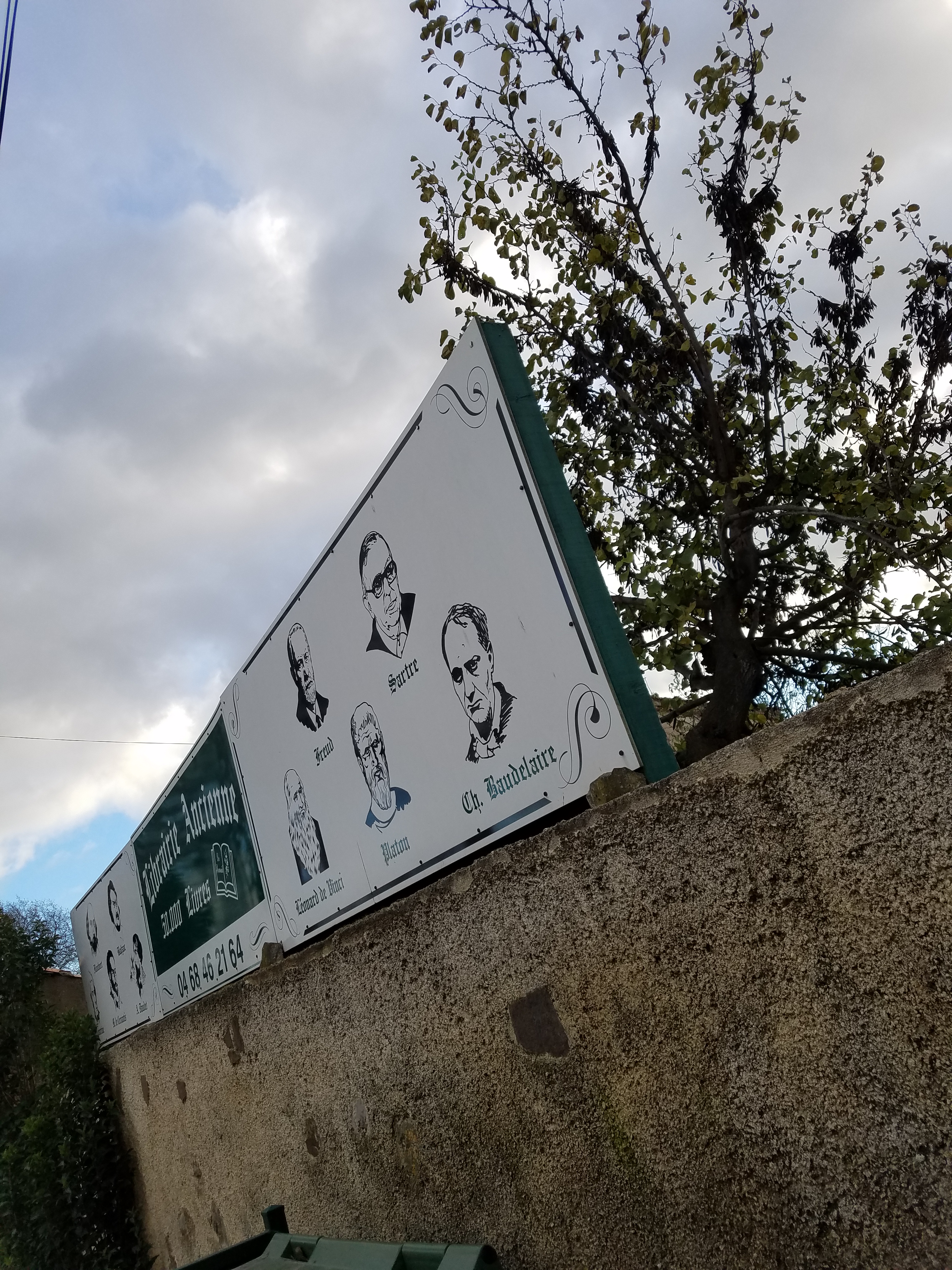
Today, after last minute shopping in a quiet mall outside downtown Narbonne, some to-go sushi from the supermarché, and an espresso in the cafe by the mall exit, we ventured to a small hamlet close to Salelles called le Somail, one of the three divisions resting on the Aude. The sleepy port town boasts a tea house and ancient book store, the former closed for Christmas and the latter open for our roaming eyes and feet. Much of the tiny town is closed for winter.
 
The ancient musty chill air inside the book store reminded us of winters, many of them passed through, wind and rain soaking the stone walls of this tiny librairie tucked alongside the river of moored houseboats, cacophonous ducks and romping dogs–just before the stone bridge. The cool wind hurried our leisurely walk.
 
img_0161
The town, abandoned by tourists and inhabitants alike, stood as contrast to bustling downtown Narbonne with its courtyard restaurants a-brew with ale and crepes, narrow boutique-lined lanes, stately cathedrale de Narbonne, and street music. We spent a fine-weather, blue-skied day sightseeing, shopping and eating crepes, croque monsieur, and macarons along the outside booths and stands of the market. Inside the farmer’s market, we crammed all five of us into a tiny tapas bistro of four long bar tables, where we ate duck and scallop brochettes, planchas drenched in olive oil and garlic, and grilled aubergine and courgettes, washed down with local white wine for us and orangeina for the kids.
 
We are gaining weight in kilos but will be losing it in pounds when we return, so it should be easy. Right?

Carcassonne

Like most days this week, I start out of a disrupted sleep, having lain way past a decent hour. I awaken late morning French time most days and go to bed early evening California time. My iPad tells French time and my laptop refuses to leave California. I work late into the French night completing blog posts for my employer on Miami time. Time spins nauseatingly.
 
Yesterday, after awakening around 11:30 French time and playing musical transformer and usb chords (Who has the Samsung/iPhone charger??!!), I swallowed a bite of pain au chocolat and quick coffee to motor off to Carcassonne, the Medieval fortress and castle, which also sports a lovely restaurant rated by a tire company (yes, I know it’s a coincidence that restaurant raters and tires have the same name).
 
After eating a sumptuous lunch of creative concoctions like foie gras coated in sweet wine emulsion merengue on a pop sickle stick (wtf, right?), and drinking too many Kir Royals and local white wine, we walked through the castle entry via a narrow cobble stone street filled with souvenir shops.
 
And when my oldest daughter ran into one shop walled with medieval swords and daggers, I knew it wouldn’t be long before her father was paying for two Game of Thrones John Snow swords. I warned them that drunken purchases never look good in the morning, to no avail.
 
But the day was lovely, the castle impressive and our spirits high. Captive momentarily to another time, another dimension really (Can you believe this was all built manually over decades?), I quietly absorbed every loose stone in the dirt path, every brilliantly green blade of grass, every cotton cloud in the sky, and every skip, hop and climb of my scampering daughters up and down castle walls and walkways.
 
The drive home along pine and canal-lined country lanes that often slowed us into narrow cobble stone alley towns squeezed between sugar cube cafes and cursive patisseries, in the quiet cold darkness just after dusk was peaceful. Four phones, two iPhones and two Samsungs, ran out of juice (and GPS), so we had to feel our way home, through every roundabout.
 
Home: Medieval dust still lingering on our clothes, in our breath, we each retired to our places, the girls to their room with stolen chargers to resurrect their connections to Snapchat, Twitter and California life time, me to my laptop and work, and mother and son to the telly to watch lame French game shows.
 
 And the next day: do it all over again in a new town, new castle or cathedral, casting our lines into a timeless sea of changing faces, feasts and facades, our feet in neither and both worlds, floating, lost and leisurely.

Mother, you had me.


What mother hasn’t asked herself what it is to be a mother? Cradling fragile life in the palms of your heart, ever on your mind, on your breast, in your nose, wearing them like perfume, you ask yourself how you could possibly keep yourself from hurting them. You ask yourself how you ever lived without them, as if that time before them barely existed. At least I wondered how.

And even now as their floating circumference widens, their sights set on spaces and places far from the core (and corps)–deliberately so–I question my hand, the child crafter’s touch. Did I spoil them too much, under-prepare them for a world I could not have conceived let alone predicted? Have I taught them healthy respect for life, theirs and others’, as well as their fellow planetary inhabitants? If I built their core properly, they will stand.

I’ve learned in yoga that a strong core lies behind every movement, every asana. Such is life. I think of that time a mommy just like me commented that my two-year old seemed to have a strong core. I recall few complimentary words about my mothering worth noting. That one I remember.

My own mother stands symbolically now, like a white alabaster Greek statue, only emaciated rather than plump-full eternally life. Death could not come slower. But she stands (still, sometimes) rickety and frail, tremulous, palsied, but awake somehow–a matriarchal stance to life. Just.don’t.give.up. Your children live for, through, by and despite you. Even after-breath. 

We’ve done our part, passing on the genetic code, dicing up human destiny somehow. We’ll rest soon and long.

Happy birthday Mom. I’ll never give you up.  

The thing about perspective…Ten for Today

What a thing to do, this getting away to change the scenery. Being on a family trip to France and Spain has brought not only refreshment to a pretty stale when it wasn’t toxic year, even years (I’ve had some years), but also a much needed perspective check. Seeing new lands, even if they’re the old ones, helps shift awareness into the absorbing/observing mode and backed out of the constant spewing mode.

The women I travel with, my daughters, are entwined in memory and making memories. My mother in law’s home is filled with childhood memories, flashbacks and glimpses: one was six and the other three the last time we visited. It was summer then. But this time they’ve brought themselves to their mamie’s house: inquisitive, cynical, wry and wondering. They’re excited but skeptical about this new outlook they were promised in this more socially conscious historically and gustatorily fermented with history country. It’s all about food, everywhere, every day.

They want to believe this land holds lure, romance–and it does–but they’re wise enough to know, despite the language barrier, that their 82 year old grandmother can sound as narrow-minded, silly, prejudiced, stereotypical and judgmental as any American. It’s both a national and a family thing. Their mamie is…well, their mamie. She is all of France and all of her. They love and hate to see themselves in her. 

And yet, the strangeness and familiarity of it all gives them, us, the comfort and discomfort to sit back and play compare and contrast, and practice some serious appreciation. They have options to be part of the world, not just their world. 

Oh, and internet access is sketch at best. The better to see their sometimes scowling, sometimes intent, oftentimes laughing faces.