You Can’t Always Get

152701

It’s a familiar trap, a pattern many recognize–getting caught between wanting to do the “right” thing for someone else or for the self.

The conflict pits ahimsa, or non-harm in thought or deed, against satya, truthfulness in the Yamas.

Trying today to unwind my thinking, past my feelings, habits and impulses, to identify my needs. I am caught up in the should’s. And I dislike it.

Yes, I grew up with a mother who attended co-dependents anonymous and that may explain why, in the past, I instantly responded to calls for volunteers for the school, sports organizations, non-profits, family and friends whenever I could. I built habits for some need I had to fulfill to help. But what about now?

The balance of helping others and helping myself is the challenge. Getting it right is not always easy, but I am more interested today in examining these knee-jerk reactions and judgments that come with “I should help this guy out” compulsion.

I give a lot of time and attention to a long-time friend who cannot reciprocate, and I am becoming resentful and disinclined to see this friend any more. This would seem like a no-brainer, dump the freeloader, but it is not that simple. I don’t want to (thinking) be beholden to a give to get something or quid pro quo value system. The impulse to give irrespective of gain is in line with my values.

Resentment (feelings) arises for sure in this equation, but the more important question, if I give myself time to respond the next time my friend, who I will call Ash for convenience, calls and asks to go out to lunch to talk (read: monopolize the conversation), is why I feel compelled to be the sympathetic ear, ignoring my own therapeutic need to be heard and share thoughts and feelings.

Mind you, this friend does not always take but often enough where the obligatory “should’s” hit me whenever I see that text or telephone number on my screen. The first reaction is a tiny wince and inaudible sigh. I have known Ash a long time and spent countless hours being a friend. Is it habit?

I wrestle with passive-aggressive responses too–unavailability, calling back much later, too late, and just plain ignoring. That is not a good friend, I chide myself. Feeling guilty is not helpful, either. The spiral of internal chain reactions is exhausting…I shouldn’t ignore…just say what I feel…don’t want to hurt someone for what I perpetuated…time I cannot afford and don’t want to give…others who need it more…giving unconditionally…compassion…

…and on and on.

How to get past the stuff, the gunk (too much thinking or not enough), to the discerned need, my real need in this relationship, occupies my day today. Being truthful.

I know the answer–for me, anyhow. Time. Give myself time to decipher my need–for that moment, any given moment–before saying yes to engaging with Ash. Examining the relationship a bite at a time may lead to the larger answer that I sought today, too overwhelming, as to what I need in this relationship, not want, project, hope or atone for in it.

The Stones got it right: You can’t always get what you want, but if you try sometimes, you might find you get what you need.

Given enough precious time.

credit:  goodreads.com/MickJagger

Pratyahara and Pencils: teaching writing is about seeding awareness in students

  
This was exactly what Professor Yip meant by being detached — not being without emotion or feeling, but being one in whom feeling was not sticky or blocked. Therefore in order to control myself I must first accept myself by going with and not against my nature.

Bruce Lee 

Pratyahara and pencils populate my thoughts today. Back to school, I can smell the freshly sharpened pencils—not that anyone sharpens pencils in my college classes so much. The sensory memory recalls the time of year: fall, school, endings, beginnings and lifelong learning. Cycles that inspire.

Inspiration arises in peculiar places. During a particularly dry creativity spell, I sat through the annual English department meeting last week at school, my employer, and felt a sudden spark. It was midway through a workshop on workshopping (silly sounding but fruitful) when I began to write about…

Continued here

Wrestling with brooding thoughts and ahimsa


So what, do the Ashley Madison hackers or “malicious crackers,” if you will, believe in some moral equivalency? Is it justified to harm unfaithful spouses because the victims of their hack are deemed by their culture to be morally bereft? Pretty easy to hide behind a screen and commit malice, not caring about the innocents in the bombing fallout, like children and unsuspecting spouses. Seems to me sociopathic, flexing God complexes by rejected social misfits, more likely. Hard to come up with a sympathetic narrative or righteous cause.

No, they cannot be blamed for subscribers’ suicides as something more goes on in the lives of suicides than fallout from exposure by affairs. Psychological destruction is already part of those poor souls’ lives. But the old but-for test could prove damning. But for the exposure by the hackers, the suicides may have not been pushed over the edge of the precipice, maybe found a way to seek help before grasping on to the no-hope ledge and sliding down.

A travesty seen up close, as well for the hackers who now can live as the hunted. That treacherous misstep or march outside the law is one in a long road into forever curtailing freedom so taken for granted like air. Even if they get away with it. Their freedom has been delivered up to forces greater than their prank, crime and self-serving “morality.” They are no Edward Snowdens. 

They remind me of the elementary school kids I grew up with who threw M80’s out of the school bus window on to the lawns of random properties along the bus path. The vandalists just wanted to stir things up, satisfy an urge in themselves to destroy something. 

Isolation and independence are an illusion, the distortion of the un-self-realized minds, like rowdy, selfish school children. The deluded hackers are learning about the laws of cause and effect in their god-i-hope-so-for-their-mothers’-sakes invisible hideouts. I am hard pressed to wish them well.


credit: regmedia.co.uk

The Little Death

  
Yet Freud’s or the French’s little death (orgasm) requires total submission and trust–to let go of holding on without fear of being judged or betrayed by another, a body or self. 

Different pathway to the same result, which is total obliteration, mind-erasure, loss of control over the world–fear and pleasure. 

Both test humanity.

When terror burns its path through a being, however, surfing its electricity at sonic light, what remains is not so much silence as a spentness, a vapid stripping of nerves that leaves a permanent mark, maybe a tic, a recurring memory, or a dullness close to death.

Dopamine refuses fear the same experience as orgasm, though dopamine injects its life-loving pleasure-ful substance in both, pre-death.

Both are ineluctable surrender, an abandonment of reason and belief, a blackness in the mind’s hole.

But I’d take a cheap orgasm over a good scare any day.


credit: http://www.notable-quotes.com

Is Sylvia Plath a cultural appropriator?

image

Daddy

BY SYLVIA PLATH

You do not do, you do not do   

Any more, black shoe

In which I have lived like a foot   

For thirty years, poor and white,   

Barely daring to breathe or Achoo.

Daddy, I have had to kill you.   

You died before I had time——

Marble-heavy, a bag full of God,   

Ghastly statue with one gray toe   

Big as a Frisco seal

And a head in the freakish Atlantic   

Where it pours bean green over blue   

In the waters off beautiful Nauset.   

I used to pray to recover you.

Ach, du.

In the German tongue, in the Polish town   

Scraped flat by the roller

Of wars, wars, wars.

But the name of the town is common.   

My Polack friend

Says there are a dozen or two.   

So I never could tell where you   

Put your foot, your root,

I never could talk to you.

The tongue stuck in my jaw.

It stuck in a barb wire snare.   

Ich, ich, ich, ich,

I could hardly speak.

I thought every German was you.   

And the language obscene

An engine, an engine

Chuffing me off like a Jew.

A Jew to Dachau, Auschwitz, Belsen.   

I began to talk like a Jew.

I think I may well be a Jew.

The snows of the Tyrol, the clear beer of Vienna   

Are not very pure or true.

With my gipsy ancestress and my weird luck   

And my Taroc pack and my Taroc pack

I may be a bit of a Jew.

I have always been scared of you,

With your Luftwaffe, your gobbledygoo.   

And your neat mustache

And your Aryan eye, bright blue.

Panzer-man, panzer-man, O You——

Not God but a swastika

So black no sky could squeak through.   

Every woman adores a Fascist,   

The boot in the face, the brute   

Brute heart of a brute like you.

You stand at the blackboard, daddy,   

In the picture I have of you,

A cleft in your chin instead of your foot   

But no less a devil for that, no not   

Any less the black man who

Bit my pretty red heart in two.

I was ten when they buried you.   

At twenty I tried to die

And get back, back, back to you.

I thought even the bones would do.

But they pulled me out of the sack,   

And they stuck me together with glue.   

And then I knew what to do.

I made a model of you,

A man in black with a Meinkampf look

And a love of the rack and the screw.   

And I said I do, I do.

So daddy, I’m finally through.

The black telephone’s off at the root,   

The voices just can’t worm through.

If I’ve killed one man, I’ve killed two——

The vampire who said he was you   

And drank my blood for a year,

Seven years, if you want to know.

Daddy, you can lie back now.

There’s a stake in your fat black heart   

And the villagers never liked you.

They are dancing and stamping on you.   

They always knew it was you.

Daddy, daddy, you bastard, I’m through.

Sylvia Plath, “Daddy” from Collected Poems. Copyright © 1960, 1965, 1971, 1981 by the Estate of Sylvia Plath. Editorial matter copyright © 1981 by Ted Hughes. Used by permission of HarperCollins Publishers.

Irving Howe charged that “there is something monstrous, utterly disproportionate, when tangled emotions about one’s father are deliberately compared with the historical fate of the European Jews.” Susan Gubar wrote similarly that using the Holocaust as metaphor diminishes the Jewish experience,  the real of it, personalizing and fictionalizing it.

Is that a form of cultural appropriation?

Mindfulness: Culturally Diverse not Divisive

  
My Eagle (Eastern Washington University Eagle) and I speak most days about her training, school, roommates and life in the Northwest. Her pre-season schedule keeps her wickedly busy, but yesterday we ended the day unwinding to the news of her day and mine. 

After reminding me of her class schedule, one class being African American studies, we began a discussion about cultural appropriation, having referenced the class that Rachel Dolezal (former professor at EWU and President of the NCAA who made the news recently by her parents outing her as white) would have taught. 

Not surprisingly, she and I differed. She thought social media had gotten it right this time. People should not be consuming cultural artifacts as if unattached to the people who suffered or strove through the badges, persecution or honors of and by those cultural expressional effects. 

One example she insisted on was the appropriation of “clueless white girls” adorning themselves with henna though they do not care a whit for Indian culture or people. In fact, she claims, these same young white girls actively discriminate and ridicule cultures different from their own (if whiteness is a culture as well as a position of privilege and power?), including Indians.

Admittedly, my most played role as devil’s advocate annoys my children. But this time I was not baiting. I countered with labeling and generalizing as liable to injure as much as the lack of consciousness of some consumerists. Not all cultural appropriations spell disrespect. 

We live in a multicultural world, America being one of the most diversely populated. Adapting the behaviors, clothing, styles and language of other cultures organically arises from living among others. What matters–the same always–are words and actions consciously spoken and taken. 

To love another culture so much as to adapt it is not uncommon. People move to other countries more suitable to their natures. Look at Cat Stevens, who left American fame and fortune to live in a culture more nourishing to his spirit. One can question his or anyone’s motives for “abandoning” his or her birthright, but why, what’s the point?

The people my daughter–and her social network–criticize, live inauthentically and thereby injure others, I suspect. To affect the style of another group is an act of honoring, blind imitation, or malicious mockery, depending on the intentions of the adapter. 

But all behavior may be measured as moral, immoral or amoral, depending upon the degree to which the actor moves beyond him or herself toward another–and with a conscious intention of producing good or ill will.

Mindfulness is an overused term, quickly turning trite. But in truth, to bring mind to bear on everything we do matters most. Morality is another term that gets maligned in its use, overuse and abuse. But the morality that the philosophers hypothesize about in classrooms, bars and libraries through time immemorial informs the morality I believe defines mindfulness:  an ethics of right behavior toward others, which is situationally switched on by a mind and heart likewise opened and active.

I am not foolhearty enough to believe in a “correct” behavior for every situation, but the footpath toward morality starts with a consciousness of the causes and effects of what we do, otherwise known as awareness. Thinking awake and remembering that we belong to a community are two steps in the right direction on that path.

At the conclusion of our call, I asked her what I should write about next, after plastic bags and waterless urinals. She offered sex work and cam girls. Um….wait, what?
 

credit: socialwork.simmons.edu

The California Plastic Ban

  
Read the full article of the excerpt I posted a few days ago, as it appears at The Mindful Word.

Walking out of the market, it suddenly hit me. Something different. Oh, that’s right. No one asked me if I would like to buy a bag for ten cents, and my two hands carried one plastic food-stuffed bag each. I wondered how long I had been unaware of the … (read more here)

Argue!

  
Should vivisection on animals be universally banned?

California’s gun control laws are the strictest in the nation and do not need tightening.

Costa Rica’s Preventia policies are unjust and inhumane.

The papparazzi need to be reigned in from their reign of destruction.

Coed education beats same-sex education miles high.

Long Beach police officers are doing a great job despite the public outcry against police brutality.

The higher divorce rate among military families compared to non-military familes cries out for resources.

Street art is not graffitti!

Torture has its place in terrrorist prevention.

Inception is not a coherent thriller.
 

It’s end of the summer semester research term paper time. So many arguments, so many readily available resources, and so many fallacies.  My students, weaned on the Internet, both master and destroy logic. Familiar with the bounty that is the network–social, educational and otherwise–they can research. They find stuff. However, likewise products of the world wide of webbings, traps for the unweary, they believe without discernment. 

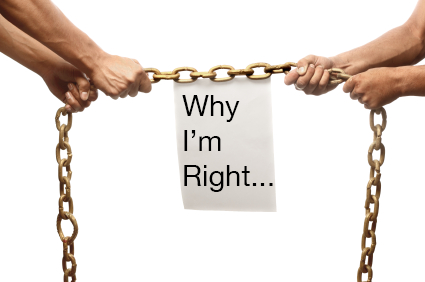
Teaching young minds to think in verticals and horizontals tasks the impatient and weary. Entitlement does not only measure ownership attitudes; the right to be right falls in the heap of our stuff. Ours. Mine. Not yours.

How else does the abounding madness of polarizing non-sense stop: me vs. you, right vs. wrong, with us or against us? Isn’t that the major premise of Saul Alinsky’s Rules for Radicals--keep the pressure on with conflict so power can slip in its agenda? 

I responded to a social media prompt on a relative’s Facebook page about the minimum wage not being about bickering over which unskilled worker should get two dollars more than the other. Two good responsive posts about the issue over dignity of work, skilled vs. unskilled worker…and then it came: the post about me, me, me and what I do and don’t blame me for trying to work and make money. 

Buzz kill. There is no response to a hijacked discussion of a public issue by someone’s feelings about his or her life or imaginary persecution–a failure to read and understand a public forum’s purpose in the shades of meaningful and polite interaction. 

Teach a mind to think, reason and discern: rule one of a civilzed nation.
 

credit: http://static.squarespace.com/

The Gift of Writing in the Mindful Word

  
My first piece published as a contributing writer for this wonderful journal, The Mindful Word, came out today. Please enjoy this esssay about writing and teaching students old and young about the craft I attribute as salve for what ails us in the human condition of illusory separateness.
Peace, 

the Gaze