When You’re a Grown up


My daughter and I were at the frozen yogurt store the other day when we overheard a boy about five years old say to presumably his mother, “I can’t wait til I’m a grownup!” Not exactly sure of the context, but I believe his mother had just conditioned his frozen yogurt choices on being old enough to know what was good for him.

Though the exclamation produced a smile on my face, my 19-year-old-off-to-college-this-week daughter quickly turned to the boy and said, “Don’t rush it, kid. You don’t know what you’re asking for.” And she laughed so as not to terrorize the boy.

I turned to her and asked, “Is it that bad?” She nodded, yes.

I know the anxiety of living away from home for the first time preys on her nerves, playing a checklist of to-do’s and what-if’s in her mind on endless repeat. I feel her.

She and I differ that way. When I left home, I had no thoughts. I left on the sheer will of want: whatever I wanted. It was only after I left that I began to worry as I realized I had no idea how to write a check let alone balance a checkbook. I had only one experience with a bank: a savings account my mother opened for me when I was in junior high, one with a little blue, firm-covered, palm-sized bank book in which to register deposits and withdrawals. I remember how grown up I felt then. But that bank book, regulated by my visions of large purchases and the change in my mother’s purse divided by four, did little to teach me about pooling money in time to pay rent, feed myself and pump gas into my car. 

I learned, especially after a few months of barely living on graham crackers and cottage cheese or peanut butter. A visiting uncle, a psychologist  from Texas, remarked to my mother at one family gathering during that time, “Does she have anorexia?”

Burning by my own mistakes was my way. Still is. So long as they were mine. My mother did little to prepare any of us five children for the world as she protected us–wittingly or unwittingly–from the responsibilities of grown-ups, cocooned as we were in our middle class suburban neighborhood.

Maybe it was the time too. She stayed at home and cooked for us, washed our clothes and poured our milk for us. I remember telling her one day in sudden astonished awareness, “Mom, I’m 12. I can pour my own milk.”

My children did not grow up the same way. Their parents worked and so had to fend for themselves more. Even when I worked from home when they were small, I advocated for their independence. As soon as they were old enough to complain about what was for dinner, I let them know they could make their own if they did not like what was on the menu and then showed them how to use the stove. 

I am not suggesting my kids are not over protected or spoiled in other ways, however. While my parents had no means to buy their children things we nevertheless asked for, my kids have had more money given to them than I had. Growing up in a one-wage factory laborer family, we became accustomed early on to the idea that any material items we wanted would have to be purchased by our own means. I worked mowing lawns, helping my brother deliver newspapers and babysitting from the time I was 8.

My daughters, on the other hand, were raised to believe their grades and sports were their jobs, that they had too many years ahead for the paying jobs that they would eventually have to report to daily. “Don’t rush into working,” I always said.  

So my 19 year old has had a job for a year now; she worked part time while attending the local community college to pay for her car, books, concerts and clothes. I know it has been a stretch, the responsibility, though I know it hasn’t been a shock. She is used to budgeting her time and her resources, having been over-scheduled since she was 6 with soccer practice, piano lessons, school, and whatever the day’s playdates or parties brought.

But it is not the practical how-to’s or what-to-do’s that have her worried about moving out. I know it. She can figure things out, and it isn’t as if she is completely cut from the cord. Smart phones have kept us connected for years now anyhow, near or far. I group text my daughters to come down from their upstairs perches (more like second-story caves) to dinner (when I cook).

Nope. What she fears, I imagine, is what we all do. Doing it herself–whatever it is. The psychological state of being on her own, which prefigures the time when she will be truly on her own, no parents to call upon for a word of advice or a few bucks (or few hundred) to carry her over til payday, is the foundational fear–of death, first others and then her own. 

Not to be too dramatic, but Freud did not get everything wrong. Death and sex are primary human motivators. Everything that drives us is rooted in either or both. 

When my daughter goes off to college, it will symbolize that eventuality (hopefully far down the line) of being on her own without the umbrella of parental love. She will experience it as a mix of anxiety and excitement. And even as she will be making her own love, whether parenting or not, which will occupy enormous space in her mind and heart, she will one day yearn–even if it is just for a moment—for a time when the burdens, seemingly too heavy to bear, were barely perceptible just as they were lurking, unnoticed, above her childhood, as she splashed in an inflatable pool in the backyard and wondered what was for lunch and if she would ever not be bored on endless summer days.

I know I have.

And perhaps my mother, sitting among us near motionless in the skin of a fading light, silently reminds her, also symbolically, that connections run deeper than the physical–etched like the voice that called her to dinner at night all those years of play and idle dreaming. Even when the voices are silenced into memory, beginnings and endings forge life forward even as they fall backward in the marching on. 

Independence

  
Happy Independence Day! I suppose I will be celebrating something like that–the roundabout essence of it, anyhow–next week when I drive my daughter up north a couple states to college. I imagine the scene of having unloaded the last of her belongings from the car into her apartment and saying goodbye: my oldest child off to begin a new phase of her life–independence.

She and I have been preparing for this moment all of our lives.
 
And while she has suffered no grievances that have necessitated her leaving, no unbearably unfair treatment or restrictions like those American colonists who could not assemble, receive speedy justice or a fair wage living by the tyranny of a distant king, she must leave to seek her independence. There is no other way to grow into the human she will become. 

We both know it. And while we understand the leaving will behoove us both, stretch us both into the next phase through the forces of fear, anxiety and excitement of new spaces, we mourn something passing permanently: our time together up til now.

She and I realize that independence begets great freedom and the commensurate responsibility arising from that liberty, on the part of both the liberator and the liberated. My first born will bear the responsibility of tapping into all of the resources she has at her disposal, the inborn and acquired, to leverage her mistakes and maximize her growth, pleasure and education in books and in the streets. My responsibility is letting her, watching with faith that I did my job the best I could, teaching to and modeling for this moment of severing the cord. 

For in keeping her tied–whether by finances, guilt or need–is a far greater responsibility, one I am not prepared to take on. Those who would keep another in need or greed will eventually pay a steeper price than of losing that dependent other. And so it is with a nation.

America celebrates its freedom today, marking a day of great deeds by a population led by fearless, brilliant men  in an awe-inspiring act of bravery: foregoing personal interest for the greater good in the name of freedom, a principle far more important than life and limb. And not mere oppression moved these future citizens of a new nation to act. It was something more compelling, deeper within the human spirit that spans the heights of ultimate honor and goodness to the very depth of devilry and satanic cruelty. We are a strange duality of a species that way.
 
I am sure no one was more surprised than Frederick Douglass, an ex slave, to be called upon to speak to the nation’s celebration of freedom and independence in an era when slavery still existed. The irony was not lost on him. He mentions that strange fact in the bewilderment of his having been called upon to speak. But the amazing man is if not merely discreet, magnificent in his tact, bravery and circumspection while rousing the call that the opportunity brought him at that strange moment of addressing his mostly if not entirely white audience, I would guess, at Rochester, New York, in a speech called “History is a Weapon: the meaning of July Fourth for the Negro”, nothing short of masteful in prose and passion.
 
Douglass first assures his respect and acknowledgment of great men and great deeds, for so uncontested in greatness a cause as lofty as freedom:

Fellow Citizens, I am not wanting in respect for the fathers of this republic. The signers of the Declaration of Independence were brave men. They were great men, too-great enough to give frame to a great age. It does not often happen to a nation to raise, at one time, such a number of truly great men. The point from which I am compelled to view them is not, certainly, the most favorable; and yet I cannot contemplate their great deeds with less than admiration. They were statesmen, patriots and heroes, and for the good they did, and the principles they contended for, I will unite with you to honor their memory. 

They loved their country better than their own private interests; and, though this is not the highest form of human excellence, all will concede that it is a rare virtue, and that when it is exhibited it ought to command respect. He who will, intelligently, lay down his life for his country is a man whom it is not in human nature to despise. Your fathers staked their lives, their fortunes, and their sacred honor, on the cause of their country. In their admiration of liberty, they lost sight of all other interests. 

They were peace men; but they preferred revolution to peaceful submission to bondage. They were quiet men; but they did not shrink from agitating against oppression. They showed forbearance; but that they knew its limits. They believed in order; but not in the order of tyranny. With them, nothing was “settIed” that was not right. With them, justice, liberty and humanity were “final”; not slavery and oppression. You may well cherish the memory of such men. They were great in their day and generation. Their solid manhood stands out the more as we contrast it with these degenerate times. 
How circumspect, exact and proportionate were all their movements! How unlike the politicians of an hour! Their statesmanship looked beyond the passing moment, and stretched away in strength into the distant future. They seized upon eternal principles, and set a glorious example in their defence. Mark them! Fully appreciating the hardships to be encountered, firmly believing in the right of their cause, honorably inviting the scrutiny of an on-looking world, reverently appealing to heaven to attest their sincerity, soundly comprehending the solemn responsibility they were about to assume, wisely measuring the terrible odds against them, your fathers, the fathers of this republic, did, most deliberately, under the inspiration of a glorious patriotism, and with a sublime faith in the great principles of justice and freedom, lay deep, the corner-stone of the national super-structure, which has risen and still rises in grandeur around you. 
 
However, the irony of asking an ex-slave living in the time of institutionalized slavery newly confirmed by a legislative decree that commanded the nation to honor the slave owner’s rights to gather up escaped slaves and return them to slavery, to speak about independence on a national celebratory day, cannot but scream not only irony but cruelty, the kind that bedevils the human constitution also.

Behold the practical operation of this internal slave-trade, the American slave-trade, sustained by American politics and American religion. Here you will see men and women reared like swine for the market. You know what is a swine-drover? I will show you a man-drover. They inhabit all our Southern States. They perambulate the country, and crowd the highways of the nation, with droves of human stock. You will see one of these human flesh jobbers, armed with pistol, whip, and bowie-knife, driving a company of a hundred men, women, and children, from the Potomac to the slave market at New Orleans. These wretched people are to be sold singly, or in lots, to suit purchasers. They are food for the cotton-field and the deadly sugar-mill. Mark the sad procession, as it moves wearily along, and the inhuman wretch who drives them. Hear his savage yells and his blood-curdling oaths, as he hurries on his affrighted captives! There, see the old man with locks thinned and gray. Cast one glance, if you please, upon that young mother, whose shoulders are bare to the scorching sun, her briny tears falling on the brow of the babe in her arms. See, too, that girl of thirteen, weeping, yes! weeping, as she thinks of the mother from whom she has been torn! The drove moves tardily. Heat and sorrow have nearly consumed their strength; suddenly you hear a quick snap, like the discharge of a rifle; the fetters clank, and the chain rattles simultaneously; your ears are saluted with a scream, that seems to have torn its way to the centre of your soul The crack you heard was the sound of the slave-whip; the scream you heard was from the woman you saw with the babe. Her speed had faltered under the weight of her child and her chains! that gash on her shoulder tells her to move on. Follow this drove to New Orleans. Attend the auction; see men examined like horses; see the forms of women rudely and brutally exposed to the shock ing gaze of American slave-buyers. See this drove sold and separated forever; and never forget the deep, sad sobs that arose from that scattered multitude. Tell me, citizens, where, under the sun, you can witness a spectacle more fiendish and shocking. Yet this is but a glance at the American slave-trade, as it exists, at this moment, in the ruling part of the United States.
 

How could he not but be appalled, amazed and agonized by the hypocrisy of a nation in celebration of freedom? Those who chose him to speak at this great hall before free people, scant few, if any, who were black in that audience, most probably saw him as a symbol of freedom and independence, a man who escaped slavery, self-educated, self-determined, an abolitionist working tirelessly for the freedom of all enslaved men, women and children, having to argue that black men are men. They undoubtedly saw him as a beacon of rugged individualism, ignoring the indignity of such irony in the existence of slavery. 

The same spirit of absolute sacrifice and bravery that recalled a nation that risked life for liberty was needed to free the rest of the population, and yet, there was not enough solidarity, sheer numbers to stand behind the black population to do so. It would take white people, privileged and empowered to cede some of that exclusive power and risk security for themselves and that of their families in the name of conscience. That cause was not as compelling nor urgent as the institution of slavery that existed far longer than it should have in this country largely consisting of so called God-loving people. The ultimate divide in the human composition, the extremes of polarities comes to light on this day we celebrate one of the poles.
 
Americans! your republican politics, not less than your republican religion, are flagrantly inconsistent. You boast of your love of liberty, your superior civilization, and your pure Christianity, while the whole political power of the nation (as embodied in the two great political parties) is solemnly pledged to support and perpetuate the enslavement of three millions of your countrymen. You hurl your anathemas at the crowned headed tyrants of Russia and Austria and pride yourselves on your Democratic institutions, while you yourselves consent to be the mere tools and body-guards of the tyrants of Virginia and Carolina. You invite to your shores fugitives of oppression from abroad, honor them with banquets, greet them with ovations, cheer them, toast them, salute them, protect them, and pour out your money to them like water; but the fugitives from oppression in your own land you advertise, hunt, arrest, shoot, and kill. You glory in your refinement and your universal education; yet you maintain a system as barbarous and dreadful as ever stained the character of a nation-a system begun in avarice, supported in pride, and perpetuated in cruelty. You shed tears over fallen Hungary, and make the sad story of her wrongs the theme of your poets, statesmen, and orators, till your gallant sons are ready to fly to arms to vindicate her cause against the oppressor; but, in regard to the ten thousand wrongs of the American slave, you would enforce the strictest silence, and would hail him as an enemy of the nation who dares to make those wrongs the subject of public discourse! You are all on fire at the mention of liberty for France or for Ireland; but are as cold as an iceberg at the thought of liberty for the enslaved of America. You discourse eloquently on the dignity of labor; yet, you sustain a system which, in its very essence, casts a stigma upon labor. You can bare your bosom to the storm of British artillery to throw off a three-penny tax on tea; and yet wring the last hard earned farthing from the grasp of the black laborers of your country. You profess to believe “that, of one blood, God made all nations of men to dwell on the face of all the earth,” and hath commanded all men, everywhere, to love one another; yet you notoriously hate (and glory in your hatred) all men whose skins are not colored like your own. You declare before the world, and are understood by the world to declare that you “hold these truths to be self-evident, that all men are created equal; and are endowed by their Creator with certain in alienable rights; and that among these are, life, liberty, and the pursuit of happiness; and yet, you hold securely, in a bondage which, according to your own Thomas Jefferson, “is worse than ages of that which your fathers rose in rebellion to oppose,” a seventh part of the inhabitants of your country. 

Fellow-citizens, I will not enlarge further on your national inconsistencies. The existence of slavery in this country brands your republicanism as a sham, your humanity as a base pretense, and your Christianity as a lie. It destroys your moral power abroad: it corrupts your politicians at home. It saps the foundation of religion; it makes your name a hissing and a bye-word to a mocking earth. It is the antagonistic force in your government, the only thing that seriously disturbs and endangers your Union. it fetters your progress; it is the enemy of improvement; the deadly foe of education; it fosters pride; it breeds insolence; it promotes vice; it shelters crime; it is a curse to the earth that supports it; and yet you cling to it as if it were the sheet anchor of all your hopes. Oh! be warned! be warned! a horrible reptile is coiled up in your nation’s bosom; the venomous creature is nursing at the tender breast of your youthful republic; for the love of God, tear away, and fling from you the hideous monster, and let the weight of twenty millions crush and destroy it forever! 

Lest we forget our history…

All Roads Lead to Anger

  
I am an asshole on the road. 

While I have never engaged in road rage, I rage plenty on the road in seething insults and strings of profanity that I cannot help but recognize as an inheritance from my father.

I always believed I was most like my mother: cheerful, determined, optimistic and rational. But that’s because my father was never around, working round the clock as he did. Come to find out after he moved in a few years ago, I am much like him.

I not only inherited my dad’s long, skinny legs and dark eyes, but also his temper. 

My Dad could be nasty. My memories soak in pools of chiding, my mother wagging her finger at her husband after yet another profanity blasted from his lips. His pet names for his wife included colorful epithets that would curdle any feminist’s blood–really any civil human being’s blood.   

My father’s vulgarity fully bloomed in a car. I drive like him: impatiently, erratically, and aggressively. All the curses I ever heard growing up fly freely from my mouth in explosions of hateful disdain on the road. I transform from human to monster. 

I know habit has a large part to do with it, but I am nevertheless surprised at the ferocity of my anger the moment I encounter a perceived slight on the road: it rises in a flash hotter and more suddenly than those that plagued me for years before menopause. It feels like a siege, as if I have no control over an acid-spewing alien cocooning inside me that bursts from my guts and spews terror. 

And when I have just spit aloud from clenched teeth the words: “You f#@*ing asshole!” with venom, I immediately catch myself, just as automatically as the words that flew out of my mouth, “What is wrong with you?!!” 

Therein lies part of the problem: not the knee-jerk flying foul language and anger triggered by insignificant, impersonal lane encroachments but the counter reaction of self-berating. It does nothing to change the reactive fury. 

Not that I condone the behavior, the lack of control in the face of something so irrational and trivial. Like any bad habit–smoking, nail biting, leg shaking (all of which I have had to beat)–the behavior masks some other neglected need, some other unattended emotion, unhealed wound, stewing conflict or ongoing unresolved problem.  

Most often, however, we seethe in separation, having polarized ourselves in opposition to those who would thwart our efforts, not only on our immediate but our larger destination–at least that is our perception.

When we lash out at the unknown ‘other’ out there in the world, someone we have reduced to a concept, a negative speed bump in our lives, whether that be the generic bad driver (or merely inattentive driver), not to mention the total road blocks–“the racist cop”, “the black thug”– or the more specifically named and reviled “woman” or “Asian” or whichever derogatorily denoted driver, we do so because we are isolated–and not just in the safety of our cars. We are closed up inside of ourselves, removed from our innate artist’s eye able to see the details of others. I know this because no one except the seriously ill or wounded cannot memorize the lines in his mother’s face as she sits paralyzed placid in her wheel chair or the dimples in her babies’ knees.  

The mind can see if allowed to.
 
The distance between us is self-imposed, learned, unconscious and/or conscious. It derives from the dis-remembrance of our primal past as cave-dwelling groups of protective survival and the ever-unfolding illusion of separateness, the change in us since those days.

Change comes from active awareness of our material being. If the scientists’ and spiritualists’ postulations resonate truth, we are all part and particle of the same star bursts, the same matter that existed eons before us, made us. Our DNA that shapes us is shaped similarly to that of the earth’s flora and fauna. Whether our individual components–genetic or nurtured–make us tall, short, dark or light skinned, good drivers or bad drivers, even-tempered or hot-tempered, we are all respiring sentient beings that matter, are matter, both divine and profane.
 
When we forget that, we other-ize, sense the loneliness of that disconnection, and get angry. And that’s okay. Eventually, we shift sight, change gears to lower breathing rpm’s, and recognize ourselves as the free-way, the one leading us all to the same exit and on ramps.

 
Photo credit:  wakeup-world.com

Published in elephant journal:  what happens when we surrender to yoga


Credit: Leslie Alejandro

Even the Supreme Court surrenders to something larger than itself. We all must give in, be a part of the fabric of an order, principle, and/or belief not only for the sake of facilitating justice to those around us but for ourselves–to be the justice. 

Labels define merely to confine. Lately, yoga has been taking a hit in the news. One Congress person dismissed it as religion that he did not want to see endorsed or foisted upon him in our nation’s participation in the celebration of International Yoga Day last week. 

Schools resist implementing yoga classes for a similar anticipated outcry despite the fact that teaching children to listen to their bodies and minds early cannot but be beneficial for adulthood when life speeds up and they, like so many, will lose touch with themselves, feel alienated, ill and angry at “others.”
Yoga is more and less than religion. The responsibility the practice teaches benefits everyone. Please enjoy my essay published in elephant journal on a singular definition of yoga, not exclusively mine, but culled through my experience.

Peace, 

the Gaze

On Rebelle Society–my intimate journey to self acceptance

Please visit Rebelle Society to read “my intimate journey to self acceptance” which has been published today. I hope you enjoy it.

Peace

Evan was not my first love. My heart framed in poetry books, I sought love early. By fourteen I had had my first heartbreak and by sixteen, I was initiated to the world of embattled sex my mother fear-burned into me: woman as fortress and men as invader.

It was the 70s and free love was the slogan but not the practice. I was not the only young woman who paid the bodily price of losing what I did not understand I had–self-love, real love.

So when I fell in love with and married a French man a few years later, love was permeated with heady visions of Romantics like Byron and Wordsworth, but sex was informed by the attitudes of Plath and Sexton, hardened and cynical.

In my mind, love and sex were distinct and only the former was indispensable.

I loved Jean-Marc, but we were not so much “in love” as we were good friends. To me, that was more important.

Besides, it was clear I was not his physical type. He had had a girlfriend when I met him in college, a French goddess of natural beauty, as if she emerged from the heather, golden smooth skin delightfully coating her delicate bones and showcasing her eyes of sea blue.

She was the essence of what I deemed poetic femininity at the time. And I was nothing like her, not delicate, soft, supple, petite or graceful. I wasn’t French. I was New York, bookish and big.

But several years into our marriage, I grew thinner, more athletic. I struck a lean, tall figure with improved grace and balance from running and tennis. I had transformed the book worm smoker of pubs and diners around New York to an outdoorsy athletic competitor in California.

When I separated from my husband, I was in the best shape of my life, 28 years old with a hard body everyone noticed but me.

That is when I met Evan.

Evan taught me to love my body. I met him after my husband confessed that he was in love with someone else, a friend he had grown up with in France. Even though that relationship did not pan out, both of us needed time to sort things out.

In reality, the separation between us occurred long before, had been growing inside me. Jean-Marc’s vision of me affected my own. I was a rebound, the consoler and good friend when the goddess dumped him one New Year’s eve.

I was no beauty, but I was comfort.

His eye for aesthetics and style were distinguishing features of my attraction to him but also the very features that attracted him to others, beautiful, lean, olive-complected men I later came to find out.

So why did I choose someone who could not love my body? Over the years, I have considered that question.

Perhaps the body-mind division I fixed early on, prioritizing the intellectual over the physical sublimated my bodily emotions–etched the picture of an unlovely woman in my mind.

But I imagine, poor body image grew out of many seeds: my parents’ relationship, genetics, cultural dictates, social influences and my own love relationships.

Though Jean-Marc and I shared a love that made us grow in the comfort and safety of that umbrella love of young adults, he could not love me intimately, the way a lover sighs at the sight of his beloved’s nakedness. And we couldn’t talk about it for the pain and the guilt. But the elephant in the room nearly crushed me.

Eventually, I was flattened. I no longer had desire–until Evan.

I fell in love with him in a cafe in New York. He spoke soothingly about presence–being present in each moment–and though I had read my zen and Heidegger, I was witnessing the words rather than thinking about them.

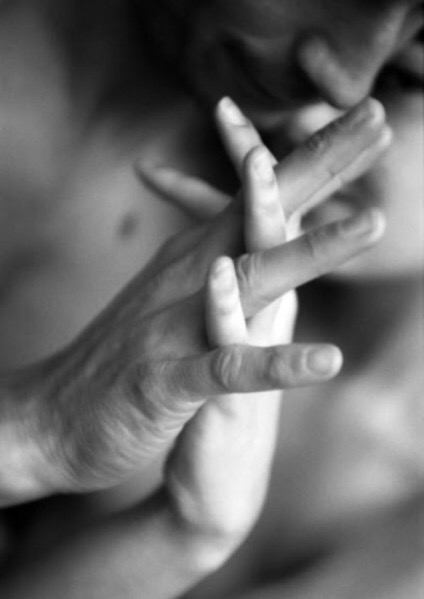
He warned me beforehand and then he touched my hand and said, “You’re a writer; describe the experience of my hand.” Of course I didn’t know what he meant; I only said I wanted to be a writer–not that I was–and I was off balance with his touch.

So I described how I felt uneasy with a near stranger’s touch. To which he asked, “Does it feel warm? soft? rough? Can you feel the arced tips of the nails unforgiving yet pleasantly smooth?”

I hadn’t even thought of the physical sensation. I never did. All passed through my mind first and the physical was always sublimated, denied or ignored. Probably why I rarely saw a doctor, going about my business trying not to think of what ailed me.

Later, his first touch of studied tenderness opened my eyes and aroused passion I buried long before I knew its heat, its colorful flavors. He touched me, what was before his eyes, not a projection of me.

And then he took me on a tour of the secret vales and rich verdure of my body. It blazed real love.

Love–true love–is presence in touch; it needs no longing, fantasy, style, grace or poise–merely acceptance in being.

When I embraced my own beauty, uniquely my biological experience, replete with singular angles and curves, scars and splotches, I learned to be heart-wise loved by someone who could love me–all of me–and confirm I was worthy of another’s hand softly sweeping the hair off my brow.

My feminine, I learned, was desire—being—in touch.

How can we ever know how others sense the world? The question should evoke a yearning to find out without the hope of ever doing so. However, it is the practice–the focused being of and with others–that matters. It’s how we connect, avoid loneliness, while maintaining our own integrity.

It is how we find love, real love.

Touch led me from interpreting the world to experiencing it. Getting out of my mind, possessed with others’ formulations of love and sex, and into the moment–breathing presence; it brought me the fullness of acceptance, as a body, my body, with someone else’s.

No, Evan did not teach me acceptance by his touch; eventually, I was able to receive his touch by my own clarity–of space, moment, nearness of another’s presence becoming my own.

He taught me to “see” like the scientists and philosophers and lovers we are–empirically, intellectually and emotionally.

I wasn’t rushing headlong into someone else’s story for me. I had learned to better integrate my body and mind, which took examining inherited perceptions: those of my mother, husband, authors, and culture.

It took practice to own my body. It still does.

And being in the precise moment recalled by someone’s touch–healing in its grounding.

Evan lies next to me now, his pillowed head in the shadow of mine. I am reading, elbow-propped, turned away.

We are prone, bare, having just settled into bed for the night. Humid heat of a New England summer makes flannel impossible and silk torturously sticky. We sleep this way most nights four seasons long.

His body is serpent shape mirror of mine with inches of space between us, creating the comfort of a cooling air canal. We are art in symmetry.

His hand, open palmed, smooths across the contours of my hip, waist and shoulder, smearing heat like oil upon the line of curvy seas in the imagination of his hand–port to starboard to port again. The slow rhythm of his caress lulls my lids to half mast as the warmth and tingling skin sensors combine, dance me to lullaby languor. These are the moments.

I stop reading to softly lower my head to the pillow, ever so slowly, avoiding the slightest ripple in the water of his soliloquy wave. I hold my breath the whole way down.

Releasing, exhaling in measured silent wisps of warm air through my teeth and the pebble O my lips make, anchor hits bottom, the sync of his hypnotic oar undisturbed; it continues to brush the still of my anatomy’s ebb and flow.

I breathe just enough air to live, causing not so much as a flutter-by in the sheets. If I fill my lungs too deeply, selfishly, I will signal sleep’s onslaught, killer of this powerfully peaceful moment of breath, body and hand. No dream could be better than this. I own it–to the coral depths of fibrous memory.

Published on Rebelle Society: Ananda–Count Your Bliss-ings Not Your Troubles


Please enjoy my article on Rebelle Society, a wonderful, impeccably professional and delightful site full of creativity and practical information as well. I have been a fan even before the editors accepted my first submitted essay on February 7th of this year. Good fortune visited me the day I happened upon them in a search for something compelling to write about on a lackluster day creatively speaking. I go there often now just to get a lift.

I hope you, my dear readers and happen-to-drop-by visitors, take some pleasure from momentary ananda my words may inspirit.

Peace, 

the Gaze

Ananda

A lover of poetry and yoga, sex and wine, and family and friends, I, like the rest of humanity, yearn for blissful moments. And though I am not a scholar of Sanskrit or the Vedantas with its Hindu terms in metes and measures, I sometimes look to their words for understanding bliss–and for creativity.

On a particularly grey day of dreary weather and woe in the face of loss–my mother’s withering mind, my oldest daughter’s going off to college next month, the recent loss of my second career in the kind of misstep that leaves me in awe of how close we all are always to falling into the margins–I contemplate bliss and its countless manifestations just to cheer me up.

However, more often I catalogue my gifts to inspire longer-term goals like grateful living and daily writing.

We–my lingual species–take for granted words like bliss, happiness, joy and even sadness, depression or despair, the ready words to capture nuances of feeling. Yet, as a complexly feeling people, we enjoy labeling the colors of our moods, one of the many inheritances that distinguishes us from other earthly creatures.

Bliss, with its thick, rich history and vibrancy steers us through that complexity as it soaks us with recognition, sense and order. The feathered tendrils of meaning that touch upon its neighboring moods captured in “pleasure” and “delight” create extensions that reach down and through our lives.

Whether we search the Oxford English Dictionary or the Vedas and the Dictionary for Spoken Sanskrit, Ananda–the Sanskrit word for bliss–wholly resonates the thought-emotion from the eternal to the local. I often write on it for poetic inspiration, especially when my mood and writing discipline falters. Its order and principles cure writer’s block.

When I am stuck, I, like the Sanskrit Dictionary, begin with Pleasure, a term with associations ranging from the simple, like the tickle of childhood in watching the mercury bubble gurgle to and fro inside the glass of an old-time thermometer, to the ecstatic, like orgasm from an in-love-with lover or the runner’s high amid the stillness of a solitary crisp morning run along a cow-lined country lane in the heather of Central France.

Pleasure alone is not enough, however, for the distinct flavors of bliss parsed from the Sanskrit. Thinly sliced from Pleasure is Sensual Pleasure, which I must confess drives my daily experiences. Lure by all that teases the senses, I can close my eyes and smell the house-filled aroma of garlicky tomato sauce simmering and feel the headiness of inhaling the sweet, milky scent of my infant’s skin.

Poetry writes itself to the earliest memories of my mother’s fingernails stroking the scalp beneath the thick curls framing my resting head in her lap.

Two others related to Sensual Pleasure are Sensual Joy, found in a late Friday afternoon nap, unclothed and entwined with a lover, and a Kind of Flute, an instrument hollow and wooden or a vessel for champagne, both soothing and stimulating the ears and mind. The memory sounds of dancing to South American pan flutes puffed outside the market in downtown Caracas and toasting in the new year floats in the buzz of the bubbles and sway.

Which is a different high from Delight, a sharper edged bliss compared to the roundness of pleasure. I find it in placing that last piece into that one perfectly matched squiggly space left in the 1000-piece jigsaw puzzle or the twenty dollar bill pulled from the pocket of my jeans one unsuspecting morning.

It’s the imagined lightswitch on when it all makes sense.

Happiness strikes me as less spiky than the sparkle and shine of Delight, deeper set and sustained: the mood makes us skip down the path just because…it is a lightness in the step, in the being. But turn happiness up a notch to a swelling sustenance to the heart and you have joy.

Joy catches us unawares, say, when a mother turns from her busy-ness to spy her infant’s gaze following her every movement. However, Joy’s cousin Enjoyment is quieter, less a beaming and more a warmth, though no less satisfying. For me, it’s a book to live in for a while; the first bite of deep, dark, smoky chocolate; or the silent spell of a Shakespearean sonnet.
But Pure Happiness is seeing the fruits of our efforts to help others ripen and blossom or the awe of creating another human being through unimaginable struggle.

Yet another bliss, Cheerfulness is not so much a mood as a temperament that drifts between internal and external space: the unforced mental smile naturally unfolding at the thought of another day as another opportunity to get something right or the gleam in the eyes of the genuine gift giver.

Some types of bliss follow strife, a sort of relief as in the contrast of high pressure to low. I imagine this sensation in Sanskrit as End of the Drama. I think of it as resolution after the struggle, war, riot, tussle, or tragedy and in another bliss–a Thing Wished For–the triumph of acceptance, often a satisfactory ending to a poor beginning.

Reaching to the sublime, Beatitude anticipates the first spring blossom clearing the snow face, break-through acts of kindness, a helping hand when all hope is lost, a miracle, and nature’s whisper. Somehow related in my mind, One of the Three Attributes of Atman or Brahman in the VedAnta Philosophy means a sort of holy, the oneness at the tip of the final exhale concluding meditation.

And in all things comes the contentment in order: Name of the Forty-Eighth year of the cycle of Jupiter intuits that human comfort in prediction and patterns and the recognition of the unknowable vastness, the multiverse, of which we are merely particles from planetary bursts—as well as the burden that knowledge relieves.

And finally earthbound and encircling ourselves, bliss is a Kind of House like all shelters that provide the safety and security that we imagined as children gleefully building blanket forts in the living room.

A trick of the mind or a daily devotion, inventorying all that makes us happy not only soundly defeats the writing doldrums but potentially pulls us from a slump, maybe even depression. The habit balances us–if not as an antidote, at least as a partial cure for the ills of a day or a life–and improves health.

A day when even the sun seems to let us down is perfect for cataloguing gifts and counting bliss-ings. Let us begin with Ananda.

Note: Classifications of Ananda are in the Dictionary for Spoken Sanskrit; definitions are in the mind of this star gazing poet.

Just–in time

She barreled through the classroom because she was a barrel, as wide as she was tall, and she was tall. Young, vibrant and cheery with an obvious eye for the boys in the classroom so much so that even I knew at a sullen and cynical 14 that she craved attention. Perhaps her size measured her insecurity.

She had ink black straight hair, long, parted in the middle falling down her back. Her thick black eyeliner matched the color of her hair and framed her deep brown crinkling eyes. She smiled a lot, teasingly–especially with the boys.

I resented her flirting in slight sexual innuendo, all for male attention, just like I disliked my mother’s constant catering to my father who, in return, called her “fat ass” or “sumbitch.” An adolescent of the woman warrior seventies,  I believed in taking no shit. Miss Hill’s pandering to the scarcely post-pubescent boys was shit; it annoyed me, which conflicted with the attraction to her enthusiasm for my favorite subject, English.

I wanted not only to like her, to take her seriously, but for her to notice me, despite the quiet and unprepossessing persona I wore at the time. An ‘A’ student, I yearned to be recognized for my smarts–my perceived strength.

“This is a wonderful piece, something I can see Janis Ian or Carole King singing,” she scrawled in large, deep-ink flourishes in my journal. She had assigned a journal at the beginning of the year, instructing us, the class, to write our thoughts–whatever we wanted–just to incent us to write. With such loose parameters, I wrote poems, cherished song lyrics, doodles and observations, all of which added up to my solitary, dark, introverted teenager dreams and drama.

Music–all kinds–made my world back then: everything from hard rock/metal to folk to classical. Before that sophomore year, I was a cellist. The local elementary school offered music lessons to third graders and so I learned the cello (after the music teacher grabbed my hand, looked at my long fingers and decided cello it would be instead of the violin I and everyone else pleaded for). I played second or third chair in the orchestra throughout my school years up to 9th or 10th grade when I perfected a full time recreational weed and boys pastime.

I especially loved fine lyrics: the poetry of Joni Mitchell, Neil Young and Dylan. That year Phoebe Snow sprung on the scene with Poetry Man, which prompted me to buy a couple of her albums. Her warbling jazz-soul sound, intoned from a space between her nose and throat in the register of a deep tenor or high alto, intrigued me. And some of her lyrics spoke bitter-sweetly about disappointment, fear and inadequacy. I felt her.

One song in particular consumed me so that I memorized the lyrics after too many spins of the vinyl. The title described my life–as I felt it: “Inspired Insanity.” The piece still holds a foundational place in my music history more for its statuesque placement from an impressionable youth and sentimentality than for its musical appeal.

In fact, a friend recently asked me to name a favorite song–seemingly impossible–but for the qualification that it somehow represent me. Instinctively, I named “Inspired Insanity” more likely from habit or history than actuality, but it was the first song that came to mind.


I’ve since moved across ample fields of genres and artists to add much more sophistication and style than her simple folk-jazz temperament into my listening repertoire occasionally moving back again to folk, where music returns time and time again: think Tracy Chapman in the 90s, Iron and Wine a few years back and some of the ballads of current bands like the Weepies of the Indie folk rock genre.

It must have been what I was going through at the time as a moody self exiled 14 year old in a New York winter hibernation, either loneliness, disconnection or generalized angst about me in the world. But the song spoke the yearning inside: “Help yourself to my new clothes. Borrow some of my daydreams too…You can call me hung up but when I call you, don’t hang up the phone…Come visit me, inspired insanity.”

Perhaps I felt taken for granted. Or simply taken. My mind did not register quickly enough all the outside motivations, what strangers or acquaintances wanted of me, and so I created misunderstanding. My intuition absorbed into analytical musings always. Books not people amused me, made me feel lucky, desired, understood…made me feel. People were not my strong suit. But 14 year olds generally don’t do people well.

I only knew I craved attention for what I could master, and I excelled at school. I had cracked the code of teachers and books long before, so I kept my eye on the coveted ‘A,’ did what I had to while enjoying some of it along the way. My ‘A’s’ were the teacher nods that validated me.

So at mid-year, when I read her praise, replete with exclamation points, next to the journal entry containing the entire neatly penned Snow song, I silently shrieked, panicked with the horror of the mistake.

“She thought I wrote this?! Oh no!!”

Instant shame, embarrassment, fear and flattery combined to redden my face, flushing heat all the way down to my ankles.

It had been painful enough to deliver my thoughts and poems to her, a stranger reading my creations, my penned pretties, not just the usual rote academic scribblings, but I consoled myself in safety of the teacher-student relationship. I trusted she would never ask me to bare my soul only to betray me by reading my work to the class. She may have even given such assurance in assigning it.

Not like in 9th grade when Mr. Rowe announced to the class that the creative project would be performed or read to the class. Back then, I combined my two loves, writing and music, and somehow mustered the courage to play a recording of a song I wrote and performed on the guitar. The ballad told the story of an assigned text, A Single Pebble, the Yangtze River Chinese gold miner who braved the forces of society and the river and lost (unless you count the immortalization by John Hersey). The image of my reserved former self does not comport with that project choice, but the certainty of the recollection cannot be denied. I can still sing some of the song.

But the song in 9th grade spelled pure victory in an earned ‘A’ for work performed, finished and collected. If memory serves, mention of using the song to accompany the reading for future classes echoes proudly (whether real or imagined) in my mind’s ears.

Not so this mistaken praise. Though mortified, my ego beamed with the attributed talent of writing such a song, which translated into the belief in me as a poet–or a songwriter, at the very least. I could not help but conclude that the other poems in the journal led her to believe so. Otherwise, how could she not detect the difference in style, the clear polished finish of the one song compared to the other driblets of word leakage (the estimated worth of my creative endeavors)?

So, though I feared she would discover the song some day and judge me a fraud–burned with the humiliation of that thought–I did round back to the idea that she presumed; I did not misrepresent. I assumed she would figure it all out, while simultaneously dreading she would not. I had little faith in human capability or not enough experience to realize that she most probably would not even remember the whole incident. She, a 22 year old, teaching her first job probably, had more to do and think about than one song in one journal of her dozens of students in several classes.

However, the scene often played out in my mind of her buying the album and hearing the song, so familiar in some way, and not knowing why. Or, the flash of recognition coupled with memory of first reading the song would conjure up my image before her eyes: the quiet student who dressed in coveralls, flannel shirts and construction boots (the original Doc Martens) and wrote poetry. Would she color that image with respect for my musical tastes or disappointment in the assumed attempted fraud perpetrated on her–even if the assignment was ungraded?

It doesn’t matter. I know. The minuscule moment magnified in my mind from teen hood speaks louder to the undigested lesson, the latent effect of that experience. Somehow I registered (or chose to) that someone recognized me as capable of producing publishable work, something as good as Phoebe Snow lyrics (which in hindsight proves less poetry than song, raw and unpolished; I mean her lyrics without the voice through them fell short of spectacular). The 14 year old me sensed the twinge of an inkling of a promise: perhaps I too could create something worthwhile, a source of another’s delight or ease of sorrow.

If only I could withstand the collective gaze of others.

Eventually, I did adapt to scrutiny. Inspired by past small successes and fleeting acts of bravery, I pushed myself through the paralysis of stage fright, figuratively for me but very real for Phoebe Snow (and Joe Cocker), and performed, wrote and occasionally sang for my living and others’ entertainment.

Real inspired insanity–sometimes frenetically and other times serenely–produces beauty, wisdom, advice or instruction. Its seeds can be found in frozen undetected time tucked in between the blinks that flutter chaos and creativity, and sway a life to the left or right. Perhaps the heat of a blush imprinted a dormant notion that unlocked itself in time, just at the right time, when I began to write–without fear.


image credit:  http://wewantedtobewriters.com/wp-content/uploads/2012/05/Chron-Higher-Ed.jpg

Courage

  
Oxford English Online Dictionary defines courage as follows:

noun

The ability to do something that frightens one, or Strength in the face of pain or grief.

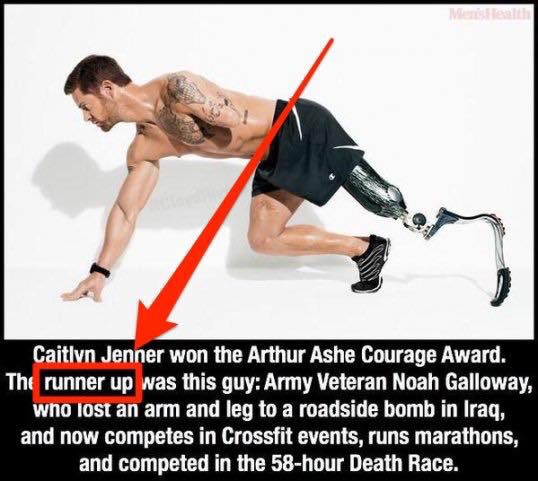
Some people in social media today are bitching about the public’s lauding Caitlyn Jenner (when they are not commenting on her age or her dress or her makeup) for her “bravery.” 

Even people I have deemed intelligent and sensitive have posted Facebook critiques with photos of their candidates for the definition of bravery such as this:

  
Classic.

And yet another post-er believes this is more befitting of the adjective:


Both social media post-ers are men, one conservative and one progressive, one older (mid-fifties) and one younger (mid-thirties).  See a trend here?

To be brave, one must risk life and limb or recover from loss of life (the one before loss of limbs) and limb(s). And be men. 

Now, admittedly, I have seen no female contributors to the courage definition, none with a picture to share, but if there were any, I would imagine it would be of cancer survivors or mothers crossing minefields to save their babies. 

But the first reason for Caitlyn’s doubtful courage is her womanhood. The second reason is her health. It is apparently not bravery to kill off her fortunate birthright–the white male privilege–to become a woman whose worth is measured by her appearance and her ability to graciously absorb the arrows of disdain and second class citizenry based on frippery and gossip, like the target she has now become. And for what? It’s not like she needed the money or the publicity like her former step family.

What’s so brave about that? I agree. She must be a masochist to become a woman in this society–to be treated like meat. 

But Jon Stewart in his latest The Daily Show always says it best:


As a woman, Jenner can now look forward to her physical appearance, not her talents or mind, being the object of daily scrutiny. Should she ever need to work, she can look forward to earning roughly 77% of what a man makes. Should she ever face physical or sexual violence, she, not her attacker, will be treated with suspicion. As a woman, Jenner will also have to get used to hearing not just new pronouns but other fun words like “shrill,” “nagging,” “bossy” and “emotional.” And then, of course, there’s the catcalling, which a “beautiful” woman like Jenner can now expect daily. 

A person transitioning to live as her true self is a wonderful thing and America has come a long way toward accepting transgender people. As Stewart so aptly pointed out, though, the real struggle now is to bring up the lives of all women. On that front, there are still miles to go.

Perhaps the clichés we are fed about hero imagery and the hardship stories that go viral to tug at our heart strings in quiet, reverential sentimentality get in the way of our seeing the bravery of transformation, being faithful to the universal need to be our authentic selves even in the face of total annihilation through either vilification or idolotry. 

Caitlyn Jenner may be just a woman now, but her twice-baked celebrity-dom has transformed her into a paper doll image, something to wag about as a projection of an idea, sans flesh and blood, no matter how much skin gets bared where.

And I am not disputing the other photos depict bravery, though they are subject to the same fate as Caitlyn–the loss of humanity to an idea of something like heroism or bravery or Facebook likes.

The take home idea: Why would anyone want to be a woman in a misogynist society?

Power to the People:  Happy Memorial Day (a flag wave to free speech)

Flag waving

  
Credit: James Gort

I am not fond of patriotic measurement. Those who denounce others for lack of patriotism are often too busy waving flags to find time to write their Congress people about the injustices around them: the disproportionate number of black youth in prisons, the war against the poor, and the cycling of drug addicts in prisons on the wheel of blind ineffective policies and inhumane disdain for the weak and poor, to name a few. The ignorants of history get my guts gurgling. 

Peace-loving by nature, I do bite when rankled. My teeth sunk into an unsuspecting victim on Facebook (where else more appropriate?) on an ex-student’s thread after the post question asked why everyone was getting so riled up over PacSun’s new design: an upside down flag. The first responder raged about disrespect for the flag. I smelled that one coming.

Also inherently pedantic and boorish, I tried to positive spin the symbol as patriotic while teaching a history lesson about the founding fathers of our nation finding it so important to democracy that citizens of a nation DO speak up and out for what they believe are best policies and interests for the country, whether those sentiments are critical or supportive of existing ideas, policies and laws. However, the tepid response held that a positive critique helped more than a negative one. 

She misses the point.

When PacSun disseminates t-shirts with upside down flags, it may be merely smart marketing to the rebel, the cool folk, the hipsters or youth generally, those with piss and vinegar in them about something–and not necessarily the country’s welfare. However, the symbol should evoke the ultimate patriotic act: expressing dissatisfaction with the nation’s behavior. 

What could be more patriotic than to care about the nation enough to speak up? To want changes? Apathy or blind complicity wreaks destruction to a democracy grounded on a bustling marketplace of ideas. 

How else do our nation’s law and policy makers know how to represent us if not for speaking out (yeah, I know…lobbyists, special interests and favors) at least in principle, on Constitutional constructs. Flag waving signals symbolic respect, approval and support of a nation, in whole or in part. Protests, letters to the district Congress person, flag burning and iconic imagery and slogans of dissent, such as upside down flags, literally and symbolically disapprove a nation in whole or in part. 

Patriots of a nation act, speak and opine. Shallow patriots wait for holidays to post sentimental gestures, gratified that they have done their part. Traitors silence speech of others, censor opinions they disapprove, the very acts from which the founding fathers of this country sought to protect its citizens. 

Plenty is upside down in America now. The downward facing flag speaks legions to me, one citizen among many who feel the same. Those who disagree speak freely in cafes on the streets, at the dinner table of their homes,  slouched at their desks on their electronic devices and behind the screens of anonymity on social media. 

And that’s the beauty of it–the freedom to express disagreement, exchange ideas and learn something–in a nation that not only tolerates but requires it for its very existence.

On this Memorial Day, remember American history. The antidote to tyranny lies in the people–who are the sovereignty in this nation–assembling, whether in private or public, to meet with other minds in order to keep the government in compliance with the needs of its rulers–the people. 

Power to the people, and their voices, echoing from the battle field groans of dying soldiers to the exclamation points typed on an IPad to punctuate a Facebook debate.

Motherhood on Mother’s Day: Let it Be


My Dear Daughters:


   No letter, especially one to daughters, should begin with I’m sorry, but this one does. I’m sorry. Though regrets are a waste of time, I must apologize for your inheritance. No, I don’t mean money. In all likelihood, your fortunes are your own to make. And I know of no genetic medical challenges in store for you in this lifetime. No, this apology comes upon seeing the two of you drive off to lunch together, one tight-lipped and tense, the other tentative and earnest.


You see, dear daughter number two in birth order, you have inherited the portion of your mother’s temperament that ruffles easily when you convince yourself that another has acted poorly or unjustly or incompetently. You do not suffer lightly the effects of others’ actions on your life, irritated at the shortcomings of your fellow beings. You stew. 


To make matters worse, you can’t shake it off. When you decide to change teams and find the coach knows little more than the last one and your teammates are no different, no more skillful or intelligent or cooperative than the last, you simmer, aggravated after a game where the forwards hardly ever anticipate your serves from mid-field and so miss scoring opportunity after scoring opportunity, while the coach fails to instruct and the defense fails to adjust for the deflected offense. 


So you grouch for the rest of the day, angry at your teammates, your coach, but mostly at yourself for having chosen the team, or for even playing soccer in the first place.


And you, daughter number one, I owe you an apology for both your inability to fix your sister and your desire to do so. Like me, you feel discomfort when others display unpleasant emotions, even if  they are mere facial expression. Your sister cannot hide what she feels, though she speaks not a word or a sigh. Her face tells the story–sorry again, second born, for yet another trait passed on. 


And you feel responsible when you are not completely oblivious. Sensitivity is not your strongest attribute. You need to be hit over the head, spoken to directly, told what someone feels, unable to intuit. I gave you that obtuseness. Then when you hear the complaint, the source of woes, compassion turns to anxiety to solve the break, the mood, or problem. 


That anxiety leads to paralysis. Your mind turns foggy with the pressure to create, find an idea. And so you retreat, get disinterested and frustrated. You have no idea what to do to please her, though you try: bribe her with first choice of music in your car or chocolate or a trip to the mall. You try teasing and joking but the list of sorry-I-gave-that-trait-to-you includes stubbornness on her part as it does cluelessness on yours. 


But you know she unwinds in time, flexes her tension and exhales in release when she does, so there’s no rushing through it. The two of you cleave to one another as the best of friends, so you know.


Daughter born first, the days ahead bring many lessons about letting go, acceptance and boundaries, yours in relation to others. Your compassion will hold you in good stead if you never swallow it down in futility rather than acceptance: you can offer but no one has to accept. Perhaps she cannot. That is not your fault. Give, nevertheless, without the expectation of receiving. Help others because others need help, not to get results. You are not here to fix but to try.


Daughter born second, when you too learn to accept yourself, mistakes and all, your moods will calibrate, even out. Your expectations so high for yourself, you project those on to others who cannot meet them. If only you can merely see people, observe them without judging, and accept your strengths and weaknesses realistically without judgment, you may be able to do the same for others. 


The expanding pressure contracts and recedes in the exhaust of toxic release, the poison of fear–of disappointment, not measuring up, and not succeeding–whether aimed at you or others.


You both have a lifetime ahead of procuring patience, and if you get the jump on everyone else, you may discover the secret, the jewel of existence, of slowing down just as time speeds up. If you can, if somehow in cinematic slo-mo you can envision your two hands grab the big hand of the clock, just like when you were little we learned from that interactive picture book with the brightly colored spinning clock hands (blue for the big one and red for the small one) and hold that big boy back with all your might, you better the odds at beating the odds against you–your inheritance. 


Take time, my daughters, to be and let be. She who came after you needs time to work the inarticulable undulations of anger mounted on uncertainty overlaid on the foundation of fear that shift and morph like sea kelp ebbing and flowing with the tide. If you, my first born, breathe slowly, let every drop out before you sip another slow breath in, the extra seconds may allow you the focus, the time it takes for the words to come, the ideas to set you free:  “She is who she is, and I am who I am. Nothing more.”

I am sorry but have no regrets. You two embody the best I have to offer–and more. 

With all my love…
Happy Mother’s Day, Mom. I know you know.