Dooms Day

  
La Mort de César (ca. 1859–1867) by Jean-Léon Gérôme

 
Caesar:

Who is it in the press that calls on me?

I hear a tongue shriller than all the music

Cry “Caesar!” Speak, Caesar is turn’d to hear.
 
Soothsayer:

Beware the ides of March.
 
Caesar:

What man is that?
 
Brutus:

A soothsayer bids you beware the ides of March.
 
Julius Caesar Act 1, scene 2, 15–19
 
Today is bad omen day, or “I told you so” day. Julius Caesare apparently was warned of the treachery that awaited him at the Senate–many times and ways–yet he remained in denial, denying even his own gut feeling that the nasty-liver-missing-heartless entrails of a dozen or more sacrificed beasts did not bode well.
 
According to UK’s The Telegraph, The Ides of March: The assassination of Julius Caesar and how it changed the world, Caesar was warned by an entrails reader that ill fortune awaited him. According to this account, Caesar actually died with an unopened scroll in his hands, given to him by a messenger warning him of the treachery. But nooooo, he had to go to show good appearances, at the beckoning of his so-called friends and countrymen.
 
For drama’s sake, Shakespeare spiced up Caesar’s departure with parting words, “Et tu, Brute?” and anyone who knows anything popularly about Caesar’s death, probably knows it through Shakespeare’s play, required reading in many high schools and undergraduate college courses.
 
In the English-speaking world, we know a slightly different story, thanks to Shakespeare. He lifted Caesar’s dramatic dying words, “Et tu, Brute?” from an earlier play by Richard Edes, and made them a part of the assassination mythology. In reality, most Roman writers state that Caesar said nothing, but merely pulled his toga up over his face. They do note, however, that some people were spreading the story that Caesar had gasped, “καὶ σὺ, τέκνον?/You too, my child?” to Brutus. (Many Romans of all classes were bilingual, with the more educated frequently preferring to speak Greek.)
 
Most famously, however, Shakespeare does away with Spurinna, the venerable entrails-gazer, and instead invents a soothsayer in a crowd, who shouts the famous prophetic warning to Caesar, “Beware the Ides of March!” It is, perhaps, one of Shakespeare’s most famous lines and, as a direct result, “the Ides” has come to mean a date of doom.
 
Doomsday. I hope not. My father has a doctor’s appointment today in preparation for surgery. The innards of my breakfast cereal looked okay this morning, however. I think it’ll be all right.
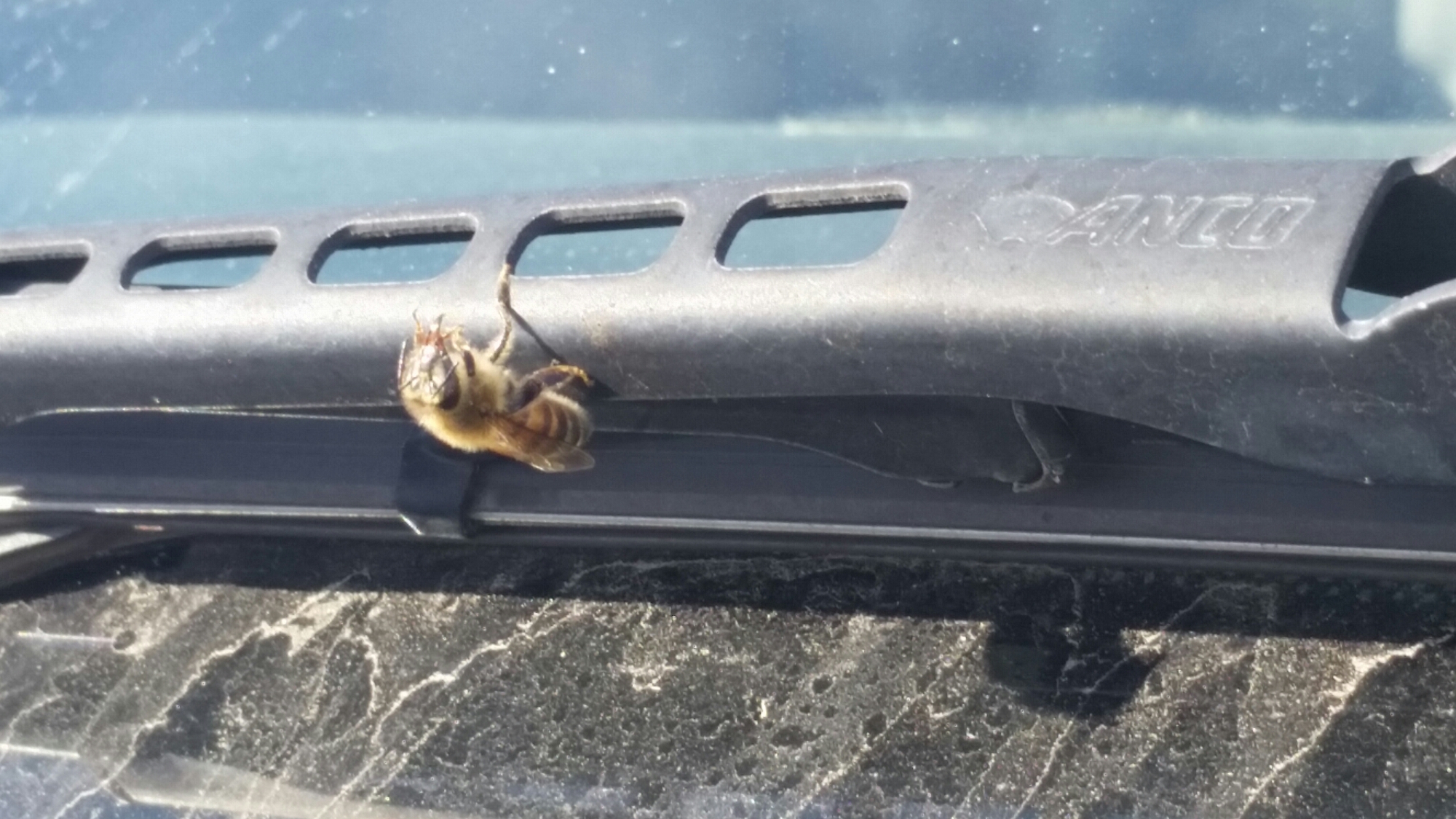
Six Bee Poems

image

Six Bee Poems

I Tell The Bees

He left for good in the early hours with just
one book, held tight in his left hand:
The Cyclopedia of Everything
Pertaining
to the Care Of the Honey-Bee; Bees, Hives,
Honey, Implements, Honey-Plants, Etc.
And I begrudged him every single et cetera,
every honey-strainer and cucumber blossom,
every bee-wing and flown year and dead eye.
I went outside when the sun rose, whistling
to call out them as I walked towards the hive.
I pressed my cheek against the wood, opened
my synapses to bee hum, I could smell bee hum.
‘It’s over, honies,’ I whispered, ‘and now you’re mine.’


The Threshold

I waited all day for tears and wanted them, but
there weren’t tears. I touched my lashes and
the eyewater was not water but wing and fur
and I was weeping bees. Bees on my face,
in my hair. Bees walking in and out of my
ears. Workers landed on my tongue
and danced their bee dance as their sisters
crowded round for the knowledge. I learned
the language too, those zig-zags, runs and circles,
the whole damned waggle dance catalogue.
So nuanced it is, the geography of nectar,
the astronomy of pollen. Believe me,
through my mouth dusted yellow
with their pollen, I spoke bees, I breathed bees.


The Hive

The colony grew in my body all that summer.
The gaps between my bones filled
with honeycomb and my chest
vibrated and hummed. I knew
the brood was healthy, because
the pheromones sang through the hive
and the queen laid a good
two thousand eggs a day.
I smelled of bee bread and royal jelly,
my nails shone with propolis.
I spent my days freeing bees from my hair,
and planting clover and bee sage and
woundwort and teasel and borage.
I was a queendom unto myself.


Going About With The Bees

I walked to the city carrying the hive inside me.
The bees resonated my ribs: by now
my mouth was wax, my mouth was honey.
Passers-by with briefcases and laptops
stared as bees flew out of my eyes and ears.
As I stepped into the bank the hum
increased in my chest and I could tell the bees
meant business. The workers flew out
into the cool hall, rested on marble counters,
waved their antennae over paper and leather.
‘Lord direct us.’ I murmured, then felt
the queen turn somewhere near my heart,
and we all watched, two eyes and five eyes,
we all watched the money dissolve like wax.


CCD

My body broke when the bees left,
became a thing of bones
and spaces and stretched skin.
I’d barely noticed
the time of wing twitch
and pheromone mismatch
and brood sealed in with wax.
The honeycomb they
left behind dissolved
into blood and water.
Now I smell of sweat and breath
and I think my body cells
may have turned hexagonal,
though the bees are long gone.


The Sting

When the wild queen leads the swarm
into the room, don’t shut the door on them,
don’t leave them crawling the walls, furniture
and books, a decor of moving fuzz. Don’t go off
to the city, alone, to work, to travel underground.
The sting is no more apis mellifera, is a life
without honey bees, without an earful of buzz
an eyeful of yellow. The sting is no twin
waving antennae breaking through
the cap of a hatching bee’s cell. The sting
is no more feral hive humming in the stone
wall of the house, no smell of honey
as you brush by. No bees will follow, not one,
and there lies the sting. The sting is no sting.

About this poem

First published in 2011.

Jo Shapcott

Jo Shapcott won the National Poetry Competition in 1985 and 1991. Her collections include: Electroplating the Baby(1988), which won the Commonwealth Poetry Prize for Best First Collection, Phrase Book (1992), and My Life Asleep (1998), which won the Forward Poetry Prize (Best Collection). Her Book: Poems 1988-1998 (2000), consists of a selection of poetry from her three earlier collections. Her latest book of poems, Of Mutability, (Faber, 2010) was shortlisted for the Forward Poetry Prize and won the Costa Prize for Book of the Year. She was awarded the Queen’s Gold Medal for Poetry in 2011 forOf Mutability. She is also co-editor (with Linda Anderson) of a collection of essays about Elizabeth Bishop and co-editor with Matthew Sweeney of an anthology of contemporary poetry, Emergency Kit. She teaches on the MA in Creative Writing at Royal Holloway, University of London.

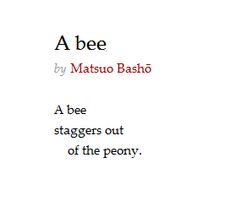
Basho’s Bee Meets Monsanto

basho bee

…Monsanto’s contribution to the vanishing bee population is detailed. From genetically altered corn, Monsanto produced an insecticide called Bacillus thuringiensis (Bt), which once ingested by bees, Bt binds to receptors within the bee’s stomach lining that keeps the bee from eating. Of course this weakens the bee, causing the breakdown of the inner stomach wall, which in turn makes the bee susceptible to spores and bacteria. To further compound the problem, for years the lobbying power of the chemical giant denied causing damage to the bee’s internal immune capacity for resistance to parasites, which of course only continued to kill off the bee population worldwide. Thus, continued chemical use, especially in America, only exacerbates this growing problem.

Death and Extinction of the Bees

By Joachim Hagopian

Global Research, March 07, 2016


Before there was Bernie, there was Peter.

singer

Peter Singer, an Australian-born ethical philosopher, writes in his essay, “The Singer Solution to World Poverty,” that ‘wealthy’ (living beyond basic needs) people should donate to world organizations that feed the hungry so as to eradicate world hunger:

In the world as it is now, I can see no escape from the conclusion that each one of us with wealth surplus to his or her essential needs should be giving most of it to help people suffering from poverty so dire as to be life-threatening. That’s right: I’m saying that you shouldn’t buy that new car; take that cruise, redecorate the house, or get that pricey new suit. After all, a thousand-dollar suit could save five children’s lives.

He even provides in his essay a toll free number to call Oxfam with a donation.

Singer asks elsewhere (or maybe it wasn’t Singer), if every person in the developed world donated the cost of his or her third pair of shoes (Do we need three pairs?) to the world bank, which would effectively end world hunger, are we morally obligated to so donate? If morality is defined as right behavior as in doing right by another, then yes, to be considered moral, each person is morally obligated to donate.

But what if ending world hunger results in overpopulation and the disappearance of planetary resources to feed everyone like water, clean air and soil, for example? Is it then moral to donate?


credit: pbstwimg.com

Life in the Gap


Understanding is a process of contemplating and confronting mysteries. It’s like we have two selves, the observant and the enlightened. One ingests with absorption while the other processes by simmering. Their timing is not always the same. Sometimes understanding arrives much later than input data. But it is our pricking drive of curiosity and our slow-cooking insight that comprises learning–and living.
 
Frank Conroy, writer and musician, says in his essay entitled “Think About It,” that “Education doesn’t end until life ends, because you never know when you’re going to understand something you hadn’t understood before.” This elasticity of understanding, the distance between input and processing, is the expanse of the canvas of our lives, covers the whole painting. Conroy so aptly puts it, “The physical body exists in a constant state of tension as it maintains homeostasis, and so too does the active mind embrace the tension of never being certain, never being absolutely sure, never being done, as it engages the world. That is our special fate, our inexpressibly valuable condition.”
 
We doubt. We feel insecure in ignorance–some of us–and so we look for answers. Sometimes we find them in our immediate search, like when I ask my students to Google a word, ‘avuncular’, for instance, when that word turns up in their reading. Other times, we don’t find the answer or solution until much later–or never.
 
I remember one ex-client explaining his divorce. Of his wife of 30 years, he said, “I did not hear what she said–or I did not understand her words.” He told me his wife complained that he didn’t work hard for the family, which baffled him since he was putting in 12-hour days and weekends, socking away retirement and college money. He could not understand how that was not working for his family–until he did. “Now I know she wanted me to look at her, to work hard at being there for her and our boys each day by spending time and focus on them, not my work,” he confessed. He shuttered out simple words spoken to him before his experience allowed him to “see”.
 
That lag time between learning and understanding is the human condition. Some would even say that inside that gap–between ingestion and digestion–is rubbery, elastic life itself. Maybe.
 
credit: wikipedia

Fuck Contentment

A moniker for good living, 

this fear of discomfort, 

ever drifting toward ever-comfort,

called contentment. 

Just give me this or that–

this president, 

this career, 

this amount of money, 

this family, 

lover, 

mother, 

neighborhood–

and everything will sail, 

Cadillac shocks across

the fresh asphalt forest floor.

If I can be comfortable,

just end this struggle,

this pain and anguish,

strife, 

this ambitious striving,

I will be content. 

I once knew this

 instinctively. 

“Contentment is death,”

I said at solitary 14.

 The day I am content, 

all juices have dried. 

The day I surrender, 

turn from struggle, 

un-face the tick of the clock, 

is the time to lay down,

take peace to a deep hole,

dug in my own backyard,

or in an abandoned dirt lot.

I am neither hero nor warrior. 

Just thirsty, 

a third rate ecstasy vampire,

seeking small electric bites, 

a taste of the powerful, 

the blissful, 

and the sublime. 

To touch the electrified wire 

to tolerate the charge, 

where it sparks,

risking pain and death,

beats the static hum

sounding the heated surge,

only the pulsing effects,

not the beat itself. 

I remember reading the poet:

“I want to write what marks me,

gets me killed.” 

I wondered if I did too:

stop fearing, I thought,

stop warning safety, 

stop honoring caution 

and forego the refrain,

letting shit fly and scatter, 

roam and bust, 

fling and crust 

and curdle like dying, 

like spoiled cream, 

like decay and wither,

the words, let them

paralyze, plunder and poison,

let them arrest a heart, 

gore truth from a bloody lung,

a festering bullet hole to the brain,

let them burn

and gnaw

and lacerate;

let them disrupt dreams

and torture sleep.

Let them brand flesh,

singe hair and spew bile.

Let them upturn content-

meant to pacify and please.

Let them fist screams

and tear at vacant stares.

Let them drown dun breasts

and poetic gentility.

Let them beat the fuck out of you

–and me too.

Writing to Know Me

writer

I, like many, write to grow myself and grow knowledge not only of all that’s out there but also of all that’s on my mind.

Novelist Judith Guest in the Foreword to Natalie Goldberg’s Writing Down the Bones writes: “It is easy to lose sight of the fact that writers do not write to impart knowledge to others; rather, they write to inform themselves.”

That may seem egocentric, but isn’t that all that anyone can be? I read writing advice daily: write for others, give readers something to chew on; enrich them. Well I, for one, know that I may never sit down to write with my readers’ benefit in mind. That I could not do. I would write not one word (and did not for decades) with so much burden, so much expectation.

Besides, it’s presumptuous to believe I have anything to offer my reader–knowledge, advice, tips, beauty–beyond my human experience. I offer one person’s view of one person’s observations.

After I have sent something out there–to be read–then, that is when I send my hopes and wishes that someone somewhere finds something in my words, something worth the time spent reading them. But if I wrote with that same desire, that my recollections reach a reader, I would not write for fear of disappointing.

Anyone out there? (sound of crickets)

The Poetry of Being

  
The components of being build essences of the all told, acted, sung and noted.

They shake out doings done and yet to come like San Andreas’ fault, not a fault. 

Did we quake? My shoulders shuddered like a surge, a heart murmur or eruption.

No, the inner mechanics of rebellion taking a stand on all things ingest just arose.

When the ear throbbing starts, I know I’m lost to it, going into floated notice din.

My heartbeat declares so loudly inside my ears in its under water muffle-areum.

I doubt creation’s pen then, my mouth moving silently, my hands ripping at keys.

Keyboard fingers fly like the cocaine toad hopping brain’s clicking away at strings.

There’s this word association that bleeds writing, a lapse, slide gurgle into them:

Strung words, the meaning of which is not revealed until they mix and sit together.

They settle in a rhythm and slur, brushed water tinted smears blotting tilted space.

Poetry and being entwine thus: letter, scene, wish, guess all overlaid in blindness. 

Squeezed juice, the nothing of matter becomes me-you, and we polish air’s shine.

Our weekly or sometimes bi-monthly lunch date

  
“How was class today?”

“I finally convinced my students that writers are like magicians. They make something out of nothing. Turning a blank sheet of paper into an essay is like pulling a rabbit out of a hat, changing the properties of one thing to transform it into another.”

“And they bought that?”

“They did.”

“Because you hold their future, namely their grades, in your hands, you think?

“Maybe. Whatever it takes.”

“Sounds like teaching is a lot like extortion.”

“There’s a lot of ‘or else’ in life, not just in teaching. Everything is a matter of dangling carrots or dodging sticks: Pay your bills on time or pay penalties, finance charges or lose your electricity. Pay your bills on time and build good credit, so you can have more credit. Sticks and carrots.”

“Speaking of which, I’ll get the check this time. You paid last time.”

“Carrot. You want me to show up next week to reciprocate–or retaliate, right?”

“Clever girl.”

When a father…

We never carry them the way they carry us, but we carry, we do.

I may never lift my father in my arms and cradle him to sleep–

but I would if that were the only thing to do, if he withered away,

the blood in his urine signaling cancer gone cure-less, and all

of his 6’3″body shrunk to size befitting my strength’s capacity.

His burden was not the same as mine now, yet just as heavy.

I make his doctor appointments, petition his insurance carrier

for returns and permissions, for money owed and paid, due

promises others should keep, I track them and bite my nails

when he drives, counting the days til the inevitable unknown.

I am his memory and his nattering nit-picking conscience.

Parenting him is not like his parenting me–not like it at all.

He left parenting to his wife, my mother, who stares skeletal now.

My parenting is ironic, the young to the old, whereas his or hers

was right side up. Picking up my body in his arms to rush me,

bleeding, to the doctor downstairs when I cut my finger off in the

city apartment steel shut booming door I teased with my 3 year old

fingers til it bit my left forefinger, my pointer, right off my hand,

he carried me, but not like I carry him, in his arms, not in my arms,

but in my constant vigilance and resentment and worry and fear.

I watch him and struggle to be patient, to be nice, to be a daughter

not a mother or a wife or stranger disinterested in the outcome,

though that may be how it appears on the outside, estrangement.

But it’s never-without-burning back of the mind bearing weight,

loaded on a mind’s shoulders, sagged under heavy-careful love.

He held me in lightness and faith, worry, worship and wonder.

I speak him in my dreams, awakening to his anger and my own.

Shaking off our bodies to the dust is always on our minds, we two–

a father to a daughter-mother-mortal-stranger til the end, ours.

offset_303756