Had a great time at the Huntington Beach Tuesday night Street Fair reciting poetry like the true inspirited Beatnik.
Thanks to Jim Caron on bongos and Tyler Vrooman on bass.
We had fun!

"My mistress' eyes are nothing…"
Had a great time at the Huntington Beach Tuesday night Street Fair reciting poetry like the true inspirited Beatnik.
Thanks to Jim Caron on bongos and Tyler Vrooman on bass.
We had fun!
Il pleut dans mon coeur…
The Huffington Post exposé of this “art” exhibit is all in the title. The installation is called “Hysterical Literature,” by artist Clayton Cubitt who will show this piece next month in Mass MoCA’s “Bibliotecaphilia.” The article features videos of five women who read while, unbeknownst to the audience, being stimulated to orgasm. Interesting results that bring a new meaning to bibliophilia. What more could I add? See for yourself.
Ghost marriages? Though ghost marriages are historically reported, and thus are real, the metaphoric possibilities of the concept are far more interesting.
Ghost marriages were an ancient Chinese practice to ward off loneliness in the afterlife. The “arranged” betrothal of an unmarried deceased family member occurred when a corpse match was found to bury beside the unmarried one, usually by a relation, resulting in the intended eternal union. Though contemporary China has discarded the practice and grave robbing is outlawed, there still exists practitioners in rural areas. In fact, just last October, the BBC reported a grave-robbing incident by eligible corpse seekers, which led to arrests.
The idea of a ghost marriage is quite frankly creepy to me, but that is most probably due to my cultural predispositions. As the short TED talk featured below describes, marriage is an historical institution that is shaped by the ever-changing values and practices of a given culture throughout time. It is a flexible arrangement that conforms to the people who practice it.
But a ghost marriage is precisely what some people have, whether intended or not. Let me belabor the obvious with an example of the married couple, one of whom works endless days and nights and misses out on the benefits of marriage and family. A husband who works at an all-consuming job appears vacantly in the family functions of necessity, sometimes at dinner or breakfast before scurrying off to work. His mind is never really there, just his body. He is a symbolic figure as husband and father. Though he goes through the motions of patting his children on the head before leaping off to his car or makes love to his wife to keep up some semblance of duty, his presence is somewhere buried in what others need of him: his job.
Or perhaps his mistress’ siren call is the life-suck that keeps him a specter in his marriage. When he is home, he thinks of her and wants to be with her; she provides him with what he doesn’t get at home. He thinks of her when he does his husbandly duty to keep that circle sewn up, maybe even making it possible to complete the task of making love to his wife. He is a ghost husband.
But the ghost husband or wife may also be either or both in a marriage that has run its course, where both long to be somewhere else but remain in the marriage for the sake of the kids or for fear of financial insecurity or the unknown. The comfort of the well-worn patterns walked in the carpeted floor of the family home of thirty odd years is all that is left when desire and disdain have deadened walking bodies, zombies, that refuse to be buried. The glazed over lifeless eyes that gaze out the kitchen window onto manicured green flawless lawns of suburban safety reveal the truth.
A marriage is only as strong as its weakest member.
Marriage clearly is a highly improbable proposition. How can two people pledge themselves forever after in a lifetime of change? The inhabitants of this thing, marriage, are both the components and the encasement of that which has an independent existence itself. Marriage is both the sum of its parts and the excess, an entity in itself, an idea, a pledge, and a monument to societally structured love and order. It persists.
Like the jailhouse that stands separate from the inmates will continue to stand though the inmates perish, languish or thrive within, so too marriage survives beyond its inhabitants. The bride and groom pledge as much to the symbol and practice of marriage from wedding rituals to marriage licenses and filing joint tax returns, as they promise themselves one to the other.
Marriage tests the mettle of its subscribing members. Survivors of imprisonment and marriage–no I am not equating the two–make their world from within not without. Strong marriage mates can stretch, withstand and grow from pain, isolation and degradation yet do not stagnate in the long safe sailing days of predictability, comfort and security. Marriage is both stasis and evolution, the anchor and the ship.
Just as our bodies are garments we wear to weather the surrounding climate, so too the marriage protects us from outside forces that threaten us: disease, rejection, insecurity, heartbreak and restlessness. We trade possibility and excitement, stimulants from the outside, for the quietude and stability from within the shelter of marriage. Some of us need the staid grounding that strengthens us to journey far.
Some find themselves, what they’re made of, only in adversity. While marriage is the impetus for that discovery for some, ultimately, each of us finds within ourselves the necessary tools to make our own happiness wherever we are and with whom we are by self love; selfless compassion and forgiveness; fullness of time; persistence, presence and acceptance; growth in experience; open-mindedness and the ability to laugh at ourselves.
I love you whether or not you love me
I love you even if you think that I don’t
Sometimes I find you doubt my love for you, but I don’t mind
Why should I mind, why should I mind
What is Love anyway, does anybody love anybody anyway
What is Love anyway, does anybody love anybody anyway
Can anybody love anyone so much that they will never fear
Never worry never be sad
The answer is they cannot love this much nobody can
This is why I don’t mind you doubting
And maybe love is letting people be just what they want to be
The door always must be left unlocked
To love when circumstance may lead someone away from you
And not to spend the time just doubting
Howard Jones
I woke up with this song in my head. Since it’s an old song, I could only remember the two line, one line repeated actually, refrain, until I looked up the lyrics.
As luck would have it, however, I came across a BuzzFeed article that fed into the ear worm eating at my brain…”What is looooooooove, anyway?” According to Chloe Angyal in “The Paradoxical Rise of the Viral Marriage Proposal,” despite the present decline in marches to the altar, those who do seek marriage want it to be known–everywhere–because true love is exceptional, something that should be spread like a virus. Okay, that’s my cynically bent twist on Angyal’s showcase, which is the growing phenomenon of viral internet marriage proposals and weddings as love on public display, a paradox, she muses, that marks “contemporary romance culture.”
Aside from some fun viewing of the Danish proposal gone wrong, gone viral, and a choreographed wedding walk down the aisle (and all over the church), her premise is that romantic comedies have framed our vision and appropriate measure of the ultimate public love expression–marriage. Thus, the advent of the viral video proposal and wedding madness.
If romantic comedies tell us that the truest and most special love is performed in grand, public ways, then the advent of social media has increased the pressure on all of us to stage those performances in our own lives. Now we can all prove that our love is special and true by putting on our own romantic comedy happy ending — and now more people than ever before will be able to watch it.
Her more intriguing claims are not teased out enough, however, leaving the reader hanging, though with some good food for thought.
And, of course, for people whose love is still threatening to the status quo, treated as second-class or hidden away and kept secret, there’s enormous political and personal power in the kind of visibility that a spectacular public display provides.
Really? How does public display garner respect and not increased public aversion or even hate in minds predisposed to the threat of all that is other than themselves, their values, their world view?
After observing that the public marriage proposal smells like a trap–the woman is compelled to say yes or stab her beloved with public humiliation in addition to plain old rejection–Angyal concludes:
But marriage is evolving in a way that is historically normal, even if it feels unprecedented at our close range. This is just one of several paradoxes at the heart of how we perform and consume love today: As marriage becomes less popular, the performance of it becomes more insistent. Another paradox: Despite the intimate nature of romantic love, straight, cis couples seem more intent than ever on displaying it in public.
Not sure what she means by marriage’s evolution as “historically normal” especially since she implies by this penultimate parting thought that marriage is performing its “swan song.” Seems more like the devolution of marriage.
Love is exceptional, or at least we think “our love” is exceptional, are her final words. Perhaps that is the reason for the decline of marriage, which, historically has been all about public display. Before meticulous institutionalized record keeping, the best way to keep track of who was having kids with whom and where was by the public marriage ceremony, aside from the symbolic nature of an open declaration of love as testimony to its truth, to its manifest being. But the belief that couplehood love is unique or special is a sure set up for the big let down when it turns out to be the ordinary kind of love that morphs into fermented love over time or rubs out completely in daily friction.
I’m exceptionally fond of a definition of love I found on today’s Brainpickings.org offering by Tom Stoppard in his play The Real Thing:
It’s to do with knowing and being known. I remember how it stopped seeming odd that in biblical Greek, knowing was used for making love. Whosit knew so-and-so. Carnal knowledge. It’s what lovers trust each other with. Knowledge of each other, not of the flesh but through the flesh, knowledge of self, the real him, the real her, in extremis, the mask slipped from the face. Every other version of oneself is on offer to the public. We share our vivacity, grief, sulks, anger, joy… we hand it out to anybody who happens to be standing around, to friends and family with a momentary sense of indecency perhaps, to strangers without hesitation. Our lovers share us with the passing trade. But in pairs we insist that we give ourselves to each other. What selves? What’s left? What else is there that hasn’t been dealt out like a deck of cards? Carnal knowledge. Personal, final, uncompromised. Knowing, being known. I revere that. Having that is being rich, you can be generous about what’s shared — she walks, she talks, she laughs, she lends a sympathetic ear, she kicks off her shoes and dances on the tables, she’s everybody’s and it don’t mean a thing, let them eat cake; knowledge is something else, the undealt card, and while it’s held it makes you free-and-easy and nice to know, and when it’s gone everything is pain. Every single thing. Every object that meets the eye, a pencil, a tangerine, a travel poster. As if the physical world has been wired up to pass a current back to the part of your brain where imagination glows like a filament in a lobe no bigger than a torch bulb. Pain.
Love is knowledge. I like that in so many ways, its broad application to the unlimited: to people, learning, everything, really, and even to the unknowable. The bible’s love as patient and kind resonates rightly with me too. And I don’t know why it does exactly except for my experience as one individual has proved it so–for me. What IS love anyway?
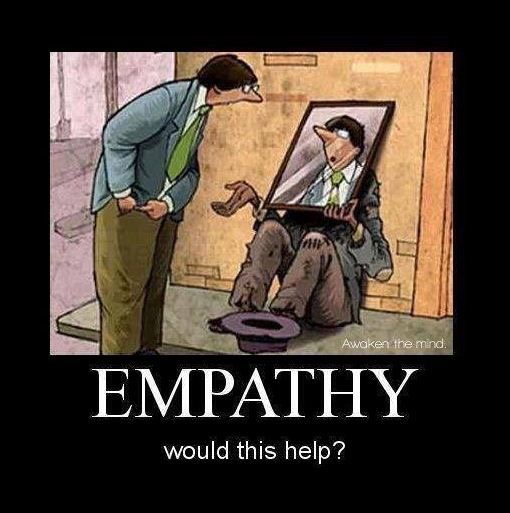
credit: http://inspiremykids.com
I enjoyed this short from Collective Evolution featured in a Psychology Today article in April, 2014, on the difference between empathy and sympathy and so share it with readers today.
While most of us know the meaning of the two words and do not need an animated short to teach us, a subtle reminder about the power placement inherent in these two terms is beautifully and simply elucidated in this short.
The two terms have always been distinguished in my mind by power. The position of the giver and receiver of sympathy as opposed to empathy is quite different. I picture it as a gazing down at another versus a locking eyes with another.
Sympathy is synonymous to pity. Pity describes an emotion derived from a feeling of superiority, even though the intention of the pitier is to give relief and express care. More often than not, however, the pitied is treated as an object, one that makes another compelled to react as if the object of pity was drawing something from the onlooker. A person who suffers from whatever misfortune of accident or fate or foolishness, is, while in the throes of such misfortune, viewed as less than in some way, less than the one who is not suffering misfortune. The sympathizer distances him or herself from the misfortune and offers sympathy to the other, possibly feeling uncomfortable with the reminder of everyone’s vulnerability to life’s unexpected or expected cruelties.
My associations with the two words is not dispositive, however. Oxford Dictionaries defines sympathy as:
1Feelings of pity and sorrow for someone else’s misfortune:
they had great sympathy for the flood victims
SYNONYMS
1.1 (one’s sympathies) The formal expression of pity or sorrow for someone else’s misfortune; condolences:
2Understanding between people; common feeling:
the special sympathy between the two boys was obvious to all
And empathy as:
The ability to understand and share the feelings of another.
These two definitions are not very enlightening because the terms are defined equivalently; the Urban Dictionary is clearer as to empathy:
Empathy
1. The ability to identify with and understand somebody else’s feelings or difficulties.
2. The transfer of somebody’s own feelings and emotions to an object such as a painting.
Where Oxford fails, Urban prevails. The clear distinction between the two terms is power–sympathizers judge:
sympathy
Sympathy differs from empathy in the following ways:
With sympathy, the helper:
Helps within his/her comfort zone
Makes a cursory judgment of the person’s needs
Often will get upset when it is explicitly revealed that their help is misguided or unwelcome (after a long buildup)
May feel as if he or she is the ‘mentor’, or the ‘superior’
With empathy, the helper:
Relates to the person on a personal basis
Forms a deep emotional bond with the person on many levels
Learns to see the situation from the person’s perspective
Sees the person more as an equal, and ‘walks in their shoes’.
The two should not be confused. More often than not, sympathy is the form of ‘caring’ that is given to those in need, and can be quite misguided, especially in dire situations that most are not used to dealing with. Most therapists, teachers, and unfortunately parents will often give this kind of ‘help’ to a troubled or very upset person. However, if they were willing to step outside their comfort zones, they could learn how to relate effectively.
The two terms should not be conflated as each embodies not only a different emotion but different disposition all together. The importance of understanding the stance “the helper” takes may help the helper to understand what she is trying to do and what she is actually doing. In other words, by feeling someone else’s pain and not trying to solve it, the empathizer puts herself into the other’s skin, stands eye to eye with the one in need of empathy, and not above or at a distance. The subject-object relationship is extinguished, at least in that empathic moment.
Brene Brown in the short RSA talk and article referenced above, outlines the key features of empathy as the ability to see from behind someone else’s eyeballs, to be non-judgmental and to communicate knowledge of the person’s plight by reiterating her position back to her or encouraging the other to speak about it. It takes putting one’s own agenda and feelings aside–and lots of practice, daily.
On this Winter Solstice morning, wishing you and yours powerful peace in the short sunlight hours and a good, long winter’s night sleep.
There’s a Certain Slant of Light – Emily Dickinson
There’s a certain Slant of light,
Winter Afternoons —
That oppresses, like the Heft
Of Cathedral Tunes —
Heavenly Hurt, it gives us —
We can find no scar,
But internal difference,
Where the Meanings, are —
None may teach it — Any —
’Tis the Seal Despair —
An imperial affliction
Sent us of the Air —
When it comes, the Landscape listens —
Shadows — hold their breath —
When it goes, ’tis like the Distance
On the look of Death —

Thanks, Jim, for sending this link my way: illustrations that kill two birds with one stone, to be perfectly cliche. They continue the conversation about the human labeling gene, particularly regarding gender, and expose my old nemesis, Disney. We have history.
Raising two daughters, I always felt it was me versus Disney. I did not want them to be sold into the slavery of gender typification and message moralizing packages Disney style, so I swore they would not see any Disney movies when they were little. They were to be raised on a steady diet of wholesome, no commercial educational programming that public broadcasting had to offer. And this in the middle of a cul de sac in a Southern California suburban neighborhood. Yeah, right.
When I could no longer sequester them and Mattel as well as Disney princesses kicked the crap out of PBS and Amy Tan’s Sagwa, the Chinese Siamese Cat, I had to choose the first Disney video I would play for my nearly three year old. Having long, long ago viewed it, I chose Bambi for the nature theme and the great animation I remembered, not the cheesy fewer-celled productions that later emerged or even the digitalized stuff now.
So, on the appointed day of induction or indoctrination, my little one and I were perched in our favorite viewing receptacles, her in a furry, pink (her choice, yes) toddler-sized soft armchair and me on the psychedelic flower power play room couch, enjoying the lisping Thumper and the adorable Bambi, when that scene emerged. The one that starts out benignly in the field…Bambi…his mother…then the dark figure…
And then I remembered, but just a half second too late. Oh right! The mom gets….BOOM! Shit! My heretofore innocent little blue-eyed, tow headed girl slowly turned to me with the look of shock characteristic of someone who just learned that he was accidentally switched in the hospital at birth and his parents were not really his parents–except worse.
“What happened to the mommy?” She asked at first rather calmly. “What happened to the mommy?! What happened to the mommy???!!!!!” she repeated with increasingly feverish pitch.
Yeah, Disney, you owe me one. That was the day I decided to put a dollar a day in the therapy jar for my kids so that when they were 18 they could go off and pay their therapists for such bad mommy moments. I still blame Disney for the sadism of that movie.
So here’s to you, Disney: undermining the world of Disney for art’s sake.

This Ted Talk is a worthwhile ten minutes of storytelling with a significant message about being who we are and the nature of our humanness and humanity.

 In the gaze of the other