cause and effect


Though once a huge fan, I have become disenchanted with cause and effect. Formerly hailed as counterpart of or precondition to logic, itself some powerful amulet to ward off irrational emotion since the Age of Reason, cause and effect aka reasons or origins, somehow dissolve into explanations and/or excuses, thereby de-motivating change.

For example, my struggles with anger, judgment and mind-chatter, seem endless. Now, I certainly can and have traced the origins of each of those behaviors as inherent or learned. My father flips into uncontrollable, body shaking, nerve-wracked rage on a hair trigger. His primary feature, besides negative, might be dubbed anger. Whereas my mother never was prone to anger–as much. But she was awfully judgmental, and over the border of cautious into the territory of suspicious. She was quick witted, the product of an agile mind, but also quick to judge. She carried pre-conceived notions and prejudices: “That long-haired boy is dirty,” she once complained to me, though I knew intimately well that he showered–with soap and shampoo–daily. 

The mind chatter may be inherited or environmentally induced or unique to me, though I seriously doubt it. Mind chatter is nearly everyone’s 21st century (and much, much longer) problem. But analysing roots to my own traits and those of my husband, children, siblings, nieces, nephews, cousins and parents is a favorite pasttime in the post-Freudian/Jung era. My family loves to do it. However, tracing origins does little to eradicate unwanted behaviors and knee-jerk reactions. In fact, the comfort, even downright smug confidence, in the careful analysis of reasons–for me anyhow–thwarts efforts to eliminate unthinking behavior by believing the job half completed.

  
No doubt changing behavior, especially ingrained thinking patterns and involuntary reactions, is enormously difficult for most. It is for me. Most emotional reactions go unrecorded, unthought of. My litany in the driver’s seat on any given day is one such example. An hour of yoga in the morning concentrating on and then achieving a connectedness with the universe, its inhabitants and all that exists flies out the car window a half hour later in the 15 minute, muttering-filled drive to school: “What are you some kind of a moron?” I might ask aloud to the car swerving into my lane ahead of me, without a mite’s notice. The violence of that question, that mindset, goes completely undetected mostly. Maybe not undetected, but completely unrestrained in the uttering. 

And then I judge myself for lack of control, criticizing myself–Miss Yoga–for the irony and absurdity, for its impeding progress to judge and anger less and focus on chatter-free presence more. Now, I might lapse into congratulating myself for a clever analysis of the causes for such “bad” behavior, like lack of sleep, lack of yoga, lack of control, lack of you name it, when that happens. Knowing and admitting my weaknesses is half the battle, right? That is the psychological lore anyhow.

But that comfort in doing half the work–incorrect math–is illusory, justificatory, rationalization. Enormous effort effects change, enables me–or anyone–to cease automatic behaviors acquired before consciousness. First, the mind chatter must quiet, reduced by half at least, so as to hear, see and smell immediate surroundings of the moment. Quieter still, to “listen” to emotional reactions as they occur or watch them arise. And then neutral observation may have a chance once the way is paved–stillness–to regard the workings of the mind and body. If I can watch the anger gather me up in the car (or anywhere I perceive my efforts thwarted or my path blocked), note it and think of it without judgment, I might short-circuit the cyclic occurrence, the connection between driving and anger severed–one street of one drive at a time. Baby steps. 

The requisite discipline overwhelms me just the thought of it, sometimes. I am too tired to separate myself out like that most days. But at least I know I have this problem and how to fix it, right? Wrong. Cause and effect unconsciously, silently and insidiously strikes just like that.

Level and Plumb


When the leaves blow

and coffee spills, cup atilt,

slosh goggle floored, splayed 

legs out wide like a downed 

ballerina, stunningly embarrassed, 

pictures hang askew, traffic piles

up, coincidental clash meetings

arise, and all goes awry, topsy

spinning turvy, electrified.
 

But if you plant your feet firmly,

tilt your head just so, right the

angle (forget the level and the 

plumb), bend to slanting, twist 

around dead center, steady and

strong, new perspective threatens

comfort yet tickles a notion clear–

if you let the turning in–

that all you held confirmed,

earth bound solid, statically 

removed, churns, burns and grinds

a new plateau, status quo evenly

spread, awaiting dissipation and 

drip-lye transformation. 

Change. 

Dayenu

  
Just like any other mother, naturally I did not want to make even minor let alone crippling mistakes in child rearing. So when it came down to the uncomfortable decisions that arose daily as my children grew, I examined my own childhood to weed out the unwanted inheritances. 

While I had an unremarkable childhood, pleasantly healthy and largely uneventful (a good thing), there are certain cultural traditions I would have eliminated. In hindsight, I wish I was mollified less and respected more as a child. I had a great need to be seen, not for attention (though that too probably) as much as for recognition of what I was capable. As the middle child of five, that was my specific plight–invisibility. I did not feel unloved, just unrecognized.

I bristled at statements like, “Oh you’ll understand when you’re older” to my exasperation at illogical or unfair reasons or causes, for example, why my father was allowed to call my mother mean names while she served him hand and foot. She was right. I would not understand then the subtleties of relationships, but I wanted someone to try me nevertheless, see if I could grasp complexities. I wanted honesty and direct explanation. Still do.

So when it came to decisions my husband and I made about imaginary beings like the tooth fairy and Santa Claus, I was adamant that we not build a relationship of lies at the outset. I did give in, however, to the argument that kids thrive on fun, and these fantasies were fun. Also, I did get to explain to my now mostly adult children what I wanted for them and the reasons for our decision to build their reality in the way we did.

So much in childhood goes unexplained and we blindly carry pieces of childhood with us, never examining them, never even looking at them, just wearing them like skin. Memories, information, habits and beliefs are all carried without notice. One battle I won is the one for deferring religion until a time the children grew old enough to choose. Religion is inherited for most of us. My children have since thanked me for giving them that option to decide for themselves.

I was raised Jewish, a culture more than a religion. Seder songs and Chanukah rituals patterned my days and years, just as a sliver of them pattern my own children’s life. While I did not pass down ritual, I did my part for the economy by indoctrinating them in the gift-giving commercial holidays like Chanukah with its alluring candle-lit solemnity and awe, and Christmas with its bright celebratory colors and good will. They knew when the getting was going to be good, counting the days to a secular consumption feast.

One song I know from my own childhood as well as candle-lit menorahs, Chanukah gifts and chicken soup was Dayenu, the passover song. Passover was not a fun holiday until after the ceremony, requiring young children to sit for far too long at a table where unintelligible words and actions played out, mystifying and boring. Until the singing of dayenu, a catchy tune that signaled eating and then running off with cousins to play.

Forty-five some odd years later, on this very day, I learned the meaning of this Hebrew word. Not that I was curious and looked it up out of the blue. No, it happened by chance. Last night I enjoyed a Valentine’s Day dinner on a stool at a local bar around the corner. I had a long day slinging sweets at the shop and craved a beer. So, while in the throes of feel-good satiety (seafood soup and roasted artichoke) and a slight buzz, I looked to the words written over the entry to the establishment, which read,  “if you are lucky enough to drink wine by the sea, you are lucky enough.”

I raised my glass to the thought and the written words and did what anyone would do: I posted a bastardized version of it to fit my current circumstances–drinking an IPA–on Facebook: “Drinking an IPA by the sea. It is enough.” The next morning’s comment from a friend was “dayenu.” After lamely asking if the word was the name of a beer as well as a song, I googled the word before receiving a response only to find the word means something like “it is enough.” 

Who knew? I obviously did not. While this may be a case of syncronicity, kismet or mere coincidence (no major planetary alignment), it should remind and caution all of us of an interesting psychological and cultural phenomenon: we are products of much we do not understand or even think about. 

And this I have often argued is how racists and bigots form most often: through mindless heredity, unthinking but powerfully instilled. This is how a culture perpetuates–unknowing, unheard, and undetected. We do not know why we know what we know or do what we do, unless we make the effort to understand, observe and mind. How else do we make changes local and global?

It is obvious from the wacky state of U.S. politics this election season that Americans hunger for drastic change and reject the mindless status quo business as usual, regardless of the wisdom or catalyst of that change: Trump the savior or Sanders the socialist, if you believe campaign rhetoric and vitriol. But this hunger is good. Feeding automatic feel-good responses, age-old prejudices and knee-jerk reactions dredged in a rotten history of exclusion, bigotry and fearmongering is not. We must examine where our frustrations and reactions derive. Are they mere mimicry? inborn? calculated? truth? Riotous urges to shout and defy are necessary sometimes but not without mindfulness. Otherwise, we are mere primates.

Being vigorously and mindfully curious, now that is enough.
 

Deny Me to the Moon

  
An exile of his own skin, he dances around himself

like a forgotten memory, webby-silk and opalesque.

Missing at the core he is, out and outwardly leaning,

seeking last letter spaces, the crossword’s final clue,

bluntly obvious solutions, words clearly spelled out,

none save himself a riddle, yet unanswered to mind.

Self-realized men confess, embrace inherited power,

weakness staring truths, scorched in skin worn open.

Banned men envision, only scoff-turned accusations,

toss blocked revelation, obstructing responsible claim

in twisted other-outerness, blaming all not one source

he who self-circles doubt, brandishing blind knife ego

’til none know his name, only echoes like tinnitis ears,

trace stirrings in songs, a residue of teflon-tinged taste

on tongues never spoken, refusal in face of god’s moon.      

The Tangerine Tree


We lived at Quo Vadis then, a dumpy avocado colored complex 

across from the dying strip mall sputtering out, 

stores no one shopped or missed when they closed, belly up or dying out. 

Remember that pizza store with brothers in the name? 

There for 20 years, like an institution, and then closed its doors one day

no warning

though someone knew the owner had cancer.
 

We were in our twenties and striving, 

you selling pots and pans and me in school.

And Barry would be on the couch some days, 

popped out of nowhere watching t.v. while I was in the bathroom.

The apartment door was always open and he wasn’t shy.

Sometimes he would show up at the door and knock.

And there he would stand dressed in snow gear.

“Let’s go skiing.” 

No matter that we both had school and jobs.

And we would go.
 

I was trying out my domestic skills then.

So I grew house plants filling the light of the window,

hung in fives across the ever-open blinds.

Those were the days of open, unlocked doors, drop-in neighbors,

never closed blinds, royal blue apartments and sleeping naked.

We cared so much about the world and so little about everything

but the intimate and local, the near and myopic scope of our lives.
 

But it was just like you–who you are really–to toss those seeds

behind you,

without a thought to the life already existing in that pot, 

the spider plant fledgeling waiting to hang

though still nestled on the window sill 

waiting to flop its trestled wings over the burnt clay lip.

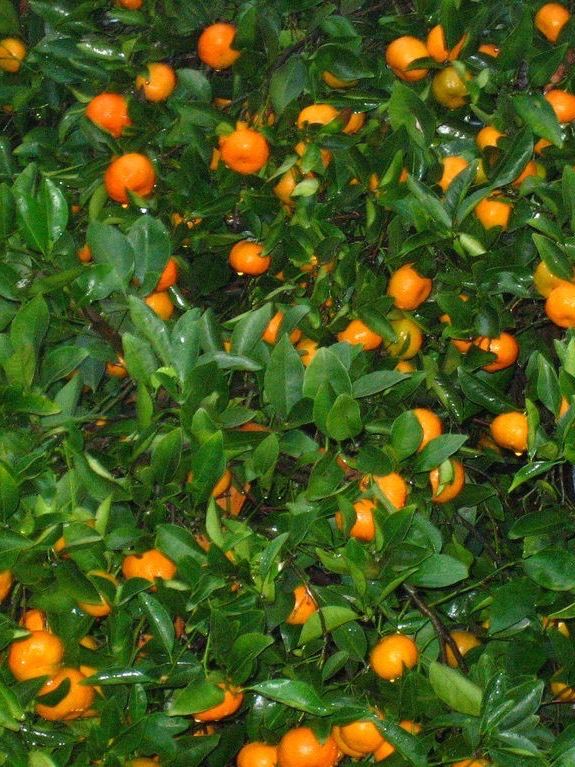
It must have been a luscious, tinny sweet tangerine that held those seeds.

Because now, dozens of years later, 

that tree that grew from strange sprouts 

crowding the spider plant on the sill, a puzzle to me then, 

and with time snuffed out the baby spider buds for soil, space and sustenance, 

room to grow and then outgrow that small pot to a larger one and then 

a larger one yet, moving with us from apartment to house to house 

where it now lives in the backyard, 

bursting with abundance.
 

It took 25 years for that tree, 

grown from thoughtlessly tossed seeds 

by one too lazy to get off the couch and trash them,

to bear fruit.

It simply grew and followed us from home to home, 

life to life, childhood to adulthood, 

and then our children’s childhood to adulthood,

and our puppies and kittens and hamsters and birds and fish and frogs

to their graves, 

some feeding the soil of tangerine tree roots, 

finally strong enough

firm enough to bear the weight of hundreds of sweet orange sun nuggets.
 

You, unwittingly, mindlessly, grew that tree you love so much now, 

picking one tangerine each morning, 

cold from the morning’s chill dew,

sucking its sugary juice and tossing the peel to the soil, 

just like you planted it 31 years before, 

when we were young and the tree was yet to be, 

its fruit long time coming.
 

And now the fruit is plentiful and we are old and love infertile, 

like sterile lovers circling, unwittingly trodding the soil of our graves.

The Machine Smiled

  
The world swims along–get up, get dressed, get on the road, get to work–in a toneless hum.

My work entails a thousand unpatterned steps and hundreds of mindless arm movements a day.

But flashes hit, halting the me-machine, sudden quiet in chaotic movement that feels like a foot’s firm landing on the ladder’s higher rung–the one I climb ’round the clock.

Something short of an ephiphany but more than a realization. Like an incremental lift culminating from hours-a-day stuttering repetitive mantras: stay focused, present and observe. 

Today motion and mind melded in the dance called machine washing at the shop, otherwise known as surrender to the method.

When thrust into each step of the process from disassembly to reassembly,  acknowledged, full-felt respected, pleasant peace befalls the me-participant in the giving way to–

no resistance, no rushing and no disrespect for time and space yields a tiny nitrous oxide blast-like high in awareness of all is well and right and good–peace in the core, litheness in the limbs–and

confirmed in the machine’s smile.

Human Nation

image

And the candidates lie while voters 

bathe in the light of soft memes

soaking themselves in pretty phrases

paired to poignant images sweet-wise,

and little girls in red, white and blue 

sequinned skirts twirl dizzyingly

mesmerizing masses of twit-whistlers

horning in on patriotic fear fervor

chords dancing adorable waifs a’spin.

Aren’t we all takers in the end,

sucking what we can get off and in

ourselves confined and conformed

to social patterns, strong-armed

cycles: do this or be stigmatized?

And so the world is just the world.

Life is just life, nothing more–

or less.

Bhavana

  
Bhavana, meaning to cultivate or develop but commonly used as a word for meditation in Buddhism, filtered down into my comprehension pool of late, that place where I can see a term’s reflection and pair it with illustrative experience to flesh out the bones of the word.

Cultivating takes time; it slowly sweeps widespread across a large swath of reading, span of years and percolation time. Like when I first tried vegetarianism back in the 90s. I ran tons then and ate little meat to keep light. Thinking the natural evolution of cutting back on animal protein was a vegetarian diet, I took the leap but was unsuccessful. I craved someting, felt a huge hole in my diet and so gave up. 

Fifteen years later, without much thought, I just stopped eating meat. And never missed it. Like yoga and meditation, dozens of attempts over several decades and then one day it all made sense and was effortless to form the habit with full understanding of that seepage, that diffusion through mental pores of  cultivated disposition to bend not only body but behavior, to flex a will to become. Unfold. 

Sometimes conscious understanding needs time to catch up to that deeper knowledge, the stretch between knowing and understanding like the lightbulb lit with the words, “So that was what he was trying to tell me,” or “now I get how to play fifth position on the fingerboard”. Before, it was flat mystery like a hollow idea.

Bhavana is like a road trip uncharted and unknown at the start but so expected at the destination. As if you always knew where you were going after rolling back all the miles that you thought you had no idea where you were–an illusion, like your shadow catching up with you.

 
credit: wikipedia

Imagine Lennon’s Song in Context


Pleasant read in Elephant Journal yesterday about the meaning of this iconic song that may surprise few but helps to remind us of something important in yet another age of crusades.

Like Heaven and Hell, countries exist only in our minds, yet we kill or die for them. Religion too is made up (imagined) by us—yet another institution that serves only to divide humans and prevent them from living life in peace. Neither are possessions real, except as a shared idea of ownership projected onto things, in turn producing yet more suffering as greed begets hunger.


When enough of us finally awaken to the fact that all of these things—religion, country, possessions—are nothing more than ideas in our minds, a world of unity, a brotherhood of man, with all the people sharing all the world, becomes possible. This may look like a dream, yet what is our current social reality but a collective delusion—a “reality” that only exists because enough people believe it? When enough “dreamers” actually see through the dream, a critical mass (what today we would call a “tipping point”) is reached “and the world live be as one.”

A simple Buddhist message to live within the reality we have, hard as it may be for many, this song also confirms the power of the imagination, whether for the highest of all achievements (Lennon’s song) or the most terrible (killing in the name of the deity of your choice). Imagine understanding and accepting the terrible beauty and destruction we create–as us. Simple and direct, less being more, the song is masterfully reiterating an ancient theme. 

Peace.

Adrift

  
I call him a drifter, 

but who remains static?

No thought ever nailed itself

down, tacked to airless walls.

No body stops unceasingly,

all that pumping and throbbing,

ever moving cogs and wheels

the sentient and incognizant alike.

Even in death and decay, there

movement devolves-transforming.

Stillness breathes a steady notion

but no such evidence exists.

Ever in motion, roving nomads,

we, the universe compels it.