The Music of Ménage a Trois

In reality, it was an unusual but mutually agreeable menage a trois, whose intimacy is reflected in that extraordinary scene of the three of them, side by side in bed, sheltering from Hitler’s aerial bombardment.
Ursula was, in her own words, “fathoms deep in love”, but Williams told her he would never leave Adeline.

So she could only be the “icing on whatever cake he had, and not a disruptive influence”.

The fascinating story of poet Ursula Wood and British composer Ralph Vaughan Williams was the subject of news in 2007 when she died at age 96, having succeeded her once-lover-then-husband by 50 years. She was 38 years his junior when they met at her prompting. At the time, Vaughan Williams was married to Adeline Fisher, cousin of Virginia Woolf, and Ursula to Michael Wood, an officer in the British army. Ursula Wood’s fascination and passionate love at first sight for the composer not only flattered the composer’s naturally roving eye for pretty women, but fueled his dying spirit as caretaker for his inherently cool natured wife who was eventually rendered immobile by rheumatoid arthritis.

When Wood entered the composer’s life, it was not long before the affair between them started. Her presence at the Vaughan Williams household was first legitimated under the auspices as young assistant and caretaker, but Adeline was shrewd enough to be credited with knowing the score. Thus, the excerpt above, which is detailed in The Daily Mail’s article by John Bridcut, as depicting Wood holding the hands of both the composer and his wife during a raid in 1944 by Hitler’s army.


Indeed, on one occasion, Ralph and his wife and Ursula and her husband all met up at the opera for what must have been a most uncomfortable evening, particularly as the opera (Williams’s own Hugh The Drover) was a romantic story of rivals in love.

After Vaughan Williams’ death, then Ursula Vaughan Williams kept the affair discreetly within her memory until her death in 2007 at which time the details were revealed by her own desire to have the true story told. Wood’s biography of her husband also provided the basis of the documentary by Bridcut, released shortly after her death.

Though it is unknown how Adeline felt about the affair right under her nose, by all appearances, however, she tolerated her husband’s relationship most likely knowing that he was a man of passion that she herself could not reciprocate whether due to her own nature or her illness or both. So, it is not far fetched to assume that rather than lose her husband, she accommodated.

Of all three, the story of patience is the most magnificent human attribute fleshed from their ménage a trois: his for caring for the wife he vowed he would not leave despite his love for Ursula, Ursula’s patient caring for both while she longed to be with him, and Adeline’s patient endurance of the love affair right before her eyes that had to hurt. Of the three, I admire Adeline the most for her practical concession of her exclusive rights to her husband’s monogamy, whether that was calculating to her own advantage or wise and charitable love in consideration of her husband’s needs, or both. 

I have maintained before that the mistress role is not easily doffed off with vilified stereotypes of cheating and deception. Sometimes–oftentimes–it is far more complicated with subtleties that reveal the intricacies of human nature adapting to circumstances, a fascinating anthropological, psychological and sociological study.


Bar Flight


credit: http://images.fineartamerica.com/saulnier


Sitting at the corner bar, satisfying the urge for a beer and relieving the boredom jitters, I’m tormented by indiscriminate shouting of barflies and distant diners lining the walls of the dark, decor of seafaring ships, anchors and fish. Sea legs. Clearly this place lacks intelligent acoustic design, much to the chagrin of the owners who honestly tried to reduce the clamor crawling the high ceilings, especially with a yoga studio above it. I once heard the story, sitting at this bar with M many months before.

My girlfriend’s already signed off for the night, so I am unconcerned about my phone’s rings, dings and buzzes. I am wherever for whatever. Thinking about the last time we met at the hotel for a quick grope and a tickle, sneaking a hurried sigh and a fierce kiss, my mind smiles, my face impassive.

The pretend-lover is off somewhere in the night, leaving town for the week tomorrow, as the story goes still smoldering in the musk stains left in my hair, emitted in the toss of my head as I spy the inhabitants of this sultry Thursday crowd. At least we got to do the fuck-and-lie before the morning’s 8 a.m. departure. What’s the weather like in the Southeast?

Often it’s the simplest moment that lingers on the tongue of my thoughts, savored in sensorial bites: a shy side glance of the twenty-something deeply brown-eyed half of the pair sitting on the stools next to me sends static up my spine, an imperceptible eye-twitch, my senses on electricity. What does it mean?

I crave quiet corners most of the time, am in love with intimate spaces with or without another. In an unsuspecting moment, memory flashes the scent of heat rushing from a wall heater mixed with bleach and sweat in a dark room in mid-afternoon while we nap, your arm dead over my hips and belly. 

Though the time is so little, so simple, it stays. Maybe that’s the draw, the beauty of it, it’s simplicity and freedom to be whatever we need it to be, something of our own creation without the stress of trying to make it be too much, like living and planning and being together, which is complicated and full of friction. Our island is tiny and sporadic, though well-timed. Maybe it’s the island that is the draw more so than I. 

His wife hates him as much as she loves him, that’s what the bar fly kitty corner to me yells over the blaring music to his companions. I wonder why. Perhaps she cannot stand the way he mispronounces the names of her favorite artist, or his snoring, explosive anger, criticism, taken-for-granted use of her body for his release coupled with the inability to fulfill her because she never figured out how that could be, relied on him to figure it out, but could not relax enough to let him, guide him or even try.

Nat King Cole croons “Unforgettable.”

Filling out a daily diary of calories in my phone app is tedious, a task I assigned myself as consciousness raising more than dieting but it has, like so many other healthy exercises enthusiastically commenced, deteriorated to an obsession. 

The same guy three stools down shouting over the next song, a 70s favorite I recognize but will have to focus on more if I want to remember the artist and title, whinnying really in a high tinny voice, about his divorce and how his wife regrets the divorce being the way it was. Also, his daughter and plans for spring break to be with her and her friends, Abbey her name, is really shaping up. Oh, so a divorce has permanently taken up residence in his conversation. The ex hates and loves him.

The divorce story’s addressees are a big bald dude and his Asian-looking companion, petite and smartly dressed with discreet cleavage, smooth-skinned soft peaks demurely and tastefully displayed below a string of pearl-like gems. She speaks with an unidentifiable accent. Like her, I am only half listening. The divorce story seems to be aimed at her, a polite, captive audience, while her boyfriend baldy winks at her looking away from the divorce tale-teller. Divorce guy wants to be heard. Baldy stays quiet, polite agreement here and there. He wants to be home fucking pearl girl. “That’s the way God meant it to be in some ways,” Divorce says. I missed the context of that statement.

Brings me back to a lover and his week of agony, strife with the wife, severe enough for him to act deflated, distracted passion, wildly unusual, so that I had to ask, as he collapsed away from me and sunk into the mattress, fists fretted together, face pinched in deep furrows, what was the matter. Did he expect me to sense his grief and ask? He is not as mysterious as I once thought. 

In our fifth year he took up confession; home life was bad, stressful, not good for the kids, he told me, the emailed story unfolding in exclamatory bursts, philosophical resignation, religious retreat and cautionary reminders. I did nothing to provoke the last so have to conjecture: it crossed his mind, the thought of leaving, running to me, but he got scared or sober or logical. He tasted the bitterness and stinging hate of hurt and revenge, the loss of power, prestige and pleasure, time spent with his children, too soon gone. 

Imagined scenarios of our making are the engine of creation, the mechanics of our story trotted out for each other to admire and merge into on cue.

Hate, vengeance and righteousness of god, fashioned to her fundamental beliefs in a church that spreads the selective word of a deity who manifested love, she believes he must be the man she wants him to be. The wont of their ilk is to toss sacred words to trump one over the other.

An ancient story repeated, their love grown in children and the grace of goods bought and sold, possession of a union, a house, a garden, two cars and a dog, they loved and rubbed each other right until it was wrong. Humans are pattern makers. God chuckles.

But he was clearly jarred, sorrowed, repentant, and seeking comfort in a resolve to improve, surrender, endure and abide, a solution time tested. Biding time is what we do. Some call it the journey. With attention, it is often referred to as presence, the fullness of time and the conjoint spirit of one. I am content. 

I prefer small pockets of pleasure disturbed by the occasional deep, destructive pothole in the roads I travel. So many lovely beings reach me, their intentions like silk tendrils of touch-full caressing care and wonder like Debussy’s Bergamasque piano silently accompanying the undulating drift of bar meanderings.  

“I will be unavailable to you that week of your return.” I told him that, and he let me go.
 
Divorce boy just informed baldy’s girl that he is going to finish his bottle of wine, though he apparently has had enough, and try his luck picking up on some girls situated elsewhere in the bar. The incongruence of girls in a bar strikes me. 

I have seen divorce boy passively sitting at the bar before–beak-nosed and paunchy with a deceptively young face, not unpleasing. He tries. I am not here often–eight or nine times a year–and the last time I was here he was too. Look at us, the lonely people. 

The two women to my left are pouring the remainder of their wine from their glasses back into the bottle. All neighboring eyes are turned to the task, like a netted tightrope walk to safety, the risk not too terrible but for the stains. The two young women have been sharing a small space, huddled in the corner of the bar, phones in hand illuminating the luster of their eyes and lipstick, checking social media, I presume, and speaking in tones reserved only for them.

Big baldy says, “I’d have to kill the guy.” Clearly man talk. I cannot imagine the stool mates to my left saying that kind of shit, defending their territory. Like R. He would do that, kick someone’s ass who looked at me had we been daylight lovers, out of the bedroom partners in a real life relationship. But I speculate.

How far can a fantasy stretch? What does anyone need beyond a little relief, some tenderness to ease the strain of survival? Maybe nothing. A will to bend, a neck crook for a weary head, an arm flung over a curled-up thigh and those who know your name may be the sum substantial of existence.  

The Archeology of an Affair

  
It is a weird feeling day. I awoke with my senses tingling and an inarticulable awareness that something, some idea or fact, was around the corner of my mind waiting to wrestle me to the ground. The first missive to manifest the strange of this April Fool’s Day came thanks to a contributor to my blog whose morning internet crawls often yield blog treasures. The piece forwarded today featured a German married man’s meticulous documenting of his 1969 to 1970 affair, almost in a rudimentary documentary of affairs. 


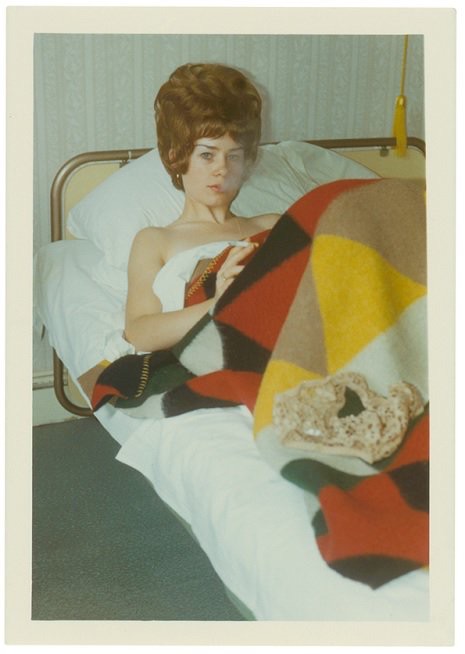
The story on dangerminds.net includes photos that appear as if witnessed circumstantially evident sex acts: indicia of before and after sex. His mistress-secretary peers into the camera, traces of sultry satisfaction hinted in the cigarette and state of partial undress. The spread includes pictures of a dress he bought her and an empty birth control container, artifacts by which we archeologists of his future could infer a story not of a man passionately in love but the age-old story of control and possession, on display–the spoils of the hunt and capture. 


The implicitly contented face of the smoking mistress with the wonderful beehive do, teased to maximum density, in bed, extended in post coital satisfaction, or so the picture hopes to portray from a purely exterior view, showcases the object of the photographer’s gaze, the same man who presumably put that look on her face–the picture of achievement and narcissistic witness to a man’s conquest and testimony to his virility and prowess. The random bits of details surrounding this short affair appear to be important recordings to a man who does not want to forget any detail that he had indeed had this affair.


The power of possession is indeed the story, one of sex as consumerism. The woman is created only as a result of and in control of his gaze, his angle, his lens and his poses. He creates the experience for possession and posterity, and so it will always be captured in the light he chose to produce. No matter that the face of the mistress hides a pretend satisfaction to please the gazer for gain or purposes of her own, if indeed that is the case (the after-sex cigarette as the symbol of the soothing needed after the near-miss or total lack of sexual satisfaction). 


Her story is subsumed in his, overtaken and dissipated into a past disappeared perhaps irretrievably, with respect to this brief affair. Where and how would such a story be told at a time when a mistress meant whore according to the mores of a time less exposed to the real lives of real people, who marry, get bored and fuck others? A portrait of a man falling prey to culturally crafted needs supplants her story: the will to possess women, and emoting through sex, i.e., he cannot please his wife any longer so he will please someone else to make him feel like the socially constructed ideal of a man as provider, conqueror, lover, success, power–all evidenced by his stuff.


Or maybe it is just a curiosity of time and place.


An Old Favorite Mistress Song

When once we lived the juicy life
the summer baked
the autumn fades
you pirate you
to steal away with me
I remember well
you’re drunk again
sweet heart you’ll say
careful there, wipe off your sleeve
don’t go searching very hard
for your other half in me
I recall your first kisses

hiding in the closet from your mrs.
the stern old sage and sensible
is what you see by day
the darkness made you cautious too
but I stopped by anyway
now you’re getting hazy
falling far into a film
I guess I’d better move along

leave you to your private realm

I recall your first kisses
predawn imagination

is all that this is


http://youtu.be/WEAfH85LgBw

Mistress, a Powerful Word to Waste


Credit: http://art247.com.au/


Margaret Sullivan of the New York Times would like to see the word “mistress” retired as a term past its prime, outdated and sexist (Is ‘Mistress” a Word That Has Seen Its Best Days?). Cued by her readers’ comments, she specifically takes issue with using the term in news stories about women having extra marital affairs, i.e., the Patreus affair. 


She complains the term denotes a woman’s long-term sexual affair with a married man, and, as some readers pointed out, which also suggests financial keeping or maintenance. Sullivan believes the term should be replaced with something less gender exclusive particularly since there is no male equivalent to the term. She also notes her male editor’s response is something akin to “Yeah, it’s outdated and sexist but oh well, what else can we come up with?”

I, however, hesitate to retire a word with such a rich history and multi-faceted application.  

The Oxford English Dictionary has this to settle for the word:

HOMEUS ENGLISH MISTRESS

mistress
Syllabification: mis·tress
Pronunciation: /ˈmistris/ 
Definition of mistress in English:
noun

1A woman in a position of authority or control:
she is always mistress of the situation, coolly self-possessed
figurative work is an unforgiving, implacable mistress
MORE EXAMPLE SENTENCES
1.1A woman who is skilled in a particular subject or activity:
a mistress of the sound bite, she is famed for the acidity of her tongue
MORE EXAMPLE SENTENCES
1.2The female owner of a dog, cat, or other domesticated animal.
EXAMPLE SENTENCES
1.3 [WITH MODIFIER] chiefly British A female schoolteacher who teaches a particular subject:
a Geography mistress
MORE EXAMPLE SENTENCES
1.4 archaic A female head of a household:
he asked for the mistress of the house
MORE EXAMPLE SENTENCES
1.5(Especially formerly) a female employer of domestic staff.
EXAMPLE SENTENCES
2A woman having an extramarital sexual relationship, especially with a married man:
Elsie knew her husband had a mistress tucked away somewhere
MORE EXAMPLE SENTENCES
SYNONYMS
2.1 archaic or literary A woman loved and courted by a man.
3 (Mistress) archaic or dialect Used as a title prefixed to the name of a married woman; Mrs.
EXAMPLE SENTENCES
Origin

Middle English: from Old French maistresse, from maistre ‘master’.

So what could be wrong with a term whose first definition from a much-cited, respectable source is “a woman in authority or control”? Sullivan rebukes the term as old fashioned; a term with implied mercenary kept status should not be attributed to a modern day woman who chooses her own lifestyle and sexuality. However, the word’s true essence conflicts with what she derides, and it is her error in the term’s misconstruction. 


A mistress is self-possessed–going against the grain with her choice of sexual partner. She defies social norms, and in doing so, she carries that culturally instilled burden of shame and conscience subverted for love, power and/or sex. She is all about tough choices that expose her to herself and others, an exposure that continually challenges her control.

In addition, the wellspring of control and ownership from which the term emerges, its earliest significance being head of household, empowers the word. As queen of her castle, the mistress does have a counterpart, the master. In this equivalence, the terms both suggest not only ownership but mastery, the knowledge and competence to operate and own all of the details of a home, including the administration of her staff in running it. 

The predecessor of the modern corporate CEO, the mistress was the operations manager of the home, which may have included serving and cleaning staff in addition to family members. And for anyone running a household, even without staff, that is no menial task. 

As one who has historically taken on the role of mistress of the house, I can assuage any fears of sexism or demeaning intent in that term. Running a household of teenagers, ailing parents with caretakers, dogs and cats, is no mean feat. To keep everything running without a hitch–flawlessly–from paying bills; coordinating transportation to sports, school and other activities; financing the upkeep of the house and the people and pets in it, all while juggling work–paid or volunteer–outside and inside the home, takes the talents of an organized multi-tasker extraordinaire. It takes control.

I used to be better at it, the juggling, when my mind was sharper and my energy level higher, but even then I had to rely on spreadsheets to track everyone’s movements and whereabouts. Running a household draws on a variety of skills inborn or acquired. Though not a long-term planner, my mind is wired to work from three steps ahead backward–necessary to captain the ship. 

When the kids were pre-schoolers, I knew at the outset of any day trip that one of my daughters was going to need a series of five, three and one minute warnings of departure as she was not good with transitions. And just the mathematics involved in planning for the outing, the gear required to anticipate any probable need ordinary or extraordinary (accidents), plus the time factor to shove kids in and out of carseats in time to meet the next appointed destination on the agenda, kept my mind in continual twists and turns of addition and subtraction:  add a few minutes for Jordyn’s resistance or chase before we leave plus a few more minutes for changing Remie’s diaper, which will inevitably be an emergency by the time I round up Jordyn and get her in the car–an exercise in figuring out the smallest movements needed to achieve the greatest effect, something like understanding quantum mechanics. 

The abilities to run, round up–kids and numbers–calculate, estimate, zoom, balance, gather, recoup, resist, stay alert, maintain composure and sanity, all while wondering where pride and sleep went is spectacularly challenging and a tremendous show of competency when done without tearing hair out, my own or anyone else’s. Not a very sexy proposition but one declaring mastery of intellectual, emotional and physical strength beyond compare–power.

Power. Mastery. Sex. To Sullivan’s point about sex, sexism and subservience, I must agree with her editors that the definition nowhere includes financial maintenance, and so the term is not as sexist as she protests. In fact, the illumination cast upon the term from its etymology, derived from the French word maitresse, master, and its name for a teacher, one of the oldest, most widely recognized longstanding, respectable working roles for women (not to be confused with the oldest profession), is the domain of mastering knowledge and communication. What could be more empowering than forming the minds of a population? 

Women are distinct, singular each, work in different ways from each other and from men. Words that carry history as performances past that umbrella performances present should not be discarded lightly, especially in the case of a word that I believe furthers the cause of empowering women–for the informed and language sensitive, that is. I take issue with divorcing ourselves from our past. It is a mistake. We need the reminder, nuanced influence and acknowledgement of who we are, where we come from and where we are heading. 

Keep the mistress as master-ess of her domain.

Who Has Affairs and Why – Dr. Peggy.com


credit:  http://assets.nydailynews.com

For a compressed (succinct but thorough) breakdown of the profile of an affair with all of its moving parts and consequences, read Who Has Affairs and Why on Dr.Peggy.com, which includes this section that I particularly appreciated because the author, Peggy Vaughn, details data I have merely passed off in summary in prior posts as the various ways we inherit our cheating disposition:

Societal factors

Affairs are glamorized in movies, soap operas, romance novels, and TV shows of all kinds. Public disclosure of public figures having affairs is headline news because we are fascinated and titillated by hearing of others’ affairs.

People are bombarded with images of women as sex objects in advertising and marketing campaigns. Over and over, the message to men is that the good life includes a parade of sexy women in their lives. Women inadvertently buy into this image and strive to achieve it.

The lack of good sex education and the existence of sexual taboos combine to make it difficult for most partners to talk honestly about sex.

As teenagers we get conditioned in deception when it comes to sex—engaging in sexual activity while hiding it from our parents.

The code of secrecy is a major factor in affairs because it provides protection for the person having affairs and leads them to believe they won’t get caught.

She concludes that there are many factors that contribute to having an affair including “pushing” and “pulling” factors, drawing to or pushing toward it.  

In addition to causes and effects of affairs, there is a brief rundown on the naturalness of monogamy–or not–as well as advice on preventions, which is…guess what?  Right.  Honesty.   

There are other similarly succint, informative articles on the site to peruse for everything affairs related, Dr. Peggy’s specialty. Most are quick reads with easy-to-read and track headings, subheadings and bold font. It took me no time to read through the site and pick up on some of the advice and factual goodies she offers.  I hope you enjoy the site as much as I did.

“How I Came to Identify with my Husband’s Mistress”


credit:  izquotes.com

Dogs are wise.  They crawl away into a quiet corner and lick their wounds and do not rejoin the world until they are whole once more.  Agatha Christie

A well written piece in The Huffington Post, Sophie Rosen, writing for divorcedmoms.com, takes her readers through her transformation from a jilted wife railing at her husband’s mistress to knowingly tasting of the same forbidden nectar in How I Came to Identify with my Husband’s Mistress.

The article starts with the confrontation, suppressed rage:  “Are you fucking my husband?”

But then she settles into the reflective tone she adapts to chronicle moving through her thought process.

More than my husband’s actions, what I found most curious was his mistress’ lack of remorse, remorse for her part in a marriage’s end, especially where three young children were involved.


She ponders this idea that sticks in the craws of most who weigh in on the subject. What is the responsibility of the mistress to her lover’s wife? The clear dividing line is between those whose policy it is to never go near a married man and those who do. Rosen enters the nebulous area of those unknowingly lured. What of those who get involved innocently, or blindly? Again, the choice can be as clear as the no-married-men-no-matter-what policy or the struggling or not so struggling cost-benefit analysis of a relationship in those three-way circumstances.   

Some might disqualify a liar on the grounds of failing the integrity test, considering the future-going prospects of someone who starts a relationship with deceit. Others may evaluate the relationship in terms of the state of the marriage, i.e., waning or holding steady, and the aims of the parties. Two may simply share time as they may until it is no longer viable to do so.  Much depends on the parties’ intentions and expectations, which, of course, tend to be as fluid as Rosen’s in the end.


Within every lie there exists its opposite — the truth. In my eyes, this was it. The truth I saw that evening came in the form of a man desperately looking for the attention and appreciation he was obviously not feeling at home, likely why he exuded such warmth when we first met and the chemistry between us was so heated.

Empathically, Rosen “sees” the lonely man, acknowledging her own loneliness, and grows an understanding of why someone might seek comfort in another who can provide it, despite his allegiance or vows to another who no longer does. So much, to me, depends on the honesty of the individual confessing his truth and the self-awareness to do so.

Indeed, if we are not careful, marriage can become the loneliest place on Earth. I know.

Though Rosen spends only one night with someone whom she suspects lied about his marital status, she does earn valuable insight about the complexity of marriage, monogamy and human beings.

Today I question whether my husband’s mistress is the same homewrecker I had once thought.

Putting herself in the position of her husband’s mistress even momentarily or to the degree that she felt appropriate–she is not the same woman as her husband’s mistress, obviously–she concludes that the fault cannot be so easily attached to one person in a triad of lies and need. Though omitted, the underlying foundation of Rosen’s conclusion is the realization of her inattention or unawareness, her own part in the destruction of her marriage

My husband and I seemed to do a pretty good job wrecking the home we had built together without any of her help.

Perhaps I have been too much a subscriber to cause and effect, but my assumption about cheating and divorce has always been that something was wrong whether it was the character of one or both parties, self-delusion, denial, youth, mid-life crisis, incompatibility, unrealistic expectations, the failure of monogamy, fateful accidents or illness or any number of life circumstances providing the impetus.The client who tearfully confessed he or she was blind sided by the cheating, that everything seemed fine was suspect. I could not help but flash on whether the person before me was willfully “blind” in some way. 

Perhaps the cynicism of the job ripened the seeds sown in me at birth.  Or maybe I was to some extent right.

We get caught up in life. We fail to open our eyes wide enough, a self-imposed squint implemented to maintain focus on the daily business of getting through the days. How can we expect to “know” ourselves let alone the other one we have sucked up into the motion and madness, scooped up and absorbed as if two were only one?  We forget our spouses were once human beings we wondered about and ached to discover.    

It is easy to say with conviction that cheating should never happen. Accepting why it often does is what remains a challenge.


She does not excuse behaviors, anyone’s. She stops short of rationalization, only hinting at her own one night allowance and commendable perceptiveness in suspecting a lie when she smells one. The take-away is the understanding that snap judgment, the black and white of it, is an unconsidered stance, too raw. Empathy, compassion and reason gathered her into the grey.

Venus and Mars

IMG_0384
credit: static1.squarespace.com

Here’s me being you (simply so):
I pull out of you, expelling seed
crash-down heavy, a filled need
with a groan and a sigh of relief
satisfaction of weariness sweet
I croak, “You’re so good to me,”
and then close my eyes to see
the vision still coursing headily
inside you, mouth to your ears
deep in silk skin-soaked tears
licking drops from your cheeks
like swallowing the salty seas
with your joy, your melted glee
all wrapped in arms so lovingly.

Here’s you being me (deftly so):
A hand slides across your spine
as you leave my warmth behind
and lie beside me in heavy sigh
of deep satisfaction and release
in closed eyes; in smiling peace
you rest in muscle soft respiring
in mind less darkness dreaming
of you, me and endless teeming
pant and chuff, a heart pounding
too softly now in brimming chest
a storm passed by, ocean’s rest
calmed to gurgling stream’s lies
unheard above a chasm’s cries.

IMG_0385
credit: http://s3.amazonaws.com

Addendum:

A small voice nags inside persistently some days, pecking at her brain like the woodpecker’s drum, “This cannot go on.”

But then it does: the constancy, the clinging-to-life braided bodies in sweet scented addiction blind, the quelled fiery imagery, soothed, enraptured in repose, all dissolved in calm lines of the heart’s monitor metered in metronomic jive of the universe’s mysterious patterns dancing.

“How do stars live so far from one another and yet reverberate from their mates’ light?” They seem so close and crowded all at once in the blanket black. At least it seems to those far below, minds upwardly poised to glean the wisdom of the sky.

“They just do.” Finding their light, knowing they are there is enough for them, he believes.

Some days the abyss yawns loudly from eons below my ribs. The aches gathered in bits and sounds from all who ever lost and lived creeps in through my ears, slides the canals and permeates the tissue so all that I hear is gaping vacancy inside the hiss and hum of respiring pumps of tedious be.

You toss me up like a rocket launched to space, not by chunky booster hands alone but the aid of my twig arms in slingshot urgency, and the quickness almost kills me, knocks my senses clear removed from silky parachutes’ inevitable return.

And when my feet finally alight upon the earth again, the descent is steady, deliberate and long, my lungs filling fat in measured whiffs of the dirt and stained ammonia air. Hitting me slice-wise along the spine is the reminder that we watch the enemy from opposite sides in distant trenches, staring down perceptions from a line never crossed.

You see me in my blindness. I blind you with my sight.

Luck of the Mistress – Nelly Ternan

IMG_0373
credit: biography.com

“These things cannot be written with a quiet hand or dry eyes.” Nelly Ternan

Sometimes it pays to be the mistress, especially to someone famous. Though the movie is a couple years old now and the biography much older, the Nelly Ternan story is a prime example of the sometimes advantageous position of the mistress–or so it would seem. In reading on the web, the facts vary slightly but all agree that she moved from actress to mistress to the rest of her life and onto fame and history without so much as a hitch. Of course there is so much to flesh out of these bare facts of Ellen Lawless “Nelly” Ternan, Charles Dickens’ mistress. If there is punishment, divine or otherwise, meted out for playing the role of mistress, this one seems to have gone unpunished.

According to Claire Tomalin’s biography, Ternan is born to a family of actors who tour the country even after the father dies in an insane asylum. One day Ternan, later acting in a burlesque show, is spotted by Dickens who casts her and her sister in his production of The Frozen Deep. Dickens, then 45 and married with 9 children (later 10), falls for the 18 year old Nelly, and they end up having a 13 year affair–though biographers differ on the nature of the relationship as Dickens himself took great pains to keep the circumstances of his estranged wife and his contacts with Ternan Victorian scandal proof secret–yielding one still born child from Dickens, who later dies, leaving his mistress money in his will. Ternan then moves on to marry a clergyman ten years her junior, with whom she has two children before he dies and she goes on to join the anti-suffrage movement. She dies of cancer at 75 years old. In 1913, that’s a pretty good long time. Much later, in 2013, a movie about her, The Invisible Woman, airs detailing her affair with Dickens, based on Claire Tomalin’s biography.

She lived 75 years, got married, had children and a long term love affair with a famous author that yielded her money and fame as long lasting if not as ubiquitous as Dickens’. She even got to campaign for her own political beliefs in her retirement. What a great story of American come uppance by being in the right place at the right time. The facts tell the story of a game with the score: Nelly 1, wife Catherine Dickens 0. Mrs. Dickens does not get her own write up and movie. No, her story is told through Dickens’ viewpoint. She goes down as the fat, grumpy woman with whom Dickens had 10 kids and then became dissatisfied for her lack of “ardor,” which is how he characterized his failing marriage at the time of meeting 18 year old Nelly.

Fame, fortune and history are random that way. Nelly’s story seems to reinforce that idea. Although, who can read between the mere hollow facts to see the story beyond the margins of the biography: the strife of being a young mistress to a much older demanding man of fame, his stress and the risk of both their reputations, or even the probable contentment of Mrs. Dickens being set up in her own apartment away from her dissatisfied husband who impregnated her ten times and left her to raise kids who likewise suffered the mortification of this hardly contained, much as Dickens tried, affair. One can only imagine the story behind the story. Unfortunately, the love letters between Dickens and Ternan were destroyed. In those letters lies the real story, I would like to believe, which is the story of passionate, irresistible love.

Valentine’s Day for the Mistress

IMG_0053

I don’t know how to write a love poem.
Overwhelmed by the subject’s ubiquity
the words shutter up tight inside of me
What can be said has often been bled
in quills to pens to one-zero roses red.
Silly tries at gallant sighs’ leapt rhyme
cry exalted emotion in schmaltzy lines
stain greasy tears of the intended eye
betrothal splaying bony legged signs.
A love poem says love like you might
by washing dishes in bone tired quiet
rubbing fingertip slight atop knuckles
barely notice my hand amid chuckles
elicited by stories through eye sparks
waving white long fingers flying larks
across meadow flap furiously in form
appears to my observing notice long.
Love wordlessly fills rhymes unheard
in flit glances, amused co-agreement
where two lives’ knowing nod is silent
an inner smile that never creases lips
like brewing heat stirring deep in hips
or scent infused of twin desires’ pours
room-filled chew open olfactory doors
body skins bleed beads of love drops
drying while our expulsive airing stops
leaving imaginary atomic pieces afloat
drifting like the sleep shared alone two
covered invisible love’s image we drew.
The portrait of a love poem fast asleep
rests in legs’ and arms’ entwined keep
in vision dream-scapes painted alone.