When Worlds Collide

    
Hard to catch my breath, like the moon sliced thinly

slivered to eighths, and thirds and halves tonight,

bitten, smothered, and bloodied, but largely ignored.

Has the moon absorbed ALL the air for its survival?

I gasp. And the battle rages outside the shop window,

the moon wrestling for light, struggling in the shadow.

Crescent beam rests on the palm frond near defeated,

gasping for a second wind before a last laser sabre stab.

And then–fade to dust, blackened sky longing, airless.

“Oh black night, I rest inside you, my Jonah, forgotten,

caged bones’ anonymity, unheard, unseen–un-re(a)d.”


It’s here…

So here it is….
19,751 words.

poetry anthology cover

List Price: $19.75

19,751 words.
an anthology. by Some Poets.
Authored by Tracy Elizabeth Plath, Alicia Sophia Martin, Some Poets

We are Some Poets. We hail from all over the globe, brought together by the love of words and art. We are 33 poets, writers, and creators whose words come from personal places, and originate in every emotion. Our anthology is one from the heart, and should be enjoyed with a cup of hot coffee and an open mind.

Publication Date:
Sep 24 2015
ISBN/EAN13:
1517403472 / 9781517403478
Page Count:
270
Binding Type:
US Trade Paper
Trim Size:
8.5″ x 11″
Language:
English
Color:
Black and White
Related Categories:
Poetry / General

Available on CreateSpace.com right now and Amazon next week.

Available on Amazon tomorrow: 19,751 Words an anthology by Some Poets

  
Yep, it’s been a work in progress for several months. What started as a fun sort of idea tossed around by members of a splinter group from last April’s Poetry Marathon, developed into a full fledged complete work of passion of …you guessed it, some poets. I am proud to call myself one of those poets. 

This collection of Poetry Marathon survivors’ poetry is not only an ecclectic mix of perspectives and styles but also a visually stunning display of photography and art talent. My humble contributions to the published work have appeared here on this blog, but the poems’ textures change just a little when dressed up in a professional compilation nested among so many other talents. 

My gratitude cannot be measured for the work of the editors and all who brainstormed to get the thing off the floor and out the door. It’s no mean feat to get 50 some odd creative types to agree and collaborate with a single aim. There were casualties on the way. But those who persevered deserve to see their accomplishment come to fruition.

Look us up on Amazon. More specific links (and shameless plugs) to come. 🙂

Peace, 
The Gaze

Are All Writer’s Introverts?

  
I googled that question today after teaching two classes, writing a few blog posts, counseling a student, and editing an article. Facing the prospects of a shift at a retail job to finish off the day’s work schedule, I am on the verge of collapsing into the couch and burying my head deep under the pillows.

People exhaust me. I am clearly an introvert, and I have never taken a test to prove it. I know it. However, whenever I confess to this most trendy of trends…”You know you’re an introvert if…” being an introvert, people are amazed. “But you’re a teacher and seem so social.” Both are true. I am a pleasant person, courteous at least, in the company of others and am certainly a teacher. I love teaching. But neither of those facts make me less of an introvert.

I hate to be the living clichĂ©, but I believe most writers are introverts, living inside of texts, which are quieter and less demanding. People require attention, not only of the mind but of all the senses. They must be heard, seen, sensed, smelled and sometimes…touched. It’s all too much by the end of the day.

While I am among the masses, however, I do not feel sapped of energy. It’s when I hit the quiet of the late afternoon, sitting in the sun’s windowed reflection under the ticking of the clock punctuating my solitude among the table and chairs, tablecloth and armoire of my kitchen/dining area that the absolute exhaustion–a bone weariness of the mind and spirit–overwhelms me.


An aphid burrowing into the cells 

homing the pulp of me, crawling 

the synapses ablaze with centipedal

feet by the hundreds across attention

span and heat of the moment glee of

questions answered and asked, again

ticking off to-do’s of the do-nothings

but ply, ply, ply; it’s my trade, my cue,

my plight, but in the end, husked,

devoured, twisted, torn and teeth-

marked, me, hollow, me, cocooned

in respite of the dark, silent sap of

the dead thickening thinned linings

undressed, undermined and stripped

swollen, aching in whispering dawn.

 
credit: laurensapala.com

Singing Joni

Joni Mitchell sings, ” I am a lonely painter. I live in a box of paints.” And when she does, I am stilled. But it is not the last sentence so much as the first, and not the last word so much as the word before–lonely–that moved me dozens of hearings. She moans the word, extended ‘O” evocative of Munch’s howl, though far more subtle, deeper and soulful. The anguish is not Munch’s, overlaid with fear, so much as the rooted, internal groan, petulant sugar, that she bemoans.

I sing that line out of nowhere driving in my car or listening to a conversation drifting in and out, particularly imbalanced ones where I witness more than counsel or contribute.

At first the metaphor of living in a box of paints brushed up against the literary lover in me. I imagined her a genie in a bottle, except a box of paints, transporting me back home–in my imagination–just visiting others’ worlds when I choose or must. But I know it’s the howl of the loooooooo that draws me to the line, to sing it. And not the lonely of loneliness. We are all lonely, though more like unsatisfied, unfocused and disassociated too often. A spiritual loneliness more than a lost or severed connection with others often characterized by missing someone or something. I do not consider that lack as lonely. It’s bigger yet smaller than one human or animal or other being, one activity.

No, the oooo in the looooo is both a ‘no’ and an ‘oh,’ like a sort of toggling between braking and accelerating a car or a dance, patterns of release and restraint.

Joni wants to paint but she sells songs instead. She is an artist, vast and particular. Many artists tear at the thrust of creation thwarted to pay the bills. We yearn to paint.

It is not so much a complaint–I can find a modicum of pleasure and certainly gratitude in anything I do, given that I allow myself to do so–as much as it is a longing, a desire ever felt, within centimeters of impossibly outstretched fingertips, a taste, a scent, a faint melody or flash of recognition come and gone. The hollow left behind–of not reaching–the come and gone, is the oooo. Both full and empty space, both present and absent. An ache. But one informed by the mind’s consent. I hurt because I worked out, something good for me. It will get better.

A promise. We live on promises. Some say that is wasting time, wasting away. Waiting is my least favorite thing to do. Impatience is my pratfall. But there is the impatience at not getting what I want–an open lane for some fucking space, room to race onward!–and there is impatience with something larger, more profound. Not attaining because…Perhaps that is the larger impatience. The because. What follows elicits the moan, sigh and gut grief.

Today “I am a lonely painter” with many mutterings to utter before the day is through, puppeteering a teacher, word-pump, and merchant. And as I dive into a replenishing yet jolting plunge into gratitude, I will channel Joni, fighting for all that is ordinary and plentiful right now–air, thought and motion.


Who’s that Knocking at my Door?


A shadow slumps in the doorway, a darkness hollowed by blazing corners

where the light exhales, squeezing past the hulking figure that is my father.

“What are we having for breakfast?” Code for make me something to eat.

Desires, requests, pleas, all are puzzles to a man who knows no direct say.

“Sure, go ahead and eat without me. You don’t give a shit about me anyway.”

Read: I want to be loved, appreciated and acknowledged as a human being.

He knows no direct. His sentences scrape the underside of a mirror, inverted.

An uneducated master of language manipulates impulses, inherited relations

to move, respond, act, resist and surrender–a force of father-thinned twining.

 
Mother instilled the love of words in those of us who shone in penning letters.

She idled hours in solving crosswords, leafing magazines, and correcting him.

“‘Don’t got’ is a double negative and makes you sound like an illiterate moron.”

Her words sliding by as if unspoken, he ignored her, she, his virtual dictionary,

until Scrabble time, where strategy schooled the unwary wordsmith defensed.

A board game master, card player extraordinaire and pathological liar, he waits.

Convinced long ago she filled me with philologist love, I glance upon his notion;

my words form around the blankness in the doorway, the gamesman stares me

while the muse I wrestled to the ground, a slutty run-around, scampers past him.

 
credit: i2.wp.com

Pratyahara and Pencils: teaching writing is about seeding awareness in students

  
This was exactly what Professor Yip meant by being detached — not being without emotion or feeling, but being one in whom feeling was not sticky or blocked. Therefore in order to control myself I must first accept myself by going with and not against my nature.

Bruce Lee 

Pratyahara and pencils populate my thoughts today. Back to school, I can smell the freshly sharpened pencils—not that anyone sharpens pencils in my college classes so much. The sensory memory recalls the time of year: fall, school, endings, beginnings and lifelong learning. Cycles that inspire.

Inspiration arises in peculiar places. During a particularly dry creativity spell, I sat through the annual English department meeting last week at school, my employer, and felt a sudden spark. It was midway through a workshop on workshopping (silly sounding but fruitful) when I began to write about…

Continued here

Back to School

maxresdefault

I cannot recall the last time I sharpened pencils, yet I smell them.

Crayons disappeared from the house five years ago when the kids stopped using them, schools dumping color-in-the-lines after fifth grade. But I can almost feel their waxy paraffin between my thumb and forefinger, leaving that oily residue that stays way long.

Like a return to the new, the school year starts in the season of dying.

The dissonance, I sense it like spasmodic leg quaking that tremulates chairs while calming nerves.

“It’s show time!” I mimic the movie star’s manic Joker’s smile as I fly out the door. No chorus line.

Yet not the performance but the insistence that erodes: “Wake up!!” I want to jolt them in stentorian holler as my head spins and spits pea soup—in a virtual world they recognize.

In real time, I merely cajole, advise, admonish and filibuster, all for their awakening to themselves, their process and their world, adrift in someone else’s expectation.


credit: http://i.ytimg.com/vi/0OwImLxeoFI/maxresdefault.jpg

“The Coddling of the American Mind” in the Atlantic

  
I have taught college students to write, read and think for over 15 years now. Before that, I did the same for high school students. My job–teaching–particularly skills for college, and more importantly, life, impresses me as one of mind crafting. I teach students how to think, using the medium of the word. Others teach the same through other media, such as art, music, math or computers, to name a few.

Since writing starts with the word, that is where I start my classes each semester. I compare grammar to life. It starts with the word, which has an essence and a function, depending on its relationship to other words. I try to illustrate this by pointing to a student and defining the student as presumably human, male or female, but also in context of a classroom, a student, peer, son or daughter, just as a noun is a noun until it is placed next to another noun and then functions like an adjective.

It has always been a hit–until recently. In the last couple of years, I hesitate to use the example because once I get past presuming a student is human, I get tangled up in words trying to be respectful of gender identification. I now find myself saying the person appears as this gender or that but may actually identify some other way…and then it gets complicated for me. I start thinking that maybe it is wrong to even presume a student represents as human, now with people going bionic by choice, according to an article I read this morning.

I am the last person to be the most sensitive in any situation. I am not a clod or a jerk (at least I don’t think so), but I can be absorbed in my own world, the material I am teaching and not notice the effect of my natural expressions. I sometimes use profanity to make a point. I reference all kinds of beliefs and politics and history, my class encompassing words and ideas. The constant running through my classes, lately, however, is my fear of others’ sensibilities. I am wary of the trap of my own words.

A true gift, the recognition of these fears in the Atlantic article entitled “The Coddling of the American Mind,” which is a thorough investigation of the temperament and tendencies of the American college student as well as some reasonable suggestions to change the trends toward litigation and censorship based on what the author identifies as distorted thinking often bordering on psychological disorders, including adapting sensitivities on behalf of other groups and identities.

The authors define and exemplify micro aggressions, catastrophizing and trigger warnings, topics, words and imagery taught in classrooms or presented in the world that trigger traumatic experiences personal, racial or historical. For example, students object to the mention of rape and rape cases in a law school class for the emotional triggers to some students’ traumatic experiences. This is merely one type of behavior that crowds the classroom’s content and censors speech.

However, as the authors assert, shielding students from offense runs counter to the exposure students should be getting to new ideas in school, including ones that offend. Schools are not bubbles but training grounds for the world beyond school, as world inhabitants, of which there is much that offends.

Attempts to shield students from words, ideas, and people that might cause them emotional discomfort are bad for the students. They are bad for the workplace, which will be mired in unending litigation if student expectations of safety are carried forward. And they are bad for American democracy, which is already paralyzed by worsening partisanship. When the ideas, values, and speech of the other side are seen not just as wrong but as willfully aggressive toward innocent victims, it is hard to imagine the kind of mutual respect, negotiation, and compromise that are needed to make politics a positive-sum game.

The article is a fair treatment of the causes and effects of this educational and social phenomenon, including a recommended list of twelve distortions (reproduced below) to identify and teach in the classroom based on cognitive therapy practices that help individuals focus on a reading of reality that is not merely emotional. I know my falll class opener may start with this article for discussion.

 Common Cognitive Distortions
A partial list from Robert L. Leahy, Stephen J. F. Holland, and Lata K. McGinn’s Treatment Plans and Interventions for Depression and Anxiety Disorders (2012).
1. Mind reading. You assume that you know what people think without having sufficient evidence of their thoughts. “He thinks I’m a loser.”
2. Fortune-telling. You predict the future negatively: things will get worse, or there is danger ahead. “I’ll fail that exam,” or “I won’t get the job.”
3. Catastrophizing.You believe that what has happened or will happen will be so awful and unbearable that you won’t be able to stand it. “It would be terrible if I failed.”
4. Labeling. You assign global negative traits to yourself and others. “I’m undesirable,” or “He’s a rotten person.”
5. Discounting positives. You claim that the positive things you or others do are trivial. “That’s what wives are supposed to do—so it doesn’t count when she’s nice to me,” or “Those successes were easy, so they don’t matter.”
6. Negative filtering. You focus almost exclusively on the negatives and seldom notice the positives. “Look at all of the people who don’t like me.”
7. Overgeneralizing. You perceive a global pattern of negatives on the basis of a single incident. “This generally happens to me. I seem to fail at a lot of things.”
8. Dichotomous thinking. You view events or people in all-or-nothing terms. “I get rejected by everyone,” or “It was a complete waste of time.”
9. Blaming. You focus on the other person as the source of your negative feelings, and you refuse to take responsibility for changing yourself. “She’s to blame for the way I feel now,” or “My parents caused all my problems.”
10. What if? You keep asking a series of questions about “what if” something happens, and you fail to be satisfied with any of the answers. “Yeah, but what if I get anxious?,” or “What if I can’t catch my breath?”
11. Emotional reasoning. You let your feelings guide your interpretation of reality. “I feel depressed; therefore, my marriage is not working out.”
12. Inability to disconfirm. You reject any evidence or arguments that might contradict your negative thoughts. For example, when you have the thought I’m unlovable, you reject as irrelevant any evidence that people like you. Consequently, your thought cannot be refuted. “That’s not the real issue. There are deeper problems. There are other factors.”

Argue!

  
Should vivisection on animals be universally banned?

California’s gun control laws are the strictest in the nation and do not need tightening.

Costa Rica’s Preventia policies are unjust and inhumane.

The papparazzi need to be reigned in from their reign of destruction.

Coed education beats same-sex education miles high.

Long Beach police officers are doing a great job despite the public outcry against police brutality.

The higher divorce rate among military families compared to non-military familes cries out for resources.

Street art is not graffitti!

Torture has its place in terrrorist prevention.

Inception is not a coherent thriller.
 

It’s end of the summer semester research term paper time. So many arguments, so many readily available resources, and so many fallacies.  My students, weaned on the Internet, both master and destroy logic. Familiar with the bounty that is the network–social, educational and otherwise–they can research. They find stuff. However, likewise products of the world wide of webbings, traps for the unweary, they believe without discernment. 

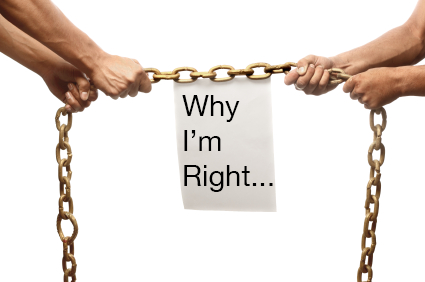
Teaching young minds to think in verticals and horizontals tasks the impatient and weary. Entitlement does not only measure ownership attitudes; the right to be right falls in the heap of our stuff. Ours. Mine. Not yours.

How else does the abounding madness of polarizing non-sense stop: me vs. you, right vs. wrong, with us or against us? Isn’t that the major premise of Saul Alinsky’s Rules for Radicals--keep the pressure on with conflict so power can slip in its agenda? 

I responded to a social media prompt on a relative’s Facebook page about the minimum wage not being about bickering over which unskilled worker should get two dollars more than the other. Two good responsive posts about the issue over dignity of work, skilled vs. unskilled worker…and then it came: the post about me, me, me and what I do and don’t blame me for trying to work and make money. 

Buzz kill. There is no response to a hijacked discussion of a public issue by someone’s feelings about his or her life or imaginary persecution–a failure to read and understand a public forum’s purpose in the shades of meaningful and polite interaction. 

Teach a mind to think, reason and discern: rule one of a civilzed nation.
 

credit: http://static.squarespace.com/