You Can’t Always Get

152701

It’s a familiar trap, a pattern many recognize–getting caught between wanting to do the “right” thing for someone else or for the self.

The conflict pits ahimsa, or non-harm in thought or deed, against satya, truthfulness in the Yamas.

Trying today to unwind my thinking, past my feelings, habits and impulses, to identify my needs. I am caught up in the should’s. And I dislike it.

Yes, I grew up with a mother who attended co-dependents anonymous and that may explain why, in the past, I instantly responded to calls for volunteers for the school, sports organizations, non-profits, family and friends whenever I could. I built habits for some need I had to fulfill to help. But what about now?

The balance of helping others and helping myself is the challenge. Getting it right is not always easy, but I am more interested today in examining these knee-jerk reactions and judgments that come with “I should help this guy out” compulsion.

I give a lot of time and attention to a long-time friend who cannot reciprocate, and I am becoming resentful and disinclined to see this friend any more. This would seem like a no-brainer, dump the freeloader, but it is not that simple. I don’t want to (thinking) be beholden to a give to get something or quid pro quo value system. The impulse to give irrespective of gain is in line with my values.

Resentment (feelings) arises for sure in this equation, but the more important question, if I give myself time to respond the next time my friend, who I will call Ash for convenience, calls and asks to go out to lunch to talk (read: monopolize the conversation), is why I feel compelled to be the sympathetic ear, ignoring my own therapeutic need to be heard and share thoughts and feelings.

Mind you, this friend does not always take but often enough where the obligatory “should’s” hit me whenever I see that text or telephone number on my screen. The first reaction is a tiny wince and inaudible sigh. I have known Ash a long time and spent countless hours being a friend. Is it habit?

I wrestle with passive-aggressive responses too–unavailability, calling back much later, too late, and just plain ignoring. That is not a good friend, I chide myself. Feeling guilty is not helpful, either. The spiral of internal chain reactions is exhausting…I shouldn’t ignore…just say what I feel…don’t want to hurt someone for what I perpetuated…time I cannot afford and don’t want to give…others who need it more…giving unconditionally…compassion…

…and on and on.

How to get past the stuff, the gunk (too much thinking or not enough), to the discerned need, my real need in this relationship, occupies my day today. Being truthful.

I know the answer–for me, anyhow. Time. Give myself time to decipher my need–for that moment, any given moment–before saying yes to engaging with Ash. Examining the relationship a bite at a time may lead to the larger answer that I sought today, too overwhelming, as to what I need in this relationship, not want, project, hope or atone for in it.

The Stones got it right: You can’t always get what you want, but if you try sometimes, you might find you get what you need.

Given enough precious time.

credit:  goodreads.com/MickJagger

White Afros

  
Succinct and powerful while not too patronizing, today’s Huffpost article by Zeba Blay entitled “4 ‘Reverse Racism Myths’ that Need to Stop,” dispels four myths, really erroneous convictions that discomfited white people have about an historically discriminated population’s unique struggle. 

She targets this specific population of social media shouters, most probably, who apparently need education I’m guessing from her approach. Her point: To deny that blacks have been systematically shut out of ‘privileges’ white people have enjoyed unfettered by racial discrimination such as education, jobs and safety is to deny history. To believe that all is well is to choose ignorance. 

She begins with distinguishing racism from prejudice or bigotry, which is an important distinction, the former including that systematic exclusion while the latter two may refer to specific instances of hate or preference. But the upshot undergirding all four myths is like it or not, being born white is still hitting the lottery in this country because of its history that to date has not been erased, rectified or reconstituted. 

White people have no standing to complain. And trying to catch up to white society is not privilege. 

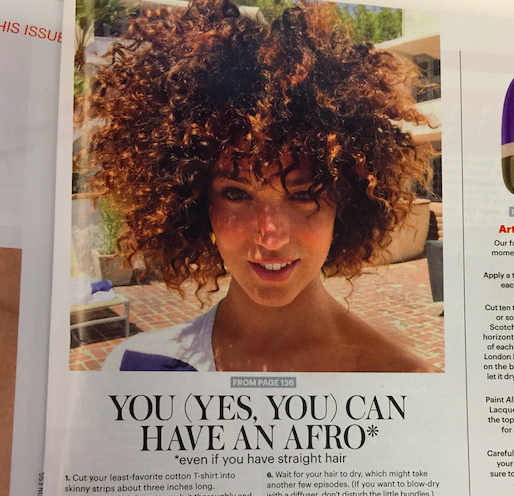
But while I respect the author’s opinion about cultural appropriation, white girls wearing Afros, for instance, I disagree that doing so is always unmindful theft or disregard of a people’s cultural strife. Systemitized thinking–labeling and generalizing as a means to exclude–is the core of oppression. While I would not say it is reverse discrimination to object to white afros, I maintain that there is a difference between respectful emulation and mindless appropriation.

Besides, some of us have hair that does nothing else but ‘fro. The seventies were good to me.


Ashley Madison and American Hypocrisy 


What do I think about the Ashley Madison come Josh Duggar (a name I first heard yesterday) “scandal”? Not too much. Surprising coming from someone whose blog is themed on the mistress in that word’s narrowest and broadest sense. But I have written a lot on the subject of infidelity from all sides, and much boils down to the same recurring ideas:

People get hurt–are hurt–and that saddens me. Luckily, counseling resources for the infidelity-wounded exist. Some have called those hurt by infidelity, victims, like the wife of this Duggar, publicly humiliated by someone who apparently spoke out in defense of “family values.” A shame, but the story often unfolds as more complicated than good guys and bad guys, abusers and victims.

People are not honest. Relationships survive on honesty, an ongoing practice that most are not dedicated to but expect from others.

America’s hypocrisy and sexual dysfunction fosters dysfunctional relationships. It is no secret that what we say what we want is not what we want–or do. I featured this article from The Daily Beast before, but it reports the unsurprising facts and bears repeating:


As Pew reports, extramarital affairs are generally condemned worldwide but the U.S. still seems to be uniquely moralistic about them. In fact, most major developed nations in the world are more accepting of infidelity than the U.S., including Australia, Britain, Canada, Germany, Spain, and Japan.

In France, a mere 47 percent of adults find extramarital affairs unacceptable, which is less an endorsement of their practice and more a reflection of a widespread refusal to think of it as “a moral issue.” In America, sex is a moral language by default; abroad, less so…
 

All this being said, Americans’ sexual words do match up with their sexual actions in some special cases. Fifty-seven percent of men and 65 percent of women approve of having babies outside of marriage, although CDC estimates show that only 40 percent of all births are to unmarried women. Divorce rates appear to be on their way down in the 21st century while acceptance of divorce has been steadily increasing.

But these are some of the only realistic moral attitudes in a country where sexual attitudes and sexual behavior tend to be dissonant. And although this mismatch might be mystifying in and of itself, the probable reasons behind it are not: the United States has the largest population of Christians of any country and is one of the only deeply religious wealthy nations in the world. That math—like most Americans—does itself.

Ashley Madison? Only in America.
 

credit: johnmbecker.com

Cultural Appropriation or Emulation: Does it Matter?

  
Published in the Mindful Word, please enjoy an article I contributed to the ongoing conversation about Rachel Dolezal, cultural appropriation and social media. 

For those of us who grew up in a Pakistani, Sri Lankan, Bangladeshi, or Nepali household, our struggles to fit in are vastly different in magnitude, but the solidarity exists. So that’s why we are upset when someone wakes up one day and decides to exploit our turbulent identities as a disposable fashion—and by doing so be rewarded as a paragon of globalization and cultural acceptance. How dare they regard Indian fashion as effortlessly cool and chic while we make it look “fobby,” or a stubborn adherence to our culture that purports us to be “fresh off the boat.”


How dare they have a crush when we spent our entire lives trying to love.

Read more here.

Peace, 

Gaze

“The Coddling of the American Mind” in the Atlantic

  
I have taught college students to write, read and think for over 15 years now. Before that, I did the same for high school students. My job–teaching–particularly skills for college, and more importantly, life, impresses me as one of mind crafting. I teach students how to think, using the medium of the word. Others teach the same through other media, such as art, music, math or computers, to name a few.

Since writing starts with the word, that is where I start my classes each semester. I compare grammar to life. It starts with the word, which has an essence and a function, depending on its relationship to other words. I try to illustrate this by pointing to a student and defining the student as presumably human, male or female, but also in context of a classroom, a student, peer, son or daughter, just as a noun is a noun until it is placed next to another noun and then functions like an adjective.

It has always been a hit–until recently. In the last couple of years, I hesitate to use the example because once I get past presuming a student is human, I get tangled up in words trying to be respectful of gender identification. I now find myself saying the person appears as this gender or that but may actually identify some other way…and then it gets complicated for me. I start thinking that maybe it is wrong to even presume a student represents as human, now with people going bionic by choice, according to an article I read this morning.

I am the last person to be the most sensitive in any situation. I am not a clod or a jerk (at least I don’t think so), but I can be absorbed in my own world, the material I am teaching and not notice the effect of my natural expressions. I sometimes use profanity to make a point. I reference all kinds of beliefs and politics and history, my class encompassing words and ideas. The constant running through my classes, lately, however, is my fear of others’ sensibilities. I am wary of the trap of my own words.

A true gift, the recognition of these fears in the Atlantic article entitled “The Coddling of the American Mind,” which is a thorough investigation of the temperament and tendencies of the American college student as well as some reasonable suggestions to change the trends toward litigation and censorship based on what the author identifies as distorted thinking often bordering on psychological disorders, including adapting sensitivities on behalf of other groups and identities.

The authors define and exemplify micro aggressions, catastrophizing and trigger warnings, topics, words and imagery taught in classrooms or presented in the world that trigger traumatic experiences personal, racial or historical. For example, students object to the mention of rape and rape cases in a law school class for the emotional triggers to some students’ traumatic experiences. This is merely one type of behavior that crowds the classroom’s content and censors speech.

However, as the authors assert, shielding students from offense runs counter to the exposure students should be getting to new ideas in school, including ones that offend. Schools are not bubbles but training grounds for the world beyond school, as world inhabitants, of which there is much that offends.

Attempts to shield students from words, ideas, and people that might cause them emotional discomfort are bad for the students. They are bad for the workplace, which will be mired in unending litigation if student expectations of safety are carried forward. And they are bad for American democracy, which is already paralyzed by worsening partisanship. When the ideas, values, and speech of the other side are seen not just as wrong but as willfully aggressive toward innocent victims, it is hard to imagine the kind of mutual respect, negotiation, and compromise that are needed to make politics a positive-sum game.

The article is a fair treatment of the causes and effects of this educational and social phenomenon, including a recommended list of twelve distortions (reproduced below) to identify and teach in the classroom based on cognitive therapy practices that help individuals focus on a reading of reality that is not merely emotional. I know my falll class opener may start with this article for discussion.

 Common Cognitive Distortions
A partial list from Robert L. Leahy, Stephen J. F. Holland, and Lata K. McGinn’s Treatment Plans and Interventions for Depression and Anxiety Disorders (2012).
1. Mind reading. You assume that you know what people think without having sufficient evidence of their thoughts. “He thinks I’m a loser.”
2. Fortune-telling. You predict the future negatively: things will get worse, or there is danger ahead. “I’ll fail that exam,” or “I won’t get the job.”
3. Catastrophizing.You believe that what has happened or will happen will be so awful and unbearable that you won’t be able to stand it. “It would be terrible if I failed.”
4. Labeling. You assign global negative traits to yourself and others. “I’m undesirable,” or “He’s a rotten person.”
5. Discounting positives. You claim that the positive things you or others do are trivial. “That’s what wives are supposed to do—so it doesn’t count when she’s nice to me,” or “Those successes were easy, so they don’t matter.”
6. Negative filtering. You focus almost exclusively on the negatives and seldom notice the positives. “Look at all of the people who don’t like me.”
7. Overgeneralizing. You perceive a global pattern of negatives on the basis of a single incident. “This generally happens to me. I seem to fail at a lot of things.”
8. Dichotomous thinking. You view events or people in all-or-nothing terms. “I get rejected by everyone,” or “It was a complete waste of time.”
9. Blaming. You focus on the other person as the source of your negative feelings, and you refuse to take responsibility for changing yourself. “She’s to blame for the way I feel now,” or “My parents caused all my problems.”
10. What if? You keep asking a series of questions about “what if” something happens, and you fail to be satisfied with any of the answers. “Yeah, but what if I get anxious?,” or “What if I can’t catch my breath?”
11. Emotional reasoning. You let your feelings guide your interpretation of reality. “I feel depressed; therefore, my marriage is not working out.”
12. Inability to disconfirm. You reject any evidence or arguments that might contradict your negative thoughts. For example, when you have the thought I’m unlovable, you reject as irrelevant any evidence that people like you. Consequently, your thought cannot be refuted. “That’s not the real issue. There are deeper problems. There are other factors.”

Science Meets Philandering

hardinginternal87873

I like today’s compelling Fox news story about Ancestry.com’s confirmation of President Harding’s love child. Some folks were vindicated and love shone on the day.

Of course my first thought questions the motivation, desire and impetus for such DNA testing to prove something that does not really matter in terms of inheritance or political effect these many years after the fact. Who even remembers Harding’s presidency?

But this passage is my favorite:

Based on DNA from Britton’s grandson and descendants of Harding, the results are 99.9 percent certain, Ancestry said. The findings were first reported Thursday by The New York Times.

I mean there is always that .01% chance of mistake. Then what? 😉

Mindfulness: Culturally Diverse not Divisive

  
My Eagle (Eastern Washington University Eagle) and I speak most days about her training, school, roommates and life in the Northwest. Her pre-season schedule keeps her wickedly busy, but yesterday we ended the day unwinding to the news of her day and mine. 

After reminding me of her class schedule, one class being African American studies, we began a discussion about cultural appropriation, having referenced the class that Rachel Dolezal (former professor at EWU and President of the NCAA who made the news recently by her parents outing her as white) would have taught. 

Not surprisingly, she and I differed. She thought social media had gotten it right this time. People should not be consuming cultural artifacts as if unattached to the people who suffered or strove through the badges, persecution or honors of and by those cultural expressional effects. 

One example she insisted on was the appropriation of “clueless white girls” adorning themselves with henna though they do not care a whit for Indian culture or people. In fact, she claims, these same young white girls actively discriminate and ridicule cultures different from their own (if whiteness is a culture as well as a position of privilege and power?), including Indians.

Admittedly, my most played role as devil’s advocate annoys my children. But this time I was not baiting. I countered with labeling and generalizing as liable to injure as much as the lack of consciousness of some consumerists. Not all cultural appropriations spell disrespect. 

We live in a multicultural world, America being one of the most diversely populated. Adapting the behaviors, clothing, styles and language of other cultures organically arises from living among others. What matters–the same always–are words and actions consciously spoken and taken. 

To love another culture so much as to adapt it is not uncommon. People move to other countries more suitable to their natures. Look at Cat Stevens, who left American fame and fortune to live in a culture more nourishing to his spirit. One can question his or anyone’s motives for “abandoning” his or her birthright, but why, what’s the point?

The people my daughter–and her social network–criticize, live inauthentically and thereby injure others, I suspect. To affect the style of another group is an act of honoring, blind imitation, or malicious mockery, depending on the intentions of the adapter. 

But all behavior may be measured as moral, immoral or amoral, depending upon the degree to which the actor moves beyond him or herself toward another–and with a conscious intention of producing good or ill will.

Mindfulness is an overused term, quickly turning trite. But in truth, to bring mind to bear on everything we do matters most. Morality is another term that gets maligned in its use, overuse and abuse. But the morality that the philosophers hypothesize about in classrooms, bars and libraries through time immemorial informs the morality I believe defines mindfulness:  an ethics of right behavior toward others, which is situationally switched on by a mind and heart likewise opened and active.

I am not foolhearty enough to believe in a “correct” behavior for every situation, but the footpath toward morality starts with a consciousness of the causes and effects of what we do, otherwise known as awareness. Thinking awake and remembering that we belong to a community are two steps in the right direction on that path.

At the conclusion of our call, I asked her what I should write about next, after plastic bags and waterless urinals. She offered sex work and cam girls. Um….wait, what?
 

credit: socialwork.simmons.edu

The California Plastic Ban

  
Read the full article of the excerpt I posted a few days ago, as it appears at The Mindful Word.

Walking out of the market, it suddenly hit me. Something different. Oh, that’s right. No one asked me if I would like to buy a bag for ten cents, and my two hands carried one plastic food-stuffed bag each. I wondered how long I had been unaware of the … (read more here)